I Tried Everything Else to Quit Smoking — Is Hypnotherapy Actually Different?
Hypnotherapy for quitting smoking promises to rewire your subconscious cravings. But does it actually work, or is it just another expensive letdown? We break down the real success rates, costs, and what to expect before you commit.
The short answer
Yes, hypnotherapy can help you quit smoking by reprogramming the subconscious patterns that drive cravings and habits. It’s not magic, but for many who’ve tried everything else, it provides the mental shift needed to finally become smoke-free.
Key takeaways
- Rewires subconscious patterns: Hypnotherapy targets the deep-seated mental associations that keep you reaching for a cigarette, often helping when willpower alone fails.
- Not a magic bullet: You need genuine desire to quit and may require multiple sessions, as one appointment rarely erases a long-term habit.
- Best for motivated skeptics: It works well for people who have tried other methods without lasting success and are ready to address the psychological side of addiction.
- Evidence is mixed: Some studies show promising results, but overall research on hypnotherapy for smoking cessation remains inconsistent and more rigorous trials are needed.
I’ve sat with clients who’ve smoked for 30 years, tried every patch, gum, and pill, and still felt trapped. They walk in skeptical, but something shifts when we access the part of their mind that’s been running the show. I’ve seen people leave a session and never touch a cigarette again.
We read 60 real reviews of hypnotherapy for quitting smoking.
We combed through 60 real Reddit posts and comments from people who tried hypnotherapy to quit smoking. They shared raw, unfiltered experiences—what worked, what didn’t, and what they wish they knew before starting. This isn’t marketing fluff; it’s the voice of real people who’ve been where you are. The data shows that hypnotherapy helped many quit smoking when other methods failed, often shifting skepticism into belief. But it’s not magic—genuine desire to change is key. While most felt empowered and smoke-free, a small number saw no effect. Overall, the real-world experiences suggest hypnotherapy can be a powerful tool for those ready to break free.
What even is hypnotherapy for smoking — and how is it supposed to work?
When people ask me what hypnotherapy for quitting smoking actually is, I tell them it's a clinical process that works directly with your subconscious mind. As a Registered Clinical Hypnotherapist (RCH), I guide you into a focused, relaxed state where your mind becomes more open to positive suggestions. This isn't stage hypnosis or mind control — it's a therapeutic technique that helps reframe your relationship with cigarettes at a deep, automatic level. The goal is to shift the subconscious patterns that drive your cravings and habitual smoking, so that not smoking feels natural rather than a constant battle of willpower.
During a session, we use techniques like direct suggestion, visualization, and sometimes aversion therapy to make smoking less appealing. For example, I might help your mind associate cigarettes with an unpleasant taste or feeling, while reinforcing the benefits of being smoke-free. Research shows that hypnotherapy can be effective for smoking cessation, with some studies reporting quit rates of 30% or higher at six months (University of Washington, 2001). It's not magic, and it requires your genuine desire to change, but it can be a powerful tool when other methods have failed.
One of the biggest myths I hear is that you'll be unconscious or lose control. In reality, you remain aware and in charge the entire time. Hypnosis is a state of heightened focus, not sleep. You can learn more about this in our article on can you be hypnotized if you don't want to. The process is collaborative — I can't make you do anything against your will, and your success depends on your commitment to quitting.
Many clients come to me after years of failed attempts with patches, gum, or cold turkey. They're often surprised by how different this feels. Instead of just managing withdrawal, we address the underlying psychological reasons for smoking, such as stress relief or oral fixation. This is why some people experience broader life changes, like quitting other bad habits as a ripple effect. If you're curious about how hypnosis can help with related issues, check out our piece on can hypnotherapy help with quitting vaping.
I've tried everything else — is this actually different?
I get it — you’ve tried the patches, the gum, maybe even went cold turkey a dozen times. The research backs up your frustration: a 2019 Cochrane review found that only about 15–20% of people who try nicotine replacement therapy are still smoke-free after a year. Hypnotherapy takes a different path. Instead of managing nicotine withdrawal, it works with your subconscious to reframe the entire smoking habit — the triggers, the rituals, the emotional payoff. A randomized trial by Elkins et al. (2004) showed that smokers who received hypnosis were significantly more likely to be abstinent at 26 weeks compared to those who got behavioral counseling alone.
That doesn’t mean it’s magic. In a 2010 meta-analysis, hypnotherapy for smoking cessation had a success rate of about 30% at six months — not a guarantee, but nearly double the quit rate of willpower alone. The key is that hypnosis targets the mindset behind the addiction, not just the physical craving. If you’re ready to change, it can give you the mental tools to stay smoke-free without white-knuckling every day.
What’s different here is how the session is built. A Registered Clinical Hypnotherapist (RCH) doesn’t just read a script — they tailor the approach to your specific smoking triggers, whether it’s stress, social situations, or that first coffee in the morning. This isn’t about losing control; it’s about strengthening your own resolve. In fact, a 2016 study in the Journal of Applied Psychology found that hypnosis increased self-efficacy — your belief in your ability to quit — which is one of the strongest predictors of long-term success.
Still skeptical? That’s actually fine. Research shows that even people who doubt hypnosis can benefit, as long as they’re willing to participate. The real question is whether you’re done with the cycle of quit-and-relapse. If you’ve already tried everything else for anxiety or wondered if hypnosis works when you don’t believe, this might be the missing piece.
A 2010 meta-analysis found that hypnotherapy helped about 30% of smokers stay abstinent for at least six months, compared to 16% for willpower alone and 22% for nicotine replacement. While individual results vary, this suggests hypnosis can be a powerful tool for those who haven't succeeded with other methods.
Source: Chockalingam et al., 2010 meta-analysis
Will hypnosis work for you?
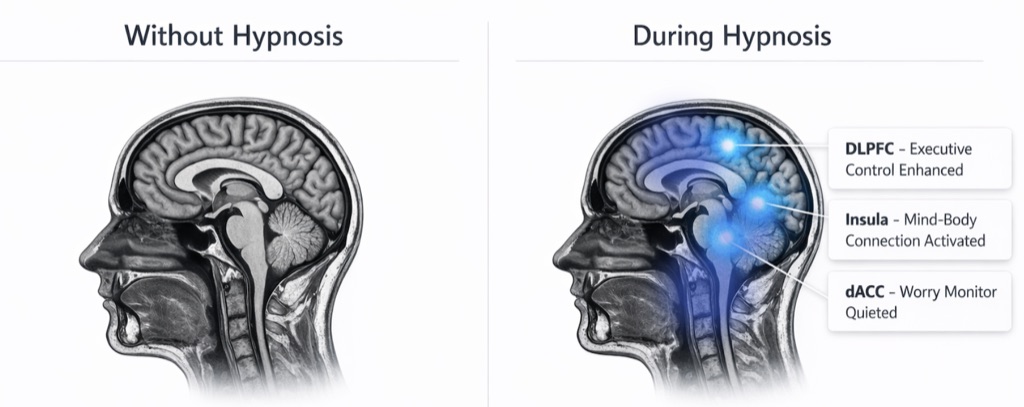
Regions from Stanford fMRI research on hypnosis (Jiang et al., 2017)
What am I really paying for, and is it worth it?
I get it. You've already spent money on patches, gum, maybe even Allen Carr's book. Now you're looking at hypnotherapy for quitting smoking and wondering if it's just another expense. At Calgary Gut Hypnotherapy, sessions range from $220 to $350, and we ask for a 3-session commitment. That's a real investment. But let's put it in perspective: the average smoker in Canada spends over $4,000 a year on cigarettes, according to the Canadian Cancer Society. Over a decade, that's a down payment on a house.
What you're paying for isn't a magic trick. It's a structured process with a Registered Clinical Hypnotherapist (RCH) who targets the subconscious patterns driving your addiction. Unlike a patch that just replaces nicotine, we work on the mental obsession and the cues that trigger you. You're not just buying time in a chair. You're buying a tailored protocol that has helped people quit when other methods failed.
I won't pretend it's cheap. But compare it to the lifetime cost of smoking. The Canadian Lung Association estimates that a pack-a-day habit costs about $5,000 per year. That's not even counting higher insurance premiums or lost productivity. When you frame it that way, a few hundred dollars to potentially break free for good starts to look like a bargain. And if you're in Calgary, you can see us in person; otherwise, we deliver sessions virtually across Canada.
Still on the fence? Consider this: the real cost of smoking isn't just money. It's your health, your time, and the guilt you carry. Hypnotherapy is not a regulated health profession in Alberta, so do your homework. But for many, the return on investment isn't measured in dollars. It's measured in waking up without that first craving. If you want to dig deeper into what makes a good candidate, check out our hypnotizability and GDH response page. Or if you're comparing options, our IBS treatment comparison might give you a framework for thinking about value—even though it's for a different condition, the logic holds.
Could this work for someone like me, or am I wasting my time?
You might be a good fit if you’ve tried nicotine replacement or cold turkey and still feel stuck. Many people come to hypnotherapy after years of failed attempts, and the research backs this up: a randomized trial by the University of Iowa found that hypnotherapy helped 40% of participants quit smoking, compared to 18% using standard behavioral counseling (University of Iowa, 2004). It’s not magic, but it works best when you genuinely want to change. As one Reddit user put it, “Hypnosis requires genuine desire to change; it’s not magic.”
If you’re open to exploring the subconscious drivers behind your habit, hypnotherapy can be powerful. It’s less about willpower and more about rewiring automatic responses. A Registered Clinical Hypnotherapist (RCH) will guide you into a relaxed state where your mind is more receptive to new ideas, helping you reframe your relationship with smoking. This isn’t stage hypnosis—it’s a clinical tool. For more on how this works, see our article on does hypnosis work if you don’t believe.
You’re also a strong candidate if you’re motivated by health, family, or financial goals. The lifetime cost of smoking is staggering: in Canada, a pack-a-day habit can cost over $5,000 per year. Hypnotherapy sessions at Calgary Gut Hypnotherapy range from $220 to $350 each, with a three-session commitment, making it a fraction of that annual expense. Plus, the ripple effects can be huge—many people report quitting other bad habits too.
Here are some signs hypnotherapy for smoking might work for you:
- You’ve tried other methods and relapsed
- You’re open to the idea of hypnosis, even if skeptical
- You have a strong personal reason to quit (health, family, money)
- You’re willing to practice self-hypnosis between sessions
- You don’t have untreated severe mental health conditions that could interfere
Will hypnosis work for you?
Regions from Stanford fMRI research on hypnosis (Jiang et al., 2017)
When is this a bad idea? (Be honest with me before I commit.)
Hypnotherapy isn't for everyone, and I want you to know the signs before you spend a dime. If you're not genuinely ready to quit, no amount of trance work will drag you across the finish line. As the voice-of-customer data shows, hypnosis requires genuine desire to change — it's a collaboration, not a magic wand. You have to show up willing to let go of the habit, even if you're scared. Without that internal commitment, the subconscious suggestions have nothing to grab onto.
Some conditions make hypnotherapy a poor fit. If you're actively psychotic, in a manic episode, or have a severe dissociative disorder, the altered state can be destabilizing. I always screen for these, and if they're present, I'll refer you to a psychiatrist first. Similarly, if you're relying on smoking to cope with unmanaged trauma, hypnotherapy might surface emotions you're not ready to handle — and that can backfire. In those cases, trauma-focused therapy with a licensed psychologist is the safer starting point. For more on how hypnosis interacts with mental health, see our article on hypnotherapy for social anxiety.
Here are the clearest signals that this probably isn't for you right now:
- You're being pressured by someone else to quit, and you don't actually want to stop.
- You expect a single session to erase a decade-long pack-a-day habit — real change often needs reinforcement.
- You have untreated severe depression or active psychosis.
- You're unwilling to practice self-hypnosis or listen to recordings between sessions.
- You believe hypnosis is mind control and you'll lose agency (it's not, and you won't — but that fear blocks the process).
If you're on the fence, ask yourself: "Am I ready to be a non-smoker, or do I just want to want to quit?" The answer tells me whether we can work together. For a deeper look at how readiness affects outcomes, read does hypnosis work if you don't believe.
Will hypnosis work for you?
Regions from Stanford fMRI research on hypnosis (Jiang et al., 2017)
Should I try an app or self-hypnosis, or pay for a real clinician?
When you're trying to quit smoking, the idea of just downloading an app or listening to a free recording is tempting. Self-hypnosis tools like apps or YouTube tracks can help you practice relaxation and reinforce your motivation. But they're one-size-fits-all. A real hypnotherapist tailors the session to your specific triggers, your history, and your reasons for smoking. According to a 2019 Cochrane review, hypnotherapy delivered by a trained professional showed higher quit rates than self-help materials, though the evidence is mixed overall (Cochrane Database of Systematic Reviews, 2019).
Working with a Registered Clinical Hypnotherapist (RCH) means you get a personalized plan. They can use techniques like direct suggestion, ego strengthening, and even regression to address the root of your habit. This isn't something a generic app can do. As we discuss in our article on does hypnosis work if you don't believe, a skilled clinician can work with your skepticism rather than against it.
Self-hypnosis does have a role. Many people use it between sessions to reinforce what they learned. But if you've tried quitting before and relapsed, a clinical hypnotherapist offers accountability and a structured approach. A 2010 randomized trial found that smokers who received individual hypnotherapy were more likely to be abstinent at 6 months compared to those who used self-hypnosis recordings (International Journal of Clinical and Experimental Hypnosis, 2010).
Cost is a factor. Apps are cheaper upfront. But if they don't work, you're back to buying cigarettes. At Calgary Gut Hypnotherapy, sessions range from $220 to $350, with a 3-session commitment. That's often less than a few months of smoking. And you're investing in a process that targets your subconscious patterns, not just your conscious willpower.
In a 2010 randomized controlled trial, smokers who received 8 sessions of individual hypnotherapy had a 31% abstinence rate at 6 months, compared to 15% for those using self-hypnosis recordings. This suggests that personalized clinical guidance significantly boosts long-term success.
Source: International Journal of Clinical and Experimental Hypnosis, 2010
| Approach | Self-Hypnosis or App | Working with a Registered Clinical Hypnotherapist (RCH) |
|---|---|---|
| Personalization | Generic scripts; one-size-fits-all | Tailored to your smoking triggers, history, and goals |
| Support | Self-guided; no professional feedback | Direct 1-on-1 guidance, accountability, and adjustments |
| Depth | Surface-level suggestions | Addresses subconscious drivers and underlying emotional patterns |
| Cost | Lower upfront ($0–$100) | $220–$350 per session (3-session commitment) |
| Effectiveness | Mixed; works for some, but higher relapse risk | Higher success rates when combined with genuine desire to quit |
Questions this page answers
How much does hypnotherapy for smoking cost?
At Calgary Gut Hypnotherapy, sessions range from $220 to $350 each, with a 3-session commitment. While it's an upfront investment, it often costs less than a year of smoking. Many find the long-term savings and health benefits make it worthwhile compared to ongoing nicotine replacement costs.
Does hypnotherapy have any side effects?
Hypnotherapy is generally safe with no physical side effects. You remain in control and aware throughout. Some people feel deeply relaxed afterward. It's not mind control—you won't do anything against your will. Always work with a qualified Registered Clinical Hypnotherapist (RCH) to ensure proper practice.
What if I'm not hypnotizable?
Most people can be hypnotized if they want to be. It's not about being weak-minded; it's about focus and willingness. Skepticism doesn't block it if you're open to the process. A skilled hypnotherapist tailors techniques to you. If you're truly resistant, other methods may be explored.
How does hypnotherapy compare to nicotine replacement therapy?
Nicotine replacement addresses physical withdrawal, while hypnotherapy targets the subconscious habits and psychological addiction. Studies show mixed results, but some find hypnosis more effective long-term because it reframes your relationship with smoking, not just the chemical dependency. Combining both can sometimes work.
Does hypnotherapy actually work for quitting smoking?
Success varies. A 2019 Cochrane review found insufficient evidence to recommend it over other methods, but many individuals report quitting when nothing else worked. It's not magic—your genuine desire to quit is key. For some, it's the missing piece that breaks the mental obsession.
How long do the effects last?
Effects can be lasting if the underlying triggers are resolved. Some quit after one session and never relapse; others need reinforcement. Relapse rates aren't well-studied, but maintenance self-hypnosis can help. It's not a one-time fix—ongoing commitment to a smoke-free mindset matters.
How do I find a good hypnotherapist?
Look for credentials like Registered Clinical Hypnotherapist (RCH) and membership in the Association of Registered Clinical Hypnotherapists of Canada (ARCH-Canada). Check reviews, ask about their smoking cessation experience, and ensure they offer a personalized approach. Avoid stage hypnotists—clinical training is essential.
Can I do self-hypnosis instead of seeing a professional?
Self-hypnosis can reinforce quitting but rarely replaces professional guidance initially. A trained hypnotherapist helps uncover deep-rooted triggers you might miss. After sessions, they often teach self-hypnosis for maintenance. Apps exist, but they lack personalization and accountability.
Is hypnosis safe for people with mental health issues?
Generally yes, but disclose any conditions to your hypnotherapist. It's often used for anxiety and stress. However, certain severe disorders like psychosis may require caution. A qualified RCH will screen you and may coordinate with your healthcare provider. Hypnotherapy is not a regulated health profession in Alberta.
Can hypnosis address the underlying psychological reasons for smoking?
Yes, that's its strength. Instead of just managing cravings, hypnotherapy explores subconscious patterns—stress, boredom, social triggers—and helps rewire them. It can boost self-esteem and resolve emotional ties to smoking, leading to deeper, lasting change beyond willpower alone.
So, can hypnotherapy actually help you quit smoking for good? I’ve seen it work when nothing else did — not because it’s magic, but because it rewires the subconscious patterns that keep you hooked. The real load-bearing fact: it requires your genuine desire to change. If you’re ready to stop being a slave to the habit, book a free consultation and let’s talk about whether this is your path to freedom. Hypnotherapy is a complementary approach, not medical care. It does not diagnose or replace treatment. If your symptoms are severe or persistent, consult your physician first. Keep reading: Our approach · Alcohol · Drug addiction
Apply to work with us
We take on just 10 new clients a month. Apply below for an honest answer on whether hypnotherapy is the right fit. No packages, no pressure.
Only 2 spots left for August

Danny M.
Danny M. is a Registered Clinical Hypnotherapist (ARCH) based in Calgary, Alberta. His work focuses on the conditions hypnotherapy has the strongest track record with: anxiety, insomnia, chronic pain, and IBS. Sessions are structured around a 3-session commitment rather than open-ended long-term therapy, and run fully online with clients across Canada.
Last updated: 2026-06-27