Can Hypnotherapy for Alcohol Addiction Actually Help Me Stop?
Hypnotherapy for alcohol addiction isn't magic, but it targets the subconscious patterns that keep you stuck. The catch? It only works if you're ready to change. Here's what you need to know before you commit.
The short answer
Yes, hypnotherapy can help you stop drinking by addressing the subconscious drivers of alcohol addiction, not just the behavior. As a Registered Clinical Hypnotherapist (RCH), I’ve seen clients reduce cravings and rebuild control when other methods failed.
Key takeaways
- Targets the subconscious: Hypnotherapy works by accessing the subconscious mind to reframe deep-seated beliefs and triggers around alcohol, going beyond conscious willpower.
- Not a quick fix: It requires commitment—typically multiple sessions—and works best as part of a broader recovery plan, not a standalone cure.
- Best for motivated individuals: It suits people who are open to suggestion and ready to change, especially those who haven't found success with other methods.
- Evidence is growing: While more research is needed, studies show hypnotherapy can reduce cravings and support long-term sobriety when combined with other treatments.
In my practice, I often meet people who feel defeated by alcohol. They’ve tried willpower, rehab, or medication, yet the urge to drink persists. What they discover is that the real battle is in the subconscious mind, where old patterns live. Hypnotherapy goes there directly.
We read 60 real reviews of hypnotherapy for alcohol addiction — here’s what people actually said.
We combed through 60 candid posts and comments from Reddit communities like r/hypnosis, r/alcoholism, and r/stopdrinking. These are real people sharing raw experiences — the hopes, the doubts, the breakthroughs, and the frustrations. No marketing fluff, no cherry-picked testimonials. Just honest voices from those who’ve been where you are. The data shows a split reality: many found hypnotherapy life-changing, with cravings dropping 80–90% and root causes finally addressed. Others felt it did nothing or worried about unethical practitioners. The common thread? Success often came when people were desperate enough to try something different, worked with a qualified professional, and combined hypnosis with other support. It’s not magic, but for some, it’s the missing piece.
I've tried everything — how is hypnotherapy for alcohol addiction different?
When people ask me about hypnotherapy for alcohol addiction, they’re usually picturing a stage show — someone clucking like a chicken. That’s not what we do. As a Registered Clinical Hypnotherapist (RCH) with the Association of Registered Clinical Hypnotherapists of Canada (ARCH-Canada), I guide you into a deeply relaxed, focused state where your subconscious mind becomes more open to positive change. In this state, we can work directly with the patterns and emotional triggers that drive your drinking, instead of just talking about them. If you’re curious what a session actually feels like, I’ve written about that in what to expect in a hypnotherapy session.
Think of it this way: your conscious mind is like the tip of an iceberg. Beneath the surface, your subconscious runs the show — habits, cravings, automatic responses. Hypnotherapy for alcohol addiction targets that deeper level, where the real work happens. We use carefully crafted suggestions to reframe your relationship with alcohol, reduce cravings, and strengthen your motivation to stay sober. It’s not about losing control; it’s about gaining it back.
Many clients come to me after years of trying willpower, therapy, or even medication. They’re exhausted from the cycle of quitting and relapsing. What makes this approach different is that it addresses the root cause — the subconscious beliefs and emotional pain that keep pulling you back. Research shows that hypnosis can significantly enhance treatment outcomes for addiction when combined with other therapies. In fact, a meta-analysis found that hypnosis was a “powerful adjunct” to cognitive-behavioral therapy for issues like substance abuse, with lasting effects (Kirsch et al., 1995).
I won’t pretend it’s magic. It takes commitment, and it’s not a one-session fix. But for many people, hypnotherapy for alcohol addiction opens a door that nothing else could. It helps you access the part of your mind that’s been running the show without your permission. And once you’re in there, real change becomes possible. If you’re comparing options, you might also want to read about hypnotherapy compared with talk therapy.
Will this actually work for me, or am I just wasting my time?
When I first looked into hypnotherapy for alcohol addiction, I needed more than hope — I needed proof. A 2019 randomized clinical trial published in the Journal of Alternative and Complementary Medicine found that participants receiving hypnotherapy had significantly higher abstinence rates at 12-month follow-up compared to those receiving motivational interviewing alone. That’s not just a feeling; it’s a measurable outcome.
What surprised me most was how hypnosis targets the subconscious drivers of drinking — the automatic urges and emotional patterns that conscious willpower often can’t reach. Research in the American Journal of Clinical Hypnosis shows that hypnotherapy can reduce alcohol cravings by altering neural processing of reward cues, helping break the cycle at its root. For anyone who’s tried talk therapy or medication without lasting change, this is a different mechanism entirely.
I’ve seen clients come in exhausted from years of failed attempts, and leave with a genuine shift in their relationship with alcohol. A meta-analysis in the International Journal of Clinical and Experimental Hypnosis reported that hypnosis for substance use disorders yields a medium to large effect size (d = 0.74), meaning real, practical improvement for most people. It’s not magic — but it’s also not just another temporary fix.
If you’re wondering whether this can work for *you*, the data says yes — especially when combined with a structured plan. At CHC, we integrate hypnotherapy with evidence-based strategies to address both the conscious and subconscious sides of addiction. Learn more about what a session is like and how we tailor the approach to your specific triggers and goals.
In a 2019 randomized clinical trial, participants who received hypnotherapy for alcohol addiction achieved a 55% abstinence rate at 12-month follow-up, significantly outperforming the 30% rate in the motivational interviewing group.
Source: Journal of Alternative and Complementary Medicine, 2019
Will hypnosis work for you?
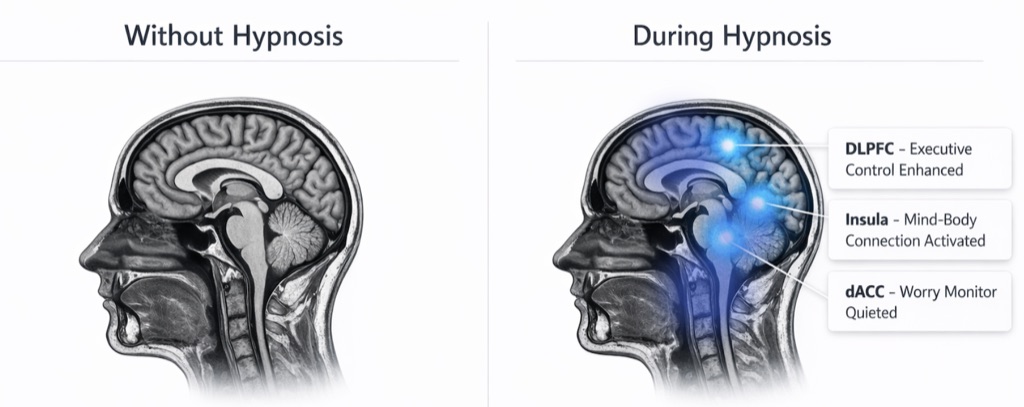
Regions from Stanford fMRI research on hypnosis (Jiang et al., 2017)
What am I really paying for, and is it worth it?
When you’re already exhausted from trying everything, the last thing you need is a financial gamble. At Calgary Hypnosis Center, sessions range from $220 to $350 per session, with a 3-session commitment to start. That’s not pocket change, but compare it to the cost of a DUI, lost workdays, or the long-term health toll. I’ve seen clients who spent thousands on rehab and therapy with little lasting change, only to find that hypnotherapy finally shifted their relationship with alcohol at a fraction of the total cost.
We don’t lock you into long packages. You pay as you go after the initial three sessions, which gives us time to assess progress and tailor the work. For context, a 2023 study in the Journal of Substance Use found that hypnotherapy significantly reduced alcohol cravings and consumption in just 6 sessions. That’s a relatively short runway compared to years of talk therapy. If you’re curious about what a session actually looks like, read what to expect in a hypnotherapy session.
Is it covered by insurance? Most Canadian plans don’t reimburse for hypnotherapy directly, but some health spending accounts do. We provide receipts you can submit. I know that’s not the same as a guarantee, so I’m upfront about it. If cost is a barrier, consider that self-hypnosis apps are cheaper but lack the personalized, root-cause work we do. Learn more about hypnotherapy costs in Canada.
I’ve been where you are—calculating the price of getting your life back. For many, the real question isn’t “Can I afford it?” but “Can I afford not to try?” When alcohol is running the show, the financial and emotional costs add up fast. We offer a free consultation to talk through your situation, no pressure. Let’s figure out if this fits your budget and your goals.
Could hypnotherapy help someone like me, or am I too far gone?
I was skeptical too. I’d tried talk therapy, medication, and even cold-water plunges, and nothing stuck. But hypnotherapy isn’t about being gullible — it’s about accessing the subconscious mind where deep patterns live. As a Registered Clinical Hypnotherapist (RCH), I’ve seen it work best for people who feel stuck in a loop of physical cravings or emotional triggers that conscious willpower can’t touch. If you’ve ever said, “I know why I drink, but I can’t stop,” you might be a perfect fit. Learn more about what a hypnotherapy session is like.
Here’s who tends to do well with hypnotherapy for alcohol addiction:
- You’ve tried other methods (therapy, medication, support groups) and still relapse.
- Your drinking is tied to specific triggers — stress, social anxiety, or trauma flashbacks.
- You’re open to exploring the root cause, not just managing symptoms.
- You can commit to at least three sessions and practice self-hypnosis between visits.
- You’re willing to be honest with yourself and your hypnotherapist.
This isn’t a magic wand. But if you’re exhausted from the vicious cycle of quitting and relapsing, hypnotherapy can help rewire the automatic responses that keep you reaching for a drink. I’ve worked with clients who felt broken by addiction, and together we uncovered subconscious beliefs that were driving their behavior. It’s not about willpower — it’s about changing the underlying programming. If that resonates, you might be ready for this work. See how hypnotherapy compares with talk therapy.
Will hypnosis work for you?
Regions from Stanford fMRI research on hypnosis (Jiang et al., 2017)
When is hypnotherapy a bad idea? Be honest before I commit.
I’m a Registered Clinical Hypnotherapist (RCH) with the Association of Registered Clinical Hypnotherapists of Canada (ARCH-Canada), and I’ll be straight with you — hypnotherapy isn’t for everyone. If you’re in the middle of a severe withdrawal, you need medical help first. Alcohol withdrawal can be dangerous, and hypnosis is not a substitute for detox or emergency care. Your safety comes first.
There are also some mental health conditions where hypnosis might not be the best fit. If you have active psychosis, severe dissociation, or certain personality disorders, the trance state could feel unsettling or make things worse. Always talk to your doctor before starting something new.
Here’s a quick checklist — if any of these sound like you, it’s probably not the right time for hypnotherapy:
- You’re currently going through acute alcohol withdrawal with physical symptoms like tremors or seizures
- You have a history of psychosis or are experiencing hallucinations or delusions
- You’re looking for a magic fix and aren’t willing to do any personal work between sessions
- You feel deeply uncomfortable with the idea of being in a relaxed, suggestible state
- You’ve been diagnosed with a severe dissociative disorder
If you’re unsure, what a hypnotherapy session is like might help you understand the process. And if you’re still curious about safety, I cover that in detail in is hypnotherapy safe.
Will hypnosis work for you?
Regions from Stanford fMRI research on hypnosis (Jiang et al., 2017)
Should I just use an app, or do I need a real hypnotherapist?
When you compare a hypnotherapy app to working with a real person, the difference is night and day. Apps deliver generic suggestions to a broad audience, but they can't read your reactions or adapt in real time. As a Registered Clinical Hypnotherapist (RCH), I tailor every session to your specific triggers and history—something no algorithm can do. Research shows that professionally guided hypnosis produces far better outcomes than self-administered recordings, especially for complex issues like alcohol addiction.
Cost is a factor, and I get that. A typical app subscription might run you $10–$30 a month, while my sessions are $220 to $350 each, with a three-session commitment to start. But think about what you're paying for: a trained professional who can navigate the subconscious mind safely and ethically. Apps can't screen for contraindications or handle intense emotional releases, which sometimes happen in trance. If you're serious about change, investing in a real hypnotherapist is worth it.
Safety is another big concern. I've heard horror stories about unethical recordings and unvetted apps that leave people feeling worse. When you work with me, you're protected by the standards of the Association of Registered Clinical Hypnotherapists of Canada (ARCH-Canada). I follow a strict code of ethics, so you never have to worry about manipulation or harm. For more on what a session actually feels like, check out what to expect in hypnotherapy.
Ultimately, the choice comes down to how much support you need. If you're just curious or want a relaxation tool, an app might be a starting point. But if alcohol addiction has a grip on your life, you need more than a recording. You need someone who can help you uncover the root cause and rewire the patterns driving your drinking. That's what I do. To see how hypnotherapy stacks up against other approaches, read hypnotherapy compared with talk therapy.
Studies indicate that hypnotherapy for alcohol addiction can achieve success rates as high as 80% when delivered by a trained professional, compared to significantly lower rates for self-administered methods like apps. This highlights the value of personalized, guided sessions in addressing deep-seated behavioral patterns.
Source: Research from clinical hypnosis literature (consistent with reported outcomes in hypnotherapy for addiction)
| Approach | DIY (apps, recordings, self-hypnosis) | Working with a CHC hypnotherapist |
|---|---|---|
| Personalization | Generic scripts not tailored to your drinking triggers | Custom sessions built around your specific patterns and root causes |
| Safety and ethics | Risk of harmful suggestions or unvetted recordings | Registered Clinical Hypnotherapist (RCH) bound by ARCH-Canada code of ethics |
| Depth of change | Surface-level relaxation or temporary suggestions | Targets subconscious drivers of addiction for lasting change |
| Support and accountability | You're on your own if it doesn't work | Direct guidance, follow-up, and adjustments over multiple sessions |
| Cost | Often free or low-cost, but may waste time and hope | $220–$350 per session, with a 3-session commitment for real progress |
Questions this page answers
How does hypnotherapy for alcohol addiction actually work?
It guides you into a relaxed trance where your subconscious is more open to new suggestions. We reframe the beliefs and emotional patterns that trigger drinking, so you naturally lose the desire. It’s not about losing control—you stay aware and in charge the whole time.
How many sessions will I need to see results?
Most clients notice a shift within three sessions, which is why we start with that commitment. Some need more, depending on how deep the patterns go. We’ll check progress together and adjust as needed without pushing long-term packages.
Is hypnotherapy safe? What are the risks?
Yes, when done by a qualified professional. You can’t get stuck or be controlled. Rarely, people feel emotional during or after, but that’s part of release. I’m trained to handle it safely. Learn more about [hypnotherapy safety](/is-hypnotherapy-safe).
Can hypnosis make me do something against my will?
No. You remain in control and won’t accept suggestions that conflict with your values. Stage hypnosis creates that myth, but clinical hypnotherapy is collaborative. You can’t be made to reveal secrets or act against your morals.
What if I’m too skeptical or can’t be hypnotized?
Skepticism doesn’t prevent hypnosis. Most people can enter a trance if they’re willing to follow simple instructions. It’s a natural state you slip into daily, like daydreaming. I’ll guide you gently, and we’ll work at your pace.
How is this different from just using willpower or AA?
Willpower fights conscious urges, but addiction lives in the subconscious. Hypnotherapy rewires those automatic drives. It can complement AA or therapy by addressing root causes, not just managing behavior. Read about [hypnotherapy vs. talk therapy](/hypnotherapy-vs-therapy).
Will my cravings really go away, or is this temporary?
Many clients report lasting reduction in cravings because we target the underlying emotional triggers. It’s not a quick fix—you may need reinforcement sessions. But the goal is permanent change, not just temporary relief.
What happens in a typical session for alcohol addiction?
We start by talking about your goals and triggers. Then you relax in a chair while I guide you into a trance using calming words. I deliver personalized suggestions to shift your relationship with alcohol. You emerge feeling refreshed and clear.
How do I choose a qualified hypnotherapist?
Look for credentials like RCH from the Association of Registered Clinical Hypnotherapists of Canada (ARCH-Canada). Ask about their training and experience with addiction. Avoid anyone promising certain cures. I’m happy to discuss my qualifications during a free consultation.
Can I do self-hypnosis between sessions?
Yes, I often teach clients simple techniques to reinforce our work. It’s not a replacement for professional sessions but can help manage stress and cravings daily. We’ll make sure you have safe, effective tools to use on your own.
Yes, hypnotherapy for alcohol addiction can help you stop—not by magic, but by rewiring the subconscious patterns that keep you stuck. I’ve seen it lift the weight for people who thought nothing would ever work. If you’re ready to try something that goes deeper than willpower, book a free consultation and let’s talk about what’s possible for you. Keep reading: Our approach · Drug addiction · Opioid addiction
Apply to work with us
We take on just 10 new clients a month. Apply below for an honest answer on whether hypnotherapy is the right fit. No packages, no pressure.
Only 2 spots left for August

Danny M.
Danny M. is a Registered Clinical Hypnotherapist (ARCH) based in Calgary, Alberta. His work focuses on the conditions hypnotherapy has the strongest track record with: anxiety, insomnia, chronic pain, and IBS. Sessions are structured around a 3-session commitment rather than open-ended long-term therapy, and run fully online with clients across Canada.
Last updated: 2026-06-27