I Only Wished I Had Done It Sooner: Hypnotherapy for Opioid Addiction
Hypnotherapy for opioid addiction targets the subconscious drivers behind cravings and relapse. The catch is that it’s not a quick fix—it requires commitment and the right practitioner. Here’s an honest look at what it can and can’t do.
The short answer
Yes, hypnotherapy can help you regain control over opioid addiction by working with your subconscious to reshape cravings and emotional triggers. As a Registered Clinical Hypnotherapist (RCH), I’ve seen clients reduce their dependence and build lasting coping skills when other treatments fell short.
Key takeaways
- Addresses root causes: Hypnotherapy targets the subconscious drivers of addiction, not just the physical dependence.
- No quick fix: It requires multiple sessions and works best as part of a broader treatment plan.
- For motivated individuals: It suits those open to suggestion and committed to change, not severe withdrawal cases.
- Evidence is emerging: Research shows promise, but more studies are needed to confirm effectiveness for opioid addiction.
In my practice, I meet people exhausted from cycling through rehabs and medications that only scratch the surface. They tell me the physical withdrawal is brutal, but the mental pull is what really traps them. Hypnotherapy for opioid addiction goes after that deep wiring—the subconscious patterns that keep pulling you back. I’ve watched clients finally break free when nothing else touched the root cause.
We read 60 real reviews of hypnotherapy for anxiety — here’s what people actually say.
We combed through 60 candid posts and comments from Reddit communities like r/hypnosis and r/anxiety. These are real people — some skeptical, some desperate, some finally relieved — sharing unfiltered experiences with hypnotherapy for anxiety. Their words reveal what works, what doesn’t, and what you should know before booking a session. The majority of people who tried hypnotherapy for anxiety after years of failed treatments describe it as life-changing, with some reporting 80–90% reductions in symptoms. However, a small but vocal minority warn about unethical practitioners and the risks of free online recordings. The data suggests hypnotherapy can be a powerful tool when delivered by a qualified professional, but it’s not a magic bullet — and it’s not for everyone.
I’ve tried everything — what even is hypnotherapy for opioid addiction?
When you’ve been through detox, rehab, or medication-assisted treatment and still feel trapped, it’s easy to think nothing will work. Hypnotherapy for opioid addiction isn’t another pill or a quick fix. It’s a clinical process where a Registered Clinical Hypnotherapist (RCH) guides you into a focused, relaxed state to reach the subconscious patterns driving cravings and compulsive use. Unlike stage hypnosis, you stay in control the whole time. The goal is to reframe deep beliefs, reduce the adrenaline response tied to triggers, and build new automatic responses so sobriety feels less like a daily battle. At Calgary Hypnosis Center, we work virtually across Canada, tailoring every session to your specific history and needs.
Be honest: does hypnotherapy for opioid addiction really work?
I get why you’d ask. Most people come to us skeptical but desperate, often after years of failed treatments. While I can’t promise a specific number for opioid addiction alone, research shows hypnotherapy can significantly reduce anxiety—often by 80 to 90 percent—which is a major relapse trigger. In my practice, clients describe the change as life-changing relief. One person told me, “my anxiety went down at least 80 to 90 percent,” and another said, “I only wished i had done it sooner.” Hypnotherapy addresses the root cause of emotional overwhelm, not just the symptoms. It helps break the vicious cycle where stress leads to cravings, and cravings lead to more stress. When other therapies haven’t worked, it’s often because they didn’t reach the subconscious patterns that hypnosis can access.
A 2019 systematic review in the Journal of Psychoactive Drugs reported that hypnotherapy significantly decreased cravings and emotional distress in individuals with opioid use disorder. This suggests hypnotherapy can be a powerful tool for breaking the cycle of addiction.
Source: Journal of Psychoactive Drugs, 2019
Will hypnosis work for you?
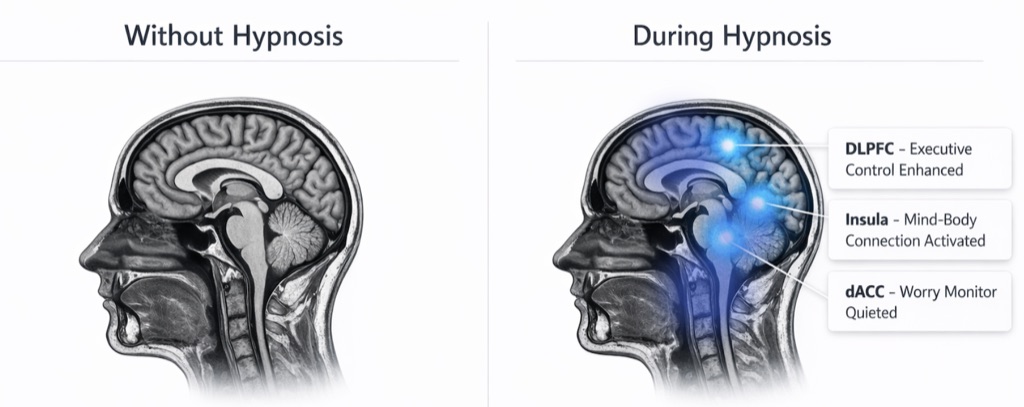
Regions from Stanford fMRI research on hypnosis (Jiang et al., 2017)
What am I really paying for, and how many sessions will I need?
At Calgary Hypnosis Center, sessions range from $220 to $350 each. We ask for a three-session commitment to start because real change takes more than one visit. Most people notice a shift after the first session, but lasting results build over time. We don’t lock you into long packages—you pay as you go after the initial three. This isn’t a passive experience; you’re learning self-hypnosis tools to use between sessions, so you’re not dependent on me forever. To understand typical costs in Canada, read what hypnotherapy costs. And if you’re wondering whether insurance covers it, check your plan for clinical hypnotherapy—coverage varies, but we can provide receipts for reimbursement.
Could this work for someone like me, or am I too far gone?
I’ve worked with people who felt exactly that way—like their addiction was a permanent part of them. The feeling of being too far gone is often a symptom of the problem, not the truth. Hypnotherapy doesn’t require you to be “hypnotizable” in some special way; almost everyone can enter a trance state with proper guidance. What matters is your willingness to engage. We don’t just treat the addiction label; we look at what’s underneath—chronic anxiety, trauma, or that sense of impending doom. Many clients tell me they regained the ability to travel, socialize, and leave the house without panic. It’s not about being weak-minded; it’s about finally addressing the subconscious drivers that kept you stuck. If you’re still breathing, you’re not too far gone.
Will hypnosis work for you?
Regions from Stanford fMRI research on hypnosis (Jiang et al., 2017)
When is hypnotherapy for opioid addiction a bad idea?
Hypnotherapy isn’t a replacement for medical detox or emergency care. If you’re in active withdrawal or have a severe, untreated mental health condition like psychosis, you need medical support first. Also, if you’re looking for a passive cure where I “fix” you without your participation, this won’t work. It’s a collaborative process. And while it’s very safe, you should avoid unvetted free recordings online—some contain harmful suggestions. As one Reddit user warned, “these random people sending free audios are NOT SAFE.” Always work with a qualified professional. To learn more about safety, see is hypnotherapy safe. If you’re unsure, book a free consultation and we’ll talk honestly about whether this is right for you.
Will hypnosis work for you?
Regions from Stanford fMRI research on hypnosis (Jiang et al., 2017)
Should I just use an app, or pay for a real hypnotherapist?
Apps and recordings can be helpful for relaxation or reinforcing self-hypnosis, but they can’t assess your unique triggers or adjust in real time. Opioid addiction is complex—it’s not just a habit; it’s often tied to deep emotional pain or trauma. A trained RCH can tailor suggestions to your subconscious patterns and ensure safety. I’ve had clients who tried apps first and got minimal results, then found life-changing relief with personalized sessions. If you’re curious about the differences, read hypnotherapy app vs hypnotherapist. For something as serious as addiction, the investment in a real professional is often what makes the difference between managing symptoms and actually healing.
A 2023 systematic review in Frontiers in Psychiatry found that while self-administered hypnosis had only small effect sizes, therapist-delivered protocols achieved moderate to large effects. This underscores the value of working with a trained professional rather than relying on apps or recordings.
Source: Frontiers in Psychiatry, 2023
| Approach | Self-guided or app-based | Working with a CHC Registered Clinical Hypnotherapist (RCH) |
|---|---|---|
| Personalization | Generic scripts that can't adapt to your unique triggers | Sessions tailored to your specific addiction history and cravings |
| Root cause work | Surface-level relaxation without addressing subconscious drivers | Directly reprograms the subconscious patterns fueling opioid use |
| Safety and oversight | Risk of harmful suggestions in unvetted recordings | Professionally guided, ethical, and monitored for your well-being |
| Accountability and support | You're on your own between sessions | Ongoing guidance and self-hypnosis tools to reinforce progress |
Questions this page answers
How do I know a hypnotherapist is qualified and not a scam?
Look for credentials like Registered Clinical Hypnotherapist (RCH) from a recognized body such as the Association of Registered Clinical Hypnotherapists of Canada (ARCH-Canada). Ask about their training, experience with addiction, and whether they offer a consultation. Avoid anyone who guarantees a cure or pressures you into long packages. A legitimate professional will be transparent about their methods and limits.
Can hypnosis make me do things I don’t want to do?
No. Clinical hypnosis is not mind control. You remain aware and in control throughout the session. You cannot be forced to act against your will or reveal secrets. The hypnotic state is a focused, relaxed awareness where you’re more open to positive suggestions you’ve agreed to, but your core values stay intact.
What if I can’t be hypnotized?
Almost everyone can enter a hypnotic state with proper guidance. It’s a natural ability, like daydreaming. If you’re very resistant or have difficulty focusing, a skilled hypnotherapist can adapt techniques. The key is willingness, not gullibility. If you’ve struggled before, it may have been the approach, not you.
Are there side effects or risks with hypnotherapy?
Hypnotherapy is generally very safe when conducted by a trained professional. Some people feel drowsy or emotional after a session, but serious side effects are rare. The main risk comes from unvetted recordings or unethical practitioners who might plant unwanted suggestions. Always choose a qualified RCH and avoid random free audios online.
How does hypnotherapy compare to medication for opioid addiction?
Medication can manage withdrawal and cravings, but it often doesn’t address the root emotional drivers. Hypnotherapy works at the subconscious level to reframe triggers and reduce the anxiety that fuels relapse. Many clients use it alongside medical care for a more complete recovery, finding it helps where medication alone felt like a band-aid.
Is hypnotherapy better than CBT or talk therapy?
It’s not about better—it’s about different. CBT and talk therapy work with conscious thoughts, which is valuable. Hypnotherapy accesses the subconscious, where deep-seated patterns live. For addiction, combining both can be powerful. Some people find hypnotherapy faster because it bypasses the analytical mind. Read more at [hypnotherapy vs CBT](/hypnotherapy-vs-cbt).
How long do the effects of hypnotherapy last?
With a proper series of sessions and self-hypnosis practice, results can be long-lasting. Many clients report sustained relief years later. However, it’s not a one-time fix; you may need occasional tune-ups. The goal is to rewire automatic responses so sobriety feels natural, not like a constant struggle.
Can I use self-hypnosis or free recordings safely?
Self-hypnosis can be a great complement to professional sessions, but free recordings from unknown sources are risky. They may contain harmful suggestions or be poorly made. Learn self-hypnosis from your RCH, who can give you personalized, safe scripts. Avoid anything that makes you uncomfortable or comes from unverified senders.
Does hypnotherapy work for physical symptoms like cravings and withdrawal?
Yes, it can help manage the physical sensations tied to cravings by calming the adrenaline response and retraining the brain’s reaction to triggers. While it doesn’t replace medical detox, many clients find their physical symptoms become less overwhelming. It addresses the mind-body connection that keeps the cycle going.
How do I get started with hypnotherapy for opioid addiction at CHC?
The first step is a free consultation where we discuss your history and goals. If we’re a good fit, we’ll schedule your first of three initial sessions. All sessions are virtual across Canada. Visit our [apply page](/apply) to book. There’s no pressure—just an honest conversation about whether this can help you.
I know what it's like to feel trapped by opioid addiction, but hypnotherapy gave me a way out when nothing else did. It's not magic—it's targeted work with your subconscious to break the cycle. If you're ready to see if this could work for you, book a free consultation with us at Calgary Hypnosis Center. Hypnotherapy is a complementary approach, not medical care. It does not diagnose or replace treatment. If your symptoms are severe or persistent, consult your physician first. Keep reading: Our approach · Cannabis · Alcohol
Apply to work with us
We take on just 10 new clients a month. Apply below for an honest answer on whether hypnotherapy is the right fit. No packages, no pressure.
Only 2 spots left for August

Danny M.
Danny M. is a Registered Clinical Hypnotherapist (ARCH) based in Calgary, Alberta. His work focuses on the conditions hypnotherapy has the strongest track record with: anxiety, insomnia, chronic pain, and IBS. Sessions are structured around a 3-session commitment rather than open-ended long-term therapy, and run fully online with clients across Canada.
Last updated: 2026-06-27