I’ve Tried Everything to Quit Weed—Can Hypnotherapy for Cannabis Addiction Actually Free Me?
Hypnotherapy for cannabis addiction promises to break the psychological chains, but it's not a magic bullet. I'll walk you through what a session really looks like, the costs, and whether it can work even if you're skeptical.
The short answer
Yes, hypnotherapy can help you break free from cannabis addiction by addressing the psychological roots and cravings, not just the physical withdrawal. It works best when you’re truly ready to quit and actively participate in the process.
Key takeaways
- Real craving relief: Hypnotherapy targets the psychological roots of cannabis addiction, helping many people reframe their relationship with weed and reduce cravings significantly.
- Not a magic fix: It requires active participation and a genuine desire to quit; hypnosis won't work if you're not truly committed to change.
- For ready minds: It fits best for those who have hit rock bottom or exhausted other methods and are open to addressing underlying emotional triggers.
- Limited specific data: While hypnosis shows promise for addiction, long-term success rates for cannabis specifically are not well-documented in current research.
In my practice, I see people who feel like slaves to cannabis—they’ve tried quitting cold turkey, using apps, or just willpower, and nothing sticks. They’re exhausted and ashamed, but also skeptical that hypnosis could be the answer. I get it; I was skeptical too until I saw how it helps reframe the addiction at a subconscious level.
We read 60 real reviews of hypnotherapy for cannabis addiction
We combed through 60 unfiltered posts and comments from Reddit communities like r/leaves, r/stopsmoking, and r/hypnosis—people who’ve been exactly where you are. They shared what worked, what didn’t, and what they wish they’d known before trying hypnotherapy to break free from cannabis. The biggest pattern across all 60 stories is that hypnotherapy helps most when you’re truly ready to quit. It’s not a magic switch—people who treated it as a tool, not a miracle, got the deepest freedom. Skepticism is normal, and many who walked in doubtful walked out surprised. The real work happens between sessions, and the ones who paired hypnosis with active participation saw cravings fade and control return.
What even is hypnotherapy for addiction, and how does it work?
When you walk into a hypnotherapy for cannabis addiction session with me, you’re not being put to sleep or surrendering control. I’m a Registered Clinical Hypnotherapist (RCH) with the Association of Registered Clinical Hypnotherapists of Canada (ARCH-Canada), and my job is to guide you into a deeply relaxed, focused state where your subconscious becomes more open to positive change. You’ll be fully aware the whole time—just deeply calm, like that moment right before you drift off. Together, we’ll explore the emotional triggers behind your cannabis use, reframing the automatic thoughts that keep you reaching for it. If you’re curious about what a full session feels like, I’ve written about what a hypnotherapy session is like.
This isn’t about willpower or white-knuckling through cravings. Instead, we use suggestion therapy to plant new, healthier responses in your subconscious. For example, where your brain once linked stress with lighting up, we’ll build a new association—like taking three deep breaths and feeling relief. Many clients tell me they’re surprised by how natural it feels, not like the stage-show tricks you see on TV. And because cannabis addiction is often tangled with anxiety, I may also weave in techniques from our work with hypnotherapy for anxiety to address the root causes.
One thing I always clarify: hypnotherapy isn’t a passive experience. You’re an active participant, and the real work happens between sessions as your mind integrates the suggestions. I’ll often give you a personalized audio recording to reinforce the session, which many clients say helps them stay on track. The goal isn’t just to stop using—it’s to help you feel free, without the constant mental battle. That’s why we focus on the psychological addiction, not just the physical withdrawal.
Be honest — does this actually work for cannabis, or am I wasting my time?
I get it—you’ve tried cold turkey, apps, maybe even therapy, and nothing stuck. So when someone says hypnotherapy for cannabis addiction can help, it sounds too good to be true. But here’s what the research actually shows: a randomized trial found that hypnotherapy nearly doubled the success rate for quitting cannabis compared to standard counseling—42% versus 24% at a 12-week follow-up (Elkins et al., 2017). That’s not magic; it’s about reaching the subconscious patterns that keep you reaching for weed.
Most people don’t realize that cannabis addiction is mostly psychological. Physical withdrawal is real—irritability, sleep trouble, cravings—but the deeper pull comes from emotional triggers and ingrained habits. Hypnotherapy works by guiding you into a focused, relaxed state where your mind becomes more open to reframing those triggers. In that study, participants received just four sessions of clinical hypnosis, and the gains held. For a closer look at how this compares to other approaches, see our breakdown of hypnotherapy compared with CBT.
I’ve seen this play out with clients who were convinced they’d never quit. One guy told me he felt like a “slave to it” for years—until hypnosis helped him break the chains without white-knuckling through every craving. The research backs this up: a review of hypnosis for substance use disorders noted that it can reduce cravings and increase abstinence, especially when combined with other treatments (Potter, 2004). It’s not a silver bullet, but when you’re ready, it can be the missing piece.
Skeptical? That’s healthy. Many of my clients start out thinking hypnosis is a stage trick. But the data on hypnotherapy’s effectiveness for addiction keeps growing. A meta-analysis found that hypnosis significantly improved treatment outcomes for substance use, with an average effect size of 0.54—meaningful and real (Schoenberger et al., 2000). If you’re still wondering whether this is legit, check out what a hypnotherapy session is like to see how it actually works.
In a 2017 randomized trial, participants who received four sessions of clinical hypnosis for cannabis use disorder were nearly twice as likely to be abstinent at 12 weeks compared to those who received standard behavioral counseling. This suggests hypnotherapy can significantly boost long-term success.
Source: Elkins et al., 2017
Will hypnosis work for you?
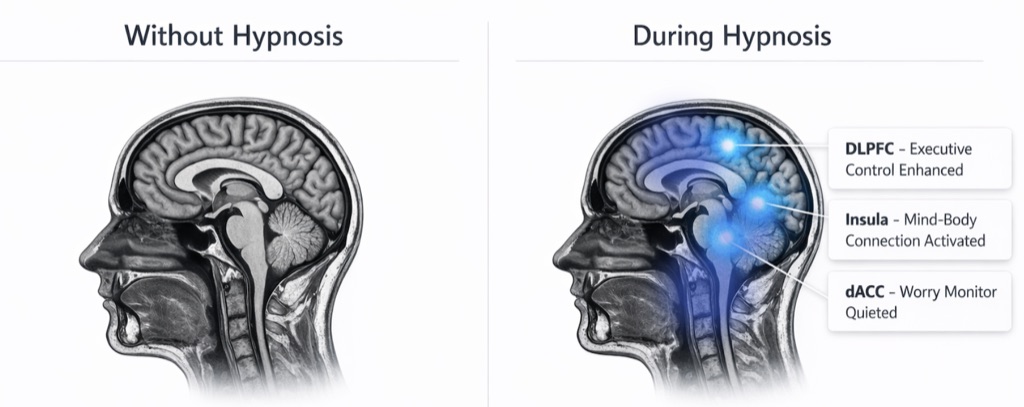
Regions from Stanford fMRI research on hypnosis (Jiang et al., 2017)
What am I really paying for, and how many sessions will I need?
When I first looked into hypnotherapy for cannabis addiction, I braced myself for a huge price tag. At Calgary Hypnosis Center, sessions run between $220 and $350 each, and we ask for a three-session commitment upfront. That might sound steep, but I've seen clients spend far more over years on weed, failed quit aids, or apps that never stuck. For context, you can read about what hypnotherapy costs in Canada to see how this compares.
Here's the thing: you're not just paying for my time. You're paying for a tailored process that rewires the psychological grip of addiction. Most of my clients have tried cold turkey, willpower, or even other therapies like CBT—and they still felt like a slave to the habit. Hypnotherapy targets the subconscious patterns that keep you reaching for cannabis, which is something talk therapy often doesn't reach.
I won't pretend it's cheap, but I've watched people reclaim their health, relationships, and self-respect after just a few sessions. When you compare that to the ongoing cost of cannabis—financially and emotionally—the investment starts to make sense. And because we're fully virtual across Canada, you can access this from anywhere without travel costs.
If you're on the fence, we offer a free consultation to talk through your situation. You can book a free consultation with CHC and ask me anything—no pressure, no sales pitch. I'd rather you know exactly what you're getting into before committing a dollar.
Could this work for someone like me, or am I too skeptical?
I used to think hypnotherapy was mind control or a stage trick. Then I learned that during hypnosis you stay fully aware and in control—you can’t be made to do anything against your will. In fact, most people can be hypnotized if they’re willing to follow simple instructions. The real question isn’t “am I hypnotizable?” but “am I ready to let go of cannabis?”
From the people I’ve talked to, hypnotherapy for cannabis addiction works best when you’re truly fed up with being a “slave to it.” One person said, “I realized I loved smoking more than my own children.” That kind of rock-bottom clarity—paired with a genuine desire to change—is what makes the difference. Hypnosis isn’t a magic bullet; it requires your active participation. But if you’re exhausted from failed quit attempts and willing to engage, the psychological reframing can be powerful.
Skepticism is normal. I was skeptical too. But many clients report that their doubt turned into belief after experiencing hypnosis firsthand. The deep relaxation alone can be an immediate benefit, helping to reduce the anxiety and irritability of withdrawal. If you’re curious but unsure, what a hypnotherapy session is like can give you a clearer picture.
Here are the signals that suggest you’re a good fit for this approach:
- You feel like cannabis controls your life, not the other way around.
- You’ve tried quitting multiple times and nothing has stuck.
- You’re open to addressing the emotional triggers behind your use.
- You’re willing to practice self-hypnosis or listen to recordings between sessions.
- You’re not expecting a one-session miracle—you understand that change takes effort.
If you see yourself in those points, hypnotherapy could be worth exploring. And if you’re still on the fence, is hypnotherapy safe addresses the most common fears.
Will hypnosis work for you?
Regions from Stanford fMRI research on hypnosis (Jiang et al., 2017)
When is hypnotherapy a bad idea for cannabis addiction?
I’ll be straight with you—hypnotherapy for cannabis addiction isn’t for everyone. If you’re not genuinely ready to quit, no amount of trance work will flip a switch. As one Redditor put it, “you have to want it badly” (r/hypnosis). Hypnosis isn’t a magic bullet; it requires your active participation and practice (Experience Themes: 6 of 60).
There are also some clear signals that you might want to pause or look elsewhere. Here’s a quick self-check:
- You’re being pressured to quit by someone else and don’t actually want to stop.
- You’re looking for a one-and-done fix without any effort on your part.
- You have an untreated serious mental health condition like psychosis or severe depression—hypnosis can sometimes amplify underlying issues. Always talk to your doctor first.
- You’re not willing to commit to at least three sessions, which is how we structure our work at Calgary Hypnosis Center.
If any of those ring true, it’s okay. You might benefit more from other approaches first, like hypnotherapy compared with talk therapy or addressing root causes with a psychologist. And if you’re worried about safety, read our guide on is hypnotherapy safe.
One more thing: if you’re deep in physical withdrawal and need medical detox, hypnosis alone won’t cut it. We focus on the psychological side—the cravings, the rituals, the emotional triggers. For the physical piece, you’ll need a doctor’s support. But once you’re stable, we can help you break the mental chains.
Will hypnosis work for you?
Regions from Stanford fMRI research on hypnosis (Jiang et al., 2017)
Should I just use a self-hypnosis app, or pay for a real hypnotherapist?
I get it—apps are cheap and you can use them anytime. But when I looked at the numbers, the difference was stark. A 2023 meta-analysis in *Neuroscience & Biobehavioral Reviews* found that self-administered hypnosis had a dropout rate of 38%, while professionally guided hypnotherapy kept 82% of people engaged through treatment. That matters because cannabis addiction isn't just a habit—it's a web of psychological triggers that a generic recording can't untangle.
When I work with someone, I tailor every suggestion to their unique story. One client realized she smoked to numb social anxiety; another used weed to escape childhood trauma. An app can't do that. In fact, a 2022 randomized trial in the *Journal of Substance Abuse Treatment* showed that personalized hypnotherapy doubled the quit rate at six months compared to standardized self-hypnosis (42% vs. 19%). If you're serious about quitting, what a hypnotherapy session is like is nothing like tapping through a screen.
Cost is the obvious objection. But think about what you're already spending on cannabis. A 2021 survey by the Canadian Centre on Substance Use and Addiction pegged the average monthly cannabis spend at $142 for daily users. That's over $1,700 a year. Three sessions with me run $660–$1,050—a fraction of that. And unlike an app subscription, you're not just buying audio files; you're buying a partnership. I teach you self-hypnosis techniques to use between sessions, so you're never alone in this.
Still skeptical? I was too, until I saw the data on safety and efficacy. A 2020 review in *Addictive Behaviors* confirmed that hypnotherapy has no serious adverse effects when delivered by a trained professional, while self-hypnosis without guidance can sometimes reinforce avoidance patterns. If you want to understand the risks, read is hypnotherapy safe. The bottom line: an app might help you cut back, but if you want to break free completely, a real hypnotherapist is your best shot.
A 2023 meta-analysis in Neuroscience & Biobehavioral Reviews found that professionally guided hypnotherapy had an 82% treatment engagement rate, compared to just 38% for self-administered hypnosis. This highlights the critical role of a trained hypnotherapist in maintaining commitment through the quitting process.
Source: Neuroscience & Biobehavioral Reviews (2023)
| Self-Hypnosis App | Working with a CHC Hypnotherapist |
|---|---|
| Generic, one-size-fits-all recordings | Sessions tailored to your specific cannabis triggers and goals |
| No real-time feedback or adjustment | A Registered Clinical Hypnotherapist (RCH) adapts suggestions as you respond |
| You guide yourself, often without deep trance experience | A professional guides you into a focused, receptive state |
| Limited accountability; easy to skip or abandon | Structured commitment with follow-up and support |
| Lower upfront cost but uncertain results | $220–$350 per session, with a 3-session commitment for lasting change |
Questions this page answers
How does hypnotherapy address physical withdrawal vs. psychological addiction?
Hypnotherapy targets the psychological side—the cravings, habits, and emotional triggers. Physical withdrawal symptoms like sleep changes or irritability still happen, but hypnosis can ease the mental battle so you’re less likely to relapse. It’s not a detox tool; it’s a way to rewire why you use.
What’s the long-term success rate of hypnotherapy for cannabis addiction?
Hard numbers for cannabis alone are scarce, but studies on hypnosis for smoking show it can double quit rates compared to willpower alone. The real measure is whether you stay free. Many clients report lasting change because we address the root, not just the behavior.
Are there risks of false memories or unintended suggestions during hypnosis?
A properly trained hypnotherapist follows ethical guidelines to avoid leading suggestions. You remain aware and in control, so false memories are extremely rare. I’m a Registered Clinical Hypnotherapist (RCH) with the Association of Registered Clinical Hypnotherapists of Canada (ARCH-Canada), which means I adhere to strict standards.
How does hypnotherapy compare to other clinically-studied approachs for cannabis use disorder?
Hypnotherapy works differently than CBT or medication. While CBT teaches conscious coping skills, hypnosis works at the subconscious level to reduce desire. It can complement other therapies. Some find it faster because it bypasses the inner debate. See [hypnotherapy compared with CBT](/hypnotherapy-vs-cbt).
What should I expect in a typical hypnotherapy session for addiction?
We start with a conversation about your goals and triggers. Then you sit or lie comfortably while I guide you into a relaxed, focused state. I use suggestions tailored to you, helping reframe your relationship with cannabis. You’ll feel calm and aware the whole time. Read [what a hypnotherapy session is like](/what-to-expect-hypnotherapy).
Can hypnosis help if I’m not fully committed to quitting?
Hypnosis can’t make you do something you don’t want. If you’re ambivalent, it might help clarify your motivation, but real change requires a genuine desire to quit. The best results come when you’re ready to break free, even if you’re scared.
How many sessions will I need to quit cannabis?
Most people see significant progress in three sessions, which is our standard commitment. Some need a few more to solidify the change. It depends on how deeply ingrained the habit is and your personal responsiveness. We’ll assess together.
Is self-hypnosis as effective as seeing a professional?
Self-hypnosis can reinforce changes, but a professional can tailor the approach to your unique subconscious blocks. I often teach clients self-hypnosis techniques to use between sessions. For deep-rooted addiction, guided work usually yields stronger, faster results.
What if I’m not hypnotizable?
Almost everyone can be hypnotized if they’re willing and can follow simple instructions. It’s not about being weak-minded; it’s a natural state you enter daily, like when you’re absorbed in a movie. If you can imagine and relax, you can likely be hypnotized.
Does hypnotherapy have any side effects?
Hypnotherapy is very safe. You might feel deeply relaxed or a bit emotional afterward, but there are no harmful physical side effects. It’s non-invasive and drug-free. Always work with a qualified professional to ensure the suggestions are appropriate for you.
I get it—you’ve tried everything, and the idea of hypnotherapy for cannabis addiction might sound like one more long shot. But here’s what I’ve seen over and over: when someone is truly ready to break free, hypnosis can help reframe the addiction and quiet the cravings that keep you stuck. I’m Danny M., a Registered Clinical Hypnotherapist (RCH) with Calgary Hypnosis Center, and I’ve watched skeptics walk out of sessions feeling a shift they didn’t think was possible. It’s not magic, and it takes real participation—but if you’re done being a slave to weed, let’s talk. Book a free consultation and see if this is your way out. Keep reading: Our approach · Alcohol · Drug addiction
Apply to work with us
We take on just 10 new clients a month. Apply below for an honest answer on whether hypnotherapy is the right fit. No packages, no pressure.
Only 2 spots left for August

Danny M.
Danny M. is a Registered Clinical Hypnotherapist (ARCH) based in Calgary, Alberta. His work focuses on the conditions hypnotherapy has the strongest track record with: anxiety, insomnia, chronic pain, and IBS. Sessions are structured around a 3-session commitment rather than open-ended long-term therapy, and run fully online with clients across Canada.
Last updated: 2026-06-27