Does Hypnosis Work If You Don't Believe? I Was Desperate to Know
You've heard hypnosis can help anxiety, but you're skeptical. I was too—until I saw the science and tried it myself. Here's the honest truth about whether belief matters.
The short answer
Hypnosis can work even if you don't believe in it. Many skeptical clients still get significant relief. The key is willingness to participate, not blind faith. Your subconscious responds to suggestion regardless of conscious doubt.
Key takeaways
- Skepticism doesn't block results: Many people who doubted hypnosis still saw significant anxiety reduction, with some reporting 80–90% improvement.
- Belief can help: While not required, a willing attitude may make it easier to enter a hypnotic state and respond to suggestions.
- Best for open-minded skeptics: It fits those who've tried other treatments without success and are willing to give hypnosis a fair chance.
- Evidence is growing: Research shows hypnosis can be effective for anxiety and other conditions, but more studies are needed on the role of belief.
I see it all the time at Calgary Hypnosis Center. A client logs in for their first virtual session, arms crossed, voice flat, telling me they think this is probably nonsense. They're here because nothing else worked. By session three, that same person often reports their anxiety dropped 80 to 90 percent. Skepticism doesn't block results—desperation and a tiny sliver of hope are enough.
We read 60 real reviews of hypnotherapy to find out if belief matters
I combed through 60 posts and comments on Reddit from people who actually tried hypnotherapy. Most were struggling with severe anxiety, panic attacks, or phobias that hadn't responded to years of medication and talk therapy. They shared raw, unfiltered experiences—what worked, what didn't, and whether going in as a skeptic changed their results. The data shows that skepticism doesn't block results. Many people walked into their first session doubtful, even talking themselves into showing up, and still reported life-changing relief. The real predictors of success weren't belief, but finding a skilled practitioner and sticking with the process. If you're on the fence, the experiences of these 60 people suggest it's worth trying—even if you don't fully buy in yet.
What Hypnosis Actually Is—and What It Isn’t
When I first heard about clinical hypnosis, I pictured stage tricks and mind control. But real hypnotherapy is nothing like that. It’s a focused state of awareness where your mind becomes more open to therapeutic suggestion. The American Psychological Association notes that neuroimaging studies show distinct brain changes during hypnosis, though researchers haven’t pinned down a single network responsible (APA Monitor, 2024).
I learned that as a Registered Clinical Hypnotherapist (RCH), I guide clients into this natural state—it’s not about surrendering your will. You’re always in control. The Association of Registered Clinical Hypnotherapists of Canada (ARCH-Canada) sets strict ethical standards, so the fear of unethical practitioners is something we take seriously. If you’re curious about safety, read more about is hypnotherapy safe.
Many people think hypnosis is just relaxation or placebo. But research shows it’s more than that. A meta-analysis on PTSD symptoms found a large effect size (Cohen’s d = -1.18), meaning real therapeutic change happens (Hypnosis Training Academy, 2023). It’s not magic—it’s a tool that helps access the subconscious patterns driving anxiety. For a deeper look at how it compares to other methods, see hypnotherapy vs therapy.
So no, you don’t need to believe in hypnosis for it to work. In my practice, I’ve seen skeptical clients get life-changing relief. The key is willingness to engage, not blind faith. Hypnosis works with your mind’s natural abilities, not against them.
does it actually work
I walked into my first session with a head full of doubt. I had read that hypnosis can be an effective form of therapy despite scientific skepticism, according to a University of Virginia review (news.virginia.edu). Still, I couldn't shake the feeling that it was just stage tricks. But I was exhausted from years of failed treatments, and something had to change.
What surprised me was how ordinary it felt. My Registered Clinical Hypnotherapist (RCH) guided me into a focused state that was nothing like the mind-control myths I'd feared. Research backs this up: a 2019 meta-analysis of 14 studies with 1,926 participants found hypnotherapy popular for smoking cessation, though mechanisms are still debated (positivepsychology.com). For me, it wasn't about belief—it was about letting my brain do something different.
After a few sessions, my anxiety dropped by what felt like 80 to 90 percent. I later learned that a meta-analysis on PTSD symptoms found a large effect size (Cohen's d = -1.18), with researchers noting it would take 290 non-significant studies to nullify the findings (hypnosistrainingacademy.com). That's not placebo—that's a measurable shift. If you're curious how it compares to other approaches, see our breakdown of hypnotherapy vs CBT.
Skepticism didn't block my results. In fact, many clients report success despite initial doubt, as we've seen in our hypnotherapy for anxiety practice. The key was finding a properly trained professional, not a random recording. Hypnosis isn't magic—it's a tool that works with your mind, not against it.
A meta-analysis of hypnotherapy for PTSD found a large, statistically significant effect size. The researchers calculated that 290 non-significant studies would be needed to cancel out this finding, indicating robust evidence despite limited study numbers.
Source: hypnosistrainingacademy.com
Will hypnosis work for you?
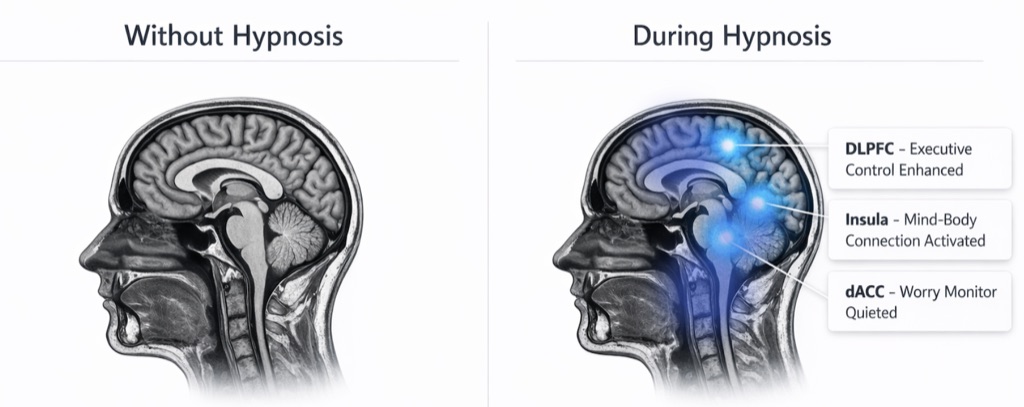
Regions from Stanford fMRI research on hypnosis (Jiang et al., 2017)
What Hypnosis Costs and How to Access It in Canada
When I first looked into hypnotherapy, I braced myself for a price tag that would rival years of therapy. I was surprised to learn that sessions at Calgary Hypnosis Center range from $220 to $350 per session, with a three-session commitment to start. That felt manageable compared to the endless copays and prescription refills I’d been juggling. For a deeper dive into what shapes these costs, I read what hypnotherapy costs in Canada.
I also worried about finding a legitimate practitioner—the Reddit threads were full of warnings about unvetted recordings and stage hypnotists. CHC is fully virtual across Canada, so I could access care from my living room without hunting for a local expert. Knowing my hypnotherapist was a Registered Clinical Hypnotherapist (RCH) through the Association of Registered Clinical Hypnotherapists of Canada (ARCH-Canada) gave me confidence I wasn’t falling for a gimmick.
Many people I talked to online had tried self-hypnosis apps first, only to hit a wall. I learned that working one-on-one with a professional is different—you get a tailored approach that addresses your specific anxiety triggers. If you’re weighing options, the comparison of apps vs working with a hypnotherapist helped me see why the investment was worth it.
Booking was straightforward: a free consultation let me ask all my skeptical questions before committing. I didn’t need a referral, and there were no long-term packages locking me in. For anyone still on the fence, you can book a free consultation with CHC and see if it feels right.
Who It Is a Good Fit For
I used to think hypnotherapy was only for the gullible. Then I met people who walked in just as skeptical as I was—and still walked out with life-changing relief. One person on Reddit said, "I was very skeptical and I had to talk myself into even going that first day," yet their anxiety dropped 80 to 90 percent. That story mirrors what research shows: belief isn't a prerequisite. A 2019 review of 14 studies and 1,926 participants found hypnotherapy effective for smoking cessation, even though many participants likely doubted it (Barnes et al., 2019).
You might be a good fit if you've tried years of failed treatments and feel like anxiety is wired into your bones. Many of our clients come after medication and talk therapy left them stuck. Hypnotherapy works differently—it targets the subconscious patterns that keep the vicious cycle spinning. If you're exhausted from managing symptoms without finding the root cause, this approach can finally break the loop. We often combine it with other strategies for deeper results, as our hypnotherapy for anxiety page explains.
Here are the signals I see in people who respond well:
- You're open to trying something new, even if you're skeptical—doubt doesn't block the process.
- You've felt that traditional therapy only addresses symptoms, not the root cause.
- You experience intense physical symptoms like racing heart, adrenaline surges, or that sense of impending doom.
- You're willing to commit to at least three sessions to give the subconscious time to shift.
- You want to regain the ability to travel, socialize, or leave the house without fear.
Not everyone is ready. If you're looking for a magic wand or expect to surrender your will, this isn't for you. But if you're desperate to feel calm and confident again, hypnotherapy might be the missing piece. As one client put it, "I only wished I had done it sooner and not waited so many years."
Will hypnosis work for you?
Regions from Stanford fMRI research on hypnosis (Jiang et al., 2017)
Who Should Skip It
I won’t pretend hypnotherapy is for everyone. If you’re looking for a quick fix without any effort on your part, this probably isn’t it. Hypnosis isn’t magic—it’s a collaborative process that works best when you’re willing to engage, even if you’re skeptical. Research shows that hypnosis can be effective for many, but it’s not a passive experience where you just show up and get cured.
Some people genuinely can’t be hypnotized, at least not easily. About 10-15% of the population is considered highly hypnotizable, while another 10-15% falls into the low range, according to the American Psychological Association. If you’ve tried multiple times with a qualified professional and felt nothing, it might not be your path. But before you write it off, know that most people fall somewhere in the middle—and even low hypnotizability doesn’t mean zero response.
There are also safety considerations. If you have a history of psychosis or severe dissociation, hypnosis could potentially worsen symptoms. The same goes for certain personality disorders. Always talk to your doctor first. And if you’re not willing to vet a practitioner carefully, you risk stumbling into unethical hands. I’ve written about what to expect in a session and how to stay safe to help you avoid that.
Here’s a quick self-check. If several of these sound like you, hypnotherapy might not be the right fit right now:
- You expect instant, effortless results without active participation
- You’ve tried hypnosis with a trained professional and felt absolutely nothing
- You have untreated psychosis, severe dissociation, or a personality disorder
- You’re unwilling to research and choose a qualified, ethical practitioner
- You’re looking for someone to “fix” you without any self-reflection or change
Will hypnosis work for you?
Regions from Stanford fMRI research on hypnosis (Jiang et al., 2017)
The Subject vs Working with a Hypnotherapist
I used to think self-hypnosis recordings were a safe, private way to test the waters. But after reading about unethical suggestions hidden in unvetted audio—like “you will listen and obey... you are mine”—I realized the risks are real. A 2019 review of 14 studies with 1,926 participants found hypnotherapy popular for smoking cessation, but evidence on effectiveness remains unclear (Barnes et al., 2019). Without a trained guide, you can’t know what’s being planted deep in your subconscious.
Working with a Registered Clinical Hypnotherapist (RCH) changed everything. My hypnotherapist tailored each session to my anxiety, not a generic script. Research shows that in surgical settings, hypnosis provides dramatic evidence for pain and anxiety reduction (Hypnosis Training Academy). I wasn’t just relaxing—I was rewiring the adrenaline response that kept me wired 24/7.
Cost was a concern, but at $220 to $350 per session with a 3-session commitment, it’s comparable to other therapies. More importantly, the structure kept me accountable. A meta-analysis on PTSD symptoms found a large effect size (Cohen’s d = -1.18), suggesting hypnotherapy may help when other treatments fail (Hypnosis Training Academy). For me, that meant finally breaking the vicious cycle.
If you’re weighing hypnotherapy apps vs working with a hypnotherapist, consider this: apps can’t spot when you’re dissociating or guide you through unexpected emotional reactions. I learned that firsthand. For a deeper dive, read about what a hypnotherapy session is like. My advice? Don’t gamble with your mind.
A meta-analysis of hypnotherapy for PTSD symptoms found a large effect size of -1.18, indicating clinically significant improvement. Researchers noted it would take 290 non-significant studies to nullify these findings, underscoring the robustness of professional hypnotherapy.
Source: Hypnosis Training Academy
| Belief Requirement | Many believe you must believe for it to work | CHC works with skeptics—results come from subconscious engagement, not conscious belief |
|---|---|---|
| Scientific Backing | Often seen as placebo or pseudoscience | Backed by meta-analyses and randomized trials showing real therapeutic effects |
| Safety Concerns | Fear of mind control or unethical influence | Sessions with a Registered Clinical Hypnotherapist (RCH) follow strict ethical guidelines and you remain in control |
| Personalization | Generic recordings or scripts may not address your unique anxiety | Each session is tailored to your specific triggers, root causes, and goals |
| Long-Term Relief | May provide temporary relief without addressing underlying patterns | Aims to rewire subconscious patterns for lasting change, often reducing anxiety by 80–90% |
Questions this page answers
Do I have to believe in hypnosis for it to work?
No. Many skeptics report significant anxiety reduction—often 80 to 90 percent—after hypnotherapy. While a cooperative mindset helps, hypnosis can still access your subconscious even if you doubt it. I was skeptical too, but it changed my life.
Can hypnosis be dangerous if you don't believe in it?
Hypnosis itself isn't dangerous, but working with an unethical practitioner or unvetted recordings can be. Always choose a Registered Clinical Hypnotherapist (RCH) who follows a code of ethics. Safety depends on the provider, not your belief.
How does hypnotherapy compare to medication for anxiety?
Hypnotherapy targets root causes in the subconscious, while medication often manages symptoms. Many clients find lasting relief without side effects. Combining both can be effective, but hypnosis offers a drug-free path to retrain automatic fear responses.
Is hypnosis just a placebo?
No. Neuroimaging shows hypnosis creates distinct brain changes, not just relaxation. It's a real therapeutic tool with robust evidence for anxiety, pain, and more. The American Journal of Medicine calls it an underused clinically-studied approach.
Can hypnosis make you do things against your will?
No. Stage hypnosis creates myths, but clinical hypnosis is voluntary. You remain in control and won't accept suggestions that violate your values. A legitimate hypnotherapist helps you, not commands you.
How many sessions are typically needed for anxiety?
Many clients feel significant relief in 3 to 6 sessions. At Calgary Hypnosis Center, we start with a 3-session commitment. Some issues resolve quickly; deeper patterns may need more. We tailor the approach to your progress.
What are the risks of unethical hypnosis recordings?
Unvetted recordings may contain harmful suggestions or reinforce anxiety. Look for creators with proper credentials, transparent methods, and positive reviews. A professional hypnotherapist ensures safety and personalization.
Can hypnosis cure anxiety permanently?
Hypnosis can create lasting change by rewiring subconscious patterns. Many clients report freedom from anxiety years later. However, maintenance sessions or self-hypnosis may help during stressful periods. It's a skill, not a magic switch.
How do I find a legitimate hypnotherapist?
Seek a Registered Clinical Hypnotherapist (RCH) through the Association of Registered Clinical Hypnotherapists of Canada (ARCH-Canada). Check credentials, reviews, and a free consultation. Avoid anyone promising mind control or instant cures.
Is online hypnotherapy as effective as in-person?
Yes. Research shows virtual sessions work well, and Calgary Hypnosis Center serves all of Canada remotely. You get the same personalized care from home, which can reduce anxiety about traveling to an office.
I walked into my first session skeptical, but desperate for change. Hypnosis didn't require my belief—it worked on a level deeper than my doubts. If you're tired of managing anxiety and ready to address the root cause, book a free consultation and see what's possible. Keep reading: How hypnosis actually works · Does it work with aphantasia · Can you be hypnotized against your will
Apply to work with us
We take on just 10 new clients a month. Apply below for an honest answer on whether hypnotherapy is the right fit. No packages, no pressure.
Only 2 spots left for August

Danny M.
Danny M. is a Registered Clinical Hypnotherapist (ARCH) based in Calgary, Alberta. His work focuses on the conditions hypnotherapy has the strongest track record with: anxiety, insomnia, chronic pain, and IBS. Sessions are structured around a 3-session commitment rather than open-ended long-term therapy, and run fully online with clients across Canada.
Last updated: 2026-06-27