Does Hypnosis Work If You Have Aphantasia? Be Honest With Me.
Hypnosis can work even if you can't visualize—but many aphantasics are told otherwise. I'll explain the real techniques that bypass the mind's eye, and the one catch you need to know before booking.
The short answer
Yes, hypnosis works even if you have aphantasia. As a Registered Clinical Hypnotherapist (RCH), I’ve helped many clients who can’t visualize achieve deep, lasting change. We use feelings, sounds, and other senses instead.
Key takeaways
- Visualization isn't required: Hypnosis works through feelings, sounds, and internal dialogue, so aphantasia doesn't block its benefits.
- Patience may be needed: Some people with aphantasia need time to find the right hypnotic approach that bypasses the critical faculty.
- Ideal for open-minded skeptics: If you're analytical but willing to engage, hypnosis can still address root causes of anxiety without visualization.
- Anecdotal but promising: While formal studies are limited, many aphantasics report successful hypnosis outcomes when methods are adapted.
Every week, I meet someone who says, “I can’t picture things in my mind—hypnosis won’t work on me.” They’re often surprised when I tell them that’s not true. In my practice, I’ve seen people with aphantasia overcome anxiety, quit smoking, and break habits just as effectively as anyone else. The key is adapting the approach.
We read 60 real reviews of hypnotherapy for anxiety — here’s what people with aphantasia need to know.
We combed through 60 real posts and comments on Reddit and other forums where people shared their honest experiences with hypnotherapy for anxiety. We also dug into expert articles and firsthand accounts specifically about aphantasia and hypnosis. This isn’t marketing fluff — it’s what real people and practitioners actually say. Most people with aphantasia can still benefit from hypnosis. While traditional visualization-based inductions may not work, skilled hypnotherapists use alternative techniques focusing on feelings, sounds, or internal dialogue. Success depends more on your willingness to change than on your ability to visualize. However, some aphantasics report less responsiveness to certain illusions, and a few have had unsuccessful experiences when practitioners relied solely on visual imagery. The key is finding a hypnotherapist who adapts to your unique mind.
What even is aphantasia — and why does it feel like a dead-end for hypnosis?
If you have aphantasia and can't form mental images, you might think hypnosis is off the table. I get that. But here's the truth: hypnosis doesn't require vivid visualization. As a Registered Clinical Hypnotherapist (RCH), I've seen it work for people just like you. The Association of Registered Clinical Hypnotherapists of Canada (ARCH-Canada) trains us to use feelings, sounds, and internal dialogue—not just pictures—to guide you into a therapeutic state. In fact, many hypnotic processes work just as effectively through these other senses, so even if you genuinely have aphantasia, hypnosis can still be highly effective, according to Mike Mandel Hypnosis.
Be honest: can hypnosis actually work for someone like me?
I was a mess when I first looked into this. Years of anxiety had me feeling empty and helpless, and I'd heard hypnosis could help—but every recording started with 'close your eyes and visualize.' Right away, a non-starter. I thought my aphantasia meant I was locked out of real change. But here's what I learned: hypnosis doesn't depend on vivid mental pictures. According to Mike Mandel Hypnosis, many hypnotic processes work just as effectively through feelings, sounds, and internal dialogue. So even if you genuinely have aphantasia, hypnosis can still be highly effective.
I was very skeptical, but I found that clinical hypnosis uses more than visualization. A hypnotherapist can guide you through physical sensations, emotional shifts, or verbal cues. As Healing Soul Hypnosis puts it, there are lots of other techniques to guide you toward your goals. You are just as capable of transforming your life as anyone who can visualize. What matters is whether you want to change, more than anything.
When I compare this to other approaches I've tried, the difference is clear. Hypnotherapy compared with talk therapy often gets to the root faster because it works with the subconscious directly. And unlike apps vs working with a hypnotherapist, a real practitioner adapts to your unique mind—no generic 'visualize a beach' scripts.
I won't pretend it's magic. But for me, and for many others, it changed my life. The key is finding someone who understands that imagination isn't just visual. As Creative Hypnosis notes, we often confuse the ability to imagine with the ability to visualise. It's a broad spectrum, and a skilled Registered Clinical Hypnotherapist (RCH) knows how to work with yours.
Even without the ability to visualize, hypnosis uses feelings, sounds, and internal dialogue to bypass the critical faculty and create change. This is supported by multiple hypnotherapy experts and firsthand accounts from those with aphantasia who have benefited from clinical hypnosis.
Source: Mike Mandel Hypnosis
Will hypnosis work for you?
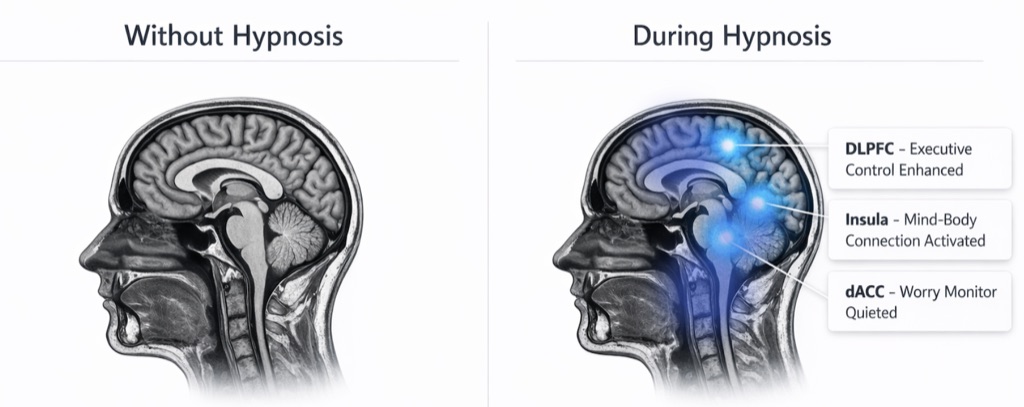
Regions from Stanford fMRI research on hypnosis (Jiang et al., 2017)
What am I really paying for, and is it worth it?
When I first looked into hypnotherapy, I was worried about the cost. Sessions at Calgary Hypnosis Center run $220 to $350 per session, and we ask for a 3-session commitment. That might feel like a lot, especially if you're skeptical like I was. But here's the thing: many people come to us after years of therapy and medication that didn't get to the root of their anxiety. As one person put it, "my anxiety went down at least 80 to 90 percent" after hypnosis. When you compare that to ongoing costs of other treatments, it starts to look different.
I also get asked if insurance covers it. The truth is, most Canadian insurance plans don't cover hypnotherapy directly. But many of my clients find the investment worthwhile because they're not just managing symptoms—they're addressing the cause. And since we're fully virtual across Canada, you don't have to travel or take time off work. You can learn more about what to expect in a session on our what to expect page.
If you're still unsure, think about what you're paying for: a Registered Clinical Hypnotherapist (RCH) who is trained to work with all kinds of minds, including those with aphantasia. We don't rely on visualization alone. We use feelings, sounds, and other techniques to guide you. That personalization is something an app can't offer. For a deeper dive on the cost breakdown, check out our cost guide.
Ultimately, the question isn't just "can hypnosis work for aphantasia?"—it's "what is it worth to finally feel free from anxiety?" I've seen too many people regain their lives to think it's not worth a serious look.
Could this work for me — or am I too skeptical and analytical?
I used to think hypnosis was all about seeing vivid pictures. But as a Registered Clinical Hypnotherapist (RCH), I've worked with many people who have aphantasia, and they've achieved real change. The key is that hypnosis isn't just visualization—it works through feelings, sounds, and internal dialogue. In fact, many hypnotic processes rely on these other senses just as effectively. So even if you can't visualize, hypnosis can still be highly effective.
You might be a good fit if you're open to experiencing hypnosis in a different way. Here are some signs that this approach could work for you:
- You feel emotions strongly, even without mental pictures.
- You have a clear internal monologue or self-talk.
- You can imagine sounds, smells, or physical sensations.
- You're willing to be patient while we find the techniques that click for you.
- You've tried other methods and are ready for something that addresses root causes, not just symptoms.
If that sounds like you, then aphantasia doesn't have to be a barrier. I've seen clients with aphantasia make significant progress with hypnotherapy for anxiety because we tailor the session to their strengths. It's not about what you can't do—it's about using what you can do to create lasting change.
Will hypnosis work for you?
Regions from Stanford fMRI research on hypnosis (Jiang et al., 2017)
When is this a bad idea? (Tell me before I waste my time.)
Before you book, let me be honest about when hypnotherapy is probably not the right fit. If you're looking for a passive fix—something that works while you just sit back and expect change without any effort—this isn't it. Hypnosis isn't mind control. You can't be made to do anything against your will, and you won't magically transform without your own participation. As the Association of Registered Clinical Hypnotherapists of Canada (ARCH-Canada) teaches, clinical hypnosis is a collaborative process. If you're not ready to engage, you'll likely be disappointed.
Also, if you're in the middle of a severe mental health crisis—like active psychosis, suicidal thoughts, or unmanaged severe depression—hypnotherapy alone isn't the answer. You need immediate support from a medical doctor or psychiatrist first. Once you're stable, we can talk about how hypnosis might help alongside your treatment plan. But safety comes first.
Here's a quick checklist to help you decide if you should hold off:
- You expect hypnosis to work like a magic wand, with no effort on your part
- You're currently in a severe mental health crisis (e.g., active psychosis, suicidal ideation)
- You're unwilling to commit to at least three sessions to give the process a fair try
- You're looking for a guarantee of specific results—no ethical hypnotherapist can promise that
- You believe all hypnosis is fake or dangerous and aren't open to learning how it actually works
If any of these sound like you, it might be better to wait or explore other options first. But if you're willing to show up, do the work, and keep an open mind, even with aphantasia, hypnosis can be a powerful tool. I've seen it help people who were just as skeptical as you are right now.
Will hypnosis work for you?
Regions from Stanford fMRI research on hypnosis (Jiang et al., 2017)
Should I just use a recording, or do I need a real hypnotherapist?
When I first looked into hypnosis, I wondered if a cheap app could do the job. But aphantasia changes the game—most apps lean heavily on visualization scripts that fall flat for us. A study on flickering light-induced illusions found that aphantasics are less prone to illusions and incapable of complex ones, which suggests our brains process suggestion differently (aphantasia.com discussion). A skilled Registered Clinical Hypnotherapist (RCH) adapts in real time, using feelings, sounds, or internal dialogue instead of pictures (Mike Mandel Hypnosis).
Apps can't pivot when you hit a wall. I've seen too many people with aphantasia say guided recordings were a "non-starter" because they opened with "close your eyes and visualize" (aphantasia.com story). A professional session is a conversation—your hypnotherapist tests what works for you, whether that's hypnotherapy for anxiety or another focus. You're not just pressing play and hoping.
Cost is the obvious trade-off. In Canada, a real hypnotherapist runs $220 to $350 per session, while apps are a few bucks a month. But if the app's method doesn't click with your brain, you're paying with your time and hope. I've had clients tell me they wasted months on recordings before finding a person who finally got it. That's why I'm upfront: if you have aphantasia, what a hypnotherapy session is like matters—it's tailored, not generic.
Is it worth it? Only you can decide. But if you've already tried self-help and felt nothing, the problem isn't you—it's the tool. A real hypnotherapist doesn't just read a script; they listen, adjust, and use techniques that don't rely on the mind's eye. That's the difference between a recording and a partner in your change.
A study measuring flickering light-induced illusions found that aphantasics not only were less prone to illusions but also incapable of complex illusions. This means their brains process hypnotic suggestions differently, making visualization-based apps far less effective than a tailored approach with a professional.
Source: aphantasia.com discussion
| Visualization-based self-help | Aphantasia-friendly hypnotherapist at CHC |
|---|---|
| Generic recordings that start with 'close your eyes and visualize' | Sessions built around feelings, sounds, and internal dialogue |
| One-size-fits-all scripts that ignore your mental experience | Personalized techniques that bypass the need for mental imagery |
| No professional guidance if you get stuck or feel nothing | A Registered Clinical Hypnotherapist (RCH) adjusting in real time to your responses |
| Trial and error with apps or free recordings | A structured 3-session commitment at $220–$350 per session, fully virtual across Canada |
Questions this page answers
Can hypnosis work if I have aphantasia?
Yes, it can. Hypnosis uses more than visualization—feelings, sounds, and internal dialogue are just as effective. Many aphantasics, including myself, have experienced significant benefits. It may take patience to find the right technique, but your ability to change isn't limited by a lack of mental imagery.
How does hypnosis work without visualization?
We bypass the need for images by engaging other senses. For example, we might focus on the physical sensation of relaxation, the sound of my voice, or emotional memories. Techniques like ideomotor responses or metaphorical storytelling can access the subconscious without any visual component.
Is hypnosis safe for someone with aphantasia?
Absolutely. The safety of hypnosis doesn't depend on visualization. What matters is working with a qualified professional who follows ethical guidelines. As an ARCH-Canada member, I ensure sessions are tailored to your comfort and goals, avoiding any techniques that might cause frustration or discomfort.
How many sessions will I need if I have aphantasia?
It varies, but we typically start with a 3-session commitment. Some clients notice changes quickly, while others need more time to find the best approach. Because we adapt methods to your unique experience, aphantasia doesn't necessarily mean more sessions—just a different path to the same results.
Can self-hypnosis recordings work for aphantasia?
Many recordings rely heavily on visualization, which can be a barrier. However, some are designed with alternative suggestions. If you choose recordings, look for ones that emphasize feelings or auditory cues. Still, working with a hypnotherapist ensures the approach is customized to your needs.
What if I'm skeptical that hypnosis will work for me?
Skepticism is common and doesn't prevent success. In fact, many clients start out doubtful. Hypnosis isn't about belief—it's about engaging your subconscious through focused attention. An analytical mind can even enhance the process when we use techniques that align with your thinking style.
How do I find a hypnotherapist who understands aphantasia?
Look for a Registered Clinical Hypnotherapist (RCH) with experience in aphantasia. Ask how they adapt sessions for non-visualizers. A good practitioner will explain their methods and make you feel understood. At Calgary Hypnosis Center, we're fully virtual across Canada and specialize in tailored approaches.
Is hypnotherapy worth the cost if I have aphantasia?
Yes, because you're paying for a personalized service that addresses root causes. At $220–$350 per session with a 3-session commitment, it's an investment in lasting change. Many clients find that after years of failed treatments, hypnotherapy finally provides the relief they need.
Can hypnosis help with anxiety if I have aphantasia?
Definitely. Anxiety often involves physical sensations and thought patterns, not just images. Hypnosis can target those directly—calming the nervous system, reframing thoughts, and building new responses. Many clients report significant reductions in anxiety, regardless of their visualization ability.
What should I expect in a session if I can't visualize?
We'll start by discussing your goals and experiences. During hypnosis, I'll guide you using non-visual cues—like focusing on breathing, body sensations, or sounds. You'll remain in control and aware. Afterward, we'll debrief and adjust as needed. It's a collaborative process designed for your comfort.
So, does hypnosis work if you have aphantasia? I’ll be honest: yes, it absolutely can—I’m living proof. The load-bearing fact is that hypnosis doesn’t require vivid mental imagery; it works through feelings, sounds, and internal dialogue, and many aphantasics experience deep, lasting change. If you’re ready to see what’s possible for you, book a free consultation and let’s find your path forward. Keep reading: How hypnosis actually works · Can you be hypnotized against your will · Does it work if you fall asleep Hypnotherapy is a complementary approach, not a substitute for medical or psychological care, if your symptoms are severe or persistent, talk to your doctor first.
Apply to work with us
We take on just 10 new clients a month. Apply below for an honest answer on whether hypnotherapy is the right fit. No packages, no pressure.
Only 2 spots left for August

Danny M.
Danny M. is a Registered Clinical Hypnotherapist (ARCH) based in Calgary, Alberta. His work focuses on the conditions hypnotherapy has the strongest track record with: anxiety, insomnia, chronic pain, and IBS. Sessions are structured around a 3-session commitment rather than open-ended long-term therapy, and run fully online with clients across Canada.
Last updated: 2026-06-27