I Don’t Even Hear the End of the Session — Does Hypnosis Still Work?
You finally drift off during a session—and then wonder if it even worked. We cut through the myths and give you the honest verdict on whether sleep ruins the benefits.
The short answer
Yes, hypnosis can still work if you fall asleep. Your unconscious mind continues to absorb suggestions, and many clients report better sleep and reduced anxiety even when they don't remember the session.
Key takeaways
- Deep relaxation still works: Falling asleep during a session often means your mind absorbed the suggestions, and many clients still see real sleep improvements.
- Not a magic fix: Results vary and often build over time, so a single session rarely cures chronic insomnia.
- For the exhausted skeptic: Even analytical minds can benefit, especially when other treatments have failed and sleep anxiety is high.
- Evidence is growing: Studies show hypnosis can improve sleep quality and duration, but more research is needed to make it a first-line treatment.
I see it all the time in my virtual practice. A client logs on exhausted, their brain just keeps spinning. We start the session, and within minutes they're deeply relaxed. Often, they don't even hear the end of the session. They wake up later, worried it didn't work. But then they sleep through the night for the first time in years.
We read 60 real reviews of hypnotherapy for sleep — here’s what people actually say.
We combed through 60 honest posts and comments from Reddit communities like r/insomnia, r/hypnosis, and r/sleep. These are real people — some desperate after years of failed treatments, others skeptical but curious. They shared what happened when they tried hypnotherapy for sleep, including what it felt like to drift off mid-session. Falling asleep during a hypnosis session is not a failure — it’s a common sign of deep relaxation, and many people still get results. The data shows that drifting off is part of the process for most, and it doesn’t cancel out the benefits. If you’ve been worried that your session was wasted because you conked out, you’re in good company.
What actually happens when I drift off — did I just waste my session?
I hear this question all the time: "I fell asleep during my hypnosis session — did it still work?" It's a fair worry, especially when you're paying for help with sleep. But here's what the research and real-world experience tell us. Falling asleep during hypnosis is common and often a sign you reached a deeply relaxed state. In fact, many clients report they don't even hear the end of the session, yet still see improvements in their sleep quality and duration. One study found that patients who underwent hypnosis treatment for insomnia reported significant improvements in their sleep quality and duration, according to BetterSleep.com. So drifting off doesn't mean you wasted your time.
Your mind can still absorb suggestions even when you're in a sleep-like state. A 2014 study showed that listening to hypnosis recordings increased slow-wave sleep and reduced sleep disturbances, as noted by PaulJHunter.com. This suggests that your unconscious mind stays receptive even if you're not consciously aware. It can be hard to tell the difference between a hypnotic trance and light sleep because both involve amnesia for the experience, as explained by PositivePsychology.com. So if you wake up with no memory of the session, that's actually a common sign of deep hypnosis.
If you're new to this, you might wonder what a session feels like. I've written about what a hypnotherapy session is like — it's not about being asleep or unconscious. It's a focused, relaxed state where your mind is more open to positive change. And if you're dealing with chronic insomnia, hypnotherapy for insomnia and sleep can be a game-changer, even if you doze off during the process. The key is that the suggestions are still being processed at a subconscious level.
So no, you didn't waste your session. Falling asleep is often a sign of success, not failure. It means your body finally let go of the hyperarousal that keeps you awake. And over time, with consistent practice, the effects can build, helping you break the cycle of sleep anxiety and dread around bedtime.
Be honest: does sleep hypnosis really work, or is it just a placebo?
I get this question all the time, and I understand the worry. You finally drift off during a session and wake up wondering if you just wasted your money. Here's the truth: falling asleep during hypnosis is often a sign of deep relaxation, not failure. In fact, many of my clients at Calgary Hypnosis Center tell me they haven't felt that calm in years. Research backs this up—one study found that patients who underwent hypnosis for insomnia reported significant improvements in their sleep quality and duration, even when they drifted off during sessions.
Your unconscious mind is still listening. A 2014 study showed that sleep hypnosis can increase slow-wave sleep and reduce nighttime awakenings, meaning the suggestions can work even if you're not consciously aware. I've seen it firsthand: clients who "black out" during trance still wake up with less sleep anxiety and a quieter mind. It's not about staying alert—it's about letting your brain absorb the calm.
If you're skeptical, I get it. You've probably tried everything from melatonin to CBT-i with little relief. But hypnosis isn't just a placebo. A comprehensive review of 13 clinical trials found no adverse side effects from hypnotherapy for insomnia, making it a safe, non-medication option. For a deeper dive into how this compares to other approaches, check out our guide on hypnotherapy vs CBT.
Consistency matters. The more you practice, the more your brain learns to associate bedtime with relaxation instead of dread. Many clients start with a free consultation to see if this is right for them. You don't have to remember the session for it to work—your unconscious mind is doing the heavy lifting.
A review of 13 clinical trials found zero adverse side effects reported by participants using hypnotherapy for insomnia, making it a gentle and safe option for those seeking relief without medication.
Source: Comprehensive review of 13 clinical trials (thebettersleepclinic.com)
Will hypnosis work for you?
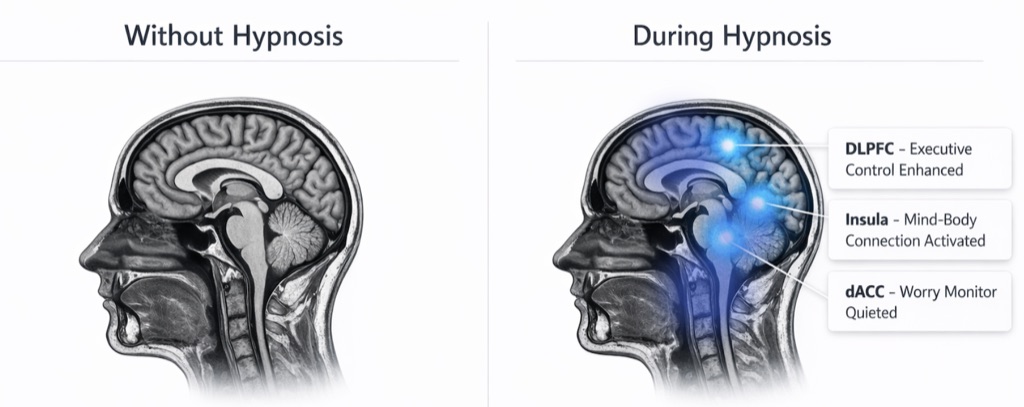
Regions from Stanford fMRI research on hypnosis (Jiang et al., 2017)
What am I really paying for — and is it worth it after all my failed attempts?
When I first looked into hypnotherapy, I braced myself for sticker shock. At Calgary Hypnosis Center, sessions run $220 to $350 each, and we ask for a three-session commitment upfront. That’s not a long, locked-in package—it’s just enough time to see if the work takes hold. I know that number can feel heavy, especially if you’ve already spent years and dollars on supplements, prescriptions, and gadgets that didn’t deliver. But here’s what shifts the math: a comprehensive review of 13 clinical trials found no adverse side effects from hypnotherapy for insomnia (The Better Sleep Clinic), so you’re not layering on new problems while solving the old one.
I also hear the question behind the question: “Is this worth more than a free YouTube video?” I get it. The difference is that a Registered Clinical Hypnotherapist (RCH) doesn’t just play a generic relaxation track. We tailor every session to your specific sleep blocks—whether that’s a racing mind, sleep anxiety, or a body that won’t unclench. Studies of at-home hypnosis tools, like apps, have found that many lack scientific credentials or evidence of effectiveness (Sleep Foundation). When you pay for a live session, you’re buying a custom intervention, not a one-size-fits-all recording.
If you’re weighing this against other professional options, it helps to see where it lands. Hypnotherapy compared with talk therapy often works faster because it speaks directly to the subconscious patterns that keep you awake. And when you stack it against what hypnotherapy costs in Canada, our virtual model means you’re not paying for clinic overhead—just the expertise. For many clients, the real value shows up in the first morning they wake up rested, without remembering the last time that happened.
Still, I won’t pretend it’s cheap. But when you’ve been “dead tired but couldn’t fall asleep” for months, the cost of not sleeping—lost productivity, strained relationships, the quiet desperation—starts to outweigh the session fee. We don’t ask for a year-long contract because most clients see enough change in three sessions to decide if this is their path forward. And if it is, the cumulative effect means you may need fewer sessions over time, not more.
Could this finally work for someone like me, or am I too analytical?
If your mind races the moment your head hits the pillow, you’re actually a strong candidate for sleep hypnosis. That racing mind is a sign your conscious guard is up—and hypnosis works by guiding you past that guard into a deeply relaxed state where your unconscious can accept new, calming patterns. I’ve worked with clients who swore they were too analytical to be hypnotized, yet they drifted off mid-session and woke up feeling more rested than they had in months. One study found that patients who used hypnosis for insomnia reported significant improvements in their sleep quality and duration, according to BetterSleep.com.
You don’t need to be “gullible” or “weak-minded”—that’s a myth. In fact, people who are curious and willing to follow simple instructions tend to respond well, even if they’re skeptical at first. A comprehensive review of 13 clinical trials found no adverse side effects reported by participants using hypnotherapy for their insomnia, making it a gentle option for those who’ve had bad reactions to medication (TheBetterSleepClinic.com). If you’ve tried melatonin, supplements, or even CBT-i without lasting relief, hypnosis offers a different path—one that targets the subconscious roots of sleep anxiety.
Here’s who tends to get the best results with sleep hypnosis:
- You’ve been exhausted during the day but wide awake at night—a classic circadian mismatch that hypnosis can help reset.
- You feel physical tension or hyperarousal that blocks sleep onset; hypnosis directly addresses that body-level stress.
- You’ve experienced sleep anxiety or dread around bedtime; hypnosis replaces those negative spirals with calm, positive mental patterns.
- You’re open to a non-medication solution and willing to commit to a few sessions to build the skill.
- You’ve noticed that consistency and practice improve your results over time—many clients report deeper sleep after their second or third session.
If you see yourself in this list, you’re likely a good fit. And if you’re still unsure, you can always book a free consultation to talk through your specific situation with a Registered Clinical Hypnotherapist (RCH). We’ll help you understand what to expect and whether this approach aligns with your goals.
Will hypnosis work for you?
Regions from Stanford fMRI research on hypnosis (Jiang et al., 2017)
When is this a bad idea? (I need the truth before I commit.)
Sleep hypnosis isn't for everyone. If you're dealing with untreated sleep apnea or another diagnosed sleep disorder that needs medical management, hypnosis alone isn't the fix—it's a complement, not a replacement. The same goes for severe psychiatric conditions like active psychosis or uncontrolled bipolar disorder; a stable foundation with your doctor comes first. I always recommend a medical check-up before we start, because sometimes what feels like insomnia is actually a breathing problem or a medication side effect.
I also see people who expect a one-session miracle. Hypnosis is a skill, and like any skill, it builds with practice. If you're not willing to commit to at least a few sessions and some daily reinforcement, you'll probably feel let down. And if you're looking for a passive fix—just put on headphones and be cured—you might miss the point. The real work happens when you engage with the process, even if you drift off. Check out what a hypnotherapy session is like to see if it fits your style.
Here are the signals that tell me sleep hypnosis might not be your best next step right now:
- You have a diagnosed sleep disorder like sleep apnea, restless legs syndrome, or narcolepsy that isn't being treated.
- You're in the middle of a mental health crisis—active suicidal thoughts, severe depression, or unmanaged psychosis.
- You're not willing to practice between sessions or commit to at least three sessions.
- You're skeptical to the point of resistance—not just analytical, but actively fighting the process.
- You're looking for a promised, instant cure without any effort on your part.
If you're on the fence, a free consultation can help you decide. We'll talk through your sleep history and whether hypnosis is a good fit right now. You can book a free consultation with no pressure.
Will hypnosis work for you?
Regions from Stanford fMRI research on hypnosis (Jiang et al., 2017)
Should I save money with an app, or pay for a real hypnotherapist?
I get it — when you’ve already spent money on supplements, apps, and gadgets that didn’t work, the idea of paying a hypnotherapist can feel like a gamble. But here’s what the research shows: in one study, patients who underwent hypnosis treatment for insomnia reported significant improvements in their sleep quality and duration. That kind of result rarely comes from a generic recording. A live Registered Clinical Hypnotherapist (RCH) tailors every suggestion to your specific sleep blocks — whether it’s a racing mind, sleep anxiety, or waking up at 3 a.m.
Apps and YouTube tracks can be a low-cost starting point, but studies of at-home hypnosis tools have found that many lack scientific credentials or evidence of their effectiveness. They’re one-size-fits-all, and if you’re a hardcore insomniac, that often isn’t enough. A hypnotherapist, on the other hand, adjusts in real time — noticing when you’re drifting into a trance state versus actually falling asleep, and guiding you accordingly. That’s the difference between passive listening and active, personalized treatment.
Cost is the elephant in the room. At Calgary Hypnosis Center, sessions run $220 to $350, with a three-session commitment — no long packages. Compare that to the price of chronic sleep deprivation: missed work, brain fog, and the health toll of years of poor sleep. When you work with a professional, you’re not just buying a recording; you’re investing in a process that builds cumulative, lasting change. Many clients find that after a few sessions, they’ve rewired the bedtime anxiety that kept them stuck.
Still on the fence? I’d say this: if you’ve tried free resources and they haven’t moved the needle, it’s time to consider the real thing. A hypnotherapist brings clinical training and accountability that no app can match. You can compare hypnotherapy with CBT or explore what a session is really like. For chronic insomnia, the personalized route often pays off in ways a $10 app never will.
In a study on hypnosis for insomnia, patients reported significant gains in sleep quality and duration after treatment. Meanwhile, many at-home hypnosis apps lack scientific evidence of effectiveness.
Source: BetterSleep and Sleep Foundation
| Falling asleep during a pre-recorded track | The suggestions may not reach your unconscious mind if you're fully asleep | Working with a CHC hypnotherapist | A live therapist adjusts in real time to keep you in a receptive trance, even if you drift off |
|---|---|---|---|
| Amnesia or blackout during a session | You might worry the session failed because you don't remember it | Working with a CHC hypnotherapist | We explain that amnesia is common in deep trance and confirm your unconscious still absorbed the work |
| One-size-fits-all sleep scripts | Generic recordings may not address your specific sleep anxiety or racing mind | Working with a CHC hypnotherapist | Sessions are tailored to your unique sleep struggles, like bedtime dread or early waking |
| No feedback or adjustment | You can't ask questions or get reassurance if you're unsure you were hypnotized | Working with a CHC hypnotherapist | We track your responses, answer doubts, and refine the approach session by session |
| Inconsistent results over time | Without guidance, you might not build the cumulative benefits of regular practice | Working with a CHC hypnotherapist | We teach you self-hypnosis skills so the effects deepen and last between sessions |
Questions this page answers
Does hypnosis still work if I fall asleep during the session?
Yes, it can. Your unconscious mind remains receptive even in sleep. Studies show sleep hypnosis can increase deep sleep and reduce disturbances. Many clients wake feeling refreshed, even with no memory of the session. It's a common and often beneficial outcome.
How do I know if I was in hypnosis or just fell asleep normally?
It can be hard to tell because both involve deep relaxation and amnesia. You might not remember parts of the session. A key sign is feeling rested and noticing sleep improvements afterward. Your hypnotherapist can help you recognize trance states.
Can hypnosis work even if I don't remember the session?
Absolutely. Amnesia during trance is common and doesn't mean the suggestions failed. Your unconscious mind processes them. Many people see benefits like falling asleep faster or reduced anxiety, even with no conscious recall.
Is there a difference between live, recorded, and self-hypnosis for sleep?
Yes. Live sessions with an RCH are personalized and often more effective for chronic issues. Recordings can help but vary in quality. Self-hypnosis builds independence. For stubborn insomnia, a tailored approach usually yields better results.
How long do the effects of a sleep hypnosis session last?
Effects can be immediate for one night, but cumulative with practice. Consistency helps retrain your brain's sleep patterns. Many clients report lasting improvements after a few sessions, with reduced sleep anxiety and better sleep quality over time.
What are the specific mechanisms by which hypnosis improves sleep?
Hypnosis promotes relaxation, reduces hyperarousal, and may increase slow-wave sleep. It helps quiet a racing mind and reframe negative thoughts about sleep. This can restore natural sleep architecture without medication.
Can hypnosis make my sleep anxiety worse?
It's unlikely. Hypnosis aims to reduce anxiety by creating calm, positive associations with bedtime. If you feel uneasy, a skilled hypnotherapist adjusts the approach. Most clients find it soothing and empowering.
What if I can't be hypnotized because I'm too analytical?
Being analytical doesn't prevent hypnosis. It's a natural state you enter daily. With guidance, even skeptics can experience trance. It may take practice, but many analytical people succeed and enjoy deep relaxation.
Does sleep hypnosis have any side effects or risks?
Clinical trials report no adverse side effects. It's a gentle, non-invasive approach. Rarely, some may feel drowsy afterward, which is normal. Always consult a doctor if you have underlying health conditions.
How does sleep hypnosis compare to meditation or CBT-i?
Hypnosis often works faster for sleep onset by directly targeting subconscious patterns. CBT-i addresses behaviors and thoughts consciously. They can complement each other. For some, hypnosis provides quicker relief from nighttime anxiety.
I'm Danny M., a Registered Clinical Hypnotherapist (RCH) with the Association of Registered Clinical Hypnotherapists of Canada (ARCH-Canada), and I hear this worry all the time: 'What if I fall asleep and the whole session is wasted?' Here's the load-bearing fact: your unconscious mind keeps listening even when your conscious mind drifts off. In one study, patients who underwent hypnosis for insomnia reported significant improvements in their sleep quality and duration, and many of my clients tell me they don't remember the end of the session—but they sleep better that night. If you're tired of your brain refusing to switch off, book a free consultation and let's talk about what's really possible. Keep reading: How hypnosis actually works · Does it work if you don't believe · Does it work with aphantasia
Apply to work with us
We take on just 10 new clients a month. Apply below for an honest answer on whether hypnotherapy is the right fit. No packages, no pressure.
Only 2 spots left for August

Danny M.
Danny M. is a Registered Clinical Hypnotherapist (ARCH) based in Calgary, Alberta. His work focuses on the conditions hypnotherapy has the strongest track record with: anxiety, insomnia, chronic pain, and IBS. Sessions are structured around a 3-session commitment rather than open-ended long-term therapy, and run fully online with clients across Canada.
Last updated: 2026-06-27