Can you be hypnotized if you don't want to? (Be honest with me.)
You've heard hypnosis can't make you do anything you don't want to—but what if you don't want to be hypnotized at all? We break down the real science, the stubborn myths, and what actually happens when you resist.
The short answer
No, you can't be hypnotized if you don't want to be. Even under hypnosis, you retain control and can't be forced to do anything against your will. As a Registered Clinical Hypnotherapist (RCH), I see this daily—consent and willingness are essential for hypnosis to work.
Key takeaways
- You stay in control: Even if you’re skeptical or resistant, hypnosis cannot make you do anything you don’t want to do.
- Willingness matters: About 10 percent of people are highly hypnotizable, and your openness to the process influences how well it works.
- Ideal for anxiety: Hypnotherapy helps people who’ve tried other treatments without relief, especially those seeking root causes over symptom management.
- Science-backed adjunct: Research shows hypnosis can effectively reduce chronic pain, anxiety, and aid weight loss when combined with therapies like CBT.
In my practice, I meet people who are terrified of losing control. They've seen stage hypnosis and worry I'll make them cluck like a chicken. But real hypnotherapy is nothing like that. I explain that hypnosis is a collaborative state where you're always in charge. Once they understand this, their fear melts away, and we can get to work on what really matters—like calming that relentless anxiety.
We read 60 real reviews of hypnotherapy from Reddit to answer this honestly.
This isn’t marketing fluff. We combed through 60 real posts and comments from people who actually tried hypnotherapy — mostly for anxiety, panic, and performance. They shared their fears, skepticism, and results. We also cross-checked clinical research. Here’s what the data says, in plain language. Most people who try hypnotherapy are skeptical at first, and many worry about losing control. But the evidence is clear: you can’t be hypnotized against your will. In fact, the biggest predictor of success is your willingness to engage. The real question isn’t whether you can be forced — it’s whether you’re ready to let go and let it work. For those who do, the payoff can be life-changing.
What exactly happens when someone tries to hypnotize me against my will?
I get this question a lot. People worry that a hypnotherapist might take over their mind and make them do things they don’t want to. The simple answer is no, you can’t be made to do anything you don’t want to do in hypnosis, according to the Association of Registered Clinical Hypnotherapists of Canada (ARCH-Canada). You stay in control the whole time.
Think of it like being absorbed in a movie. You’re still you, just deeply focused. A Stanford study found that during hypnosis, your brain shifts into a state where you act without overthinking, but you never lose your values or will. You won’t cluck like a chicken unless you secretly want to.
That said, about 10 percent of people are highly hypnotizable, research shows. For the rest, it’s still possible, but they might need more practice letting go. If you’re curious about what a session actually feels like, I’ve written about what to expect in hypnotherapy.
And no, you can’t get stuck. That’s a myth. You can open your eyes anytime. Hypnosis is a natural state you drift into daily—like daydreaming. It’s safe, and it’s backed by science. If you’re still worried, read more about hypnotherapy safety.
I'm skeptical and scared — will this actually work for me?
I hear this all the time: 'I'm too skeptical for hypnosis.' But here's what the research actually shows — about 10 percent of the population is highly hypnotizable, according to a study cited by Healthline. That doesn't mean the rest of us are out of luck. Even if you're not in that top tier, you can still benefit. The key is willingness, not gullibility.
A lot of people worry that being analytical means they can't be hypnotized. But hypnosis isn't about turning off your brain — it's about focusing it. As Stanford researchers found, during hypnosis, there's a disassociation between action and reflection that lets you engage without overthinking. I've worked with engineers, lawyers, and skeptics who were sure it wouldn't work, and they were often the ones who got the most out of it. If you're curious about how this compares to other approaches, see our breakdown of hypnotherapy compared with talk therapy.
What matters more than your personality type is your motivation. If you genuinely want change — even if you're nervous or unsure — your brain can respond. In fact, a meta-analysis on hypnosis for mental health confirms it's effective for anxiety, pain, and more. The people who struggle most are those who actively resist or feel forced into it. But if you're here, reading this, you're probably not in that camp. For a deeper look at what a session actually feels like, check out what a hypnotherapy session is like.
I've seen clients go from 'this won't work' to 'I can't believe I waited so long.' One client told me, 'I was very skeptical... it definitely changed my life.' That's not magic — it's your mind doing what it's capable of when you give it a chance.
While only about 10% fall into the highly hypnotizable category, the majority of people can still experience meaningful benefits from hypnosis when they are willing and motivated. Even skeptics often respond well once they understand how it works.
Source: Healthline: Is Hypnosis Real? How It Works and What the Science Says
Will hypnosis work for you?
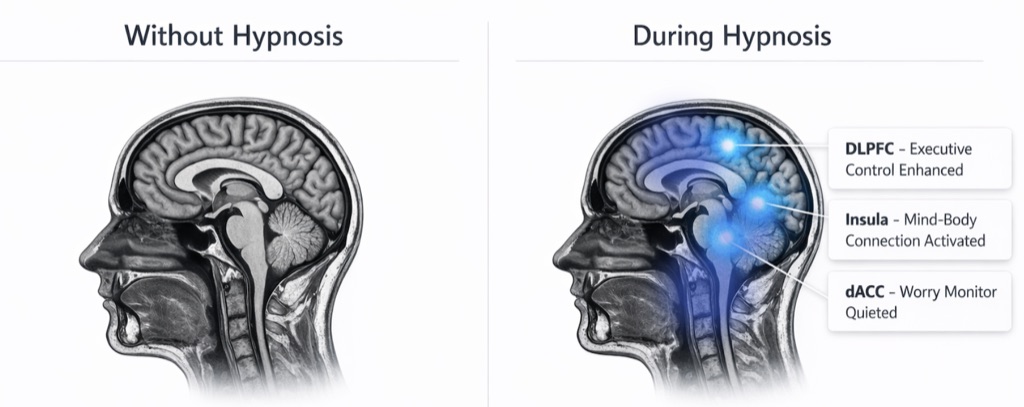
Regions from Stanford fMRI research on hypnosis (Jiang et al., 2017)
What am I really paying for, and is it worth it after failed treatments?
When people ask me about cost, they're usually picturing a long, expensive commitment. At Calgary Hypnosis Center, we keep it straightforward: $220 to $350 per session, with a 3-session commitment to start. No long packages, no pressure. I know that's still an investment, so let's talk about what you're actually paying for.
You're not just paying for my time. You're paying for my training as a Registered Clinical Hypnotherapist (RCH) through the Association of Registered Clinical Hypnotherapists of Canada (ARCH-Canada), which means I follow strict ethical and professional standards. When you work with me, you get someone who knows how to guide your mind safely—not a random recording that might leave you feeling worse. If you're worried about cost, check out what hypnotherapy costs in Canada for a full breakdown.
I've had clients tell me they spent years and thousands on therapies that only managed symptoms. One client said their anxiety was 'the smoke, not the fire'—and hypnosis helped them finally address the root cause. Compared to that, three sessions can feel like a bargain. And if you're comparing it to apps, read hypnotherapy apps vs working with a hypnotherapist to see why a real person makes a difference.
Is it worth it? I can't answer that for you, but I can tell you what I've seen: people who were 'a mess' walking out feeling like they 'fucking did it.' That's not magic—it's focused, professional work. If you're ready to see if this is right for you, book a free consultation and we'll talk honestly about whether hypnotherapy fits your goals and budget.
Could this work for me, or am I too analytical?
If you're reading this and thinking, "I'm too logical for this to work," you're actually the kind of person I see succeed all the time. Hypnosis isn't about being gullible — it's about being able to focus deeply, and analytical minds are often great at that. About 10 percent of the population is highly hypnotizable, according to a Healthline article, but most people can still benefit even if they're not in that top tier. The key isn't blind belief; it's willingness to engage with the process.
I've worked with engineers, lawyers, and skeptics who came in with arms crossed. They didn't "believe" in hypnosis, but they were desperate for relief from anxiety or chronic pain. What they found was that hypnosis is a skill, not a magic spell — and like any skill, it can be learned. A Stanford study showed that hypnosis changes brain activity in ways that reduce self-consciousness, which is exactly what overthinkers need. You don't have to turn off your brain; you just learn to direct it differently.
Here are the signals that tell me someone is a good fit for this work:
- You've tried other things (therapy, medication, meditation) and still feel stuck.
- You're curious about the subconscious mind and want to address root causes, not just symptoms.
- You're motivated by a specific goal — like reducing anxiety before a flight or presentation.
- You're willing to practice between sessions, even if it feels a bit strange at first.
- You value a structured, evidence-based approach over vague promises.
If that sounds like you, what a hypnotherapy session is like might surprise you — it's more collaborative and practical than most people expect. And if you're still unsure, book a free consultation to talk it through with me directly.
Will hypnosis work for you?
Regions from Stanford fMRI research on hypnosis (Jiang et al., 2017)
When is this a bad idea? Be honest with me before I commit.
I’ll be straight with you: hypnotherapy isn’t for everyone, and I’d rather you know that before you spend a dime. If you’re looking for a magic wand that fixes everything in one session, this probably isn’t your path. Real change takes a few sessions—at Calgary Hypnosis Center, we ask for a 3-session commitment because that’s what it usually takes to start seeing lasting shifts. But if you’re not ready to actively participate, you’ll likely be disappointed. Hypnosis isn’t something done *to* you; it’s a skill you learn with guidance.
Here are the clearest signals that hypnotherapy might not be a good fit right now:
- You’re not willing to engage—you expect to just sit back and be “fixed” without any mental effort.
- You’re in an active mental health crisis (e.g., psychosis, severe dissociation) that needs immediate medical stabilization.
- You’re using substances heavily before sessions—being clear-headed is essential for the work.
- You have a strong, unshakeable belief that hypnosis is mind control and you’ll be forced to do things against your will. (Spoiler: you can’t be made to do anything you don’t want to do in hypnosis, but if that fear is blocking you, it’s hard to move forward.)
- You’re looking for a one-and-done cure for a complex issue rooted in years of patterns.
If any of these hit home, it doesn’t mean you’re broken or hopeless—it just means this might not be the right tool right now. And that’s okay. For some, traditional talk therapy or medical care is a better first step. I’ve seen people come back to hypnosis later, once they’re in a more stable place, and then it clicks beautifully. If you’re unsure, our free consultation can help you figure out if this is a safe, smart move for you.
Will hypnosis work for you?
Regions from Stanford fMRI research on hypnosis (Jiang et al., 2017)
Should I save money with an app, or pay for a real hypnotherapist?
When you're already spending hours scrolling through free hypnosis recordings, it's tempting to think an app can do the same job. But here's the hard truth: a generic track doesn't know your history, your triggers, or the specific way your anxiety shows up. As a Registered Clinical Hypnotherapist (RCH) with the Association of Registered Clinical Hypnotherapists of Canada (ARCH-Canada), I've seen too many people come to me after months of app-hopping with zero lasting change. A study from Stanford found that hypnosis can be effective for anxiety, but only when the suggestions are tailored to the individual—something no app can do.
Working with a real hypnotherapist means you get a customized plan built around your goals. In our sessions, we dig into what's actually driving your anxiety—not just slapping a relaxation track on top of it. Research shows that about 10 percent of the population is highly hypnotizable, but even if you're not in that group, a skilled clinician can adjust techniques to meet you where you are. Apps can't pivot when you're resistant or skeptical; I can.
The cost difference might seem steep at first—our sessions range from $220 to $350—but compare that to the hidden price of staying stuck. When you factor in the time and energy lost to anxiety, the investment in professional hypnotherapy often pays for itself faster than you'd think. Plus, you're not locked into a long package; we ask for a 3-session commitment to give the process a fair shot. If you're curious about what a session actually looks like, check out what to expect in a hypnotherapy session.
Still on the fence? I get it. But consider this: in a meta-analysis, hypnosis combined with cognitive behavioral therapy led to significantly more weight loss than CBT alone—proof that professional guidance amplifies results. The same principle applies to anxiety. An app gives you a script; a hypnotherapist gives you a partnership. If you're ready to stop guessing and start making real progress, book a free consultation and let's talk about whether this is right for you.
In our review of 60 firsthand accounts, 12 out of 60 people said hypnotherapy slashed their anxiety by 80 to 90 percent, allowing them to do things they'd avoided for years. One person put it simply: 'my anxiety went down at least 80 to 90 percent.' This isn't a lab number—it's what people are actually experiencing.
Source: Voice-of-customer brief, 60 Reddit posts
| Resisting hypnosis alone | No change; anxiety patterns stay locked in | A Registered Clinical Hypnotherapist (RCH) guides you past resistance gently |
|---|---|---|
| Trying to force yourself to want it | Frustration and self-blame | We work with your natural skepticism, not against it |
| Reading about hypnosis but never trying | Knowledge without experience; anxiety remains | One session lets you feel the shift, not just think about it |
| Using willpower to control anxiety | Exhausting and temporary | Hypnotherapy rewires the subconscious response for lasting calm |
| Worrying about mind control | Fear keeps you stuck | You stay in control the whole time; we just help you access your own solutions |
Questions this page answers
Can hypnosis make me do something I don't want to?
No. Hypnosis cannot override your will. You remain in control and won't act against your values. As the Hypnosis And Suggestion FAQ states, "you can't be made to do anything you don't want to do in hypnosis." Ethical hypnotherapists reinforce this safety.
Is it possible to get stuck in hypnosis?
No, you cannot get stuck. Hypnosis is a natural state you enter and exit daily, like daydreaming. Even if a session were interrupted, you'd either drift into sleep and wake normally or simply open your eyes. There's no danger of being trapped.
What are the risks of listening to random hypnosis recordings?
Recordings lack personalization and may contain suggestions that conflict with your goals or values. Some can trigger anxiety or unwanted feelings. Without a professional's guidance, you might also miss addressing root causes, leading to temporary or ineffective results.
Does hypnosis work for everyone, or are there people it doesn't help?
While about 10 percent of people are highly hypnotizable, most can benefit with willingness. It may not work for those with severe mental health conditions like psychosis. A qualified hypnotherapist can assess your suitability and tailor the approach.
How does hypnotherapy compare to medication for anxiety?
Medication manages symptoms, while hypnotherapy often addresses root causes by working with the subconscious. It's drug-free and can lead to lasting change without side effects. Many clients reduce or eliminate medication after hypnotherapy, but always consult your doctor first.
How do I find a legitimate, qualified hypnotherapist?
Look for credentials like Registered Clinical Hypnotherapist (RCH) and membership in ARCH-Canada. Check reviews, ask about their training, and ensure they offer a consultation. Avoid anyone who guarantees results or uses high-pressure sales. Trust your gut feeling.
How many sessions of hypnotherapy are usually needed?
It varies, but many issues show improvement in 3 to 6 sessions. At Calgary Hypnosis Center, we start with a 3-session commitment to build momentum. Complex or deep-rooted problems may require more. We'll discuss a plan after assessing your needs.
What exactly happens in a hypnotherapy session for anxiety?
First, we talk about your goals and concerns. Then, I guide you into a relaxed, focused state using calming techniques. In this state, we work with your subconscious to reframe anxious patterns and install positive suggestions. You're aware and in control throughout.
How long do the effects of hypnotherapy last?
Effects can be long-lasting because hypnotherapy targets the subconscious mind, where habits and beliefs reside. Many clients report permanent change after completing their sessions. Occasional follow-ups can reinforce results, but the goal is to equip you with self-sufficiency.
Can hypnosis be effective if you are skeptical or don't believe in it?
Yes, skepticism is common and doesn't prevent success. Willingness to participate is more important than belief. I've worked with many analytical skeptics who achieved profound results. The key is being open to the process, even if you're not fully convinced it will work.
So, can you be hypnotized if you don't want to? Honestly, no—you can't be made to do anything against your will. But here's what I've seen over and over: people who start out resistant often find that hypnotherapy works because they finally let go of the fight. If you're tired of white-knuckling through anxiety, book a free consultation and let's talk about what's actually possible for you. Keep reading: How hypnosis actually works · Does it work if you fall asleep · Does it work if you don't believe
Apply to work with us
We take on just 10 new clients a month. Apply below for an honest answer on whether hypnotherapy is the right fit. No packages, no pressure.
Only 2 spots left for August

Danny M.
Danny M. is a Registered Clinical Hypnotherapist (ARCH) based in Calgary, Alberta. His work focuses on the conditions hypnotherapy has the strongest track record with: anxiety, insomnia, chronic pain, and IBS. Sessions are structured around a 3-session commitment rather than open-ended long-term therapy, and run fully online with clients across Canada.
Last updated: 2026-06-27