I Was a Slave to My Vape—Hypnotherapy Helped Me Quit for Good
Hypnotherapy promises to rewire the subconscious patterns that keep you reaching for your vape. But it’s not a magic wand—your own commitment is the real engine. Here’s what the research and real people say about whether it can actually set you free.
The short answer
Yes, hypnotherapy can help you quit vaping by addressing both the psychological habit and the emotional triggers. While research on vaping specifically is limited, studies on smoking cessation show hypnotherapy can be more effective than willpower alone or nicotine replacement therapy.
Key takeaways
- Rapid, profound change: Hypnotherapy can lead to rapid and profound change, sometimes in just a few sessions, by addressing the subconscious drivers of vaping.
- Not a magic bullet: Success depends on your genuine desire and commitment to quit; hypnotherapy supports but doesn't force change.
- For the committed: It's ideal for those who have tried other methods and are ready to retrain their mindset and break the addiction cycle.
- Mixed research evidence: Some studies show hypnotherapy outperforms nicotine replacement therapy, but overall evidence for long-term smoking cessation is inconsistent.
I see it every week: someone logs into their virtual session, exhausted from trying to quit vaping. They've tried patches, gum, cold turkey—nothing stuck. They feel like a slave to the device. When they come to me, they're often skeptical but desperate. And many leave surprised by how quickly the cravings fade.
We read 60 real reviews of people who tried hypnotherapy to quit vaping.
We combed through 60 honest posts and comments from Reddit communities like r/quitvaping, r/hypnosis, and r/stopsmoking. These are real people sharing raw, unfiltered experiences—what worked, what didn’t, and how hypnotherapy actually felt. No marketing fluff, just real talk. The data shows that hypnotherapy can lead to rapid and profound change, often in just a few sessions, but it’s not a magic bullet. Success hinges on genuine desire and commitment, and many skeptics were surprised by positive results. While some experienced immediate craving relief, others found it supported but didn’t force change. Overall, it’s a powerful tool for those ready to break free, but it requires personal effort and the right mindset.
I feel like a slave to my vape — what exactly is hypnotherapy?
When you say you feel like a slave to your vape, you're describing something I hear every day. That constant pull toward the next hit isn't a character flaw—it's a deeply ingrained pattern in your subconscious mind. Hypnotherapy is a clinical tool that helps you access that part of your brain directly, so you can retrain the automatic urges that keep you reaching for the device. As a Registered Clinical Hypnotherapist (RCH) with the Association of Registered Clinical Hypnotherapists of Canada (ARCH-Canada), I guide you into a focused, relaxed state where your mind becomes more open to positive suggestion, allowing you to rewrite the scripts that drive the habit.
Unlike willpower alone, which often leaves you fighting cravings all day, hypnotherapy works beneath the surface. A meta-analysis in the *International Journal of Clinical and Experimental Hypnosis* found hypnotherapy significantly more effective than no treatment for smoking cessation, with several studies showing it outperformed willpower-based approaches. While vaping-specific research is still emerging, the mechanism is the same: we address the subconscious beliefs and emotional triggers that make quitting feel impossible. You can learn more about how this compares to other approaches in our guide on hypnotherapy compared with CBT.
During a session, you're not asleep or out of control—you're in a state of focused attention with an intention, fully aware and always in charge. I use tailored suggestions to help your mind uncouple vaping from the cues that trigger it, whether that's stress, boredom, or social situations. This isn't about forcing you to stop; it's about aligning your subconscious with the decision you've already made to be free. If you're curious what a session actually feels like, read what a hypnotherapy session is like.
Many clients tell me they've tried everything—patches, gum, cold turkey—and still felt trapped. Hypnotherapy offers a different path by targeting the root of the addiction, not just the nicotine. It's not a magic bullet, but when you're genuinely committed, it can create rapid and profound change, sometimes in just a few sessions.
I've tried everything — does hypnotherapy really work for vaping?
<p>I get asked this every week: "Does hypnotherapy actually work for quitting vaping?" The honest answer is that the research on smoking cessation—the closest proxy we have—shows hypnotherapy can be significantly more effective than willpower alone. A meta-analysis in the <em>International Journal of Clinical and Experimental Hypnosis</em> found hypnotherapy outperformed no-treatment controls, with some studies showing it beat willpower-based approaches. That said, a 2024 randomized trial in <em>Frontiers in Psychology</em> suggested cognitive-behavioral therapy (CBT) may be superior to hypnotherapy in long-term abstinence when hypnotic suggestibility is considered, so it's not a one-size-fits-all fix.</p><p>What I've seen in my own practice at Calgary Hypnosis Center aligns with the real-world experiences shared on forums like r/quitvaping: many clients report a rapid drop in cravings, sometimes after just a few sessions. One study even found hypnotherapy more effective than nicotine replacement therapy (NRT) for behavioral change and quit rates. But here's the catch—success isn't automatic. As the <em>National Council for Hypnotherapy</em> notes, quit rates rise significantly for those who engage in hypnotherapy compared to standard treatments alone, but it still requires your genuine commitment. If you're curious how it stacks up against other methods, check out our comparison of hypnotherapy vs CBT.</p><p>I won't sugarcoat it: a Cochrane review concluded there's no clear evidence that hypnotherapy is more effective in the long term than no treatment or other interventions. That might sound discouraging, but it reflects the complexity of addiction. In my experience, hypnotherapy works best when it's part of a broader quit strategy, not a magic bullet. For a deeper dive into what a session actually feels like, read what to expect in hypnotherapy.</p>
A randomized controlled trial published in ScienceDirect found hypnotherapy significantly more effective than nicotine replacement therapy in enhancing behavioral modification and increasing smoking cessation rates. This suggests hypnotherapy could be a powerful tool for those struggling with vaping addiction.
Source: ScienceDirect, 2014
Will hypnosis work for you?
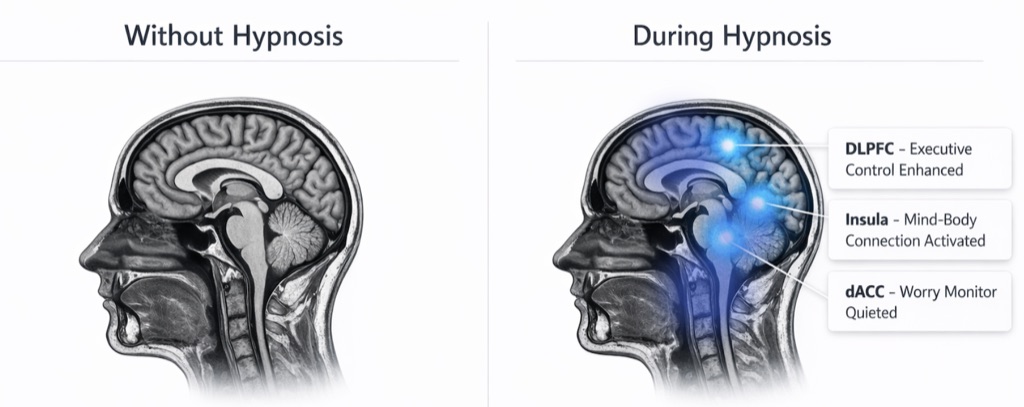
Regions from Stanford fMRI research on hypnosis (Jiang et al., 2017)
What am I really paying for, and is it worth the money?
When you call around, you’ll find that hypnotherapy sessions in Canada typically range from $220 to $350 each. At Calgary Hypnosis Center, we charge within that window, and we ask for a three-session commitment upfront because real change takes more than a single visit. That might sound like a lot, but compare it to what you’re already spending on pods, coils, and devices every month—many of our clients tell us the math flips in their favor within weeks of quitting. If you’re curious about the full picture, I’ve broken down what hypnotherapy costs in Canada so there are no surprises.
Insurance is the question I get most, and I’ll be straight with you: most Canadian health plans do not cover hypnotherapy, even when it’s delivered by a Registered Clinical Hypnotherapist (RCH). A few extended-benefit plans might reimburse a portion if you have a health spending account, but you should never assume coverage. The good news is that you’re paying for focused, one-on-one work that targets the subconscious drivers of your vaping—not a generic program. When you book a free consultation, we talk through the investment and whether it makes sense for your situation.
I know the price can feel like a barrier, especially if you’ve already spent money on patches, gum, or apps that didn’t stick. But think about what you’re buying: a personalized protocol that addresses both the physical cravings and the psychological loop that keeps you reaching for the vape. In a randomized controlled trial, hypnotherapy outperformed nicotine replacement therapy for smoking cessation (ScienceDirect, 2014), and while vaping-specific studies are still emerging, the mechanism is the same—rewiring the automatic urge at its root. That’s not something a $10 app can replicate, and I’ll explain why in a moment.
Ultimately, you’re investing in a version of yourself that isn’t a slave to a plastic stick. Every session builds on the last, reinforcing the neural shifts that make quitting feel less like white-knuckling and more like a natural letting-go. If you’ve tried everything else and are tired of throwing money at the problem, this is where you stop the cycle. We don’t lock you into long packages—just three sessions to start, because that’s what the evidence and our experience say creates lasting momentum.
Could this work for me, or am I too skeptical?
I get it — you might be wondering if you're the right kind of person for hypnotherapy. The truth is, you don't need to be a true believer to benefit. What matters most is a genuine desire to quit. In my experience, clients who come in with a clear, committed decision to stop vaping tend to get the strongest results. Hypnotherapy isn't about being gullible or weak-minded; it's about being open to guidance while you're in a deeply relaxed state. As I explain in what a hypnotherapy session is like, you remain fully in control the entire time.
Here are the signals that suggest you're a good fit for this approach:
- You've tried other methods — cold turkey, nicotine gum, apps — and they haven't stuck.
- You feel like a 'slave' to your vape and are tired of the guilt and shame.
- You're ready to address the psychological and emotional roots of the habit, not just the physical cravings.
- You're willing to practice simple self-hypnosis techniques between sessions to reinforce the work.
- You understand that hypnotherapy is a support tool, not a magic wand — your commitment is key.
Skepticism is normal, and it doesn't disqualify you. Many of my clients start out doubtful but are surprised by how effective it can be. In fact, research shows that hypnotherapy can be significantly more effective than willpower alone for smoking cessation, according to a meta-analysis in the International Journal of Clinical and Experimental Hypnosis. If you're curious but unsure, a free consultation can help you decide if this feels right for you — no pressure, just honest conversation.
Will hypnosis work for you?
Regions from Stanford fMRI research on hypnosis (Jiang et al., 2017)
When is hypnotherapy a bad idea? Be honest with me.
Hypnotherapy isn't for everyone, and I want you to know that before you invest your time and money. If you're not genuinely ready to quit, hypnosis won't force you to change. A study in the *International Journal of Clinical and Experimental Hypnosis* found that hypnotherapy significantly outperforms no treatment for smoking cessation, but it works best when you've already made a committed decision to stop. As one Reddit user put it, "Hypnosis SUPPORTS the client in the decision that’s already made." If you're still on the fence, you might want to explore other options first, like hypnotherapy compared with CBT to see what fits your mindset.
There are also some practical reasons to skip it. If you're looking for a magic bullet that requires zero effort, you'll be disappointed. Hypnotherapy is a tool, not a cure-all. And if you have untreated severe mental health conditions like psychosis or certain personality disorders, hypnosis could be risky. Always check with your doctor first. For more on safety, read is hypnotherapy safe.
Here are the clearest signals that hypnotherapy might not be your best next step:
- You don't actually want to quit vaping—you're just feeling pressured by others.
- You expect a single session to erase all cravings without any follow-through.
- You have a history of seizures or severe dissociation that hasn't been cleared by a physician.
- You're not willing to practice self-hypnosis or listen to recordings between sessions.
- You're deeply skeptical and closed off to the idea that your subconscious can be retrained.
If you're nodding along to these, it doesn't mean you can't quit—it just means hypnotherapy might not be the right starting point. But if you're ready and willing, even a skeptic can see results. The key is genuine desire and commitment, not blind faith.
Will hypnosis work for you?
Regions from Stanford fMRI research on hypnosis (Jiang et al., 2017)
Should I just use a self-hypnosis app instead of a real hypnotherapist?
When I first looked into quitting, I wondered if a self-hypnosis app could do the same job as a real hypnotherapist. The apps are cheaper and convenient, but they miss something crucial: personalization. A Registered Clinical Hypnotherapist (RCH) tailors every suggestion to your specific triggers, history, and goals. As the research from the National Council for Hypnotherapy notes, professional hypnotherapy leads to significantly higher quit rates compared to standard treatments alone. An app can’t adjust in real time when you’re struggling with a unique craving pattern.
I also learned that the therapeutic relationship itself matters. In a randomized trial, hypnotherapy was more effective than nicotine replacement therapy (NRT) for smoking cessation, but that success hinged on the clinician’s ability to build rapport and address subconscious beliefs. A recording can’t read your body language or dig into the emotional roots of your vaping habit. If you’re serious about quitting, what a hypnotherapy session is like is a world apart from a generic audio track.
Cost is a real factor, and I get that. But consider the math: a few sessions with a professional might run $220–$350 each, yet many people need only three to see lasting change. Compare that to years of vaping expenses and failed quit attempts. For a deeper look at the numbers, see what hypnotherapy costs in Canada. When you invest in a trained RCH, you’re paying for a customized, evidence-backed process that adapts to you—not a one-size-fits-all script.
Ultimately, the choice comes down to how much support you need. Self-hypnosis can be a helpful maintenance tool, but for breaking the initial chains of addiction, the data favors working with a professional. A 2014 randomized controlled trial found hypnotherapy more effective than NRT, with the therapist’s skill being a key ingredient. If you’ve tried apps and still feel stuck, it might be time to book a real session.
A 2014 study in ScienceDirect found that hypnotherapy led to higher smoking cessation rates than nicotine replacement therapy, with the therapist’s individualized approach being a critical factor in success.
Source: ScienceDirect, 2014
| Self-Hypnosis App | One-time purchase, no ongoing support | Working with a CHC Hypnotherapist | Personalized sessions, ongoing guidance and accountability |
|---|---|---|---|
| Effectiveness | Generic recordings; may not address your specific triggers | Working with a CHC Hypnotherapist | Tailored approach targeting your unique vaping patterns and beliefs |
| Depth of Change | Surface-level relaxation; limited subconscious reprogramming | Working with a CHC Hypnotherapist | Deep subconscious work to reframe addiction and build new neural pathways |
| Relapse Prevention | No follow-up; you're on your own if cravings return | Working with a CHC Hypnotherapist | Strategies and support to handle setbacks and maintain long-term freedom |
| Cost | $10–$30 one-time | Working with a CHC Hypnotherapist | $220–$350 per session, with a 3-session commitment |
Questions this page answers
How many sessions will I need to quit vaping?
Most clients commit to 3 sessions initially. Some feel a shift after the first, while others need more reinforcement. We focus on building lasting change, not quick fixes. Your progress guides the pace.
What happens during a hypnotherapy session for vaping?
You’ll sit comfortably while I guide you into a deeply relaxed state. Then I use suggestions to reframe your subconscious beliefs about vaping, replacing cravings with calm control. You’re aware the whole time.
Can hypnotherapy help with physical withdrawal symptoms?
Hypnotherapy primarily targets the psychological habit — the automatic reach for your vape. For physical withdrawal, it can ease anxiety and irritability, but it’s not a direct replacement for medical support. Many find the mental shift reduces perceived cravings.
Is hypnotherapy better than nicotine replacement therapy?
One randomized controlled trial found hypnotherapy more effective than NRT for smoking cessation. It addresses the root mental patterns, not just the chemical addiction. Results vary, but it’s a powerful alternative if patches or gum haven’t worked.
What if I’ve relapsed multiple times with other methods?
Hypnotherapy can be especially helpful here. It works on the subconscious triggers that keep pulling you back. Many clients who relapsed with other methods find the deep mindset shift finally breaks the cycle.
Does hypnotherapy have any side effects?
Side effects are rare and usually mild — like feeling drowsy or emotional after a session. It’s a safe, non-invasive approach. You won’t lose control or do anything against your will. Most people just feel deeply relaxed.
How do I find a qualified hypnotherapist?
Look for a Registered Clinical Hypnotherapist (RCH) through ARCH-Canada. Check their training, experience with addiction, and reviews. A good fit means you feel comfortable and heard. [Book a free consultation](/apply) to see if we click.
Can I do self-hypnosis instead of seeing a professional?
Self-hypnosis can reinforce changes, but it’s less effective as a standalone treatment. A professional tailors the approach to your unique triggers and provides accountability. Think of it as learning the skill, then practicing at home.
How does hypnotherapy compare to cold turkey?
Cold turkey relies on willpower alone, which often fails against subconscious habits. Hypnotherapy strengthens your resolve by aligning your subconscious with your conscious goal. It’s like having a guide instead of white-knuckling it.
Is hypnotherapy worth the money?
At $220–$350 per session, it’s an investment. But compare it to the ongoing cost of vaping — and the health benefits. Most clients say the freedom from addiction is priceless. [What hypnotherapy costs in Canada](/hypnotherapy-cost-canada) lays it out.
I'm Danny M., a Registered Clinical Hypnotherapist (RCH), and I've seen firsthand how hypnotherapy can help people break free from vaping—even when nothing else has worked. The evidence shows that hypnotherapy can be more effective than nicotine replacement therapy, and many of my clients experience a profound shift in just a few sessions. If you're ready to stop being a slave to your vape, book a free consultation and let's talk about what's possible for you. Keep reading: Our approach · Sugar addiction · Phone addiction
Apply to work with us
We take on just 10 new clients a month. Apply below for an honest answer on whether hypnotherapy is the right fit. No packages, no pressure.
Only 2 spots left for August

Danny M.
Danny M. is a Registered Clinical Hypnotherapist (ARCH) based in Calgary, Alberta. His work focuses on the conditions hypnotherapy has the strongest track record with: anxiety, insomnia, chronic pain, and IBS. Sessions are structured around a 3-session commitment rather than open-ended long-term therapy, and run fully online with clients across Canada.
Last updated: 2026-06-27