Best Hypnotherapy Apps 2026: Reveri, Nerva & Mindset Ranked
A clinical hypnotherapist ranks the 6 apps people actually search for. Only 2 have real clinical evidence.
Apps promise relief for $15 to $90 a month. A clinical hypnotherapist charges $220 to $350 a session. Do the apps actually work, or do you need the real thing?
I'm a Registered Clinical Hypnotherapist, and I'll tell you honestly when a $99 app is enough — and when it isn't.
Will hypnosis work for you?
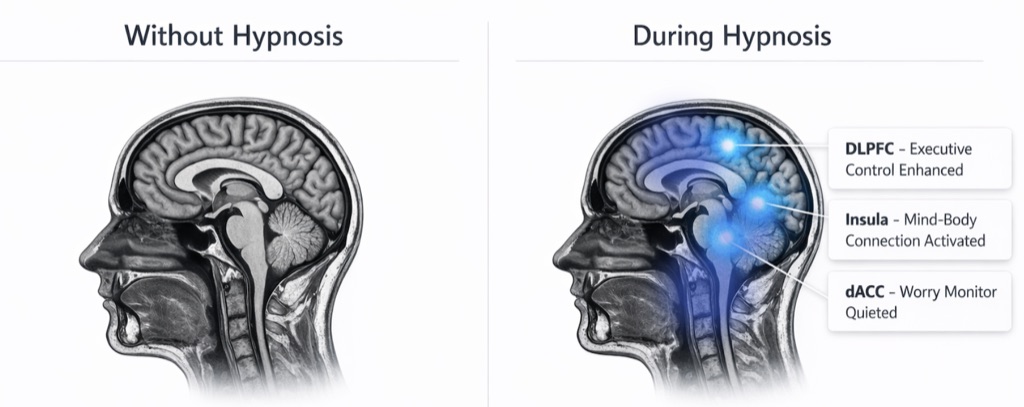
Regions from Stanford fMRI research on hypnosis (Jiang et al., 2017)
Hypnotherapy apps like Reveri, Nerva and Mindset deliver pre-recorded self-hypnosis sessions you can play anytime from your phone. In-person hypnotherapy is one-on-one work with a trained clinician who builds each session around your situation and adapts in real time. Both use hypnosis — but they are fundamentally different tools for different problems.
Here is the part the app stores won't tell you: a 2013 systematic review (Sucala et al., International Journal of Clinical and Experimental Hypnosis) found that the hypnosis apps then available were not designed by qualified professionals or tested for efficacy. The category has improved since — but only two apps have earned genuine clinical credibility as hypnotherapy.
Currently accepting 4 new weight loss clients per month
Next available: August 11th
“Went in a skeptic hoping it would work because I've tried everything.”
What This Guide Covers
- All 6 apps ranked, with real prices and evidence
- Which apps have actual clinical research (and which don’t)
- What apps genuinely get right
- Where apps fall short for real change
- When an app is enough vs when you need a clinician
- The hybrid approach most people should use
The Honest Verdict
Most “hypnotherapy” apps are guided meditation in different packaging. Two apps stand apart with genuine clinical anchoring as hypnotherapy: Reveri (Stanford-backed, broad self-hypnosis use; see our full Reveri review) and Nerva (IBS-specific, the strongest evidence in the category). A third, Mahana IBS, is FDA-cleared and evidence-backed — but it is cognitive behavioural therapy, not hypnotherapy. The rest (Mindset, Calm, Headspace) range from “useful guided audio” to “wellness theatre.” None are bad. None replace personalized clinical work on a stubborn problem.
Of the six apps people search for, only Reveri and Nerva have peer-reviewed clinical evidence as hypnotherapy tools. This is our own assessment of these six apps specifically, not a finding from either study below.
Source: Evidence-based claims are rare industry-wide (Sucala et al. 2013; Scheffrahn et al. 2025, Int. Journal of Clinical & Experimental Hypnosis)
All 6 Apps, Ranked
The quick comparison, then the honest read on each. For a shorter, standalone side-by-side of the four apps this site has reviewed in depth, see Best Hypnotherapy Apps (2026): 4 Reviewed & Compared.
| App | Method | Focus | Price (USD) | Evidence | RCH Verdict |
|---|---|---|---|---|---|
| Reveri | Self-hypnosis | Sleep, stress, pain, focus | $24.99/mo or $99.99/yr | Spiegel lab (Stanford); 84,395-user study | Best general-purpose app |
| Nerva | Gut-directed hypnotherapy | IBS | $43.99/mo, tiers to $199 | Peters et al. 2016 RCT; Monash University protocol | Best clinical evidence; IBS only |
| Mindset | Hypnotherapy + cognitive | Weight, habits, mood | ~$12.99/mo | Limited published data | Habit shaping, not clinical-grade |
| Mahana IBS | CBT (not hypnotherapy) | IBS | Rx, ~$90 total (US) | FDA De Novo 2020; ACTIB, n=558 | FDA-cleared, but it is CBT |
| Calm | Meditation | Sleep, stress | $16.99/mo | None hypnosis-specific | Great meditation, not hypnotherapy |
| Headspace | Meditation | Sleep, stress | $12.99/mo | None hypnosis-specific | Same role as Calm |
Reveri ($24.99/mo or $99.99/yr, App Store, checked July 2026)
Reveri is built on the work of Dr. David Spiegel, longtime Associate Chair of Psychiatry at Stanford. It assesses your hypnotic suggestibility upfront, then delivers short self-hypnosis sessions for sleep, stress, pain and focus. A peer-reviewed study in npj Digital Medicine analyzed self-reported stress ratings from 84,395 users across 282,893 sessions and found consistent pre-to-post reductions in stress in each of the first 10 sessions.
A peer-reviewed npj Digital Medicine study analyzed self-reported, pre-to-post stress ratings from 84,395 Reveri users. The study was observational: no control group, so it shows a pattern in real usage rather than proof of cause and effect.
Source: npj Digital Medicine (2025), retrospective observational study
Best for: day-to-day stress, mild-to-moderate insomnia, practice between in-person sessions. Where it falls short: it can't personalize an induction the way a clinician can — only 10–15% of people are highly hypnotizable (Woody & Barnier, 2008), and one fixed recording can't meet you where you sit on that curve.
Nerva ($43.99/mo, tiers up to $199 full access, App Store, checked July 2026)
Nerva is the strongest clinical-evidence story in the category: a 6-week gut-directed hypnotherapy program developed by Dr. Simone Peters at Monash University, building on the gut-directed hypnotherapy research pioneered by Whorwell and colleagues in Manchester. Whorwell et al. 1984 (The Lancet) showed 70–80% response in treatment-resistant IBS; Peters et al. 2016 (Aliment Pharmacol Ther) found app-delivered results comparable to a low-FODMAP diet. Best for: diagnosed IBS, see our deeper gut-directed hypnotherapy guide. Falls short: IBS only; daily audio adherence is the real bottleneck.
Mindset, Mahana, Calm & Headspace
Mindset (~$12.99/mo, same parent as Nerva) is fine for habit nudging but thin on evidence. Mahana IBS (Rx, ~$90 total for the full US course, not monthly) is FDA-cleared CBT, not hypnotherapy. Calm ($16.99/mo) and Headspace ($12.99/mo) are excellent meditation apps, not hypnosis tools. Treat the last three as adjacent options, not substitutes for clinical hypnotherapy.
Curious whether an app is enough for your situation?
See which option fits your needs below.
See Your Options →What Apps Get Right
I'll give the category its due — for the right person and problem, a good app genuinely helps.
“I didn't expect much from an app, but it's been helping the most recently.”
The expectation that keeps app users happy is the realistic one another poster nailed:
“It's not like it cured me overnight, but it's been noticeably better.”
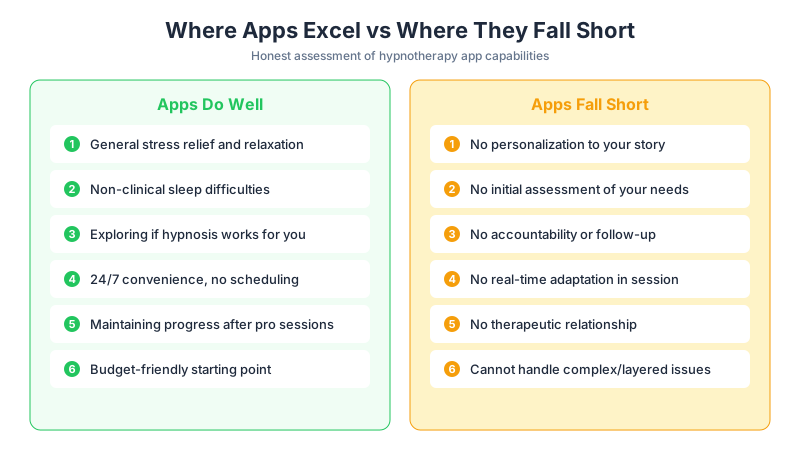
What Apps Can't Do
The limits are real, and they're why people land in my office after the recording stops working.
A fixed script can’t know your insomnia is work stress and someone else’s is grief.
A clinician notices when you tense up and adjusts; a recording plays on regardless.
Apps suit single, clear, mild-to-moderate problems — not trauma or layered cases.
Easy to download, easier to forget. No one notices when you stop.
The accountability gap is the one people underestimate — this is the pattern, in a user's own words:
“I've tried everything and I lack motivation.”
When an App Makes Sense
An App Is Likely Enough If…
Think you might need more than an app?
Three ways to get started. Find the one that fits you best.
See Your Options →Wondering if hypnosis would even work on you?
Take the free 60-second hypnotizability quiz and get your personalized results.
Take the Free Quiz →When You Need a Hypnotherapist
You Probably Need a Clinician If…
And it's often not the first port of call — it's the one people arrive at the way this poster did:
“My therapist as a last resort suggested hypnosis and honestly with how things are looking I'm not opposed lol.”
“I'd used the apps for a year. They helped me wind down, but the thing I actually came in for didn't budge until we worked on it together.”
Hypnotherapy outcomes improve when suggestions are tailored to your language, values and history — the one thing a fixed recording cannot do.
Source: Clinical hypnotherapy research
The Hybrid Approach
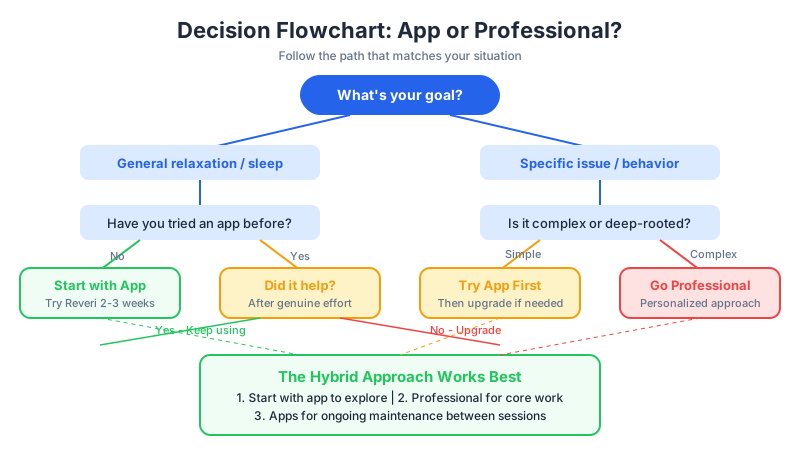
For most people, the smartest answer is “use both.”
Work with a clinician for 4–6 sessions to address root causes and learn self-hypnosis, then use an app for maintenance.
Give the right app 4–6 weeks. If it only partly helps, you've learned hypnotherapy works for you and sessions will build on it.
Cost Reality Check
| Reveri | ~$99 |
| Nerva | ~$89 |
| Mindset | ~$156 |
| Mahana IBS | ~$1,080 (Rx) |
| Calm | ~$204 |
| Headspace | ~$156 |
| 4 sessions | $880 to $1,400 |
| 6 sessions | $1,320 to $2,100 |
| 8 sessions | $1,760 to $2,800 |
The question isn't “which costs less.” It's “which actually solves my problem.”
For exactly what in-person sessions cost in Calgary, including insurance and package structure, see our Calgary hypnotherapy cost guide.
How to Decide
| If you want… | Best option | Why |
|---|---|---|
| Convenience and low cost | App (Reveri / Nerva) | Anytime access for a fraction of the price |
| Personalization | A clinician | Sessions are built around your specific situation |
| To try hypnosis first | App | Low-risk way to see if you respond |
| Help with a specific or complex issue | A clinician | Real-time adaptation and accountability |
| Maintenance after sessions | Either / both | An app reinforces the work between check-ins |
Book a consultation and I'll tell you honestly whether I can help or whether an app would be enough for your situation. No pressure, no sales script.
See Your Options →Wondering if hypnosis would even work on you?
Take the free 60-second hypnotizability quiz and get your personalized results.
Take the Free Quiz →Frequently Asked Questions
What is the best hypnotherapy app overall in 2026?
Reveri is the strongest general-purpose hypnotherapy app, built on Dr. David Spiegel's Stanford research. For IBS specifically, Nerva has the deepest clinical evidence, developed at Monash University. For habit and weight goals, Mindset is reasonable. Mahana IBS is FDA-cleared but is CBT, not hypnotherapy.
Are hypnotherapy apps backed by real clinical research?
Reveri and Nerva have the strongest evidence. Reveri's 84,395-user study is peer-reviewed but observational (self-reported ratings, no control group). Nerva was developed at Monash University with peer-reviewed RCT data (Peters et al. 2016, Aliment Pharmacol Ther). Most other "hypnosis" apps have no published evidence base.
How much do hypnotherapy apps cost compared to in-person sessions?
Apps typically run $99 to $1,080 per year. In-person hypnotherapy in Canada runs $220 to $350 per session, with most courses taking 4 to 8 sessions. Apps are dramatically cheaper, but they are not a substitute for personalized clinical work on complex problems.
Will an app work as well as a session with a clinical hypnotherapist?
For mild-to-moderate, well-defined problems in motivated users, sometimes yes. For severe, complex or treatment-resistant issues, no. The personalization, real-time adjustment and accountability of a clinician are not replicable by an algorithm.
Can I use a hypnotherapy app and see a clinical hypnotherapist at the same time?
Yes. Most clinicians actively recommend apps for between-session practice. The "hybrid" path of starting with sessions, learning self-hypnosis technique, then maintaining with an app is the most cost-effective long-term approach for many people.
Does Mahana count as a hypnotherapy app?
Technically no. Mahana IBS is a prescription cognitive behavioural therapy (CBT) app for IBS, not hypnotherapy. It received FDA De Novo authorization on November 25, 2020. It is grouped with hypnotherapy apps in searches because it treats the same condition in a similar digital format.
Key Takeaways
Wondering Which Path Fits You?
If you've tried apps and want to go deeper, or you're dealing with something specific a generic recording can't reach, let's talk.
In a consultation I'll give you an honest read — if I think an app would do the job, I'll say so.
— Danny
Ready to Work Together?
- Three ways to get started (see options below)
- Honest assessment of whether you even need a clinician
- Custom recordings for between-session practice
- 100% virtual sessions from anywhere in Canada
📅 Currently accepting new clients
Investment & Options
Choose the path that fits your needs
Cost Per Session Comparison
~$300/session for 6 personalized sessions
- 6-8 personalized sessions
- Custom to your triggers
- Direct support throughout
Best for complex cases or trauma-related eating
ApplyJust $37/session — same content, 10x less cost
- 6 full sessions (same content as 1:1)
- Self-paced, repeat anytime
- Lifetime access forever
30-day satisfaction guarantee. Not for you? Full refund.
$350 for one 45-min session
- One 45-min session
- No program structure
Just want to see what it's like
Inquire via Email
Danny M.
Danny M. is a Registered Clinical Hypnotherapist (ARCH) specialising in gut-directed hypnotherapy for IBS, gut-related anxiety, and chronic gut-centred pain. Sessions follow the Manchester Protocol as a clinical reference framework, with a 3-session commitment structure. When he's not helping clients rewire their subconscious, you'll find him at comedy improv. Reading people is a skill that works both ways.
Last updated: May 2026 · Prices and evidence verified at time of writing. Hypnotherapy is not a regulated health profession in Alberta; this article is informational and not a substitute for medical advice.
Sources & References
- •Sucala M, et al. (2013). Hypnosis: there's an app for that: a systematic review of hypnosis apps. Int. Journal of Clinical and Experimental Hypnosis, 61(4), 463-474.
- •Scheffrahn K, Alldredge CT, Snyder M, Elkins GR. (2025). Hypnosis apps: a systematic review. Int. Journal of Clinical and Experimental Hypnosis, 73(1), 79-95.
- •Spiegel D. Stanford School of Medicine, hypnosis research. PubMed
- •Whorwell PJ, et al. (1984). Controlled trial of hypnotherapy in refractory IBS. The Lancet.
- •Peters SL, et al. (2016). Gut-directed hypnotherapy vs low-FODMAP diet. Aliment Pharmacol Ther.
- •FDA De Novo authorization, Mahana IBS (Nov 25, 2020); ACTIB trial (n=558).