Self-Hypnosis vs Hypnotherapy for Stress Relief: Which Should You Try First?
Guided self-hypnosis can calm everyday stress. Professional hypnotherapy helps when stress is chronic, tangled with anxiety, or keeps returning despite self-help.
If your search is: “guided self-hypnosis vs hypnotherapy sessions for stress relief”, the honest answer is: start with the lowest-risk tool that matches the size of the problem.
For routine stress — a tight work week, racing thoughts before bed, or needing a reliable way to downshift — guided self-hypnosis is often the right first experiment. For chronic stress, panic-level anxiety, trauma history, or stress that keeps driving the same habit loop, professional hypnotherapy gives you something a recording cannot: assessment, adaptation, and feedback in the moment.
Will hypnosis work for you?
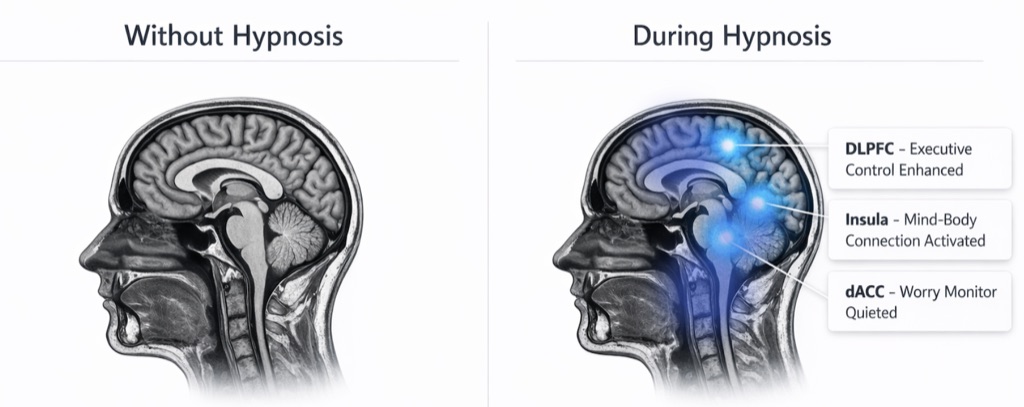
Regions from Stanford fMRI research on hypnosis (Jiang et al., 2017)
The question is not “does self-hypnosis work?” It can. The better question is: what kind of stress are you trying to change? This guide compares guided self-hypnosis, hypnosis apps, and professional hypnotherapy sessions so you can choose the right level of support without overbuying — or under-treating — the problem.
Currently accepting 4 new weight loss clients per month
Next available: August 11th
Quick Answer: Which Works Better for Stress Relief?
For stress relief, guided self-hypnosis is a smart first step when the stress is mild, situational, and you can practise consistently. Professional hypnotherapy is the better fit when stress is chronic, body-based, linked with anxiety or trauma, or you have already tried apps and still feel stuck.
You need a 10-minute reset, sleep wind-down, or daily nervous-system practice.
The stress has a repeat trigger, emotional charge, panic, avoidance, or long history.
Use both: professional sessions to build the strategy; self-hypnosis to reinforce it between appointments.
Guided Self-Hypnosis vs. Hypnotherapy Sessions for Stress Relief
Here is the practical difference. A recording can guide you into relaxation and repeat helpful suggestions. A professional session can notice where you tighten, what you avoid, which words land, and which part of the stress pattern needs a different approach.
| Option | Guided self-hypnosis / app | Professional hypnotherapy session |
|---|---|---|
| Best for | Everyday stress, sleep wind-down, focus, confidence practice | Chronic stress, anxiety loops, avoidance, panic symptoms, trauma-informed work |
| Cost | Low: free to app subscription | Higher: 1:1 clinical time and personalization |
| Personalization | Generic script; you choose what seems relevant | Session adapts to your triggers, language, body cues, and resistance |
| Feedback | None while you practise | Real-time pacing, questions, and adjustment |
| Risk of quitting too early | Higher if you get bored, doubt it, or choose the wrong script | Lower because there is structure, accountability, and troubleshooting |
| Best outcome | A repeatable calm-down skill | A targeted plan for the pattern underneath the stress |
If you are comparing both specifically for stress relief, my clinical rule of thumb is simple: try guided self-hypnosis first for stress you can name and recover from; choose professional support for stress that keeps hijacking your body or behaviour.
What is Self-Hypnosis (and When Does It Excel)?
Self-hypnosis is a state of focused attention and reduced outside distraction that you learn to enter yourself. It is not mind control and it is not the same as being asleep. In practice, most people use guided audio, breathing, imagery, and repeated suggestions to shift attention away from threat scanning and toward calm, control, or a specific goal.
Popular self-hypnosis often comes in the form of audio recordings, mobile apps, or guided scripts. The strength is repetition: you can practise the same calming pattern every day until your nervous system starts recognizing it faster.

Key Benefits & Best Uses for Self-Hypnosis
Self-hypnosis is an excellent starting point for many people and excels in specific areas:
- Stress Reduction: A short guided session can create a repeatable cue for calm and downshifting.
- Sleep Preparation: Many people use self-hypnosis as a structured wind-down when rumination spikes at night.
- Habit Reinforcement: It can reinforce positive habits you're already trying to build, like daily exercise or healthier routines.
- Minor Phobias/Anxieties: For mild, uncomplicated fears (for example, public speaking jitters that do not cause panic attacks), self-hypnosis can offer a sense of control and calm.
- Focus & Performance: Athletes, students, or professionals can use it to enhance concentration, visualization, and confidence.
- Pain Coping: For some chronic pain patients, hypnotic strategies are used alongside medical care to shift attention and reduce distress around pain.
In a randomized controlled trial of healthy adults with elevated stress, group hypnosis plus self-hypnosis audio practice lowered perceived stress versus an education-only control at 5 and 12 weeks.
Source: Fisch et al., 2020 randomized controlled trial
That does not mean an app can solve every stress problem. It does mean self-hypnosis is credible enough to test before you spend money on sessions — especially if your goal is stress recovery, sleep preparation, or a daily reset. If you want a deeper app comparison, read our guide to hypnotherapy apps vs in-person sessions.
When Self-Hypnosis Falls Short (The DIY Traps)
While valuable, self-hypnosis has limitations. It is often insufficient for deeply ingrained issues, trauma history, complex anxiety, or when you need more than positive reinforcement.
1. Lack of Personalization & Feedback
Apps and generic recordings offer a one-size-fits-all approach. They cannot adapt to your specific stress triggers, resistance, body cues, or the exact words that make your system relax. There is no one to observe your response, ask a clarifying question, or change the approach in real time.
2. Difficulty Addressing Root Causes
Many issues — chronic anxiety, deep-seated phobias, emotional eating, smoking, avoidance, or stress-driven insomnia — often have layered roots. Self-hypnosis is good at planting new suggestions. It is weaker at discovering why the old pattern keeps protecting itself.

3. Overcoming Resistance
Your mind has protective mechanisms. If stress keeps you vigilant, helps you avoid disappointment, or gives you permission to rest only after exhaustion, a generic relaxation script may not touch the deeper bargain. This is where people often say, “I know what to do, but I still can’t do it.”
4. Limited Depth of Trance
While effective for lighter states, achieving deeper, more profound hypnotic states (which are often beneficial for significant transformation) can be challenging without external guidance and pacing.
The Unique Power of Professional Hypnotherapy
Professional hypnotherapy, delivered by a trained practitioner, offers a dynamic and tailored approach that self-hypnosis cannot replicate. You are not just listening to suggestions; you are being guided through a process that responds to you.
1. Personalized Approach & Expertise
A professional hypnotherapist listens, observes your cues, and customizes each session to your needs, personality, and the nuances of the challenge. With stress relief, that might mean working with perfectionism, fear of conflict, body tension, sleep pressure, or a specific trigger that keeps showing up at work or home.
2. Advanced Techniques for Deep-Seated Issues
For issues like trauma, chronic anxiety, significant phobias, or complex behavioural patterns, a professional may use techniques such as ego-state work, parts work, imagery rehearsal, exposure-style desensitization, or analytical hypnotherapy. The point is not to make the session “deeper” for its own sake; it is to match the technique to the pattern.

3. Overcoming Internal Resistance
A skilled hypnotherapist can identify and gently work through resistance. If part of you wants calm and another part believes calm is unsafe, lazy, or irresponsible, a good session helps those parts negotiate instead of forcing positivity over the top.
Clinical reviews support hypnosis as an adjunct for pain and some anxiety-related conditions, but outcomes depend on issue type, practitioner skill, and patient fit.
Source: Jensen 2009; Kirsch et al. 1995; ASCH clinical guidance
The relationship with a professional also provides accountability and support, which can matter when stress has become a lifestyle rather than a passing state. This dynamic human connection is something no app can replicate.
When to See a Professional Hypnotherapist
Consider professional hypnotherapy when:
- Deep-Seated Issues: You're dealing with significant anxiety, chronic stress, PTSD symptoms, or unresolved trauma.
- Stubborn Habits & Addictions: For lasting change in areas like weight control, smoking cessation (read our honest research post), or breaking other ingrained patterns.
- Complex Phobias: When fears significantly impact your life and self-hypnosis isn't providing sufficient relief.
- Feeling Stuck: You've tried self-help methods, but feel a persistent internal block or resistance to change.
- Lack of Self-Motivation: You need external structure, accountability, and the specialized techniques a therapist provides.
- Exploring Root Causes: You want to delve into the origins of a problem and heal from the inside out.
If after 3 sessions you don't feel a genuine shift, we stop and reassess. No pressure. No upsell.
Learn More About Our Approach →Choosing Your Path: Self-Help Apps or a Human Expert?
The choice between self-hypnosis tools (like apps) and professional hypnotherapy isn't about one being universally superior. It's about matching the tool to the task.
When DIY is Enough:
When a Pro is Indispensable:
Investment & Options
Choose the path that fits your needs
Cost Per Session Comparison
~$300/session for 6 personalized sessions
- 6-8 personalized sessions
- Custom to your triggers
- Direct support throughout
Best for complex cases or trauma-related eating
ApplyJust $37/session — same content, 10x less cost
- 6 full sessions (same content as 1:1)
- Self-paced, repeat anytime
- Lifetime access forever
30-day satisfaction guarantee. Not for you? Full refund.
$350 for one 45-min session
- One 45-min session
- No program structure
Just want to see what it's like
Inquire via Email
Ultimately, self-hypnosis and professional hypnotherapy are not in competition. They are different levels of support. For daily stress management and reinforcement, self-hypnosis is practical and affordable. For deeper patterns, recurring anxiety, or stress that keeps affecting your behaviour, the expertise of a professional hypnotherapist is often the more direct route.
Frequently Asked Questions
Can self-hypnosis actually work?
Yes. Self-hypnosis can be effective for stress relief, sleep preparation, minor habit changes, and reinforcing positive suggestions, especially when you practise consistently.
When should I choose a professional hypnotherapist?
Choose professional hypnotherapy when stress is chronic, linked with anxiety or trauma, or tied to stubborn behavioural patterns where a personalized, dynamic, expert-guided approach is necessary.
Are hypnosis apps effective for real change?
Hypnosis apps can be helpful for daily reinforcement and mild stress. They can maintain positive states and reinforce suggestions, but they usually lack the depth, personalization, and interactive feedback needed for complex issues.
What are the main differences in approach?
Self-hypnosis is user-led, usually script-based, and focuses on suggestion. Professional hypnotherapy is therapist-led, personalized, interactive, and can use advanced techniques to explore and resolve root causes dynamically.
Ready for Real Transformation?
- Personalized approach to your unique challenges
- Uncover and resolve deep-seated subconscious blocks
- Experience lasting change beyond temporary fixes
- Expert guidance and support every step of the way
📅 Limited availability for 1:1 sessions.
References
- Fisch, S., et al. (2020). Group hypnosis for stress reduction and improved stress coping: randomized controlled trial. BMC Complementary Medicine and Therapies.
- Tran, N., Saperia, C., Neri, E., et al. (2026). Effects of app-delivered self-hypnosis on stress management. npj Digital Medicine.
- Jensen, M. P. (2009). Hypnosis for chronic pain management: systematic review and meta-analysis. International Journal of Clinical and Experimental Hypnosis, 57(3), 205-236.
- Kirsch, I., Montgomery, G., & Sapirstein, G. (1995). Hypnosis as an adjunct to cognitive-behavioral psychotherapy: meta-analysis. Journal of Consulting and Clinical Psychology.
- American Psychological Association Division 30. (n.d.). Definition and information about hypnosis. Society of Psychological Hypnosis.
- American Society of Clinical Hypnosis. (n.d.). Frequently Asked Questions About Hypnosis.