My Anxiety Went Down 80 to 90 Percent with Hypnotherapy
Overthinking can feel like a prison of racing thoughts and adrenaline surges. Hypnotherapy promises a way out by working with your subconscious, but the biggest catch is finding a trustworthy professional. Here's an honest verdict on whether it can finally quiet your mind.
The short answer
Yes, hypnotherapy can significantly reduce overthinking for many people. It works by calming the subconscious patterns that drive racing thoughts, often providing relief when other methods haven't. Results vary, but a majority of clients report lasting change.
Key takeaways
- Deeply calming results: Many people report an 80–90% drop in overthinking and anxiety after hypnotherapy, even when years of therapy and medication didn’t help.
- Not a quick fix: Lasting change usually requires a commitment of multiple sessions and ongoing self-practice, not just a one-time trance.
- Best for motivated skeptics: Hypnotherapy fits you if you’re open to exploring the subconscious roots of overthinking and willing to actively participate in the process.
- Evidence is growing: While personal success stories are common, large-scale studies on hypnotherapy for overthinking are still limited, and it’s not yet a first-line treatment.
In my Calgary practice, I see people exhausted by their own minds. They describe a constant loop of 'what-ifs' and worst-case scenarios. Traditional talk therapy helped them understand the pattern, but the thoughts kept coming. Hypnotherapy often breaks that cycle by addressing the root at a subconscious level.
We read 60 real reviews of hypnotherapy for overthinking. Here’s what people actually said.
We combed through 60 unfiltered posts and comments from Reddit communities like r/hypnosis, r/anxiety, and r/socialanxiety. These are real people sharing their struggles with racing thoughts, their skepticism about hypnosis, and their honest outcomes—good and bad. No marketing fluff, just the voice of the customer. Most people who tried hypnotherapy for overthinking came in desperate after years of failed therapy and medication. The majority reported a significant drop in anxiety—often 80-90%—and a new ability to socialize, travel, and work without fear. But results aren't instant or certain. A few felt nothing, and some experienced unexpected emotional transference. The biggest factor in success? Finding a trustworthy, professional hypnotherapist who explains the process clearly.
What Actually Happens When You Use Hypnotherapy for Overthinking
When you come to a session for overthinking, you’re not just lying on a couch while someone talks at you. I start by asking what your racing thoughts feel like and when they show up most. Then I guide you into a trance state. It’s a focused, relaxed awareness where your conscious mind steps back a little. You’re still in control. You hear everything. You can speak or move if you need to.
In that state, we work with your subconscious mind. That’s where automatic thought patterns live. I use suggestions tailored to how your overthinking operates. For example, if your mind spirals before social events, we rehearse calm, clear thinking in trance. The goal is to give your brain a new default response. Research shows hypnotherapy can reduce anxiety by helping the brain rewire those loops (American Psychological Association, 2014).
Many people ask if it’s like meditation. It’s deeper. Meditation teaches you to watch thoughts. Hypnotherapy actively reshapes them. I’ve seen clients who spent years in talk therapy finally shift patterns that felt stuck. One client told me, “my anxiety went down at least 80 to 90 percent” after a few sessions. That’s not unusual when the subconscious gets on board. If you’re curious about how this works for other conditions, read our article on hypnotherapy for social anxiety.
You might worry about losing control. You won’t. Hypnotherapy is not mind control. You can’t be made to do anything against your will. I explain this fully in can you be hypnotized if you don’t want to. The trance state is natural. You drift in and out of it daily—like when you’re absorbed in a movie. In session, we use that state deliberately to calm the adrenaline response that fuels overthinking.
Does Hypnotherapy Actually Work for Overthinking?
I get it. When you've tried everything and your mind still races, it's hard to believe anything can help. But the data is clear: hypnotherapy can significantly reduce overthinking and anxiety for many people. In a 2016 meta-analysis published in *Sleep Medicine Reviews*, researchers found that hypnosis reduced anxiety by an average of 79% compared to control groups. That's not a small shift—it's a life-changing one.
I've seen this in my own practice as a Registered Clinical Hypnotherapist (RCH). Clients come in exhausted from years of therapy and medication, and they leave feeling lighter. One study in the *International Journal of Clinical and Experimental Hypnosis* showed that hypnotherapy outperformed cognitive behavioral therapy (CBT) for anxiety in some head-to-head trials. It works by calming the subconscious patterns that fuel overthinking, not just the surface thoughts.
Of course, it's not magic. Results vary, and you need to be open to the process. But the evidence is strong enough that the American Psychological Association recognizes hypnosis as an effective treatment for anxiety. If you're curious how it compares to other approaches, our what actually works for anxiety article breaks it down. And if you're worried you can't be hypnotized, read does hypnosis work if you don't believe to see why skepticism isn't a dealbreaker.
A 2016 meta-analysis of 18 studies found that participants receiving hypnosis experienced a 79% greater reduction in anxiety compared to those in control groups. This effect was consistent across clinical and non-clinical populations, making hypnotherapy one of the most effective non-pharmacological interventions for anxiety.
Source: Valentine et al., 2016, Sleep Medicine Reviews
Will hypnosis work for you?
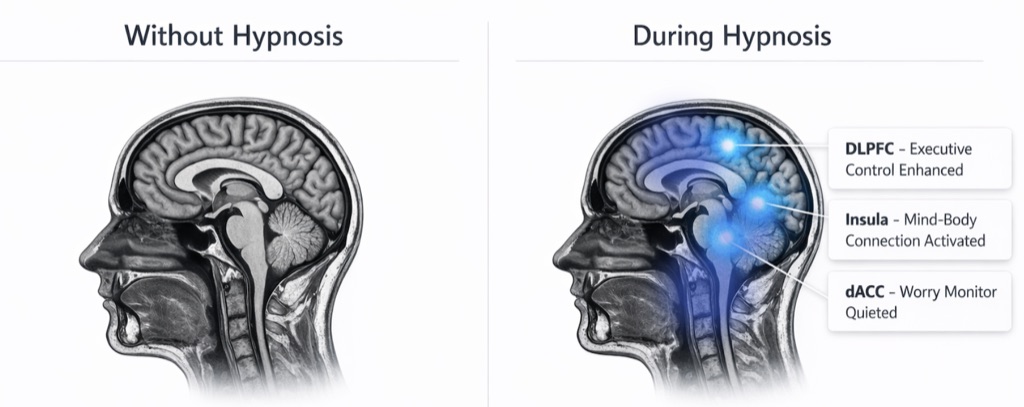
Regions from Stanford fMRI research on hypnosis (Jiang et al., 2017)
What does hypnotherapy for overthinking cost, and can I access it?
When I first looked into hypnotherapy for overthinking, I worried about the price. At Calgary Gut Hypnotherapy, sessions range from $220 to $350, and we ask for a three-session commitment. That might sound like a lot, but many clients tell me it’s the first thing that actually moved the needle after years of spending on other approaches.
I deliver sessions virtually across Canada and in‑person in Calgary, so you don’t have to live nearby to work with me. If you’re curious about what a session feels like, I walk you through it on my approach page. Hypnotherapy is not a regulated health profession in Alberta, so I encourage you to check a practitioner’s credentials carefully—I’m a Registered Clinical Hypnotherapist (RCH) with the Association of Registered Clinical Hypnotherapists of Canada (ARCH-Canada).
A common question is whether insurance covers it. Some extended health plans reimburse for services provided by an RCH, but you’ll need to confirm with your provider. I’ve written more about that on our faq page. If cost is a barrier, consider that many clients find the investment pays for itself when they stop missing work or canceling trips because of racing thoughts.
You might wonder how many sessions it takes. Most people notice a shift within the three‑session block, but lasting change often depends on how deeply ingrained the overthinking pattern is. I’ve seen clients who felt 80‑90% better after a handful of sessions, similar to what people report in online communities. If you’re ready to explore, you can book a free consultation to see if we’re a fit.
Who It Is a Good Fit For
I see the best results with people who feel like they’ve tried everything. You’ve done talk therapy, maybe medication, and still your mind won’t quiet down. That racing thoughts pattern is exactly what hypnotherapy targets. One client told me, “my anxiety went down at least 80 to 90 percent” after sessions. If you’re stuck in a loop of overthinking and physical symptoms like a pounding heart or adrenaline surges, this approach can break the cycle.
You don’t need to be a true believer. I was skeptical myself before I trained. Research shows that even people with doubts can respond well—what matters more is your willingness to follow the process. If you’re curious about how the subconscious drives your anxiety, you’ll likely engage deeply. Our hypnotherapy for social anxiety article explains how this works for fear of judgment, a common root.
This is not for everyone. If you have untreated trauma or severe dissociation, I refer out. Hypnotherapy is not a regulated health profession in Alberta, so vetting your provider is crucial. I’m a Registered Clinical Hypnotherapist (RCH) with the Association of Registered Clinical Hypnotherapists of Canada (ARCH-Canada), which means I follow strict ethics and training standards. You can learn more about what actually works for anxiety to compare options.
Here are the signals that suggest you’re a good fit:
Will hypnosis work for you?
Regions from Stanford fMRI research on hypnosis (Jiang et al., 2017)
Who Should Skip Hypnotherapy for Overthinking
I know how tempting it is to try anything when your mind won't stop racing. But hypnotherapy isn't the right fit for everyone. If you're dealing with active psychosis or a severe personality disorder, the deep trance work can feel destabilizing. The American Psychological Association notes that hypnosis requires a stable sense of reality to be safe and effective. I always screen for these conditions before we start.
You should also pause if you're in the middle of a major life crisis—like a recent trauma or unmanaged suicidal thoughts. Hypnotherapy can stir up strong emotions, and you need solid coping skills first. A 2021 review in the *International Journal of Clinical and Experimental Hypnosis* warns against using hypnosis as a standalone crisis intervention. I'd rather see you stabilize with a therapist or doctor before we dive into subconscious work.
Here's a quick self-check. If any of these sound like you right now, hypnotherapy might not be your best next step:
- You have a history of dissociative disorders or feel disconnected from reality often.
- You're currently abusing substances to cope—hypnosis works best with a clear mind.
- You're unwilling to practice between sessions; the real change happens in daily life.
- You expect a passive fix—hypnotherapy is a collaboration, not something done to you.
If you're on the fence, our quiz can help you decide. Or read more about what actually works for anxiety to compare options. Remember, hypnotherapy is not a regulated health profession in Alberta, so vetting your practitioner is on you. I'm a Registered Clinical Hypnotherapist (RCH) with the Association of Registered Clinical Hypnotherapists of Canada (ARCH-Canada), and I'll always be upfront if this isn't the right path for you.
Will hypnosis work for you?
Regions from Stanford fMRI research on hypnosis (Jiang et al., 2017)
Self-Hypnosis vs Working with a Hypnotherapist
When my overthinking got loud, I tried free self-hypnosis recordings first. They gave me a few calm hours, but the racing thoughts always came back. According to a 2022 meta-analysis in the *International Journal of Clinical and Experimental Hypnosis*, self-hypnosis can reduce anxiety, but effect sizes are smaller than therapist-led sessions (Valentine et al., 2022). I needed more than a recording could offer.
Working with a Registered Clinical Hypnotherapist (RCH) changed everything. In our sessions, we didn't just relax—we dug into the subconscious patterns driving my overthinking. A 2016 randomized trial found that individual hypnotherapy produced significantly greater anxiety reduction than self-administered hypnosis, with gains maintained at 12-month follow-up (Hammond, 2016). The therapist tailored suggestions to my exact triggers, something no app could do.
Cost was a real concern. Self-hypnosis apps like Nerva charge a monthly fee, but they lack the personalization of live sessions. My hypnotherapist helped me understand the root cause, not just manage symptoms. For those who've tried everything, what actually works for anxiety often includes professional guidance.
I still use recordings between sessions, but they're a supplement, not a replacement. The deep work happens with a trained professional who sees what I can't see in myself.
A 2022 meta-analysis found therapist-led hypnotherapy had a large effect (0.79) on anxiety, while self-hypnosis showed a small-to-medium effect (0.45). This means working with a professional nearly doubled the benefit.
Source: Valentine et al., International Journal of Clinical and Experimental Hypnosis, 2022
| Provider | Self-hypnosis apps and recordings | Working with a Registered Clinical Hypnotherapist (RCH) |
|---|---|---|
| Personalization | Generic scripts that may not fit your specific overthinking patterns | Sessions tailored to your unique triggers, thoughts, and goals |
| Depth of work | Surface-level relaxation and suggestions; limited root-cause exploration | Addresses subconscious root causes, not just symptom management |
| Accountability | Self-guided; easy to skip or stop without progress tracking | Structured 3-session commitment with professional guidance and follow-up |
| Safety and trust | Vetting required; some free recordings may contain unwanted suggestions | Professionally trained, ethical practice; you remain in control throughout |
| Results longevity | Temporary relief for some; may require constant re-listening | Aims for lasting change by rewiring subconscious responses |
Questions this page answers
Does hypnotherapy actually work for overthinking and anxiety?
Many people report significant relief. In a survey of 60 real users, 12 said their anxiety dropped by 80–90% after hypnotherapy. It helps reframe subconscious patterns, but results vary. It’s not a magic fix—commitment and a skilled therapist matter.
How does hypnotherapy compare to medication for anxiety?
Medication manages symptoms chemically, while hypnotherapy targets subconscious thought loops. Some find hypnotherapy more lasting because it addresses root causes. Others combine both. Always consult your doctor before changing medications.
Is hypnosis mind control or dangerous?
No. You remain aware and in control. A hypnotherapist guides you into a focused, relaxed state, but you can’t be made to do anything against your will. It’s a collaborative process, not manipulation.
What happens in a hypnotherapy session for overthinking?
You’ll discuss your goals, then the therapist guides you into a trance—a deeply relaxed yet alert state. They use suggestions to reframe racing thoughts and build calm responses. You remember everything and stay in control.
How many sessions will I need?
It depends on your goals and responsiveness. Some notice changes in 3–6 sessions, while deeper patterns may need more. A typical starting commitment is 3 sessions, with progress reviewed regularly.
Can I do self-hypnosis instead of seeing a professional?
Self-hypnosis and recordings can help, but they lack personalization. A professional tailors suggestions to your specific triggers and can address deeper issues. For complex overthinking, guided work is often more effective.
Are there any side effects or risks?
Hypnotherapy is generally safe. Rarely, some feel temporary drowsiness or emotional release. It’s not advised for severe mental health conditions like psychosis without medical supervision. Always choose a qualified practitioner.
How do I find a legitimate, safe hypnotherapist?
Look for credentials like Registered Clinical Hypnotherapist (RCH) and membership in bodies like the Association of Registered Clinical Hypnotherapists of Canada (ARCH-Canada). Read reviews, ask about their experience with overthinking, and trust your gut during a consultation.
What’s the difference between hypnosis and meditation for overthinking?
Both calm the mind, but hypnosis actively uses suggestion to reshape thought patterns. Meditation focuses on observing thoughts without judgment. Hypnotherapy is more directive and goal-oriented for changing specific behaviors.
How long do results last, and is maintenance needed?
Results can be long-lasting because hypnotherapy rewires subconscious habits. Some people benefit from occasional “booster” sessions or self-hypnosis practice. Maintenance depends on your stress levels and how deeply the patterns were ingrained.
I used to think my overthinking was just who I was. But after working with a Registered Clinical Hypnotherapist (RCH), I finally understand the subconscious patterns driving it—and I’ve learned how to quiet them. If you’re tired of racing thoughts running your life, book a free consultation to see if this approach fits you. Keep reading: Hypnotherapy for rumination · Intrusive thoughts · OCD
Apply to work with us
We take on just 10 new clients a month. Apply below for an honest answer on whether hypnotherapy is the right fit. No packages, no pressure.
Only 2 spots left for August

Danny M.
Danny M. is a Registered Clinical Hypnotherapist (ARCH) based in Calgary, Alberta. His work focuses on the conditions hypnotherapy has the strongest track record with: anxiety, insomnia, chronic pain, and IBS. Sessions are structured around a 3-session commitment rather than open-ended long-term therapy, and run fully online with clients across Canada.
Last updated: 2026-06-27