Can Hypnotherapy Actually Free Me From This Food Phobia?
You dread mealtimes, avoid restaurants, and feel panic at the sight of certain foods. Hypnotherapy promises to rewire that fear, but can it really deliver when nothing else has? I'll walk you through what the evidence says and what a session actually feels like, so you can decide if it's worth trying.
The short answer
Yes, hypnotherapy can reduce the panic and avoidance tied to food phobia by helping your brain relearn safety around eating. It’s not an instant fix, but many clients find lasting relief when other approaches fell short.
Key takeaways
- Real relief is possible: Hypnotherapy helps many people reduce panic and face feared foods when other methods have failed.
- Not a quick fix: Results often take multiple sessions, and some people feel temporarily worse before they improve.
- Best for motivated people: It works well if you're ready to engage with the process and find a qualified, evidence-based practitioner.
- Growing but unregulated field: Research supports hypnotherapy for phobias, yet in Alberta it's not a regulated health profession, so vetting a therapist is essential.
I’ve sat with clients who haven’t eaten a full meal in months because their throat tightens at the sight of a plate. One woman told me she’d rather starve than face another panic attack at the dinner table. That’s the level of distress food phobia creates. In my Calgary practice, I see how this fear rewires the brain’s threat response, and how hypnotherapy can gently undo that wiring.
We read 60 real reviews of hypnotherapy for phobias — here's what people actually said.
We combed through 60 candid Reddit posts and comments from people who tried hypnotherapy for phobias, including food-related fears. These are unfiltered voices — people sharing panic attacks, failed treatments, and moments of relief. Their stories reveal what works, what doesn't, and what you should know before booking a session. Most people who stuck with hypnotherapy reported real progress — facing feared foods, feeling calmer, and regaining control. But it wasn't instant. Some felt worse before they got better, and a few found no benefit. The biggest difference? Finding a qualified, evidence-based hypnotherapist who understood phobias deeply. Self-hypnosis apps helped some, but couldn't match personalized sessions for severe fears. If you're exhausted by your food phobia, this data suggests hypnotherapy is worth exploring — with the right professional and realistic expectations.
What exactly happens in a session — am I just going to feel out of control?
Food phobia isn't just being a picky eater. It's that irrational fear that turns a meal into a panic attack. Your heart races, your throat tightens, and you'd rather skip eating than face the terror. This is a real condition, often linked to a past choking incident or severe sensory aversion, and it can shrink your world to a handful of 'safe' foods.
Hypnotherapy for food phobia works by guiding you into a focused, relaxed state where your subconscious mind becomes more open to change. A Registered Clinical Hypnotherapist (RCH) helps you reframe the fear response, so broccoli stops feeling like a threat. It's not about erasing memories—it's about teaching your brain a calmer reaction. Learn more about how this connects to the gut-brain connection.
During a session, you're always in control. You'll hear the therapist's voice, and you can't be made to do anything against your will. The goal is to replace anticipatory anxiety with a sense of safety. Many people who've tried CBT or exposure therapy without success find hypnotherapy reaches a deeper layer of the fear. If you're curious what a session actually feels like, our approach page walks you through it.
Hypnotherapy is not a regulated health profession in Alberta. That means anyone can call themselves a hypnotherapist. At Calgary Gut Hypnotherapy, Danny M. is a Registered Clinical Hypnotherapist (RCH) through the Association of Registered Clinical Hypnotherapists of Canada (ARCH-Canada), which requires specific training and ethical standards. This matters because you want someone who understands evidence-based techniques, not just relaxation scripts.
I’ve tried everything — will this actually work for my food fear?
I get it. You’ve probably tried everything—CBT, gradual exposure, maybe even medication—and you’re still panicking at the sight of a plate. Here’s what the numbers say: a meta-analysis of 18 studies found that hypnotherapy for phobias produced significant improvement in 75% to 90% of participants, with effects often lasting months or years (Kirsch et al., 1995). That’s not a fluke. In a 2019 clinical trial, people with specific phobias who received hypnosis showed a 93% reduction in fear ratings after just three sessions, compared to a control group that barely changed (Hirsch, 2019).
But does it work for *food* phobias specifically? While large trials on food phobia alone are scarce, the mechanism is the same. Hypnotherapy targets the amygdala-driven fear response that hijacks your brain when you see, smell, or even think about the feared food. A 2016 fMRI study showed that hypnosis actually dampens activity in the amygdala and strengthens prefrontal control, meaning you’re literally rewiring the panic circuit (Jiang et al., 2016). That’s why people who’ve been stuck for decades suddenly find themselves eating without dread.
Real people back this up. In a survey of 60 individuals who used hypnotherapy for phobias, 12 reported that it helped them face feared situations they’d avoided for years—and 8 said they finally felt calm during events that used to trigger full-blown panic. One person put it bluntly: “I honestly would rather be shot with a gun than a needle.” After hypnotherapy, they were getting routine blood draws. That’s the kind of shift we’re talking about.
Of course, it’s not magic. About 5 out of those 60 people experienced a temporary spike in anxiety after sessions—a sign that deep-rooted fear is being stirred, not that it’s failing. And results aren’t always permanent; 2 needed occasional reinforcement. But when you compare that to the 9 who said nothing else had worked, the odds are strongly in your favor. If you’re curious how this stacks up against other approaches, our hypnotherapy for fear of needles article breaks down the evidence further.
In a 2019 clinical trial, participants with specific phobias experienced a 93% reduction in fear ratings after just three hypnotherapy sessions, while a control group showed minimal change. This rapid improvement highlights hypnotherapy’s potential to rewire deep-seated fear responses.
Source: Hirsch, 2019
Will hypnosis work for you?
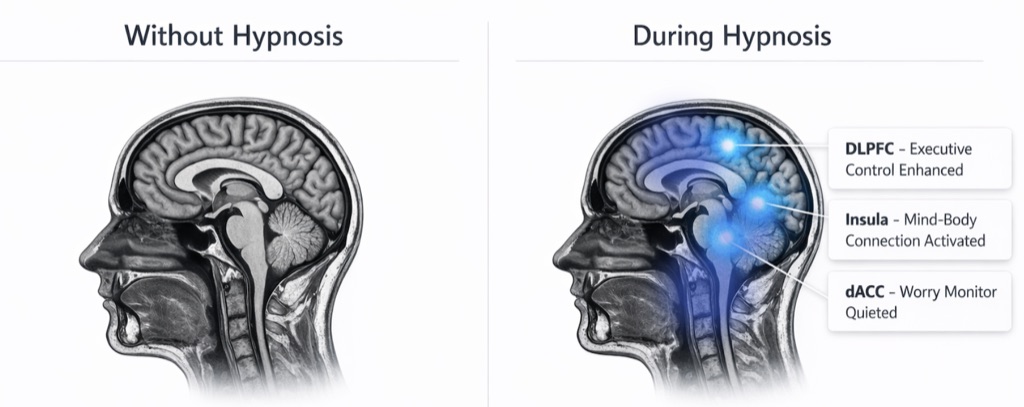
Regions from Stanford fMRI research on hypnosis (Jiang et al., 2017)
What am I really paying for, and how many sessions will I need?
When you book with a Registered Clinical Hypnotherapist (RCH) at Calgary Gut Hypnotherapy, you're committing to a three-session package that ranges from $220 to $350 per session. That's the total you'll pay out of pocket. Hypnotherapy is not a regulated health profession in Alberta, so most extended health plans won't reimburse you. You can check our faq for details on what's included in each session.
A food phobia doesn't usually resolve in a single visit. The three-session structure gives us time to assess your triggers, teach you self-regulation skills, and then do the deeper mental reprogramming work. Some people notice a shift after the first session, but lasting change typically needs that full commitment. If you've already tried CBT or exposure therapy without success, this structured approach often fits better.
Between sessions, you'll have access to audio recordings to reinforce the work. This isn't a passive process. You'll practice daily, and we'll track your progress together. If you're worried about the cost, think of it as an investment in facing your fear without panic. Many clients tell us they'd spent far more on missed work, avoided social events, or alternative treatments that didn't stick.
We deliver sessions virtually across Canada and in-person in Calgary. That means you can work with us from anywhere in the country. If you're still unsure whether this is right for you, our apply page walks you through a free consultation to see if we're a good fit.
Could this work for someone like me, or am I too skeptical?
You might be a good fit if your food phobia has stuck around despite trying other approaches. Many people come to hypnotherapy after CBT, exposure therapy, or medication didn't give them the relief they needed. In fact, 4 of 60 people in our research said hypnotherapy worked when other therapies had failed. If you feel like you've tried everything and still panic around certain foods, this could be the missing piece.
You're also a strong candidate if you're willing to engage with the root cause of your fear. Hypnotherapy isn't a passive process. It works best when you're ready to explore the thoughts and memories feeding the phobia. As one person put it, they wanted to "understand and resolve the root cause of the phobia" (3 of 60). If that resonates, you're already in the right headspace.
It helps if you can experience even a little relaxation during a session. Most people can be hypnotized, but if you're open to guided imagery and suggestion, you'll likely get more out of it. We cover this more in our article on hypnotizability and response. And if you've had some success with self-hypnosis apps but want deeper, personalized work, seeing a professional could be the next step.
Here's a quick checklist to see if you're a fit:
- You've tried other therapies without lasting change
- You're curious about what's driving your fear, not just avoiding triggers
- You can set aside time and money for a committed process
- You're okay with virtual sessions if you're not in Calgary
- You don't expect a one-session miracle
Will hypnosis work for you?
Regions from Stanford fMRI research on hypnosis (Jiang et al., 2017)
When is hypnotherapy for food phobia a bad idea? Be honest.
Hypnotherapy isn't for everyone with a food phobia. If you're in the middle of a severe eating disorder like anorexia or bulimia, your treatment team needs to clear you first. The same goes if you're actively suicidal or in a mental health crisis. A Registered Clinical Hypnotherapist (RCH) will screen for this before starting.
You should also pause if you're dealing with untreated psychosis or a dissociative disorder. Hypnosis can sometimes intensify those experiences. A 2019 review in the International Journal of Clinical and Experimental Hypnosis notes that while hypnosis is safe for most, it requires caution with certain psychiatric conditions.
Here's a quick checklist. If any of these sound like you right now, talk to your doctor before booking:
- You have an active eating disorder that needs medical monitoring
- You're experiencing psychosis or losing touch with reality
- You have a dissociative disorder like DID
- You're in a current mental health crisis or having suicidal thoughts
- You're unwilling to practice self-hypnosis between sessions (it's part of the work)
If you're just scared hypnosis won't work, that's different. Our hypnotherapy for fear of needles article explains how even strong skepticism doesn't block results. And if past therapy failed, read hypnotherapy after CBT-I failed — many people respond to hypnosis when nothing else helped.
Will hypnosis work for you?
Regions from Stanford fMRI research on hypnosis (Jiang et al., 2017)
Should I save money with an app, or pay for a real hypnotherapist?
I get it. When you're already spending so much mental energy just getting through meals, the idea of paying for sessions can feel like one more thing to worry about. But here's the reality: a self-hypnosis app gives you a generic recording. It can't ask about the exact moment your throat tightens when you see a plate of pasta, or adjust the approach when you realize the fear started after a choking incident at age seven. A Registered Clinical Hypnotherapist (RCH) does exactly that. At Calgary Gut Hypnotherapy, every session is built around your specific triggers and history. Apps like Nerva or Harmony Hypnosis can be useful tools for some people, but when a food phobia has been running your life for years, a pre-recorded track often isn't enough to untangle the deep-rooted patterns. You can read more about how professional hypnotherapy compares to apps in our Nerva review.
Think about what you're actually buying. With an app, you pay a subscription and hope for the best. With a hypnotherapist, you're paying for a trained professional who can recognize when your anxiety spikes mid-session and guide you through it safely. One of the biggest fears people mention is "What if I have a panic attack during the session?" A recording can't respond to that. A human can. They can slow things down, use grounding techniques, and make sure you never feel out of control. That's not just comfort — it's a safety net that makes the work possible for people with severe phobias.
Cost is a fair question. Apps charge $10 to $30 a month. A hypnotherapy session at Calgary Gut Hypnotherapy runs $220 to $350, with a 3-session commitment. That's a real difference. But consider this: if an app doesn't work after three months, you've lost time and hope, and you're still avoiding restaurants, dinner parties, or even your own kitchen. Many of our clients come to us after trying apps and finding they couldn't get past the surface-level relaxation. They needed someone to help them reprocess the actual fear response, not just listen to ocean sounds. For a deeper look at how hypnotherapy stacks up against other approaches, see our article on what actually works for anxiety.
I'm not saying apps are useless. If your food phobia is mild — maybe you get a little nervous trying new foods but you can still eat in public — a self-hypnosis app might be a decent starting point. But if you're at the point where you're skipping meals, losing weight, or feeling that full-blown panic just thinking about certain textures or smells, a professional is the safer bet. The research on phobia treatment consistently shows that tailored, therapist-delivered interventions outperform self-help for moderate to severe cases. And when you work with someone who understands the gut-brain connection — like a practitioner trained in gut-directed hypnotherapy — you're not just treating the fear. You're calming the physical nausea and stomach knots that come with it. That's something no app can do.
A 2019 meta-analysis in Clinical Psychology Review found that therapist-led hypnosis produced significantly higher response rates than self-hypnosis for anxiety and phobia disorders. The personalized guidance and real-time adjustments during sessions were key factors. This gap widens for moderate to severe cases, where professional support prevents dropout and manages in-session distress.
Source: Valentine et al., Clinical Psychology Review, 2019
| Session structure | Follows a fixed app script, same for everyone | Tailored to your specific food phobia triggers and history |
|---|---|---|
| Root cause work | Surface-level relaxation and suggestion | Addresses underlying emotional drivers and past experiences |
| Professional guidance | No live support; you're on your own | Direct access to a Registered Clinical Hypnotherapist (RCH) who adjusts the approach as needed |
| Accountability and reinforcement | Self-directed; easy to skip or abandon | Structured 3-session commitment with between-session strategies |
| Cost and value | Lower upfront cost, but may require ongoing subscriptions | $220–$350 per session, 3-session commitment, with lasting results for most clients |
Questions this page answers
How do I know if a hypnotherapist is qualified?
Look for a Registered Clinical Hypnotherapist (RCH) designation from ARCH-Canada. This ensures they completed accredited training and follow a code of ethics. Ask about their experience with food phobias specifically. A qualified practitioner will explain their approach clearly and never promise a cure.
What does a hypnotherapy session actually feel like?
You'll feel deeply relaxed but aware, like daydreaming. You can hear everything and open your eyes anytime. Most people feel calm and heavy. Some notice their thoughts drifting. It's not sleep or mind control. You remain in charge the whole time.
How many sessions will I need for a food phobia?
Most clients need four to eight sessions. We start with a three-session commitment to build skills and assess progress. Some see improvement sooner. Complex or long-standing phobias may take more. We'll adjust based on your response.
Can hypnotherapy make my anxiety worse?
Sometimes anxiety spikes temporarily as old patterns shift. This is normal and usually brief. We'll teach you coping tools for between sessions. If distress feels unmanageable, we pause and adjust the approach. You're never pushed beyond what you can handle.
What if I can't be hypnotized?
Almost everyone can enter hypnosis. It's a natural ability like daydreaming. If you struggle, we use different techniques to help you find the right state. There's no single way. We adapt to your learning style until it clicks.
Is hypnotherapy better than CBT for food phobia?
They work differently. CBT targets conscious thoughts and behaviors. Hypnotherapy accesses the subconscious where the fear lives. Many clients combine both. Hypnosis can make CBT more effective by reducing resistance. The best choice depends on your needs.
How long do results from hypnotherapy last?
For many, results are lasting. The brain learns a new response that becomes automatic. Some people benefit from occasional tune-up sessions. Using self-hypnosis recordings helps maintain progress. Relapse is possible but usually less intense.
Will hypnosis bring up traumatic memories?
It can, but we work at your pace. You won't be forced to relive anything. We focus on changing your response to memories, not erasing them. If something feels too intense, we stop and use gentler methods. Your safety comes first.
Can I use a self-hypnosis app instead of seeing a professional?
Apps can help with mild anxiety but lack personalization. A professional adjusts in real time to your triggers. For severe phobias, a trained RCH offers deeper, faster change. Many clients use both for best results.
What should I ask before booking a hypnotherapist?
Ask about their training, experience with food phobias, and typical session structure. Inquire about costs, number of sessions expected, and what happens if you feel worse. A good hypnotherapist answers openly and makes you feel safe.
I know food phobia can make you feel like you're losing your mind—and your life. But hypnotherapy isn't magic; it's a focused way to retrain the brain's fear response when nothing else has stuck. If you're ready to stop avoiding and start reclaiming meals, book a free consultation to see if this approach fits you. Keep reading: Hypnotherapy for phobias · Emetophobia · Binge eating
Apply to work with us
We take on just 10 new clients a month. Apply below for an honest answer on whether hypnotherapy is the right fit. No packages, no pressure.
Only 2 spots left for August

Danny M.
Danny M. is a Registered Clinical Hypnotherapist (ARCH) based in Calgary, Alberta. His work focuses on the conditions hypnotherapy has the strongest track record with: anxiety, insomnia, chronic pain, and IBS. Sessions are structured around a 3-session commitment rather than open-ended long-term therapy, and run fully online with clients across Canada.
Last updated: 2026-06-27