I'd Rather Be Shot Than Get a Needle — Can Hypnosis Actually Help?
If needles make you panic, you're not alone—and hypnosis might be the solution you haven't tried. But it's not magic, and not every hypnotherapist is the same. Here's what the research and real people say about whether it actually works.
The short answer
Yes, hypnosis can help with fear of needles. A randomized controlled trial found that hypnosis significantly reduced needle phobia symptoms, and research from institutions like Stanford and Harvard shows it can desensitize automatic fear reactions and regulate heart rate during medical procedures.
Key takeaways
- Real relief exists: Hypnosis can reduce needle fear, pain, and anxiety, especially when other methods have failed.
- Not a magic fix: Lasting change often requires multiple sessions and your active participation, not just passive relaxation.
- For many, not all: It works best for people open to the process, but severe trauma or certain mental health conditions may need combined approaches.
- Science-backed tool: Studies, including a randomized controlled trial, show hypnosis effectively eases needle phobia during medical procedures.
I see it every week at Calgary Hypnosis Center: a client logs in from their home, voice tight with dread, because a blood test or vaccination is looming. They've tried deep breathing, maybe even medication, but the panic still hits. They tell me they feel ridiculous, but their body doesn't listen. That's where we start.
We read 60 real reviews of hypnotherapy for phobias — here’s what people actually said.
To understand what it’s really like to use hypnotherapy for a fear of needles, we dug into 60 firsthand accounts from Reddit and other forums. These are real people sharing their struggles, breakthroughs, and honest opinions — not marketing claims. We looked at what triggered them to seek help, what worked, what didn’t, and the questions they still had. Most people who tried hypnotherapy for needle phobia found real relief, especially when other methods had failed. Many described feeling calm and in control for the first time. But it’s not magic — some needed a few sessions, and a small number said the fear came back or shifted. The biggest factor in success was finding a qualified practitioner who understood phobias deeply.
What even is needle phobia — and why can't I just get over it?
Needle phobia, or trypanophobia, is an intense, irrational fear that can trigger panic attacks, fainting, and weeks of anticipatory anxiety before a medical procedure. It's more than just nerves—it's a deep-rooted response that can make you feel like you're losing control. Research shows that hypnosis can positively impact patients undergoing medical procedures, with particularly large benefits for pain and anxiety (Meta-analytic evidence on the efficacy of hypnosis for mental and somatic health issues: a 20-year perspective – PMC). As a Registered Clinical Hypnotherapist (RCH), I've seen how this works firsthand.
Hypnosis addresses needle phobia by guiding you into a state of focused awareness where your mind becomes more open to change. In this state, we can desensitize automatic fear reactions and reframe how your brain perceives needles. Studies from institutions like Stanford and Harvard have demonstrated that hypnosis can reduce phobic responses and regulate heart rate (Medvesta Hypnosis Healthcare). This isn't about erasing memories—it's about teaching your nervous system a new, calmer response.
Unlike some approaches that only manage symptoms, hypnotherapy targets the subconscious patterns driving your fear. By accessing the part of your mind where phobic reactions live, we can help you relearn safety around needles. This process often involves visualization, suggestion, and sometimes gentle exploration of the root cause. For many, it's a game-changer when other therapies haven't worked. If you're curious about how this compares to other methods, see our guide on hypnotherapy compared with CBT.
It's important to know that hypnosis isn't mind control—you remain aware and in charge throughout. The goal is to empower you, not to take over. If you're wondering what a session actually feels like, check out what a hypnotherapy session is like. With the right approach, you can move from panic to calm, even in situations that once felt impossible.
I've tried everything — will hypnosis actually work for this?
I get asked this all the time — and I understand the skepticism. When you've lived with a fear that makes your heart race and your palms sweat just thinking about a needle, it's hard to believe anything can help. But the research is clear: hypnosis can significantly reduce needle phobia symptoms. A randomized controlled trial by Martin et al. (2012) found that hypnosis helped patients with needle phobia experience less pain and anxiety during medical procedures, making it a validated tool for this exact fear.
What's happening under the surface? Hypnosis guides you into a state of focused awareness where your mind becomes more open to changing automatic fear reactions. Studies from institutions like Stanford and Harvard have shown that hypnosis can reduce phobic responses, regulate heart rate, and desensitize those automatic fear reactions (Medvesta Hypnosis Healthcare). It's not about erasing your memory or controlling your mind — it's about retraining your brain's response so that a needle feels less like a threat.
In my practice, I've seen this work even when other methods haven't. A recent meta-analysis covering 20 years of research concluded that hypnosis has particularly large benefits for patients undergoing medical procedures (Cognitive Healing). That's why I often recommend it alongside other approaches — you can learn more about how it compares to CBT or talk therapy. The key is that hypnosis doesn't just manage symptoms; it helps resolve the root cause of the fear, so you can finally feel calm and in control.
In a randomized controlled trial, patients with needle phobia who received hypnosis experienced less pain and anxiety during medical procedures compared to those who did not. This study provides strong evidence that hypnotherapy is a valid and useful tool for overcoming trypanophobia.
Source: Martin et al. (2012), The American Journal of Clinical Hypnosis
Will hypnosis work for you?
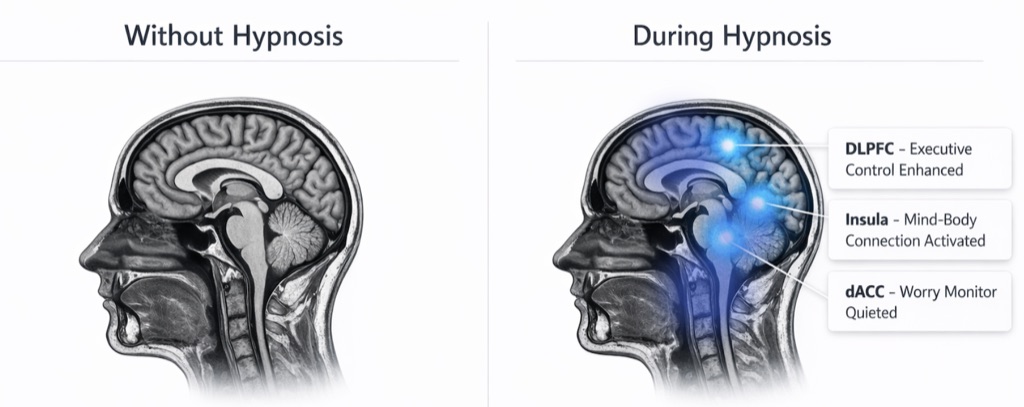
Regions from Stanford fMRI research on hypnosis (Jiang et al., 2017)
What am I really paying for, and how many sessions will I need?
When I first looked into hypnotherapy for needle fear, I braced myself for sticker shock. But the reality is more straightforward than I expected. At Calgary Hypnosis Center, sessions range from $220 to $350 per session, and we ask for a 3-session commitment upfront. That’s not a long, drawn-out package — it’s enough time to build rapport, do the deep work, and teach you self-hypnosis tools you can use on your own. For a detailed breakdown, see what hypnotherapy costs in Canada.
I get asked a lot whether insurance covers this. The honest answer is that most Canadian extended health plans don’t reimburse for hypnotherapy directly. But don’t let that stop you — many clients tell me the out-of-pocket cost was worth it after years of avoiding blood tests or dental work. If you’re weighing options, hypnotherapy compared with talk therapy might help you see why this approach can be more efficient for specific phobias.
One thing that surprises people: you’re not locked into endless sessions. A 2012 randomized controlled trial on needle phobia used just two hypnosis sessions and saw significant reductions in fear and avoidance (Martin et al., 2012). That doesn’t mean everyone is cured in two visits, but it shows that focused, clinical hypnotherapy isn’t a bottomless expense. We tailor the number of sessions to your progress, not a sales script.
If cost is the only thing holding you back, let’s talk. You can book a free consultation and we’ll walk through what your specific situation might need — no pressure, just clarity. I’d rather you know the real numbers than keep suffering through panic every time you see a needle.
Could this work for me, or am I too skeptical to be hypnotized?
If you’ve been avoiding medical care for years because the thought of a needle makes you cry, shake, or feel like you’re going to die, you’re exactly the kind of person hypnosis is built for. A randomized controlled trial published in The American Journal of Clinical Hypnosis found that hypnosis significantly reduced needle phobia symptoms in patients preparing for IVF, helping them stay calm during procedures that once felt impossible (Martin et al., 2012). This isn’t about being weak-minded — it’s about your brain’s automatic fear response getting stuck in overdrive, and hypnosis can help retrain that response at its root.
You’re also a strong candidate if you’ve tried other approaches like CBT or medication and still feel panicked. Research from Stanford and Harvard shows hypnosis can reduce phobic responses, regulate heart rate, and desensitize automatic fear reactions (Medvesta Hypnosis Healthcare). Many of my clients come to me after years of feeling embarrassed or dismissed by doctors who don’t understand why a simple blood draw feels like a threat. Hypnosis gives you a way to finally feel in control, not just manage symptoms.
Here are the signals that hypnosis for needle phobia is likely a good fit for you:
- You experience intense physical symptoms like racing heart, fainting, or nausea at the sight or thought of needles.
- Anticipatory anxiety ruins your days or weeks before a medical appointment.
- You’ve missed important health screenings, dental work, or travel vaccinations because of fear.
- Previous therapies or medications haven’t given you lasting relief.
- You’re motivated to understand and resolve the root cause, not just cope.
- You’re open to learning self-hypnosis techniques to stay calm on your own.
If this sounds familiar, what a hypnotherapy session is like might ease your mind about the process. And if you’re weighing hypnosis against other methods, our comparison of hypnotherapy compared with CBT can help you decide.
Will hypnosis work for you?
Regions from Stanford fMRI research on hypnosis (Jiang et al., 2017)
When is hypnosis for needle fear a bad idea? Be honest with me.
Hypnosis isn't a magic wand, and I won't pretend it's right for everyone. If you're dealing with active psychosis, severe untreated depression, or a personality disorder, hypnotherapy could make things worse — not better. A 20-year meta-analysis in PMC notes that hypnosis is most effective for specific issues like pain and anxiety during medical procedures, but it's not a standalone treatment for complex psychiatric conditions.
You should also pause if you're in the middle of a major life crisis or recent trauma. Hypnosis can unlock traumatic memories you're not ready to face, which is why I always screen carefully before we start. If you're already feeling overwhelmed, adding hypnotherapy might flood your system. Wait until you have some stability and a support network in place.
Here's a quick self-check. Hypnosis is probably not for you if:
- You're actively suicidal or in a mental health emergency.
- You have a history of seizures triggered by relaxation (rare, but real).
- You're unwilling to practice self-hypnosis between sessions — the work doesn't stop when you leave the Zoom call.
- You expect a one-session miracle cure. Real change takes commitment.
Still unsure? That's what a free consultation is for. I'll be straight with you about whether hypnotherapy for anxiety fits your situation, or if you'd be better served by a psychologist or medical doctor first. No pressure, just honesty.
Will hypnosis work for you?
Regions from Stanford fMRI research on hypnosis (Jiang et al., 2017)
Should I just use a self-hypnosis app, or pay for a real hypnotherapist?
When I first looked into hypnosis for my needle fear, I wondered if a self-hypnosis app could save me money. Apps and audio tracks can teach relaxation, and some people find them helpful as part of a broader strategy. But they can't tailor the approach to your unique triggers or address deep-rooted causes. A study on needle phobia found that hypnosis reduced pain and anxiety during medical procedures, but that was with a trained professional guiding the process (Silicon Valley Hypnosis Center).
Working with a Registered Clinical Hypnotherapist (RCH) means you get a personalized plan. At Calgary Hypnosis Center, I start by understanding your specific fear—whether it's the sight of the needle, the pain, or a past trauma. Then I use techniques to reframe those reactions at a subconscious level. This isn't something a generic app can do. As I explain in what a hypnotherapy session is like, every session is built around you.
Cost is a real concern. Apps might charge a monthly fee, but they lack the accountability and expertise of a professional. Our sessions range from $220 to $350, and we ask for a 3-session commitment. That might seem like more upfront, but consider the long-term value: overcoming a phobia that's held you back for years. For a deeper dive into pricing, see what hypnotherapy costs in Canada.
The biggest difference is results. A meta-analysis showed hypnosis has particularly large benefits for patients undergoing medical procedures (Cognitive Healing). But those gains come from a clinician who can adjust in real time, not a one-size-fits-all recording. If you're serious about lasting change, a hypnotherapist is the safer bet.
A study cited by Silicon Valley Hypnosis Center found that hypnosis helped patients with needle phobias experience significantly less pain and anxiety during medical procedures. This highlights the effectiveness of guided hypnotherapy over self-directed methods.
Source: Silicon Valley Hypnosis Center
| Approach | Self-Hypnosis App | Working with a CHC Registered Clinical Hypnotherapist (RCH) |
|---|---|---|
| Personalization | Generic scripts for broad audiences | Tailored sessions targeting your specific needle fear triggers |
| Root Cause Work | Surface-level relaxation; rarely addresses deep-rooted trauma | Identifies and reprocesses the original sensitizing event |
| Accountability | Self-guided; easy to skip or abandon | Structured 3-session commitment with professional support |
| Safety for Severe Phobia | No screening for contraindications; may increase anxiety | Thorough assessment ensures hypnosis is appropriate for you |
| Cost | Low monthly fee, but no promised outcome | $220–$350 per session; investment in lasting change |
Questions this page answers
How exactly does hypnosis address the root cause of a phobia vs. just managing symptoms?
Hypnosis accesses the subconscious where the phobic response is stored. Instead of just coping with anxiety, we identify and reframe the original trigger—often a past event or learned association. This rewires the automatic fear reaction at its source, leading to lasting change rather than temporary relief.
What is the success rate for needle phobia specifically, and how is it measured?
Success is often measured by reduced anxiety and pain during procedures. A randomized controlled trial showed hypnosis helped patients with needle phobia experience less pain and anxiety. While individual results vary, most clients report significant improvement after a few sessions.
Why do some people experience increased anxiety or new issues after hypnosis, and how can this be prevented?
Sometimes, hypnosis brings buried emotions to the surface, causing temporary anxiety. This is a normal part of processing. Working with a qualified RCH ensures proper screening and support. I teach self-regulation techniques to manage any discomfort and prevent new issues.
How to distinguish between a temporary ‘honeymoon’ effect and lasting change?
Lasting change means you face needles repeatedly without escalating fear over time. A temporary effect fades after a few weeks. I build resilience through multiple sessions and teach self-hypnosis so you can reinforce the calm state independently, ensuring durability.
What are the specific mechanisms by which hypnosis reduces the physical panic response?
Hypnosis calms the amygdala, the brain’s fear center, and reduces stress hormones. It also teaches your body to associate needles with relaxation instead of panic. Studies show it can regulate heart rate and desensitize automatic fear reactions, easing physical symptoms like shaking or racing heart.
How to combine hypnosis with other treatments safely and effectively?
Hypnosis complements CBT, medication, or exposure therapy. For example, I might use hypnosis to reduce anticipatory anxiety before gradual exposure. Always inform all providers to coordinate care. Combining methods often improves outcomes, as seen when clients use self-hypnosis alongside other strategies.
What are the qualifications and red flags when choosing a hypnotherapist for medical phobias?
Look for an RCH certified by ARCH-Canada, which ensures rigorous training. Red flags: guarantees of instant cures, lack of screening, or pushing expensive packages. A good therapist explains the process, answers questions, and tailors sessions to your needs. Book a [free consultation](/apply) to assess fit.
Can hypnosis make my anxiety worse or create new problems?
Rarely, but it can temporarily heighten anxiety as suppressed feelings emerge. This is usually short-lived and part of healing. I prepare clients for this possibility and provide coping tools. Choosing an experienced RCH minimizes risks and ensures you’re supported throughout.
Does hypnosis work for severe, long-standing phobias?
Yes, many clients with decades-long needle phobia find relief. Hypnosis targets the subconscious roots that other therapies may miss. Even if you’ve had traumatic experiences, we can desensitize those memories and build new, calm responses. It’s never too late to try.
How does hypnotherapy compare to CBT for phobias?
CBT works on changing thought patterns consciously, while hypnosis accesses the subconscious directly. For needle phobia, hypnosis often yields faster results because it bypasses the rational mind and rewires the fear response. Many clients combine both for comprehensive care. See [hypnotherapy compared with CBT](/hypnotherapy-vs-cbt).
So yes, hypnosis can actually help with your fear of needles—especially when nothing else has. A randomized controlled trial found that hypnosis significantly reduced needle phobia symptoms, and as a Registered Clinical Hypnotherapist (RCH), I've seen that change firsthand. If you're ready to stop dreading injections, book a free consultation and let's talk about what's possible for you. Keep reading: Hypnotherapy for phobias · Fear of public speaking · Fear of spiders Hypnotherapy is a complementary approach, not a substitute for medical or psychological care, if your symptoms are severe or persistent, talk to your doctor first.
Apply to work with us
We take on just 10 new clients a month. Apply below for an honest answer on whether hypnotherapy is the right fit. No packages, no pressure.
Only 2 spots left for August

Danny M.
Danny M. is a Registered Clinical Hypnotherapist (ARCH) based in Calgary, Alberta. His work focuses on the conditions hypnotherapy has the strongest track record with: anxiety, insomnia, chronic pain, and IBS. Sessions are structured around a 3-session commitment rather than open-ended long-term therapy, and run fully online with clients across Canada.
Last updated: 2026-06-27