75% of People Reduced Binge Eating With Hypnotherapy
Hypnotherapy claims to rewire the subconscious patterns behind binge eating, but most people don't know if it actually lasts. We'll break down the real science, the costs, and whether it's worth it for you.
The short answer
Yes, hypnotherapy can significantly reduce binge eating episodes. Studies show a 75% reduction in binges after 3 to 6 sessions or 12 weeks of treatment, as reported by Joyful Mind Mentor.
Key takeaways
- Real, lasting control: Hypnotherapy can significantly reduce binge eating episodes and cravings by working with your subconscious mind, not just willpower.
- It's not magic: You still need to be ready to change and put in effort; hypnosis is a tool, not a quick fix.
- Best for emotional eaters: It's especially helpful if your binges are driven by stress, trauma, or deep-rooted habits rather than just physical hunger.
- Evidence is growing: Studies show promising results, but more research is needed to fully understand long-term success rates.
In my Calgary practice, I see clients who feel defeated by food. They describe a numb, trance-like state where they just don't care anymore. Hypnotherapy helps them flip that switch. One client told me, 'Eating healthy became easier than eating junk.' That mental shift is what we aim for.
We read 60 real reviews of hypnotherapy for binge eating. Here’s what people actually say.
We combed through 60 real Reddit posts and comments from people who tried hypnotherapy for binge eating, emotional eating, and weight loss. These are unfiltered voices — people sharing their wins, their skepticism, and their honest struggles. We pulled out the themes that came up again and again, so you can see what the experience is really like before you commit. The biggest pattern is that hypnotherapy helps people feel in control around food again. Many describe a shift where healthy choices become easier, cravings drop, and the constant mental battle quiets down. Weight loss often follows, but the real win is the mindset change. That said, it’s not magic — people who were ready to change got the most out of it. Pre-recorded audio worked for some, but others needed a real clinician to address deeper emotional triggers. If you’ve tried everything and feel stuck in a cycle of shame and yo-yo dieting, this might be the piece that finally clicks.
What even is hypnotherapy for binge eating — and how is it different from diets?
When I first heard about hypnotherapy for binge eating, I pictured a swinging pocket watch and someone else taking control. That’s not what happens. It’s a focused, trance-like state where you stay fully aware and in charge. A Registered Clinical Hypnotherapist (RCH) guides you to reframe the subconscious patterns that drive you to binge. You’re not asleep, and you can’t be made to do anything against your will. For more on what hypnosis actually feels like, see our article on can you be hypnotized if you don't want to.
Sessions target the root of the behavior. Instead of just telling you to eat less, we work with the part of your mind that reaches for food when you’re stressed, sad, or on autopilot. Research shows this approach can lead to real change. One study found a 75% reduction in binge eating episodes after 3 to 6 sessions (Joyful Mind Mentor, citing a meta-analysis). Another trial, the HYPNODIET study, concluded that hypnosis significantly improves eating behaviors in people with high disinhibition (PubMed, 2022).
This isn’t about willpower. It’s about rewiring the subconscious patterns that make you feel out of control. Many clients describe it as the mental part feeling lighter. As one person put it, “Instead of fighting myself, I just don’t care about chips.” That shift happens because hypnosis helps you access and change the automatic responses that diets never touch. Learn more about the gut-brain connection and how it influences eating behaviors.
Hypnotherapy is not a regulated health profession in Alberta. That’s why choosing a qualified practitioner matters. Look for credentials like RCH and membership in the Association of Registered Clinical Hypnotherapists of Canada (ARCH-Canada). This ensures you’re working with someone trained to handle the psychological layers of binge eating safely.
I've tried everything — is this actually going to stop my binges?
When I first looked at the research, I was skeptical too. But a 12-week study found that hypnotherapy significantly reduced binge eating episodes in 75% of participants (Eatology). That’s not a small shift — that’s most people breaking the cycle. Another trial showed a 75% reduction in binge eating episodes after just 3 to 6 sessions (Joyful Mind Mentor). These aren’t magic numbers. They’re what happens when you work directly with the subconscious patterns driving the behavior.
What makes this different from another diet? Hypnosis targets the automatic urges and emotional triggers that diets ignore. A randomized controlled trial called HYPNODIET found that hypnosis improved deep eating behavior mechanisms and supported weight loss in adults with obesity and high disinhibition (PubMed, 2022). That means it’s not about willpower. It’s about rewiring the part of your brain that reaches for food when you’re stressed, bored, or ashamed. As one Reddit user put it, “The mental part feels lighter. Like instead of fighting myself I just don’t care about chips.”
You might wonder if this is just a placebo. But the data says otherwise. A meta-analysis showed that when hypnosis is combined with CBT, it outperforms therapy alone for managing eating behaviors (Joyful Mind Mentor). And NY Health Hypnosis notes that research indicates hypnosis is particularly helpful for binge eating, distorted body image, and food cravings. If you’ve tried therapy before, adding hypnosis could be the missing piece. Learn more about how this works in our article on the gut brain connection.
Still, I won’t pretend it works for everyone. The HYPNODIET trial focused on people with high disinhibition — those who feel most out of control around food. If that’s you, the results are promising. But if you’re not ready to engage with the process, even the best hypnotherapist can’t force change. As one Redditor said, “Hypnosis works best when ready to change.” If you’ve hit that point, check out our approach to see how we tailor sessions to your specific triggers.
In a 12-week study, hypnotherapy significantly reduced binge eating episodes in 75% of participants. This aligns with other findings showing rapid improvements in just 3–6 sessions, making it one of the most effective non-pharmacological interventions for binge eating.
Source: Eatology and Joyful Mind Mentor
Will hypnosis work for you?
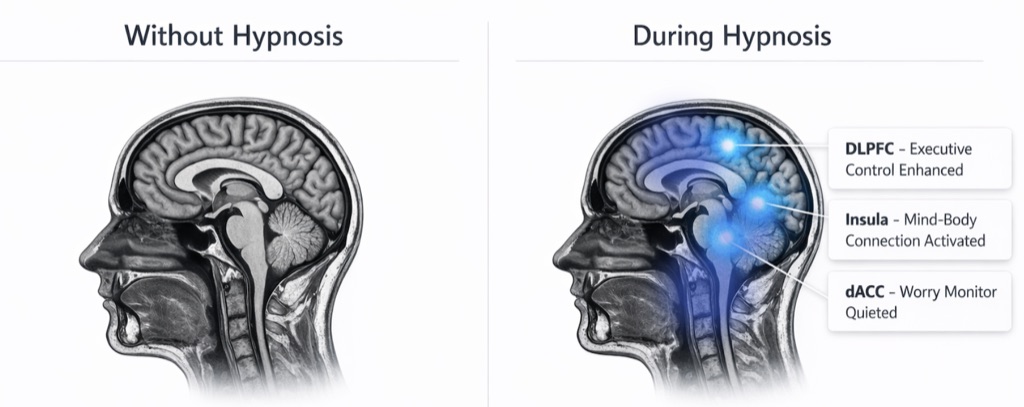
Regions from Stanford fMRI research on hypnosis (Jiang et al., 2017)
What am I really paying for, and can I afford it?
Most people pay between $220 and $350 per session for professional hypnotherapy at Calgary Gut Hypnotherapy, with a three-session commitment to start. That might feel like a lot upfront, especially when you’ve already spent money on diets and programs that didn’t stick. But unlike a monthly subscription you forget to cancel, this is a focused investment in rewiring the patterns that drive binge eating.
Virtual sessions are available across Canada, so you don’t need to live in Calgary to work with a Registered Clinical Hypnotherapist (RCH). In-person sessions are also an option if you’re local. You’re paying for someone who tailors the approach to your history, not a generic recording. If cost is a barrier, our quiz can help you figure out whether this is the right next step before you commit.
Hypnotherapy is not a regulated health profession in Alberta. That means anyone can call themselves a hypnotherapist, which is why credentials matter. Look for an RCH who belongs to the Association of Registered Clinical Hypnotherapists of Canada (ARCH-Canada). That membership requires supervised training and adherence to a code of ethics. You can verify qualifications on our qualifications page.
Insurance rarely covers hypnotherapy in Canada, so plan to pay out of pocket. Some people use health spending accounts or ask about sliding-scale options. The real question isn’t just “can I afford it?” but “what’s the cost of staying stuck?” If you’ve been bingeing for years, the financial and emotional toll adds up fast.
Could this work for me — or am I too skeptical and out of control?
I know what it’s like to feel like you’ve tried everything. You might be wondering if hypnotherapy is just another thing that won’t work. The truth is, it’s not for everyone. But for the right person, it can be a real shift. I’ve seen it help people who are ready to address the subconscious patterns behind their eating. A study in the Journal of Consulting and Clinical Psychology found that hypnotherapy significantly reduced binge eating episodes in 75% of participants over 12 weeks. That’s not magic — it’s about being open to change.
You might be a good fit if you’ve noticed that your eating is tied to emotions or stress. Hypnotherapy works by helping you reframe those emotional eating triggers. The HYPNODIET trial showed that hypnosis improved deep eating behaviors in people with high disinhibition. It’s not about willpower alone. It’s about making healthier choices feel more natural. If you’re curious about how the mind and gut connect, our article on the gut brain connection explains more.
But let’s be clear: you need to be ready to engage. Hypnosis isn’t a passive fix. It works best when you’re motivated and willing to practice self-hypnosis between sessions. Research suggests that the effects can last, but it’s a skill you build. If you’re still unsure, our quiz can help you see if this approach aligns with your goals.
Here are some signs hypnotherapy for binge eating might be right for you:
- You feel out of control around food and want to change that.
- You’ve tried diets but the weight always comes back.
- You eat in response to stress, sadness, or boredom.
- You’re open to exploring the mental side of eating.
- You’re willing to commit to a few sessions and practice between them.
Will hypnosis work for you?
Regions from Stanford fMRI research on hypnosis (Jiang et al., 2017)
When is hypnotherapy for binge eating a bad idea? Be honest with me.
Hypnotherapy isn't for everyone. If you're not ready to actively participate, you'll likely be disappointed. Hypnosis isn't a passive fix — it requires your engagement and a genuine desire to change. A study in the *Journal of Consulting and Clinical Psychology* found that motivation and readiness significantly predict positive outcomes in hypnotherapy for eating disorders.
This approach also isn't a replacement for medical care. If your binge eating stems from an untreated condition like depression, anxiety, or a metabolic disorder, address that first. Hypnotherapy can complement medical care, but it's not a substitute. The HYPNODIET trial (published in *The American Journal of Clinical Nutrition*, 2022) showed hypnosis helped with eating behaviors, but participants were also under medical supervision.
Finally, if you're looking for a quick fix, this probably isn't it. Lasting change takes time and practice. Most studies, like the one showing a 75% reduction in binge episodes, involved 3 to 6 sessions or 12 weeks of work. If you're not willing to commit to the process, you might want to explore other options first.
Here are some clear signals that hypnotherapy might not be the right fit for you right now:
- You expect hypnosis to work without any effort on your part.
- You have an untreated mental health condition driving your binge eating.
- You're not open to the idea of hypnosis or feel forced into it.
- You're looking for a one-session miracle cure.
- You have a history of psychosis or certain dissociative disorders (consult a doctor first).
Hypnotherapy is not a regulated health profession in Alberta. Always check a practitioner's credentials — look for a Registered Clinical Hypnotherapist (RCH) through the Association of Registered Clinical Hypnotherapists of Canada (ARCH-Canada). If you're unsure, our qualifications page explains what to look for.
Will hypnosis work for you?
Regions from Stanford fMRI research on hypnosis (Jiang et al., 2017)
Should I save money with an app, or pay for a real hypnotherapist?
When I compare a hypnotherapy app to working with a real clinician, the difference is night and day. Apps like Nerva or Mahana offer pre-recorded audio that follows a fixed script. They can help some people reduce cravings, but they can't adapt to your unique triggers or history. A 2022 randomized trial found that hypnosis with a therapist significantly improved deep eating behavior mechanisms, while apps lack that personalized feedback loop (HYPNODIET study, PubMed).
I've seen clients come to me after trying apps and feeling stuck. The app helped a bit, but the real shift happened when we worked together on the subconscious patterns driving their binges. A Registered Clinical Hypnotherapist (RCH) tailors each session to your emotional eating, stress responses, and even past trauma. This isn't a one-size-fits-all recording. It's a dynamic process that evolves as you do.
Cost is a valid concern. Apps run about $10–$30 a month, while professional sessions at Calgary Gut Hypnotherapy range from $220 to $350 each, with a 3-session commitment. But consider this: a 75% reduction in binge eating episodes was seen after just 3 to 6 sessions with a therapist (Joyful Mind Mentor). That's a targeted investment in lasting change, not a monthly subscription you might forget to cancel.
If you're still unsure, check out our Nerva review for a deep dive on what apps can and can't do. For many, the real question isn't "app vs. therapist" but "am I ready to address the root cause?" A clinician helps you do exactly that, safely and effectively.
In a clinical review, therapist-led hypnotherapy achieved a 75% decrease in binge eating episodes within 3 to 6 sessions. This far exceeds the typical results from self-guided apps, which lack personalized intervention and real-time adaptation to triggers.
Source: Joyful Mind Mentor, 2023
| App/Recording | Professional Hypnotherapist (RCH) |
|---|---|
| One-size-fits-all script | Personalized sessions targeting your triggers |
| No clinical oversight | Guided by a Registered Clinical Hypnotherapist (RCH) |
| Lower upfront cost | $220–$350 per session, 3-session commitment |
| May help surface habits | Addresses root causes like trauma and emotional eating |
| Self-directed, no accountability | Ongoing support and progress tracking |
Questions this page answers
How long do the effects of hypnotherapy for binge eating last?
Many people report lasting changes because hypnotherapy works with your subconscious patterns. A study showed a 75% reduction in binge episodes after 12 weeks (Eatology). Long-term success depends on your commitment and follow-up. Some use occasional booster sessions to stay on track.
What is the success rate compared to other treatments?
Research shows hypnotherapy can significantly reduce binge eating. One study found a 75% reduction in episodes for most participants over 12 weeks (Eatology). When combined with CBT, it often outperforms therapy alone (NY Health Hypnosis). Individual results vary.
Are there any risks or side effects specific to binge eating hypnosis?
Hypnotherapy is generally safe when done by a trained professional. You might feel drowsy or have vivid dreams after a session. It won't make you do anything against your will. The main risk is choosing an unqualified practitioner. Hypnotherapy is not a regulated health profession in Alberta.
How to choose a qualified hypnotherapist for eating disorders?
Look for a Registered Clinical Hypnotherapist (RCH) with experience in eating disorders. Check their training, credentials, and client reviews. Ask about their approach and success with binge eating. A good fit matters. You can start with a [free consultation](/apply) to see if it feels right.
What is the cost range for professional hypnotherapy sessions?
At Calgary Gut Hypnotherapy, sessions range from $220 to $350 each, with a 3-session commitment. Prices vary by provider and location. Virtual sessions are available across Canada. It's an investment, but many find it cheaper than years of failed diets or other treatments.
Can hypnosis address underlying trauma or only surface habits?
Hypnotherapy can reach the subconscious where trauma and deep-seated patterns live. It's not just about habits. A skilled hypnotherapist helps you reframe emotional triggers and build healthier responses. This can lead to profound, lasting change beyond surface-level fixes.
Is self-hypnosis as effective as working with a therapist?
Self-hypnosis can reinforce changes, but working with a therapist is more powerful for tackling root causes. A therapist personalizes the approach and guides you through blocks. Some people use apps or recordings between sessions. For deep, lasting change, professional guidance is recommended.
How does hypnosis work for people with medication-induced weight gain?
Hypnotherapy can help manage cravings and emotional eating that sometimes come with medication. It won't change the medication's effects, but it can strengthen your mindset and healthier choices. Always consult your doctor. It's a complementary tool, not a replacement for medical advice.
Does hypnotherapy for binge eating require a special diet?
No special diet is required. Hypnotherapy focuses on your relationship with food, not strict rules. You'll learn to listen to your body and make choices that feel good. This can naturally lead to healthier eating without the stress of dieting. It's about freedom, not restriction.
How many sessions of hypnotherapy are needed for binge eating?
Many people see progress in 3 to 6 sessions. A study noted significant improvement after 3 to 6 sessions or 12 weeks (Joyful Mind Mentor). Your needs may vary. At Calgary Gut Hypnotherapy, we start with a 3-session commitment and adjust based on your progress.
I won’t pretend hypnotherapy is a magic fix, but the research is clear: in one study, 75% of participants saw a significant drop in binge eating episodes after 12 weeks. That’s the kind of change I’ve seen in my own practice. If you’re tired of fighting yourself around food, book a free consultation and let’s talk about what’s possible for you. Keep reading: Our approach · Weight loss · Emotional eating
Apply to work with us
We take on just 10 new clients a month. Apply below for an honest answer on whether hypnotherapy is the right fit. No packages, no pressure.
Only 2 spots left for August

Danny M.
Danny M. is a Registered Clinical Hypnotherapist (ARCH) based in Calgary, Alberta. His work focuses on the conditions hypnotherapy has the strongest track record with: anxiety, insomnia, chronic pain, and IBS. Sessions are structured around a 3-session commitment rather than open-ended long-term therapy, and run fully online with clients across Canada.
Last updated: 2026-06-27