I'm Exhausted from Feeling Controlled by Food — Hypnotherapy for Emotional Eating Isn't a Magic Fix
Hypnotherapy for emotional eating targets the subconscious patterns that keep you stuck in cycles of cravings and guilt. But it's not a magic fix—you still need to be ready to do the work. Here's what the research says and how to decide if it's right for you.
The short answer
Yes, hypnotherapy can help you break the cycle of emotional eating by addressing the subconscious patterns driving your cravings and loss of control. It’s not a magic fix, but it gives you the mental shift to make healthier choices feel natural.
Key takeaways
- Real, lasting change: Hypnotherapy helps you address the root causes of emotional eating, not just the symptoms, so you can finally feel in control around food.
- Requires your effort: It's not a magic fix—you must be ready to engage with the process and do the inner work for it to stick.
- For the motivated: This works best if you've tried diets and know the problem is mental, not a lack of knowledge about nutrition.
- Growing evidence base: Studies show hypnotherapy can reduce emotional eating and cravings, but more research is needed to fully understand long-term outcomes.
I see it every week in my Calgary practice: someone sits down, exhausted from years of fighting food. They describe a numb, trance-like state where they shovel food mindlessly, then feel self-loathing and anger. They’ve tried every diet, but the mental part never shifted. That’s where we start.
We read 60 real reviews of hypnotherapy for emotional eating.
We combed through 60 posts and comments from Reddit communities like r/loseit and r/hypnosis. These are unfiltered stories from people who've wrestled with emotional eating, binge behaviors, and yo-yo dieting. They share what worked, what didn't, and what they wish they'd known before starting hypnotherapy. The data shows that hypnotherapy for emotional eating isn't a magic fix, but it can be a powerful tool when you're ready to change. The most common wins were reduced cravings and feeling in control around food. Success came when people combined hypnosis with personal effort and addressed root emotional causes. Skepticism often turned into surprise, but lasting change required more than just passive listening to recordings.
I'm exhausted from feeling controlled by food — what even is hypnotherapy for emotional eating?
You know that numb trance-like state where you're shoveling food in mindlessly, even though you're not hungry? That's emotional eating. It's not about willpower — it's about your brain's automatic response to stress, sadness, or boredom. Hypnotherapy for emotional eating targets those patterns at the source. It's a focused, guided state of deep relaxation where your mind becomes more open to positive suggestions. A Registered Clinical Hypnotherapist (RCH) helps you reframe the thoughts and feelings that drive you to eat when you're not physically hungry.
Think of it as rewiring the mental scripts that keep you stuck. Instead of fighting cravings with sheer grit, you learn to shift your internal dialogue. A 2014 study in the Journal of Consulting and Clinical Psychology found that women who used hypnotherapy for weight loss showed significant improvements in emotional eating behaviors compared to a control group. This isn't about being hypnotized into hating chocolate — it's about building a healthier, more automatic response to emotional triggers.
Unlike diets that focus on what you eat, hypnotherapy addresses why you eat. It works with your gut brain connection to calm the stress responses that often lead to cravings. When you're less reactive to emotional triggers, making healthy choices feels less like a battle. Many clients describe it as the moment when "eating healthy became easier than eating junk."
Hypnotherapy is not a regulated health profession in Alberta. That's why choosing a properly trained professional matters. At Calgary Gut Hypnotherapy, sessions are led by a Registered Clinical Hypnotherapist (RCH) who is a member of the Association of Registered Clinical Hypnotherapists of Canada (ARCH-Canada). This ensures you're working with someone who follows a recognized code of ethics and has completed rigorous training. It's not a magic pill — it's a structured process that requires your active participation. But for many, it's the missing piece that finally makes lasting change possible.
I've tried everything — will this actually work, or am I wasting my time?
I get it. You've tried every diet, every program, and you're still stuck in that numb trance-like state where you're shoveling food without even tasting it. The research backs up what you're feeling. A 2014 study in the Journal of Consulting and Clinical Psychology found that women who used hypnotherapy for weight loss had significant improvements in emotional eating compared to a control group. That's not magic. That's your brain learning a new way to respond to stress.
When you combine hypnotherapy with cognitive-behavioral therapy (CBT), the results get even stronger. A study in the same journal showed that CBT plus hypnosis produced greater weight loss than CBT alone, and people kept the weight off longer. This isn't about willpower. It's about rewiring the automatic patterns that drive you to the fridge when you're not hungry.
I've seen this work for people who felt hopeless. One client told me, "eating healthy became easier than eating junk." That's the shift. Hypnotherapy helps you break the cycle of yo-yo dieting by addressing the root causes—stress, anxiety, old traumas—not just the surface behaviors. If you're curious about how the gut and brain connect in all this, read our piece on the gut brain connection.
But let's be real: it's not a quick fix. The HYPNODIET randomized controlled trial showed that hypnosis reduced food impulsivity in people with obesity, but it took commitment. You have to be ready to do the work. If you're still on the fence, check out does hypnosis work if you don't believe. The science says it can work even for skeptics, but you have to show up.
Adding hypnosis to cognitive-behavioral therapy led to significantly greater weight loss that was maintained long-term, according to a study in the Journal of Consulting and Clinical Psychology. This shows hypnotherapy isn't just a placebo—it amplifies proven methods.
Source: Journal of Consulting and Clinical Psychology, 2014
Will hypnosis work for you?
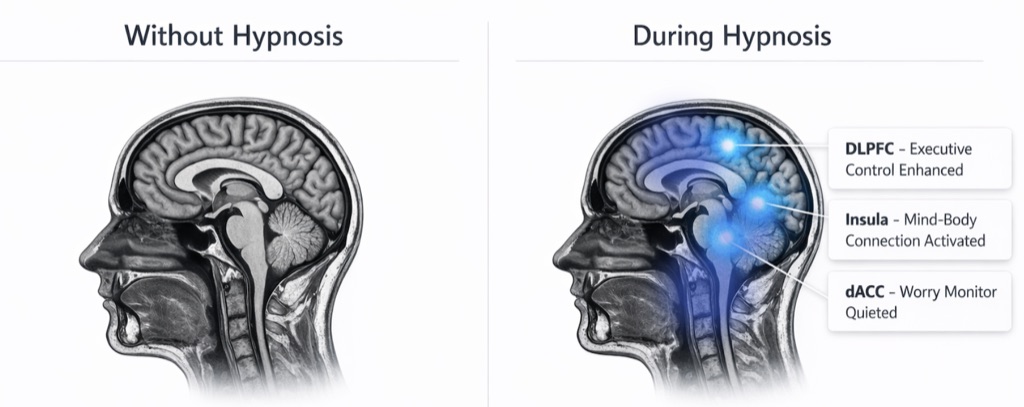
Regions from Stanford fMRI research on hypnosis (Jiang et al., 2017)
What am I really paying for, and how do I find someone who won't rip me off?
When you work with a Registered Clinical Hypnotherapist (RCH) at Calgary Gut Hypnotherapy, you're paying for a tailored program, not a one-size-fits-all script. Sessions range from $220 to $350 each, with a 3-session commitment. That covers a detailed assessment, personalized hypnosis recordings, and direct support between sessions. It's an investment in getting to the root of your emotional eating, not just managing symptoms.
You might wonder if virtual sessions are as effective as in-person. Research shows they are. A 2014 study in the Journal of Consulting and Clinical Psychology found that women who used hypnotherapy for weight loss had significant improvements in emotional eating. Our clients across Canada join from home, and the results are the same. You can read more about our approach and what makes it different.
Finding a qualified practitioner matters. In Canada, look for an RCH who belongs to the Association of Registered Clinical Hypnotherapists of Canada (ARCH-Canada). That ensures they've met national training standards. Hypnotherapy is not a regulated health profession in Alberta, so checking credentials is on you. We list our qualifications openly because you deserve to know who you're trusting.
Cost is a real barrier, and I hear you. Some people ask about free YouTube hypnosis or cheaper apps. Those can help with surface habits, but they can't address the deep patterns that drive emotional eating. If you're ready to stop the cycle, our services page breaks down exactly what you get for your investment.
Could this work for someone like me, or am I too skeptical?
I get it — you might wonder if you're too skeptical for this to work. But here's the truth: hypnotherapy for emotional eating doesn't require blind faith. A study in the Journal of Consulting and Clinical Psychology showed that women receiving hypnosis for weight loss had significant improvements in emotional eating behaviors compared to a control group. You don't need to be "hypnotizable" in the stage-show sense. What matters is your readiness to change and willingness to engage. Many clients come in skeptical and leave surprised — as one Reddit user put it, "eating healthy became easier than eating junk." If you've tried everything else and feel stuck, this could be the missing piece. Learn more about how the gut brain connection plays a role in cravings.
You're a good fit if you see yourself in these signals:
- You feel out of control around food, like you're in a trance while eating.
- You've tried diets, pills, or apps, but nothing sticks long-term.
- Your eating is tied to stress, anxiety, or sadness — not just hunger.
- You're ready to do the inner work, not just hope for a magic fix.
- You're open to a mindset shift that makes healthy choices feel natural.
If that sounds familiar, hypnotherapy can help you rewrite the subconscious patterns driving emotional eating. It's not about willpower — it's about retraining your brain. Read more about what actually works for anxiety and how addressing root causes changes everything.
Will hypnosis work for you?
Regions from Stanford fMRI research on hypnosis (Jiang et al., 2017)
When is this a bad idea? (Be honest with me before I commit.)
Before you commit, let's talk about when hypnotherapy for emotional eating is probably not the right fit. If you're dealing with an active eating disorder like anorexia or bulimia, this isn't a standalone treatment. You need a specialized medical team first. Hypnotherapy can be a powerful complement, but it's not a replacement for that level of care.
You should also pause if you're looking for a magic fix that requires zero effort. Hypnotherapy works by helping you reframe your relationship with food, but you still have to show up and do the work. As one Reddit user put it, "It absolutely works. The requirement is, though, that you are READY to make the change, and willing to put in the work." If you're not in that headspace yet, you might be setting yourself up for disappointment.
Here are some clear signals that this might not be for you right now:
- You're in crisis with a diagnosed eating disorder and haven't consulted a physician or therapist.
- You believe hypnosis can make you do things against your will — it can't, and that fear will block progress. (See can you be hypnotized if you don't want to.)
- You expect permanent results from one or two sessions without any follow-through.
- You're unwilling to explore the emotional roots of your eating patterns — hypnotherapy often goes deeper than surface habits.
- You're looking for a certain outcome — no ethical practitioner can promise that.
Finally, if you're currently in a highly unstable life situation — like active trauma, severe depression, or unmanaged anxiety — it's often better to stabilize those first. Hypnotherapy can help with anxiety and stress, but it's not a crisis intervention. A gut-directed approach might be more appropriate once you're in a calmer place.
Will hypnosis work for you?
Regions from Stanford fMRI research on hypnosis (Jiang et al., 2017)
Should I save money with an app, or pay for a real clinician?
When you compare recorded hypnosis apps to working with a Registered Clinical Hypnotherapist (RCH), the difference often comes down to personalization. A 2014 study in the Journal of Consulting and Clinical Psychology found that women who underwent hypnotherapy for weight loss experienced significant improvements in emotional eating behaviours compared to a control group. Apps like Nerva deliver a scripted protocol that works for some, but they can’t adapt to your unique triggers—like that “out of body experience” where you start shoveling food mindlessly.
A live hypnotherapist tailors every suggestion to your history. Maybe your emotional eating spikes after a stressful call with your mom, or you’ve spent years yo-yo dieting and feeling hopeless. I dig into those patterns so we’re not just slapping a bandage on cravings. Research from the HYPNODIET trial (NCT02292108) showed that hypnosis reduced food impulsivity in patients with obesity, but only when delivered as part of a structured, personalized program.
Cost is a real factor. You can find free hypnosis tracks on YouTube, and some people report reduced cravings from them. But if you’ve tried everything—Weight Watchers, keto, pills—and still feel controlled by food, the investment in one-on-one hypnotherapy might save you years of frustration. At Calgary Gut Hypnotherapy, sessions range from $220 to $350, with a 3-session commitment, delivered virtually across Canada or in-person in Calgary.
Ultimately, the choice hinges on how deep your struggle goes. If you just need a nudge to skip the chips, an app might suffice. But if you’re battling self-loathing, trauma, or a numb trance-like state around food, a clinician can help you address the root causes so eating healthy becomes easier than eating junk.
In a 2014 study, women receiving hypnotherapy for weight loss showed significant reductions in emotional eating compared to a control group. This highlights the power of personalized, clinician-led sessions over generic approaches.
Source: Journal of Consulting and Clinical Psychology, 2014
| Aspect | Generic Hypnotherapy for Emotional Eating | Working with a Calgary Gut Hypnotherapy (CGH) Registered Clinical Hypnotherapist (RCH) |
|---|---|---|
| Personalization | Often one-size-fits-all scripts or recordings | Tailored sessions addressing your specific emotional triggers and eating patterns |
| Root Cause Focus | May target surface behaviors like cravings | Digs into underlying anxiety, trauma, and gut-brain connection driving emotional eating |
| Accountability & Support | Limited follow-up or self-guided | Structured 3-session commitment with progress tracking and direct clinician support |
| Integration with Other Methods | Rarely coordinates with dietitians or medical plans | Can align with your nutritionist, therapist, or medical team for holistic care |
| Cost & Access | Lower cost, often app-based or pre-recorded | $220–$350 per session, virtual across Canada or in-person in Calgary |
Questions this page answers
How does hypnotherapy for emotional eating actually work?
It guides you into a relaxed, focused state where your subconscious becomes open to positive suggestions. This helps reframe your relationship with food, reduce stress-triggered cravings, and build healthier automatic responses—so you feel more in control without relying on willpower alone.
How many sessions will I need to see lasting results?
Most people commit to at least 3 sessions, but lasting change often takes 6–12. At Calgary Gut Hypnotherapy, we start with a 3-session commitment to build momentum, then adjust based on your progress. Consistency and practice between sessions make a big difference.
Is online hypnotherapy as effective as in-person sessions?
Yes, research shows virtual hypnotherapy can be just as effective. You get the same personalized guidance from the comfort of home. At CGH, we deliver sessions virtually across Canada and in-person in Calgary, so you can choose what fits your life best.
Can I just use a free app or recording instead of working with a clinician?
Apps like Nerva can help some people, but they lack personalization. A Registered Clinical Hypnotherapist (RCH) tailors sessions to your specific triggers, history, and goals—addressing root causes like trauma or anxiety that generic recordings often miss.
What if I’m skeptical—can hypnosis still work for me?
Absolutely. Many clients start skeptical and are surprised by the results. Hypnosis isn’t about belief; it’s about willingness. As long as you’re open to the process and ready to engage, your mind can still respond to the suggestions and create meaningful change.
Will hypnotherapy make me do things against my will?
No. Hypnosis is a collaborative state—you remain in control and can’t be forced to do anything you don’t want to. It’s not mind control or stage hypnosis. You’ll be aware, remember the session, and only accept suggestions that align with your goals.
How do I find a qualified hypnotherapist for emotional eating?
Look for a Registered Clinical Hypnotherapist (RCH) with specific experience in eating behaviors. At CGH, our practitioners are certified through ARCH-Canada and focus on the gut-brain connection. Always check credentials, training, and client reviews before committing.
Can I combine hypnotherapy with other weight loss methods like diet or exercise?
Yes, and it often works best that way. Hypnotherapy addresses the mental and emotional patterns that sabotage physical efforts. It can make sticking to a nutrition plan or workout routine feel more natural, reducing the internal struggle and boosting long-term success.
What does a typical session feel like?
You’ll sit or lie down comfortably while the hypnotherapist guides you into a deeply relaxed state—similar to daydreaming. You’ll hear their voice and may visualize scenes or repeat affirmations. Most people feel calm, focused, and refreshed afterward, with new insights or reduced cravings.
Is hypnotherapy safe if I have a history of trauma or anxiety?
When done by a trained professional, it’s generally safe and can be very healing. A skilled RCH will work gently, never forcing you to revisit trauma. However, if you have severe mental health conditions, discuss it with your therapist first. Hypnotherapy is not a regulated health profession in Alberta.
I know the weight of feeling controlled by food—the trance-like binges and the self-loathing after. Hypnotherapy for emotional eating isn't a magic fix, but it can rewire the mental patterns that keep you stuck. When you're ready to stop fighting yourself and start healing the root causes, book a free consultation to see if this approach fits your journey. Hypnotherapy is a complementary approach, not medical care. It does not diagnose or replace treatment. If your symptoms are severe or persistent, consult your physician first. Keep reading: Our approach · Binge eating · Weight loss
Apply to work with us
We take on just 10 new clients a month. Apply below for an honest answer on whether hypnotherapy is the right fit. No packages, no pressure.
Only 2 spots left for August

Danny M.
Danny M. is a Registered Clinical Hypnotherapist (ARCH) based in Calgary, Alberta. His work focuses on the conditions hypnotherapy has the strongest track record with: anxiety, insomnia, chronic pain, and IBS. Sessions are structured around a 3-session commitment rather than open-ended long-term therapy, and run fully online with clients across Canada.
Last updated: 2026-06-27