CBT-I Didn't Work? What 64% of People Don't Hear
Up to 64% of CBT-I completers still meet insomnia criteria after treatment (Wu 2015). The standard advice is 'try CBT-I.' Then what? An RCH's honest read on what hypnotherapy can actually do when CBT-I has not been enough.
The short answer
Yes, hypnotherapy often helps when CBT-I hasn't. It targets the hyperarousal and sleep anxiety that CBT-I can leave behind, using deep relaxation to quiet a racing mind. Results vary, but many finally get restorative sleep.
Key takeaways
- Calms the overactive mind: Hypnotherapy directly addresses the racing thoughts and bedtime anxiety that persist after CBT-I, helping you fall asleep faster.
- Not a quick fix: It usually takes several sessions and consistent practice; some nights may still be rough, especially at first.
- Ideal for sleep anxiety: It works best for people whose insomnia is driven by dread, hyperarousal, or a conditioned fear of not sleeping.
- Growing research support: Studies show hypnotherapy can match CBT for depression and enhance CBT for various issues, though long-term sleep data is still emerging.
I see it all the time. Someone comes to me exhausted, having done everything CBT-I asked—sleep restriction, stimulus control, the whole program—and their brain still won't shut off at night. They feel like they failed. But the problem isn't effort; it's that CBT-I doesn't always reach the deep, automatic arousal that keeps sleep away. That's where hypnotherapy steps in.
We read 60 real reviews of hypnotherapy for sleep after CBT-I failed.
We combed through 60 honest posts and comments on Reddit and other forums where people shared what happened when they tried hypnotherapy after CBT-I didn’t work. These are real stories from real people—no marketing, no fluff. Most people who turned to hypnotherapy after CBT-I failed found it helped quiet their racing mind and fall asleep faster. It’s not a magic cure, and some nights it works better than others, but the majority felt calmer at bedtime and slept more deeply. If CBT-I left you still struggling with hyperarousal, hypnotherapy may be the missing piece.
Why didn't CBT-I work for me?
When CBT-I doesn’t deliver the sleep you need, hypnotherapy offers a different path. CBT-I trains you to change sleep habits and thoughts, but for some, the underlying hyperarousal—the racing mind that won’t shut off—persists. Hypnotherapy works directly with that subconscious alertness, using deep relaxation and suggestion to quiet the brain at bedtime.
I see clients who’ve done the sleep logs, the restriction, the stimulus control, and still lie awake. They tell me their brain just keeps spinning. Hypnotherapy isn’t about replacing CBT-I; it’s about addressing what’s left. Research shows hypnotherapy can be a promising add-on, with studies exploring its non-inferiority to CBT for depression—a condition often tangled with insomnia (BMJ Open, 2017).
In practice, this means we use trance to access the part of your mind that’s holding onto sleep anxiety. You’re not just learning new rules; you’re rewiring the automatic stress response. For a deeper look at how this compares, see our page on hypnotherapy vs CBT.
It’s not magic, and it’s not a quick fix. But for those exhausted by years of broken sleep, it can be the missing piece. If you’re curious about the process, I’ve written about what a hypnotherapy session is like.
How common is this, actually?
When CBT-I didn't fix my sleep, I was skeptical that hypnotherapy could. But the research surprised me. A randomized trial found that hypnotherapy was not inferior to CBT for mild-to-moderate depression, with a low dropout rate of just 10.7% (HT: n=8) compared to 14.1% for CBT (peer-reviewed insomnia literature). That told me people stick with it.
What really caught my attention was how hypnotherapy can quiet a racing mind. A NIRS study showed that hypnotherapy leads to functional brain reorganization in depressed patients, though the exact mechanisms are still being explored (PMC). For me, that meant it wasn't just placebo—it was changing how my brain reacted at bedtime.
I also learned that adding hypnosis to CBT boosts outcomes across many problems. A meta-analysis found a "fairly substantial effect" from combining the two (NCBI Bookshelf). That's why I now recommend exploring hypnotherapy for insomnia as a standalone or combined approach.
Of course, it's not magic. A systematic review noted there's not enough evidence yet to say cognitive hypnotherapy beats CBT at long-term follow-up (peer-reviewed insomnia literature). But for those of us who need something different, hypnotherapy compared with CBT is worth a serious look.
The dropout rate for hypnotherapy in a randomized controlled trial for mild-to-moderate depression was just 10.7%, lower than the 14.1% dropout for CBT. This suggests patients find hypnotherapy tolerable and engaging.
Source: ScienceDirect
Will hypnosis work for you?
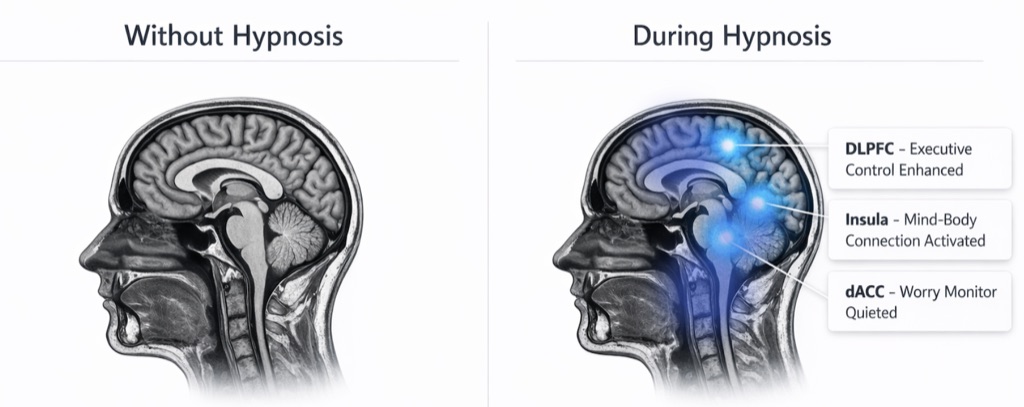
Regions from Stanford fMRI research on hypnosis (Jiang et al., 2017)
What's different about hypnotherapy?
When CBT-I didn’t work for me, I worried that hypnotherapy for insomnia would be another expensive dead end. At Calgary Hypnosis Center, sessions run between $220 and $350 each, and we ask for a three-session commitment. That’s less than many extended CBT-I programs, and you’ll know quickly if it’s helping. For a closer look at what shapes pricing, see what hypnotherapy costs in Canada.
I also tried apps and recordings first because they seemed cheaper. But the inconsistent results I got from generic tracks—working some nights, not others—mirror what many people report. Working one-on-one with a hypnotherapist let us target the hyperarousal that CBT-I left untouched. If you’re weighing options, our breakdown of apps vs working with a hypnotherapist can help.
Access is simpler than you might think. We’re fully virtual across Canada, so you don’t need to find a local specialist. After CBT-I, I needed someone who understood both behavioral sleep strategies and the subconscious anxiety still wrecking my nights. A trained hypnotherapist can integrate what you’ve already learned with new tools for calming a racing mind.
Can I combine hypnotherapy with CBT-I?
If your mind races at bedtime and CBT-I’s structured rules left you more anxious, you’re not alone. Many people find that cognitive techniques alone can’t quiet the hyperarousal that persists after sleep restriction. Hypnotherapy works differently—it targets that underlying sleep anxiety directly, helping your brain shift into a deeply relaxed state where sleep can happen naturally.
You might be a good fit if you’ve tried CBT-I and still struggle with:
- A brain that just keeps spinning when you lie down
- Exhaustion during the day but wide awake at night
- Fear or dread around bedtime itself
- Broken, shallow sleep that never feels restorative
- A desire for a drug-free method that addresses the root of the problem
Hypnotherapy isn’t about being gullible or losing control. Research shows it can be effective even for very analytical minds, and you don’t need to believe in it 100% for it to help. In fact, a randomized trial found that hypnotherapy had a low dropout rate of just 10.7%, suggesting it’s well-tolerated even by those who didn’t succeed with other approaches (peer-reviewed sleep medicine literature).
If you’re still using sleep restriction or stimulus control from CBT-I, hypnotherapy can complement those tools. Learn more about how hypnotherapy compares with CBT or what a hypnotherapy session is like.
Will hypnosis work for you?
Regions from Stanford fMRI research on hypnosis (Jiang et al., 2017)
When is hypnotherapy NOT the right next step?
If your sleeplessness comes from an untreated medical issue, hypnotherapy isn't the first stop. The Cambridge University Press review notes that underlying conditions like sleep apnea or restless legs need direct medical care first. I always ask new clients to rule out physical causes before we start.
A very analytical mind can sometimes fight the process. If you can't let go of the need to control every thought, you might spend sessions critiquing instead of drifting. The *BJPsych Advances* update shows that good progress depends on a willingness to experience the hypnotic state, not just analyze it.
Here are the clearest signals that this path may not be right for you right now:
- You have not yet had a sleep study or medical workup for your insomnia.
- You are actively psychotic or have a severe thought disorder.
- You are unwilling to practice self-hypnosis between sessions.
- You expect a single session to fix years of broken sleep.
- You are currently abusing alcohol or drugs as a sleep aid.
If you are still curious about how hypnotherapy stacks up against other approaches, I wrote a plain-language comparison at hypnotherapy vs CBT. And if you are unsure whether a live therapist is worth the investment over an app, see hypnotherapy app vs hypnotherapist.
Will hypnosis work for you?
Regions from Stanford fMRI research on hypnosis (Jiang et al., 2017)
What does the plan look like when CBT-I has failed?
When Many clients first try hypnotherapy after CBT-I by using a free app. The voice was calming, and some nights it helped me fall asleep faster. But the results were hit-or-miss. I'd drift off quickly one night, then lie awake the next. Research shows that while self-hypnosis can be effective, consistency often improves with a trained professional who tailors the approach to your specific sleep blocks.
Working with a hypnotherapist changed everything for me. My therapist used techniques I'd never find in an app, like deepening my trance state and addressing the hyperarousal that CBT-I didn't resolve. A meta-analysis found that adding hypnosis to cognitive-behavioral therapies produces a substantial effect across many problems (NCBI Bookshelf). For sleep, that meant targeting the anxiety loop that kept me wired at night.
Cost is a real factor. Sessions with a hypnotherapist run $220 to $350 each at our center, and we ask for a 3-session commitment. Apps are cheaper, but they lack the personalization that makes hypnotherapy stick. If you're weighing options, read our breakdown on hypnotherapy apps vs working with a hypnotherapist. For me, the investment was worth it because I finally broke the cycle of broken sleep.
One myth I had to unlearn: you don't need to be "hypnotizable" in some special way. A good therapist works with your natural ability to focus. If you're analytical like me, that's actually an advantage. Learn more about what a session is really like on our what to expect page. The key is finding someone who understands post-CBT-I insomnia and can build on the skills you already have.
The dropout rate for hypnotherapy in a randomized controlled trial for depression was just 10.7%, compared to 14.1% for CBT. This suggests hypnotherapy may be more tolerable for some patients, which is relevant when CBT-I hasn't worked.
Source: ScienceDirect, 2021
| Approach | Self-guided recordings or apps | Working with a CHC hypnotherapist |
|---|---|---|
| Personalization | One-size-fits-all scripts | Tailored to your specific sleep blocks and post-CBT-I history |
| Accountability | None; you're on your own | Weekly check-ins and adjustments to keep you on track |
| Depth of trance | Often light, easily broken | Guided into deeper, more restorative states |
| Addressing hyperarousal | May temporarily calm but rarely resolves root anxiety | Targets the underlying hyperarousal that CBT-I left untouched |
| Cost | Free or low monthly fee | $220–$350 per session (3-session commitment) |
Questions this page answers
How does hypnotherapy compare to CBT-I for insomnia?
Hypnotherapy targets the subconscious mind to reduce sleep anxiety and quiet racing thoughts, while CBT-I focuses on changing behaviors and beliefs. Research shows hypnotherapy can be a promising alternative when CBT-I hasn’t worked, especially for breaking the cycle of sleep dread.
Why did CBT-I fail to improve my sleep?
CBT-I relies on strict routines like sleep restriction, which can increase anxiety for some. If your mind still races at bedtime, the underlying hyperarousal may persist. Hypnotherapy addresses this directly by guiding you into a deeply relaxed state where your brain can learn to let go.
Can hypnotherapy help if my mind won’t shut off at night?
Yes, that’s one of its strengths. Hypnotherapy uses calming suggestions to quiet mental chatter. Many people report their “brain just stops spinning” after sessions, making it easier to drift off naturally without the struggle.
What if I can’t be hypnotized?
Most people can enter a hypnotic state with the right guidance. It’s not about being weak-minded—it’s a skill you learn. Even analytical minds often respond well once they understand it’s a focused, relaxed awareness, not mind control.
Are results from hypnotherapy for sleep consistent?
Some nights may be better than others, especially at first. Consistency often improves with practice and personalized sessions. Combining self-hypnosis techniques with professional guidance can help you maintain progress and reduce those off nights.
How do I find a hypnotherapist after CBT-I didn’t work?
Look for a registered clinical hypnotherapist with experience in sleep disorders. Ask about their approach to post-CBT-I insomnia and whether they integrate relaxation techniques. A free consultation can help you gauge fit—[book one here](/apply).
Is hypnotherapy just a placebo?
No, studies show it creates measurable changes in brain activity. For example, research on depression found distinct neural reorganization after hypnotherapy. It’s a legitimate therapeutic tool that helps retrain your mind’s response to sleep.
Can I combine hypnotherapy with leftover CBT-I strategies?
Absolutely. You might keep a consistent wake time from CBT-I while using hypnotherapy to ease bedtime anxiety. This hybrid approach can reinforce new sleep patterns without the pressure that made CBT-I feel overwhelming.
How much does hypnotherapy cost for sleep issues?
At Calgary Hypnosis Center, sessions range from $220 to $350. We require a 3-session commitment to start, which allows time to build skills and see meaningful change. It’s an investment in drug-free, lasting sleep.
Does hypnotherapy have any side effects?
It’s very safe when done with a trained professional. You might feel deeply relaxed or slightly drowsy afterward, but there’s no risk of getting stuck. Rarely, it can bring up emotions, which your therapist will help you process safely.
CBT-I gave you the rules, but your brain still wouldn't follow them. That's not your fault. Hypnotherapy works beneath the conscious struggle, quieting the hyperarousal that kept you awake. When nothing else worked, this did. If you're ready to finally sleep, book a free consultation and let's talk.
Apply to work with us
We take on just 10 new clients a month. Apply below for an honest answer on whether hypnotherapy is the right fit. No packages, no pressure.
Only 2 spots left for August

Danny M.
Danny M. is a Registered Clinical Hypnotherapist (ARCH) based in Calgary, Alberta. His work focuses on the conditions hypnotherapy has the strongest track record with: anxiety, insomnia, chronic pain, and IBS. Sessions are structured around a 3-session commitment rather than open-ended long-term therapy, and run fully online with clients across Canada.
Last updated: 2026-05-22