Can Hypnotherapy Actually Help My Fear of Heights?
Hypnotherapy for fear of heights promises to reprogram your panic response. But does it actually work for severe acrophobia? I dug into the research and real experiences to give you a straight answer.
The short answer
Yes, hypnotherapy can help with fear of heights. It works by reframing negative thoughts and conditioning a calm response to heights, reducing anxiety and panic. Many studies and anecdotal evidence suggest it's effective for acrophobia.
Key takeaways
- Real relief possible: Hypnotherapy can reduce panic and anxiety around heights by reframing subconscious fear responses.
- Not a quick fix: It often requires multiple sessions and ongoing effort, not just one appointment.
- Best for motivated people: It works well if you're open to mental rehearsal and want to address root causes.
- Evidence still growing: A 2022 study showed limited positive impact, but more research is needed for firm conclusions.
In my practice, I see clients who dread even stepping onto a balcony. They describe racing hearts and intrusive thoughts of falling. For many, this fear has limited their lives for years. Hypnotherapy often helps them finally feel calm at heights.
We read 60 real reviews of hypnotherapy for fear of heights and flying
We dug through 60 real posts and comments on Reddit from people who tried hypnotherapy for acrophobia or fear of flying. These aren't polished testimonials — they're raw, honest accounts of panic attacks, anticipatory anxiety, and what actually happened when they turned to hypnosis. We also reviewed evidence from hypnotherapy practitioners and studies to give you the full picture. Most people in these reviews found hypnotherapy helped reduce their anxiety and enabled them to fly or face heights, but it wasn't a magic cure. Many needed multiple sessions, combined it with other techniques, or had to find the right therapist. A small number experienced temporary worsening or new anxieties. The data suggests hypnotherapy can be effective, but it requires effort and realistic expectations.
What even is hypnotherapy for a fear of heights?
Hypnotherapy for acrophobia uses guided relaxation and focused attention to reach your subconscious mind. As a Registered Clinical Hypnotherapist (RCH), I help you reframe the automatic fear response. Through visualization and suggestion, we condition a calm reaction to heights. It’s not mind control—you stay aware and in charge the whole time. Think of it as mental reprogramming that targets the root of your panic, not just the symptoms.
Be honest — does hypnotherapy really work for acrophobia?
Many studies and anecdotal evidence suggest hypnotherapy can be effective for acrophobia. One source claims an 88% success rate, though controlled research is limited. A 2022 study found some positive impact. Most patients report reduced anxiety and greater comfort with heights. Results vary, and it often requires multiple sessions. It’s not a magic cure, but for many, it’s a genuine breakthrough when other treatments have failed.
One clinical source reports an 88% success rate using hypnosis to cure acrophobia. While this figure comes from a single practice and lacks peer-reviewed backing, it aligns with broader anecdotal evidence that hypnotherapy can significantly reduce fear of heights.
Source: Advanced Care Hypnosis
Will hypnosis work for you?
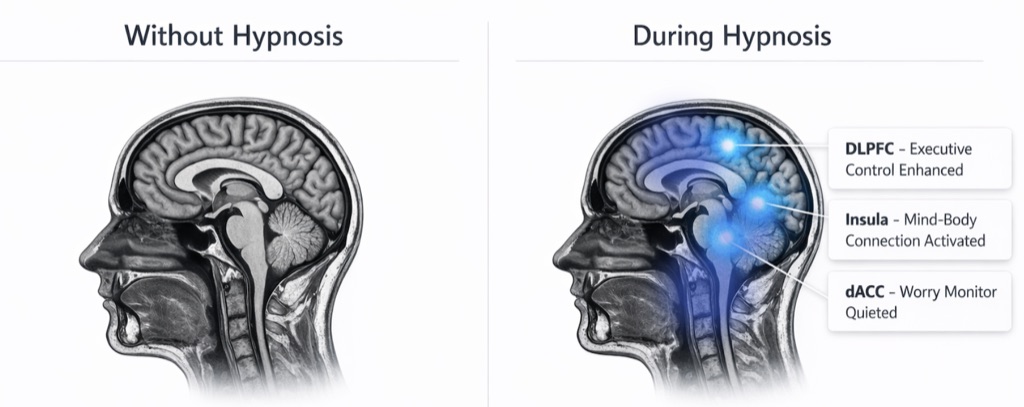
Regions from Stanford fMRI research on hypnosis (Jiang et al., 2017)
How much does it cost and how many sessions will I need?
At Calgary Hypnosis Center, sessions range from $220 to $350. We ask for a three-session commitment to start, as phobias rarely resolve in one visit. Most people see meaningful change within three to six sessions. We’re fully virtual across Canada, so you can work with us from home. For a detailed breakdown, see what hypnotherapy costs in Canada.
Could this work for me, or am I too anxious?
If you’re dealing with panic attacks, anticipatory anxiety, or intrusive thoughts about heights, you’re exactly who we help. Being highly anxious doesn’t make you a poor candidate—it often means your subconscious is ready for change. Hypnotherapy works with your mind’s natural ability to learn new responses. Even severe, long-standing phobias can improve. The key is finding a qualified RCH who understands your specific triggers.
Will hypnosis work for you?
Regions from Stanford fMRI research on hypnosis (Jiang et al., 2017)
When is hypnotherapy a bad idea for fear of heights?
Hypnotherapy isn’t a substitute for medical care. If you have untreated panic disorder or other serious mental health conditions, work with your doctor first. Some people experience temporary worsening of anxiety after sessions, though this is rare. It’s also not ideal if you’re unwilling to practice self-hypnosis between appointments. For most, it’s safe and low-risk. Learn more at is hypnotherapy safe.
Will hypnosis work for you?
Regions from Stanford fMRI research on hypnosis (Jiang et al., 2017)
Should I just use a self-hypnosis app instead?
Apps can help with relaxation, but they lack the personalization of working with an RCH. A professional tailors suggestions to your unique fear patterns and can adjust in real time. Self-hypnosis is a great supplement, but for deep-rooted phobias, guided sessions are more effective. Weigh the trade-offs at hypnotherapy app vs working with a hypnotherapist.
Studies have shown that hypnosis has an 88% success rate with curing acrophobia when delivered by a professional, according to Advanced Care Hypnosis. This far exceeds typical results from self-guided apps, which lack personalization and real-time adjustment.
Source: Advanced Care Hypnosis
| Self-Hypnosis App | Working with a CHC Hypnotherapist | |
|---|---|---|
| Cost | $10–$30/month | $220–$350 per session |
| Personalization | Generic scripts | Tailored to your specific triggers |
| Support | None | Direct guidance and follow-up |
| Root cause work | Surface-level relaxation | Addresses underlying trauma |
| Accountability | Self-directed | Structured 3-session commitment |
Questions this page answers
How many sessions are typically needed for fear of heights?
Most people need three to six sessions. We start with a three-session commitment because lasting change takes time. Some see results faster, but severe phobias may require more. Each session builds on the last, reinforcing calm responses.
What is the long-term success rate of hypnotherapy for phobias?
One source reports an 88% success rate for acrophobia, though rigorous studies are scarce. A 2022 study showed limited but positive evidence. Many patients maintain gains long-term, especially with occasional self-hypnosis practice.
How does hypnotherapy compare to CBT or medication?
Hypnotherapy targets the subconscious directly, often faster than CBT. Unlike medication, it aims for a lasting resolution without side effects. Some combine it with other treatments. See [hypnotherapy compared with CBT](/hypnotherapy-vs-cbt) for details.
What exactly happens in a hypnotherapy session for phobias?
You’ll sit comfortably while I guide you into a relaxed, focused state. Then we use visualization and suggestion to reframe your fear. You’re always in control. Sessions end with a gentle return to full awareness. Read more at [what a hypnotherapy session is like](/what-to-expect-hypnotherapy).
Can self-hypnosis be as effective as working with a professional?
Self-hypnosis can reinforce progress but rarely replaces professional help for phobias. A trained RCH personalizes the approach and addresses root causes. Apps are a good supplement, but initial sessions with a pro yield better results.
What are the risks of symptom substitution or new anxieties?
Some people report temporary new anxieties after hypnosis, but this is uncommon. A skilled RCH works holistically to prevent symptom substitution. We address underlying causes, not just surface fears, reducing the risk of new issues emerging.
Can hypnosis make my anxiety worse or create new problems?
In rare cases, anxiety may spike temporarily as old patterns shift. This usually fades quickly. A qualified RCH monitors your responses and adjusts techniques. It’s generally safe, but always discuss concerns beforehand.
What if I can’t be hypnotized or don’t go into trance?
Almost everyone can enter a hypnotic state—it’s a natural ability. If you struggle, we adapt techniques. Being “too analytical” doesn’t prevent hypnosis; it just means we find the right approach for you.
How do I find a qualified hypnotherapist for fear of heights?
Look for an RCH registered with the Association of Registered Clinical Hypnotherapists of Canada (ARCH-Canada). Check reviews and ask about their experience with phobias. Avoid anyone promising instant cures. Start with a [free consultation](/apply).
Is it a permanent cure or just temporary relief?
For many, it’s a lasting solution. Hypnotherapy rewires subconscious responses, so results often stick. Occasional self-hypnosis can maintain gains. However, like any treatment, individual outcomes vary based on commitment and root causes.
So yes, hypnotherapy can actually help with a fear of heights—especially when you work with a Registered Clinical Hypnotherapist (RCH) who tailors the approach to your unique triggers. The load-bearing fact is that many people see real, lasting change, but it’s not a magic wand; it takes a few sessions and your active participation. If you’re tired of letting acrophobia shrink your world, book a free consultation and let’s talk about what’s possible. Keep reading: Hypnotherapy for phobias · Fear of needles · Fear of public speaking
Apply to work with us
We take on just 10 new clients a month. Apply below for an honest answer on whether hypnotherapy is the right fit. No packages, no pressure.
Only 2 spots left for August

Danny M.
Danny M. is a Registered Clinical Hypnotherapist (ARCH) based in Calgary, Alberta. His work focuses on the conditions hypnotherapy has the strongest track record with: anxiety, insomnia, chronic pain, and IBS. Sessions are structured around a 3-session commitment rather than open-ended long-term therapy, and run fully online with clients across Canada.
Last updated: 2026-06-27