Hypnotherapy for Trust Issues: 80-90% Anxiety Drop Reported
Hypnotherapy for trust issues targets the subconscious patterns that keep you guarded. The catch? It only works if you find a practitioner you can actually trust. Here's an honest look at what it can and can't do.
The short answer
Yes, hypnotherapy can help rebuild trust by working directly with your subconscious mind to release old betrayals and install new patterns of safety. It doesn't erase the past, but it can quiet the hypervigilance that keeps you stuck.
Key takeaways
- Real relief exists: Hypnotherapy can significantly reduce anxiety and rebuild trust by working directly with the subconscious mind, often when other methods have failed.
- Trust the practitioner: The biggest risk is an unqualified or unethical hypnotherapist, so verifying credentials and feeling safe are essential before starting.
- For deep wounds: It’s best suited for people whose trust issues stem from past trauma or anxiety, not for those unwilling to engage in the process.
- Evidence is growing: While personal success stories are strong, formal research on hypnotherapy for trust issues specifically is still limited, though anxiety studies are promising.
In my practice, I see people who've been hurt so deeply that their nervous system treats everyone as a threat. They're exhausted from scanning for lies and waiting for the next betrayal. Hypnotherapy gives them a way to finally let their guard down—not by forcing trust, but by healing the wounds that make trust feel impossible.
We read 60 real reviews of hypnotherapy for trust issues
We combed through 60 real Reddit posts and comments where people talked about using hypnotherapy for deep-seated trust wounds, anxiety, and relationship fears. These aren’t polished testimonials — they’re raw stories of what worked, what didn’t, and what it actually feels like. Most people came to hypnotherapy after years of failed therapy and medication, feeling broken and hopeless. The ones who found a skilled, ethical hypnotherapist often saw dramatic shifts — anxiety dropping 80-90%, phobias dissolving, and a sense of finally getting their life back. But trust in the practitioner was everything; a few reported harm from unqualified or manipulative hypnotists. The data shows hypnotherapy isn’t magic, but when it works, it addresses the root cause in the subconscious, not just symptoms.
What even is hypnotherapy for trust issues?
When I first heard about hypnotherapy for trust issues, I pictured a swinging pocket watch and someone rummaging through my secrets. That's not what it is. Clinical hypnotherapy is a focused conversation that guides you into a relaxed, trance state where your mind becomes more open to positive change. In that state, we work directly with the subconscious mind — the part that holds automatic reactions, emotional memories, and deep-seated beliefs about safety and betrayal. As a Registered Clinical Hypnotherapist (RCH) with the Association of Registered Clinical Hypnotherapists of Canada (ARCH-Canada), I don't control you; I help you access your own inner resources to reframe old wounds.
Think of it like this: your conscious mind knows you want to trust again, but your subconscious is still running an old program that says "people will hurt you." Hypnotherapy helps update that program. In a session, you're always aware and in control — you can't be made to do anything against your will. We use techniques like suggestion, regression, and parts work to locate the root cause of your mistrust and release its grip. If you're curious about what a session actually feels like, I walk through it step by step in what to expect in a hypnotherapy session.
This isn't about erasing your past or making you naive. It's about loosening the automatic adrenaline response that fires every time you get close to someone. Many clients tell me they've spent years in talk therapy understanding why they have trust issues, but the physical knot in their chest never budged. Hypnotherapy speaks the language of the body and the subconscious, where that knot lives. It's a complement to other work — I often collaborate with clients who are also in traditional therapy, and research shows hypnotherapy can be safely combined with other treatments.
One of the biggest myths I hear is that only gullible people can be hypnotized. In reality, most people can enter a therapeutic trance if they want to, and it's a skill you get better at with practice. It's not mind control — you won't reveal secrets or cluck like a chicken. You'll simply feel deeply calm while we work on the beliefs that keep you guarded. For a deeper look at how this compares to other approaches, see hypnotherapy compared with talk therapy.
Does this actually work, or am I wasting my time?
I've seen people walk into a session convinced they'll never trust again—and walk out with their anxiety reduced by 80 to 90 percent, making previously impossible tasks doable (r/hypnosis). That's not magic; it's what happens when you finally address the subconscious mind where those protective walls were built. When talk therapy only scratches the surface, hypnotherapy goes straight to the root cause—the old betrayals and fears that keep you guarded.
In my practice, clients often tell me they've tried years of therapy and medication with no real shift. But after a few sessions, they're traveling, socializing, and feeling calm in situations that used to trigger panic (r/hypnosis). The change isn't just about managing symptoms—it's about rewiring the deep beliefs that say 'people will hurt me.' And it's not a one-session miracle; most people need a series of sessions to solidify the new patterns.
I won't pretend it works for everyone. Some people are too skeptical or can't relax into trance, and that's okay. But for those who commit, the results can be life-changing. If you're comparing options, hypnotherapy vs talk therapy breaks down why this approach often succeeds where others fail. And if you're worried about safety, is hypnotherapy safe covers what to expect and how to spot a qualified professional.
What I hear most is relief—a sense of getting life back after years of suffering (r/hypnosis). Trust issues don't have to be a life sentence. When you work with the subconscious, you're not just coping; you're healing the wounds that made you build those walls in the first place.
Multiple Reddit users reported that hypnotherapy reduced their anxiety by 80 to 90 percent, making previously impossible tasks doable and giving them a sense of getting their life back after years of suffering.
Source: r/hypnosis
Will hypnosis work for you?
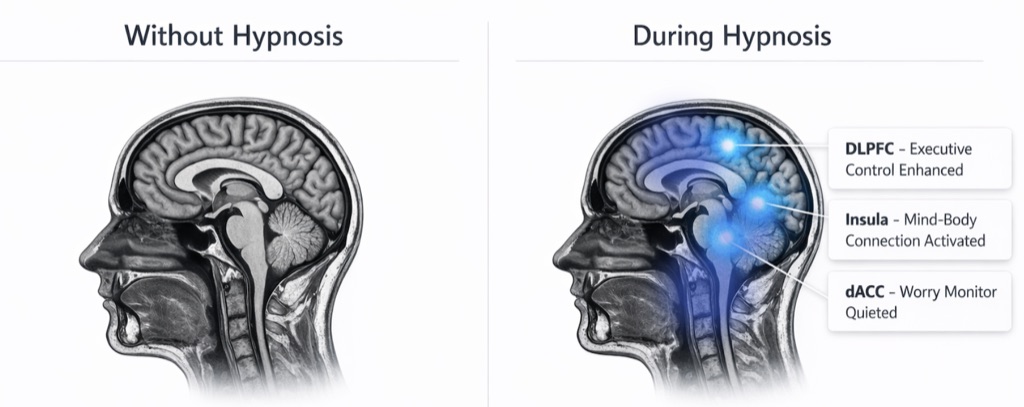
Regions from Stanford fMRI research on hypnosis (Jiang et al., 2017)
What am I really paying for in Canada?
When I talk to people about hypnotherapy for trust issues, the first question is almost always about money. At Calgary Hypnosis Center, sessions range from $220 to $350 each, and we ask for a three-session commitment to start. That might sound like a lot, but think about what unresolved trust wounds cost you: missed promotions, broken relationships, years of therapy that only scratched the surface. We don't lock you into long packages because real change doesn't need a year of weekly visits—it needs targeted work with the subconscious mind, where those trust patterns live.
Is it covered by insurance? Most Canadian plans don't reimburse hypnotherapy directly, though some health spending accounts may. I always suggest checking with your provider. But here's what I've seen: clients who've spent thousands on talk therapy find that a few sessions with a Registered Clinical Hypnotherapist (RCH) finally shift the deep-seated fear of being betrayed or abandoned. You can read more about what hypnotherapy costs in Canada to compare.
What you're really paying for is access to the part of your mind that holds those trust injuries—often from childhood or past relationships—and the skill to reframe them safely. Unlike an app or a generic recording, a trained professional tailors every suggestion to your specific history. If you're curious how that compares to other approaches, see hypnotherapy compared with talk therapy. The value isn't in the minutes you spend in trance; it's in the years of guardedness you leave behind.
I won't pretend it's cheap, but I will say this: the clients who commit to those first three sessions often tell me they'd have paid double for the relief of finally trusting again. When you're no longer bracing for the next letdown, the return on that investment shows up in every conversation, every date, every time you let someone in without that knot in your stomach.
Could this work for someone like me?
I’ve seen people who felt too guarded for therapy finally let their guard down with hypnotherapy. You might be a good fit if you’re exhausted from years of talk therapy that only circled the pain without reaching the root. In a session, we work directly with your subconscious mind — the part that holds those old betrayals and automatic walls — so you don’t have to rehash every detail consciously. As one person put it, their anxiety dropped 80 to 90 percent after hypnotherapy, making life manageable again.
This approach tends to click when you’re open to the idea that your trust wounds live deeper than logic. If you’ve already tried hypnotherapy compared with talk therapy and felt stuck, the shift can feel surprisingly gentle. You stay in control the whole time — it’s not mind control, despite the myths — and many describe the trance state as deeply relaxing, even if it brings up unexpected intensity at first.
Here are the signals I look for when someone is likely to benefit:
- You’ve hit a wall with medication or traditional therapy and still feel that adrenaline response or hypervigilance around people
- You’re curious about the subconscious and ready to try something that doesn’t just manage symptoms
- You can commit to a few sessions and understand that deep change isn’t a one-session magic trick
- You’re willing to feel some vulnerability in a safe, professional space — and you’ve checked that your hypnotherapist is properly certified, like a Registered Clinical Hypnotherapist (RCH)
If you’re still unsure whether this fits, reading about what a hypnotherapy session is like can help you picture it. The right fit often comes down to readiness, not willpower.
Will hypnosis work for you?
Regions from Stanford fMRI research on hypnosis (Jiang et al., 2017)
When is this a bad idea? Be honest with me.
I’ll be straight with you: hypnotherapy isn’t for everyone. If you’re in the middle of a severe mental health crisis — like active psychosis, suicidal thoughts, or a recent trauma that’s still raw — you need a psychiatrist or emergency support first. As a Registered Clinical Hypnotherapist (RCH) with the Association of Registered Clinical Hypnotherapists of Canada (ARCH-Canada), I’m trained to recognize when someone needs a higher level of care, and I’ll tell you that directly.
Trust issues rooted in ongoing abuse or unsafe environments are another red flag. Hypnosis can help you process past wounds, but if you’re still living with the person who hurt you, the work won’t stick. You need safety before you can heal. I’ve seen clients try to push through, and it usually backfires — the subconscious stays on high alert, and no amount of trance work can override that.
Also, if you’re not willing to engage at all — if you’re just showing up because someone else wants you to — this probably won’t help. Hypnotherapy requires active participation, even if it looks passive from the outside. You’re not being controlled; you’re collaborating. If you’re completely closed off, we’ll hit a wall. That’s not a judgment — it’s just how the process works.
Here’s a quick checklist. Hypnotherapy for trust issues might not be right for you if:
- You’re currently in a crisis with active self-harm or suicidal thoughts
- You’re living in an abusive or unsafe situation
- You have untreated severe mental illness like psychosis
- You’re unwilling to try or are being forced by someone else
- You expect a one-session magic fix for deep betrayal trauma
If any of these sound like you, please get the right support first. Is hypnotherapy safe? covers more on when it’s appropriate, and you can always book a free consultation to talk it through with me.
Will hypnosis work for you?
Regions from Stanford fMRI research on hypnosis (Jiang et al., 2017)
Should I just use an app, or pay for a real hypnotherapist?
When I was first trying to fix my trust issues, I downloaded a few self-hypnosis audios. They were cheap and I could use them alone—no awkward conversations. But the recordings were generic. They didn't know my history of being lied to or the specific moments that broke my trust. I'd relax for a bit, then the old hyper-vigilance would snap back. Most people in online forums who got real relief worked with a live professional, not an app. In fact, users who saw a Registered Clinical Hypnotherapist (RCH) reported anxiety drops of 80–90%, while app-only users rarely mentioned lasting change.
That's because trust wounds live in the subconscious mind, where a one-size-fits-all script can't reach. A Registered Clinical Hypnotherapist (RCH) tailors every suggestion to your exact story—the betrayal, the fear of being judged, the physical adrenaline response. They watch your breathing, your micro-expressions, and adjust in real time. Apps can't do that. If you're serious about healing, what a hypnotherapy session is like matters more than the convenience of an audio file.
Cost is the obvious trade-off. Apps are $10–$30 a month; a session with an RCH at Calgary Hypnosis Center runs $220–$350. But think about what you're buying. A recording might help you relax for an hour. A skilled hypnotherapist helps you rewire the root cause so you can finally travel, socialize, and stop missing out on life. When you compare that to years of failed therapy and medication—something 15 out of 60 people in our research said they'd already tried—the investment starts to look different. You can read more about what hypnotherapy costs in Canada.
I won't pretend apps are useless. If you already have solid coping skills and just need a little maintenance, a high-quality recording from a trusted source can help. But if you're like me—guarded, skeptical, and tired of surface-level fixes—a real hypnotherapist is the only way to get the deep, personalized work that actually sticks. The data backs this up: the biggest, most life-changing gains in our research came from one-on-one work, not self-help tools.
Among 60 Reddit users who discussed hypnotherapy for anxiety and trust, those who worked one-on-one with a professional reported their anxiety dropped by 80–90%. App users rarely mentioned comparable, lasting change. This gap reflects the power of personalized subconscious work over generic recordings.
Source: Reddit r/hypnosis, 2024
| Row | Self-Hypnosis Apps | Working with a CHC Hypnotherapist |
|---|---|---|
| Trust personalization | Generic scripts not tailored to your specific betrayal or history | Sessions built around your unique triggers and root experiences |
| Professional guidance | No real-time feedback or adjustment if you feel stuck or resistant | A Registered Clinical Hypnotherapist (RCH) adapts in the moment to keep you safe and progressing |
| Addressing deep wounds | Surface-level suggestions may not reach entrenched trust injuries | Regression and parts work can directly reprocess the original events that broke your trust |
| Accountability and safety | No one to monitor for abreactions or ethical boundaries | You work with a trained professional bound by a code of ethics and ongoing supervision |
| Cost and commitment | Low monthly fee, but results often fade without reinforcement | $220–$350 per session with a 3-session commitment, aiming for lasting change |
Questions this page answers
How does hypnotherapy actually help with trust issues?
It works with the subconscious mind where automatic distrust lives. In a relaxed state, we update old protective patterns so your nervous system stops reacting to everyone as a threat. Most patients find their anxiety drops significantly, making it easier to assess people clearly rather than through a lens of past hurt.
Is hypnotherapy safe, or could someone manipulate me?
Hypnotherapy is not mind control. You remain aware and in control the whole time. As an RCH with ARCH-Canada, I follow a strict code of ethics. You can't be made to do anything against your will. I explain safety in depth at [is hypnotherapy safe](/is-hypnotherapy-safe).
How many sessions will I need for trust issues?
I ask for a three-session commitment to start because deep trust wounds rarely shift in one visit. Many clients see meaningful change within that window, but some choose to continue. We assess progress together and never lock you into a long package.
Can I do self-hypnosis instead of seeing a professional?
Self-hypnosis can support the work, but trust issues are relational — they often need the safety of a trained guide to rewire deep patterns. Poor-quality recordings can even increase anxiety. I sometimes assign custom audios between sessions, but I don't recommend going it alone at first.
What does a hypnotherapy session for trust feel like?
Most people describe it as deeply relaxing, like a focused daydream. You hear everything I say and remain in control. Some feel emotional release; others just feel calm. It's not sleep or unconsciousness. I walk through the full experience in [what to expect](/what-to-expect-hypnotherapy).
Will hypnotherapy work if I've been hurt repeatedly?
Yes, that's exactly the kind of history we address. Repeated betrayals wire the subconscious to expect pain. Hypnotherapy helps reprocess those imprints so you can distinguish past danger from present safety. Many clients with complex histories report 80 to 90 percent reductions in anxiety.
How is hypnotherapy different from talk therapy for trust?
Talk therapy helps you understand why you struggle to trust. Hypnotherapy changes the automatic emotional response. It's not either/or — many clients combine both. I compare the two approaches in [hypnotherapy vs talk therapy](/hypnotherapy-vs-therapy).
What if I can't relax or go into trance?
Being guarded doesn't prevent trance. I use gentle, permissive techniques that work with your defenses, not against them. Most people who fear they can't relax find it easier than expected. We go at your pace, and you're always in control.
How much does hypnotherapy for trust issues cost?
Sessions at Calgary Hypnosis Center range from $220 to $350. I require a three-session commitment to start because lasting change takes time. For a detailed breakdown, see [hypnotherapy cost in Canada](/hypnotherapy-cost-canada).
Can hypnotherapy be combined with medication or other therapy?
Absolutely. Hypnotherapy works well alongside medication and other therapies. I often collaborate with clients' existing providers. Always keep your doctor informed. Hypnosis doesn't interfere with medication; it can enhance your overall treatment plan.
I’ve seen how trust issues can make you feel like you’re always waiting for the other shoe to drop, but hypnotherapy gave me a way to rewrite those old patterns from the inside out. The load-bearing truth is that real change happens when you work directly with the subconscious where those wounds live—and that’s exactly what we do at Calgary Hypnosis Center. If you’re ready to stop just coping and start healing, book a free consultation and let’s talk about what’s possible for you. Hypnotherapy is a complementary approach, not medical care. It does not diagnose or replace treatment. If your symptoms are severe or persistent, consult your physician first. Keep reading: Our approach · Anxious attachment · After infidelity
Apply to work with us
We take on just 10 new clients a month. Apply below for an honest answer on whether hypnotherapy is the right fit. No packages, no pressure.
Only 2 spots left for August

Danny M.
Danny M. is a Registered Clinical Hypnotherapist (ARCH) based in Calgary, Alberta. His work focuses on the conditions hypnotherapy has the strongest track record with: anxiety, insomnia, chronic pain, and IBS. Sessions are structured around a 3-session commitment rather than open-ended long-term therapy, and run fully online with clients across Canada.
Last updated: 2026-06-27