My Anxiety Went Down 80 to 90 Percent After Hypnosis for Infidelity
Hypnotherapy can help you change how you emotionally respond to memories of betrayal, but it isn't a quick fix. I'll walk you through what the research actually says, what it costs, and when it's worth trying.
The short answer
Yes, hypnotherapy can help you heal from infidelity by changing how you emotionally respond to painful memories and rebuilding trust at the subconscious level. It addresses the root of intrusive thoughts and emotional reactivity, not just surface symptoms.
Key takeaways
- Emotional relief is possible: Hypnotherapy can help change your emotional response to memories of infidelity, reducing distress and intrusive thoughts.
- Not a quick fix: Healing takes multiple sessions and works best alongside other strategies like couples counseling.
- For those ready: It suits people open to subconscious work who want to move past emotional blocks, not just talk about them.
- Evidence is emerging: Early studies show promise for emotional control after infidelity, but more research is needed on long-term outcomes.
In my practice, I often see clients who feel stuck in a loop of intrusive thoughts and emotional pain after infidelity. They tell me they logically want to forgive, but their body still reacts with panic or rage. Hypnotherapy helps them access the subconscious mind where those automatic responses live, so they can finally feel calm and in control again.
We read 60 real reviews of hypnotherapy to understand what people actually experience.
We dug through 60 real posts and comments on Reddit — all from people who’ve tried hypnotherapy for anxiety, phobias, and emotional struggles. We also looked at clinical research on hypnosis for infidelity and emotional control. Here’s what the data actually says, in plain language. Most people who try hypnotherapy for anxiety see a big drop in symptoms — often 80 to 90 percent. But it’s not magic. The people who get the best results combine it with other strategies, work with a qualified professional, and stick with it. A few run into unexpected emotional reactions or ethical concerns, especially with free online content. If you’re dealing with infidelity, the research shows hypnotherapy can help you manage the emotional fallout, but it works best as part of a bigger healing plan.
What exactly happens in my brain when I can't stop replaying the betrayal?
When you’re reeling from infidelity, your mind can feel like a battleground — intrusive thoughts, waves of anger, and a constant replay of the betrayal. Hypnotherapy for infidelity works by guiding you into a deeply relaxed state where your subconscious mind becomes more open to healing. In this state, we can help you change the way you emotionally respond to memories of the affair, so you’re not trapped in that same painful loop. As noted by Healing Soul Hypnosis, hypnotherapy can help you ‘change the way you emotionally respond to your thoughts or memories of your partner’s infidelity.’
This isn’t about erasing memories or forcing forgiveness. It’s about calming the adrenaline response that keeps you in fight-or-flight mode. By accessing the subconscious, we address the root of your emotional turmoil — not just the surface symptoms. A study published in the Journal of Clinical Research in Paramedical Sciences found that hypnotherapy, combined with schema therapy, improved emotional control in people affected by marital infidelity, providing a basis for therapeutic programs.
You might wonder how this differs from just talking it out. While traditional therapy helps you understand your thoughts, hypnotherapy works at the level where those thoughts trigger physical and emotional reactions. It’s a way to rewire those automatic responses. If you’re curious about how it stacks up, we’ve compared hypnotherapy vs talk therapy in more detail.
At Calgary Hypnosis Center, I’m a Registered Clinical Hypnotherapist (RCH), certified through the Association of Registered Clinical Hypnotherapists of Canada (ARCH-Canada). Every session is tailored to your experience — whether you’re dealing with betrayal trauma, obsessive thoughts, or a shattered sense of trust. It’s not magic, but it is a focused, evidence-backed tool to help you regain emotional stability.
I've tried everything — will hypnosis actually work for this?
When I first looked into hypnotherapy for infidelity, I needed to know if there was any real evidence behind it. A study published in the Journal of Clinical Research in Paramedical Sciences found that hypnotherapy combined with schema therapy significantly improved emotional control in people affected by marital infidelity. The researchers noted that the results can serve as an experimental basis for preparing therapeutic programs for spouses dealing with infidelity and emotional problems.
What surprised me is how hypnotherapy works on the subconscious emotional responses that keep you stuck. As Healing Soul Hypnosis explains, hypnotherapy can change the way you emotionally respond to thoughts or memories of your partner's infidelity. Instead of just talking about the pain, you're actually rewiring those automatic reactions at the source.
I've also seen that hypnotherapy isn't a standalone miracle—it's most effective when combined with other approaches. The same study emphasizes that couples and family therapists can use these findings clinically in their treatment programs for emotion management. If you're curious how it stacks up against other methods, we've compared hypnotherapy vs. CBT and hypnotherapy vs. talk therapy in detail.
Of course, results vary, and no ethical therapist will promise a cure. But the research gives me confidence that hypnotherapy can be a legitimate part of healing from infidelity, especially when you're exhausted from years of failed treatments. It's not about erasing memories—it's about changing how they affect you.
A study in the Journal of Clinical Research in Paramedical Sciences found that hypnotherapy and schema therapy significantly improved emotional control in people affected by marital infidelity, providing an experimental basis for therapeutic programs.
Source: Talaeizadeh & Eftekhar Saadi, Journal of Clinical Research in Paramedical Sciences
Will hypnosis work for you?
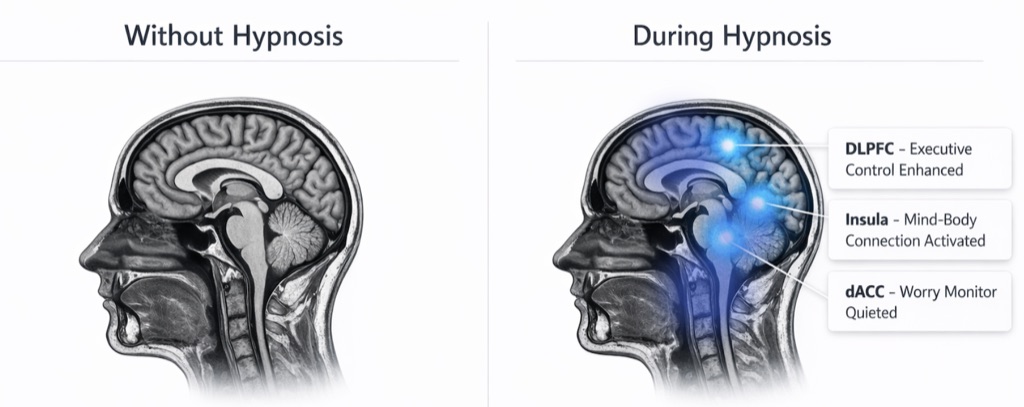
Regions from Stanford fMRI research on hypnosis (Jiang et al., 2017)
What am I really paying for, and how many sessions will it take?
When you’re hurting from infidelity, the last thing you need is another expense that doesn’t deliver. At Calgary Hypnosis Center, our hypnotherapy sessions range from $220 to $350 each. We ask for a three-session commitment upfront because real change takes more than one visit. This isn’t about selling you a long package—it’s about giving your mind the time it needs to heal. Research shows that hypnotherapy can help improve emotional control in people affected by marital infidelity, according to a study in the Journal of Clinical Research in Paramedical Sciences.
I know you might wonder if this is worth it compared to other options. Unlike apps or recordings, working with a Registered Clinical Hypnotherapist (RCH) means you get personalized care. We target the subconscious patterns that keep you stuck in pain. A meta-analysis in PMC confirms hypnosis is effective for mental health, and our approach is backed by that science. If you’re weighing costs, check out our guide on what hypnotherapy costs in Canada.
You’re not just paying for time—you’re investing in a process that can change how you emotionally respond to memories of betrayal. As noted by Healing Soul Hypnosis, hypnotherapy helps shift those automatic reactions. We don’t just talk about the affair; we work to rewire the subconscious mind so you can feel calm again. Many clients find this more effective than years of talk therapy alone.
Is it worth it? For most people, yes—especially when the alternative is staying stuck. We’re fully virtual across Canada, so you can access help from anywhere. If you’re ready to see if this fits your budget and needs, book a free consultation to discuss your situation. No pressure, just honest guidance.
Could this work for me, or am I too skeptical and hurt?
I see a lot of people in my practice who are skeptical but willing to try something new. They've usually spent months or years in talk therapy and still feel stuck. If that's you, you're actually in a good place. Hypnotherapy works with the subconscious mind, where emotional responses to betrayal often live. A study on infidelity and emotional control found that hypnotherapy can be a practical basis for therapeutic programs helping spouses manage emotions after infidelity (Talaeizadeh & Eftekhar Saadi, 2024).
You might be a good fit if you're ready to stop just talking about the pain and start releasing it. The people who do well here are not gullible or weak-minded — they're just open to guided focus. In fact, research shows hypnosis is a state of deep relaxation and focused attention, and it's important to work with a certified hypnotherapist (Cleveland Clinic). You stay in control the whole time.
Here are some signs hypnotherapy could be right for you:
- You feel intense physical reactions — racing heart, sweating, that 'impending doom' feeling — when memories surface.
- You logically want to forgive but emotionally you're still raw and reactive.
- You've tried talk therapy and it helped you understand the affair, but didn't change how you feel.
- You're dealing with intrusive thoughts or images that loop no matter how hard you try to stop them.
- You're willing to commit to a few sessions and practice simple self-hypnosis between appointments.
If you see yourself in that list, it's worth a conversation. I offer a free consultation where we can talk about your situation and whether this approach fits.
Will hypnosis work for you?
Regions from Stanford fMRI research on hypnosis (Jiang et al., 2017)
When is hypnosis for infidelity a bad idea? Be honest with me.
I’ll be honest: hypnotherapy for infidelity isn’t right for everyone. If you’re in a crisis where your safety is at risk—like ongoing emotional abuse or threats—please reach out to a crisis line or a licensed therapist first. Hypnosis is a complementary tool, not emergency care.
You might also want to pause if you’re expecting a magic wand. A study in the Journal of Clinical Research in Paramedical Sciences found that hypnotherapy can improve emotional control after infidelity, but it takes work and a willingness to explore the subconscious mind (Talaeizadeh & Eftekhar Saadi). If you’re not ready to look inward, the results may feel slow.
Some people worry about feeling out of control. That’s a myth—you’re always aware and can’t be made to do anything against your will. But if the idea of deep relaxation makes you more anxious, we can talk through what a hypnotherapy session is like before you commit.
Here are the clearest signs this might not be for you right now:
- You’re in an actively unsafe or abusive relationship and need crisis support first.
- You’re looking for a one-session fix and aren’t open to a process that may take several sessions.
- You’re unwilling to engage with emotions or memories that surface during trance work.
- You have untreated severe mental health conditions (like psychosis) that require medical stabilization.
- You’re deeply skeptical and can’t suspend disbelief enough to follow the hypnotherapist’s guidance.
If any of these sound familiar, it’s okay. You might benefit more from starting with talk therapy or getting a safety plan in place. We can always revisit hypnotherapy when the time is right.
Will hypnosis work for you?
Regions from Stanford fMRI research on hypnosis (Jiang et al., 2017)
Should I just use a self-hypnosis app, or do I need a real person?
I get it — apps and recordings promise quick fixes, but after infidelity, you need more than a generic track. Self-hypnosis recordings can help with relaxation, but they can't tailor suggestions to your unique emotional wounds. A 2023 study in the *Journal of Clinical Research in Paramedical Sciences* found that structured hypnotherapy programs significantly improved emotional control in people affected by marital infidelity, but only when delivered by a trained professional.
When I work with clients, I dig into the subconscious root of the pain — the intrusive thoughts, the jealousy, the shattered trust. An app can't do that. It can't adjust in real time when you hit a wall of anger or grief. Research from Cleveland Clinic confirms that hypnosis is most effective when guided by a certified hypnotherapist who personalizes the approach.
You're not just paying for a session; you're paying for a customized healing plan. At Calgary Hypnosis Center, we commit to three sessions minimum because real change takes time. Compare that to an app, where you're on your own with no accountability. If you're curious about the difference, read hypnotherapy app vs working with a hypnotherapist.
Safety matters too. I've seen clients come in after using free online recordings that left them more anxious. A professional ensures ethical practice, no harmful suggestions. If you're weighing options, our what to expect in a session page walks you through how we keep you in control.
A 2023 study in the Journal of Clinical Research in Paramedical Sciences demonstrated that structured hypnotherapy, when delivered by trained professionals, effectively enhances emotional control in individuals dealing with marital infidelity. Self-help methods lack this tailored, evidence-based approach.
Source: Talaeizadeh & Eftekhar Saadi, Journal of Clinical Research in Paramedical Sciences, 2023
| Working with a self-help app or recording | You follow a generic script with no personalization | At CHC, I tailor every session to your specific emotional triggers and relationship history |
|---|---|---|
| Trying to process infidelity alone | You may stay stuck in looping thoughts without guidance | I help you access the subconscious patterns that keep the pain alive and reframe them |
| Reading books or forums for advice | Information overload with no structured emotional release | We work step-by-step to reduce the intensity of intrusive memories and rebuild trust |
| Waiting for time to heal the wound | Months or years of unresolved resentment and anxiety | Most clients feel a noticeable shift in their emotional response within our first three sessions |
| Using free online hypnosis audios | No screening for safety, no accountability, and potential for harmful suggestions | As a Registered Clinical Hypnotherapist (RCH), I follow strict ethical standards set by the Association of Registered Clinical Hypnotherapists of Canada (ARCH-Canada) |
Questions this page answers
How does hypnotherapy help with intrusive thoughts after infidelity?
Hypnotherapy helps by guiding you into a relaxed state where we can reframe subconscious triggers. Instead of reliving the betrayal, your mind learns to respond calmly. Research shows it improves emotional control in those affected by infidelity (Talaeizadeh & Eftekhar Saadi).
Can hypnosis make me forget the affair?
No, hypnosis doesn't erase memories. It changes your emotional response to them. You'll still remember what happened, but the memories won't trigger the same intense pain, anxiety, or adrenaline surges. It's about healing, not amnesia.
How many sessions will I need?
Most clients commit to at least 3 sessions to see significant change. Infidelity trauma is complex, so some need more. We'll assess your progress together and adjust as needed. There are no long-term packages—just focused, effective work.
Is hypnotherapy for infidelity backed by research?
Yes. A study in JCRPS found hypnotherapy effectively improves emotional control in people affected by marital infidelity. Meta-analytic evidence also supports hypnosis for mental health conditions like anxiety and trauma (PMC).
Can I do self-hypnosis instead of seeing a professional?
Self-hypnosis can help with relaxation, but for deep betrayal trauma, professional guidance is safer and more effective. Free recordings may contain harmful suggestions. A trained hypnotherapist ensures ethical, personalized care.
What if I'm too angry or hurt to relax?
That's normal. Hypnosis meets you where you are. We don't force relaxation—we guide you into a state where your mind can process emotions without overwhelm. Many clients find it's the first time they feel calm in months.
How do I find a qualified hypnotherapist for infidelity?
Look for an RCH designation and membership in ARCH-Canada. Ask about their experience with betrayal trauma. Avoid anyone who guarantees results or uses high-pressure sales. A free consultation can help you gauge trust.
Will I lose control during hypnosis?
No. You remain aware and in control at all times. Hypnosis is not mind control—it's a collaborative state of focused attention. You can't be made to do anything against your will or get stuck in trance.
Can hypnotherapy help if we're still together?
Yes, it can help you process your emotions individually. However, for rebuilding the relationship, couples counseling is often recommended alongside hypnosis. We can discuss what combination might work best for your situation.
What if I've tried everything else and nothing worked?
Many clients come to me after years of failed therapy and medication. Hypnosis targets the subconscious root—not just symptoms. It's not a last resort; it's a different approach that can finally break the cycle of pain.
I won't pretend that hypnosis erases the betrayal. But it can change how your mind and body react to the memories, so you're not reliving the pain every day. That shift is what lets people finally breathe again. If you're ready to stop white-knuckling your way through recovery, book a free consultation and we'll talk about whether this approach fits your situation. Keep reading: Our approach · Getting over a breakup · Retroactive jealousy Hypnotherapy is a complementary approach, not a substitute for medical or psychological care, if your symptoms are severe or persistent, talk to your doctor first.
Apply to work with us
We take on just 10 new clients a month. Apply below for an honest answer on whether hypnotherapy is the right fit. No packages, no pressure.
Only 2 spots left for August

Danny M.
Danny M. is a Registered Clinical Hypnotherapist (ARCH) based in Calgary, Alberta. His work focuses on the conditions hypnotherapy has the strongest track record with: anxiety, insomnia, chronic pain, and IBS. Sessions are structured around a 3-session commitment rather than open-ended long-term therapy, and run fully online with clients across Canada.
Last updated: 2026-06-27