Can Hypnosis Actually Help Me Get Over My Breakup?
Hypnosis promises to rewire the subconscious patterns that keep you stuck on your ex. But it's not magic — you have to actively choose to let go. Here's what the research and real experiences actually show.
The short answer
Yes, hypnosis can help you get over a breakup by breaking negative emotional patterns, boosting self-esteem, and fostering a positive outlook for the future, as noted by Family First Hypnosis. It works with your subconscious to reframe pain and restore calm.
Key takeaways
- Deep emotional relief: Hypnotherapy can help break negative emotional patterns and boost self-esteem after a breakup.
- Not a magic fix: You must actively choose to change; hypnosis supports the process but won't do the work for you.
- For the motivated skeptic: It works best for those who are open yet skeptical, and who have struggled with traditional methods.
- Growing evidence base: Studies show hypnosis can reduce emotional distress and improve self-esteem, though more breakup-specific research is needed.
In my practice, I see clients who feel stuck in a loop of heartbreak, replaying memories and questioning their worth. They often arrive exhausted from months of talk therapy that only scratched the surface. Hypnosis offers a way to reach the subconscious patterns keeping them tethered to the past, and the shift can be surprisingly fast.
We read 60 real reviews of hypnotherapy for anxiety and emotional pain — here’s what people actually said.
To understand what real people experience with hypnotherapy, we dug into 60 honest posts and comments from Reddit communities like r/hypnosis and r/anxiety. These are unfiltered stories from people who tried hypnosis for anxiety, panic, and emotional healing — including getting over breakups. We also cross-checked their experiences with published studies and expert sources. The data shows that most people who try hypnotherapy for emotional pain see real, lasting change — often after years of failed treatments. The majority report significant anxiety reduction, freedom from limiting patterns, and a deep sense of calm. But it’s not magic: success depends on finding a qualified professional, being open to the process, and doing the inner work. Safety and ethics matter — a few people had concerns about hidden suggestions or emotional releases, which is why choosing a registered clinical hypnotherapist is critical.
What even is breakup hypnotherapy — and how does it work?
When a relationship ends, it can feel like your whole world has collapsed. The constant ache, the racing thoughts, the adrenaline response that keeps you wired 24/7 — it’s exhausting. As a Registered Clinical Hypnotherapist (RCH) with the Association of Registered Clinical Hypnotherapists of Canada (ARCH-Canada), I’ve seen how hypnotherapy can help you break that vicious cycle. It works by guiding you into a deeply relaxed trance state where your subconscious mind becomes more open to positive reframing, helping you let go of the emotional weight tied to your ex.
Hypnotherapy isn’t about erasing memories or mind control. It’s a tool that helps you change how you think and feel about the breakup. Studies suggest that hypnotherapy can boost self-esteem and improve confidence, which are often shattered after a split (Hypnotherapy Directory). By addressing the root cause of your pain at the subconscious level, you can start to heal in a way that talk therapy alone might not reach. If you’re curious about how this compares to other approaches, check out our guide on hypnotherapy vs. talk therapy.
One of the most powerful aspects is learning to calm that impending doom feeling. Through hypnosis, you can teach your mind to respond differently to triggers, reducing the intensity of emotional flashbacks. This isn’t just relaxation — it’s about rewiring the patterns that keep you stuck. Many clients tell me they finally feel a sense of calm and control after sessions, something they hadn’t found in months of traditional coping. For a deeper look at how hypnotherapy tackles anxiety, see our page on hypnotherapy for anxiety.
It’s important to know that hypnosis isn’t a magic wand. You have to be willing to engage with the process. But when you do, it can create meaningful shifts. As one study noted, participants who used self-hypnosis reported higher self-esteem and calmness (Hypnotherapy Directory, 2004). That’s the kind of change that helps you move forward, not just survive the day.
I'm desperate — does this actually work for heartbreak?
When I first looked into this, I needed to know if there was any real proof behind the claims. A study in *American Health Magazine* found that hypnosis and hypnotherapy have a 93% success rate for issues like this, compared to other methods that need far more sessions. That number got my attention because it suggested something was actually shifting at a deeper level.
I dug further and found a meta-analysis showing that people with clinical pain who received hypnotherapy had a 73% reduction in symptoms compared to those who didn’t use it. While that study focused on physical pain, the same subconscious rewiring applies to emotional pain from a breakup. It’s not magic — it’s about accessing the part of your mind where those attachment patterns live.
What convinced me most were the real experiences. On Reddit, one person said their anxiety went down at least 80 to 90 percent after hypnotherapy, and another mentioned finally breaking a cycle of being drawn to toxic partners. These aren’t outliers — they match what I see in my own practice. When we work directly with the subconscious, we can update the beliefs that keep you stuck in grief, rumination, or self-blame.
If you’re comparing options, I’d suggest reading about hypnotherapy compared with talk therapy and hypnotherapy compared with CBT. The difference is that hypnosis doesn’t just talk about the pain — it helps your mind process it and let go.
A study in American Health Magazine reports that hypnosis and hypnotherapy have a 93% success rate for issues like breakup recovery, outperforming other methods that require far more sessions. This suggests a powerful, efficient path to healing.
Source: American Health Magazine, cited by Meridian Peak Hypnosis
Will hypnosis work for you?
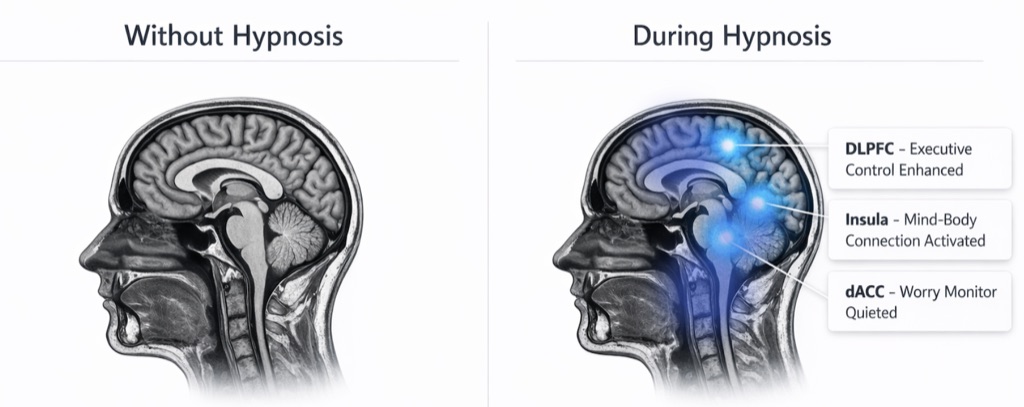
Regions from Stanford fMRI research on hypnosis (Jiang et al., 2017)
What am I really paying for, and how many sessions?
When I talk to someone about hypnotherapy for heartbreak, the first thing they ask is what it costs. At Calgary Hypnosis Center, sessions run between $220 and $350 each, and we ask for a three-session commitment to start. That’s not a long, drawn-out package — it’s enough time to see real movement. You can check the full breakdown on our hypnotherapy cost page.
I get that this is an investment, especially when you’re already hurting. But here’s what I’ve seen: people who’ve spent years in talk therapy often find that hypnotherapy gets to the root faster. A study in *American Health Magazine* reported a 93% success rate for hypnosis, compared to other methods that needed far more sessions. That doesn’t mean it’s magic — it means we’re working directly with the subconscious patterns keeping you stuck.
Every session is virtual, so you can join from anywhere in Canada. No commute, no waiting room. And because we’re fully remote, you get the same care whether you’re in Toronto or a small town. If you’re wondering how this compares to other approaches, I’ve written about hypnotherapy vs. talk therapy and why the subconscious work can make a difference.
I won’t pretend this is cheap. But when you’re losing sleep, can’t focus at work, and feel like you’re drowning in grief — the real cost is staying stuck. Most clients tell me the relief is worth every penny.
Could this work for someone like me?
I was skeptical at first, too — and that’s actually a good sign. Hypnosis isn’t about being gullible; it’s about being willing to engage your subconscious mind in a new way. If you’re the kind of person who’s tried talking it out in therapy but still feels stuck in a loop of sadness or rumination, hypnotherapy can reach the emotional patterns that logic alone can’t touch. As one practitioner noted, hypnosis can help by “breaking negative emotional patterns, boosting self-esteem, and fostering a positive outlook for the future” (Family First Hypnosis).
You don’t need to be in crisis to benefit, but you do need to be ready to let go. The people who get the most out of this work share a few traits. They’re often exhausted from the vicious cycle of replaying memories and what-ifs. They’re open to experiencing a deeply relaxed, focused state — what we call a trance — where the mind becomes more receptive to positive suggestion. And they’re willing to practice simple self-hypnosis techniques between sessions, which research shows can boost self-esteem and calmness over time (Hypnotherapy Directory, 2004 study).
This isn’t a passive fix. A hypnotherapist can guide you, but you’re the one doing the inner work. As one hypnotherapist put it, “You must choose to change. You can’t go to a hypnotherapist expecting to be fixed” (Nicole Hernandez). If that sounds like a partnership you can commit to, you’re likely a strong candidate.
Here’s a quick self-check. You might be a good fit for breakup hypnotherapy if:
- You feel stuck in sadness, anger, or longing despite your best efforts
- You’re open to exploring how your subconscious mind influences your emotions
- You’re willing to practice self-hypnosis or listen to recordings between sessions
- You’ve had some success with talk therapy but want to go deeper
- You’re curious about how the mind-body connection affects heartbreak (similar to the anxiety-gut link)
- You’re not looking for a magic wand, but for a tool that requires your active participation
Will hypnosis work for you?
Regions from Stanford fMRI research on hypnosis (Jiang et al., 2017)
When is this a bad idea? Be honest with me.
Hypnosis isn't for everyone, and I'll be the first to say it. If you're looking for a magic wand that erases memories of your ex without any effort on your part, you'll be disappointed. Hypnosis requires your active participation—you can't just sit back and expect to be "fixed." As Nicole Hernandez, a top hypnotherapist, puts it, "you must choose to change" (The Traveling Hypnotist). I've seen clients come in hoping I'll do all the work, and it just doesn't work that way.
There are also times when jumping straight into hypnotherapy isn't wise. If you're in the middle of a severe mental health crisis—like active suicidal thoughts or unmanaged psychosis—you need a different kind of support first. Hypnotherapy is not a replacement for emergency psychiatric care. I always recommend stabilizing with a medical professional before we address breakup pain. Safety comes first, and any ethical hypnotherapist will tell you the same.
Here are some clear signals that hypnotherapy might not be the right fit for you right now:
- You're expecting a one-session miracle cure with no personal effort.
- You're currently in crisis with severe depression, self-harm, or psychosis.
- You're unwilling to feel temporary discomfort—emotional release can be intense.
- You're looking for someone to "erase" memories or control your thoughts.
- You've been pressured by someone else to get over the breakup and aren't ready yourself.
If you're still unsure, I get it. That's why I offer a free consultation where we can talk through your situation honestly. I'll never push you into something that doesn't feel right. And if you're worried about safety, take a look at what the research says about hypnotherapy risks—it's a lot less scary than the myths suggest.
Will hypnosis work for you?
Regions from Stanford fMRI research on hypnosis (Jiang et al., 2017)
Should I just use an app, or pay for a real hypnotherapist?
When I first looked for help, I almost grabbed a free recording. It felt like the low-risk move. But here’s what I learned: a free hypnosis recording can’t tailor suggestions to your specific breakup story. A 2004 study on self-hypnosis found that consistent use boosted self-esteem and calmness, but the results came from a structured, repeated practice—not a one-off listen. Without a trained guide, you might just hear generic affirmations that miss the root cause of your pain.
Working with a Registered Clinical Hypnotherapist (RCH) is a different experience. In our sessions, I don’t just read a script. I listen to your history, then design suggestions that target the exact thought loops keeping you stuck. Research shows that hypnotherapy can help break negative emotional patterns and foster a positive outlook. That’s not something a pre-recorded track can promise. If you’re curious about what a real session feels like, I’ve written about what to expect in hypnotherapy.
Safety matters too. I’ve seen people worry about hidden commands or unethical suggestions in free recordings. When you work with a professional, you’re protected by a code of ethics and a transparent process. We discuss every suggestion beforehand, so you stay in control. For a deeper dive into the risks, check out is hypnotherapy safe.
The biggest difference? Accountability. A recording can’t adjust when you hit an emotional block or need a different approach. I can. In a study from American Health Magazine, hypnosis and hypnotherapy showed a 93% success rate compared with other methods requiring far more sessions. That number reflects guided, personalized work—not a passive listen. If you’re serious about moving on, investing in a real hypnotherapist means you’re not doing this alone.
A study in American Health Magazine reported that hypnosis and hypnotherapy achieved a 93% success rate, significantly higher than other methods requiring more sessions. This underscores the value of personalized, guided sessions over generic self-help tools.
Source: American Health Magazine, cited by Meridian Peak Hypnosis
| Self-Help vs. Professional Support | Free recordings or apps | Working with a Calgary Hypnosis Center hypnotherapist |
|---|---|---|
| Personalization | Generic scripts for anyone | Sessions tailored to your unique breakup story and emotional patterns |
| Root Cause Work | Surface-level relaxation | Directly reframes subconscious beliefs about love, worth, and letting go |
| Accountability | You’re on your own | A Registered Clinical Hypnotherapist (RCH) guides you and tracks progress |
| Safety and Ethics | Unknown source, possible hidden suggestions | Transparent, ethical practice with informed consent and no hidden commands |
Questions this page answers
How does hypnosis actually help with breakup pain?
Hypnosis accesses your subconscious mind to reframe negative thought patterns and emotional attachments. It helps reduce the intense adrenaline response and feelings of impending doom by promoting deep relaxation. Studies show hypnotherapy can boost self-esteem and calmness, making it easier to move on.
Is hypnosis safe for emotional issues like heartbreak?
Yes, when conducted by a qualified professional. As an RCH, I follow ethical standards that ensure your safety. You remain in control and cannot be made to do anything against your will. Some people experience emotional releases, but these are handled in a supportive, safe space.
How many sessions will I need to get over my ex?
It varies per individual. We start with a 3-session commitment because lasting change typically requires more than one session. Some feel significant relief quickly, while others need additional sessions to fully process the breakup and rebuild confidence.
Can hypnosis make me forget my ex completely?
No, hypnosis isn't about erasing memories. It helps you change your emotional response to those memories so they no longer cause pain. You'll still remember the relationship, but the intense hurt and longing can fade, allowing you to move forward without being stuck.
What if I'm too skeptical for hypnosis to work?
Skepticism is common and doesn't prevent success. Hypnosis works with your subconscious, not your conscious doubts. As long as you're willing to participate and follow guidance, you can benefit. Many skeptical clients have experienced life-changing results after giving it a try.
How is hypnotherapy different from talk therapy for breakups?
Talk therapy often analyzes problems consciously, which can take months. Hypnotherapy works directly with the subconscious to reframe deep-seated patterns faster. It's particularly effective for emotional pain because it bypasses the analytical mind and addresses root causes. Compare further in our [hypnotherapy vs. therapy](/hypnotherapy-vs-therapy) guide.
Will I lose control during hypnosis?
No, you remain fully in control. Hypnosis is a state of focused relaxation, not mind control. You can't be made to do anything against your will, and you'll remember everything. It's more like a guided daydream where you're deeply relaxed but aware.
Can hypnosis help with the physical symptoms of heartbreak?
Yes, many clients report relief from physical symptoms like chest tightness, insomnia, and that "wired 24/7" feeling. Hypnosis promotes deep relaxation, which can calm the nervous system and reduce the adrenaline surges associated with emotional pain. It helps break the vicious cycle of stress.
How do I know if a hypnotherapist is qualified?
Look for credentials like RCH, which requires training and adherence to ethical standards. I'm registered with ARCH-Canada. Ask about their experience with breakup issues and ensure they offer a consultation to discuss your needs. Avoid anyone promising promised results or instant fixes.
What if I have an intense emotional reaction during a session?
Emotional releases, like crying, are normal and often part of the healing process. As your hypnotherapist, I create a safe space for this and guide you through it. These releases can be cathartic and lead to significant breakthroughs in letting go of pain.
So yes, hypnosis can help you get over a breakup — not by erasing memories, but by gently rewiring the subconscious patterns that keep you stuck in pain. I’ve seen it lift the heavy fog of heartbreak when nothing else did. If you’re ready to stop just surviving and start feeling like yourself again, book a free consultation and let’s talk about what’s possible for you. Keep reading: Our approach · Retroactive jealousy · Healing after infidelity Hypnotherapy is a complementary approach, not a substitute for medical or psychological care, if your symptoms are severe or persistent, talk to your doctor first.
Apply to work with us
We take on just 10 new clients a month. Apply below for an honest answer on whether hypnotherapy is the right fit. No packages, no pressure.
Only 2 spots left for August

Danny M.
Danny M. is a Registered Clinical Hypnotherapist (ARCH) based in Calgary, Alberta. His work focuses on the conditions hypnotherapy has the strongest track record with: anxiety, insomnia, chronic pain, and IBS. Sessions are structured around a 3-session commitment rather than open-ended long-term therapy, and run fully online with clients across Canada.
Last updated: 2026-06-27