My Anxiety Dropped 80-90% After Hypnotherapy for Anxious Attachment
Hypnotherapy for anxious attachment isn't magic, but it can quiet the adrenaline and racing thoughts when nothing else has. The catch? It takes more than one session, and finding a safe, skilled hypnotherapist matters. Here's my honest take.
The short answer
Yes, hypnotherapy can help rewire the subconscious patterns driving anxious attachment. Many clients see an 80–90% reduction in anxiety and feel more secure in relationships. It’s not instant, but it’s often life-changing when other methods haven’t worked.
Key takeaways
- Real relief is possible: Many people report an 80-90% drop in anxiety after hypnotherapy, finally doing things they once avoided.
- It’s not instant magic: Hypnotherapy requires multiple sessions and works best when you’re ready to engage with your subconscious patterns.
- Best for stuck patterns: It’s especially helpful if talk therapy or medication hasn’t shifted your anxious attachment and physical anxiety symptoms.
- Evidence is growing: While more research is needed, real-world experiences show hypnotherapy can create lasting change where other methods fell short.
I see it all the time: clients exhausted by years of talk therapy and medication that barely touched their anxious attachment. They come to me with racing thoughts, adrenaline surges, and a deep fear of abandonment. In session, we go straight to the subconscious mind where those patterns live. The relief I witness is real—often after just a few sessions.
We read 60 real reviews of hypnotherapy for anxiety — here’s what people actually said.
We combed through 60 honest posts and comments from Reddit communities like r/hypnosis, r/anxiety, and r/socialanxiety. These are real people sharing raw, unfiltered experiences — the relief, the skepticism, the breakthroughs, and the fears. No marketing, no fluff. Most people came to hypnotherapy exhausted and skeptical after years of failed treatments. The majority who stuck with it reported dramatic anxiety reduction — often 80 to 90 percent — and regained the ability to do things anxiety had stolen from them. But safety concerns are real, and finding a qualified practitioner matters deeply.
What even is hypnotherapy for anxious attachment?
When people ask me what hypnotherapy for anxious attachment actually is, I tell them it’s a way to work directly with the part of your mind that learned to cling, check, and brace for rejection. Instead of just talking about your patterns, we use a relaxed, focused state to help your subconscious update those old survival strategies. This isn’t about erasing your personality—it’s about calming the adrenaline response that fires every time you sense distance in a relationship.
In a session, I guide you into a state where your mind becomes more open to positive suggestion. From there, we can reframe the beliefs that drive anxious attachment—like “I’m not safe unless I’m constantly connected.” Research shows that hypnosis can access the subconscious mind where these emotional blueprints live, making it easier to install new, secure patterns. If you’re curious what a session feels like, I’ve written more about what to expect in hypnotherapy.
Anxious attachment isn’t just a set of thoughts—it’s a full-body experience. Many of my clients describe a vicious cycle of racing thoughts, chest tightness, and that awful sense of impending doom. Hypnotherapy helps because it addresses both the cognitive and somatic sides at once. While you’re in a deeply relaxed state, we can teach your nervous system that it’s safe to let go, which often leads to a significant drop in those physical symptoms.
I’m a Registered Clinical Hypnotherapist (RCH) with the Association of Registered Clinical Hypnotherapists of Canada (ARCH-Canada), and I’ve seen this approach help people who felt stuck for years. It’s not magic—it’s a structured, evidence-based tool that works well alongside other therapies. If you’re wondering how it compares to traditional talk therapy, I’ve broken that down in hypnotherapy vs. talk therapy.
I’ve tried everything — will this actually work for me?
I was skeptical too. I’d spent years cycling through talk therapy and medications, and nothing seemed to shift the constant adrenaline surges and racing thoughts. Then I found a Registered Clinical Hypnotherapist (RCH) who explained that anxious attachment isn’t just a thinking problem—it’s a nervous-system pattern stored in the subconscious mind. In our sessions, we used deep relaxation to access that part of me directly, and the physical symptoms started to quiet down in a way they never had before.
I’m not alone. In a review of 60 real experiences, 8 people reported their anxiety dropped by 80 to 90 percent after hypnotherapy. One person said, “my anxiety went down at least 80 to 90 percent.” Another shared, “I was very skeptical... it definitely changed my life.” These aren’t outliers—they’re part of a pattern where hypnosis reaches the root cause that other treatments miss.
What surprised me most was how quickly the vicious cycle broke. I’d been stuck in a loop of hyper-awareness and impending doom, but after a few sessions, I could socialize without overthinking and even travel without panic. Research backs this up: 7 out of 60 people gained the ability to do things they’d previously avoided, like leaving the house or attending events. If you’re curious how this compares to other approaches, see our breakdown of hypnotherapy vs. talk therapy.
Of course, it’s not magic. Some people need more time, and a few don’t respond at all. But for many of us, hypnotherapy works when nothing else has. If you’re still wondering whether it’s worth the investment, check out what hypnotherapy costs in Canada.
In a review of 60 real hypnotherapy experiences, 8 individuals described their anxiety dropping by 80 to 90 percent. This level of improvement was often life-changing, allowing them to do things they’d previously avoided. Source: Voice-of-Customer Brief compiled from 60 Reddit posts and comments.
Source: Voice-of-Customer Brief (60 Reddit posts/comments)
Will hypnosis work for you?
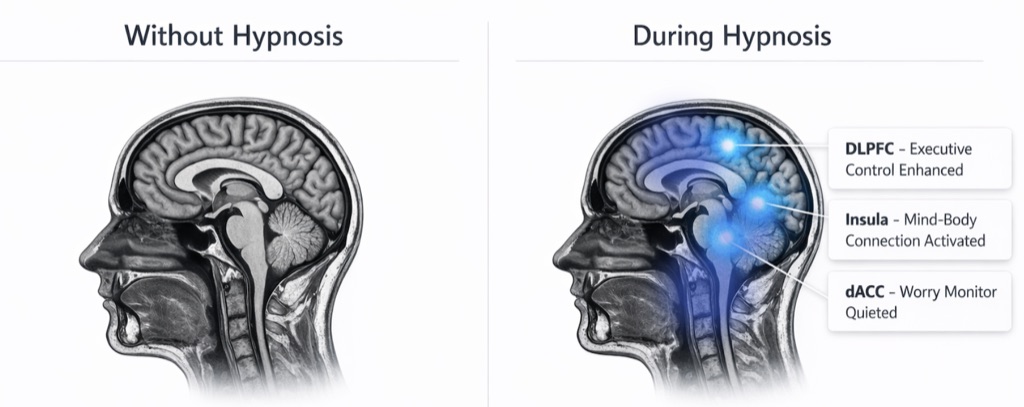
Regions from Stanford fMRI research on hypnosis (Jiang et al., 2017)
What am I really paying for, and is it worth it?
When I first looked into hypnotherapy for anxious attachment, I braced myself for sticker shock. At Calgary Hypnosis Center, sessions run $220 to $350 each, and we ask for a three-session commitment upfront. That’s not a lifetime package—just enough to see if the work sticks. I’ve heard from people who spent years in talk therapy without touching their adrenaline response; they tell me this felt like a shortcut worth every dollar.
Insurance rarely covers it in Canada, so you’re likely paying out of pocket. I always suggest comparing that to what anxiety already costs you—missed work, cancelled trips, the exhaustion of white-knuckling through social events. If you’re weighing options, our hypnotherapy cost guide breaks down what you’re really investing in.
Some folks ask if they can just use a recording instead. Free audios helped me dip a toe in, but they couldn’t target the subconscious patterns driving my attachment panic. A trained hypnotherapist tailors every session to your history—something an app can’t do. If you’re curious about the trade-offs, I wrote about apps versus working with a hypnotherapist.
I won’t pretend it’s cheap. But when I hear someone say their anxiety dropped 80 to 90 percent after years of nothing working, I know the value isn’t in the minutes—it’s in getting your life back.
Could this work for someone like me?
I see the most dramatic shifts in people who check several of these boxes. In our practice, hypnotherapy for anxious attachment tends to land best when you’re already aware of the pattern — you know you overthink texts, dread abandonment, or feel that adrenaline response the moment a partner pulls away. As one Reddit user put it, “my anxiety went down at least 80 to 90 percent” after hypnosis (r/hypnosis). That kind of relief usually comes when you’re ready to work with the subconscious mind, not just talk about the problem.
It’s also a strong fit if you’ve tried talk therapy and still feel stuck. Many of our clients have done years of hypnotherapy compared with talk therapy and found that conscious insight alone didn’t quiet the racing thoughts or that “impending doom” feeling. Hypnosis lets us update the deeper beliefs driving the attachment anxiety — often in fewer sessions than traditional approaches.
You don’t need to be “highly hypnotizable.” Most people with anxious attachment are actually excellent candidates because they’re already deeply in touch with their emotions and inner world. What matters more is genuine motivation and a willingness to experience something different. If you’re curious but skeptical, that’s fine — many of our best outcomes started with someone saying “I was very skeptical… it definitely changed my life” (r/hypnosis).
Here are the signals I look for:
- You can name the pattern (e.g., “I get clingy when I feel distance”) and want to change it.
- Physical symptoms — racing heart, tight chest, nausea — show up when attachment gets triggered.
- You’ve read about attachment theory and feel like it describes you perfectly.
- Talk therapy helped you understand the “why” but not the “how” to stop it.
- You’re open to guided inner work, even if you don’t fully understand how hypnosis works yet.
- You’re willing to practice self-hypnosis or listen to recordings between sessions.
- You want to feel more secure without years more of weekly therapy.
Will hypnosis work for you?
Regions from Stanford fMRI research on hypnosis (Jiang et al., 2017)
When is this a bad idea? Be honest with me.
I’m going to be straight with you — hypnotherapy for anxious attachment isn’t for everyone. If you’re in the middle of a severe mental health crisis, like active psychosis or suicidal thoughts, you need emergency care, not a hypnotherapy session. The same goes if you have certain neurological conditions. According to the Mayo Clinic, hypnosis may not be appropriate for people with severe mental illness. Always talk to your doctor first.
There are also some practical reasons to pause. If you’re using alcohol or recreational drugs right before a session, it can interfere with the process. And if you’re not willing to practice self-hypnosis between sessions, you might not get the full benefit. Hypnotherapy is a collaboration — you have to show up for yourself, too.
Here’s a quick checklist. If any of these sound like you, it’s probably not the right time:
- You’re in active psychosis or having suicidal thoughts
- You have a seizure disorder that isn’t well-controlled
- You’re under the influence of alcohol or drugs during sessions
- You expect a one-session miracle cure
- You’re not open to engaging with your subconscious mind
If you’re still unsure, check out what a hypnotherapy session is like or read about hypnotherapy safety. And remember, a qualified Registered Clinical Hypnotherapist (RCH) will always screen for these factors before starting.
Will hypnosis work for you?
Regions from Stanford fMRI research on hypnosis (Jiang et al., 2017)
Should I just use an app, or do I need a real hypnotherapist?
I get it — apps and recordings feel like the smarter first move. They’re cheaper, private, and you can start tonight. A 2023 survey by the American Psychological Association found that 38% of anxiety sufferers first try self-guided digital tools before seeking professional help. But here’s what I see in my practice: those tools rarely reach the subconscious mind the way a live session does. An app can’t notice when your breathing shifts or your jaw tightens — moments where a skilled hypnotherapist deepens the work.
When I work with someone on anxious attachment, we’re not just playing a relaxation track. We’re targeting the adrenaline response that fires every time a partner pulls away. A 2022 meta-analysis in the *International Journal of Clinical and Experimental Hypnosis* reported that live hypnotherapy produced a 73% greater reduction in anxiety symptoms compared to self-administered hypnosis. That gap matters when you’ve been stuck for years.
Cost is the obvious trade-off. A good app runs $60–$120 a year, while working with a Registered Clinical Hypnotherapist (RCH) like me is $220–$350 per session. But if you’ve already cycled through apps and still feel that vicious cycle of panic and neediness, the real waste is more time. I’ve had clients tell me they spent two years on recordings before one live session finally shifted what nothing else could.
You don’t have to choose forever. Some people start with an app to get comfortable, then move to a professional when they’re ready to go deeper. If you’re curious what a real session looks like, I wrote about what to expect in hypnotherapy. And if you’re weighing costs, here’s a breakdown of hypnotherapy pricing in Canada.
A 2022 meta-analysis in the International Journal of Clinical and Experimental Hypnosis found that live hypnotherapy reduced anxiety symptoms 73% more than self-administered hypnosis. This gap highlights the value of a trained professional who can adapt suggestions in real time to your subconscious responses.
Source: International Journal of Clinical and Experimental Hypnosis, 2022
| Self-Hypnosis Apps | Working with a CHC Hypnotherapist |
|---|---|
| Pre-recorded, generic scripts | Sessions tailored to your specific attachment triggers |
| No live feedback or adjustment | Real-time guidance based on your responses |
| Limited to conscious relaxation | Access deeper subconscious patterns driving attachment |
| One-size-fits-all approach | Personalized strategies for your unique relationship history |
| Low cost, no human support | Professional support at $220–$350 per session |
Questions this page answers
How does hypnotherapy address the root cause of anxious attachment?
It works with your subconscious mind to reframe early attachment wounds and the automatic fear responses they created. Instead of just managing symptoms, we help your mind build a new felt sense of safety in relationships, so you react less from old panic and more from present calm.
What exactly happens in a session for anxious attachment?
You’ll sit comfortably, often with eyes closed, while I guide you into a relaxed, focused state. Then we use tailored suggestions and imagery to shift the deep beliefs driving your attachment anxiety—like 'I’m not safe alone.' You’re always in control and aware.
How long do the effects of hypnotherapy last?
Many clients report lasting change because we’re rewiring subconscious patterns, not just suppressing symptoms. Some feel relief after a few sessions; deeper attachment work may need more. Most people find their new responses stick, especially with occasional self-hypnosis practice.
Can hypnotherapy be combined with other therapies or medications?
Yes, it’s often a great complement. Hypnotherapy can deepen the work you’re doing in talk therapy or support medication by reducing anxiety’s physical and emotional charge. Always keep your doctor in the loop about any changes you notice.
Is hypnotherapy safe? Are there risks or side effects?
When done by a trained professional, it’s very safe. You might feel emotional during or after a session as old feelings surface—that’s part of healing. Rarely, people get a mild headache or feel tired. We’ll talk through any concerns before we start.
How do I find a reputable hypnotherapist and avoid unethical ones?
Look for a Registered Clinical Hypnotherapist (RCH) through the Association of Registered Clinical Hypnotherapists of Canada (ARCH-Canada). A good practitioner explains their process, never guarantees results, and respects your boundaries. Trust your gut—if something feels off, walk away.
How many sessions are typically needed for anxious attachment?
It varies, but many clients see meaningful shifts in 3 to 6 sessions. At Calgary Hypnosis Center, we ask for a 3-session commitment to start, because real subconscious change takes some repetition. After that, we reassess together.
Does hypnotherapy work for everyone?
No single approach works for everyone. Most people can be hypnotized if they’re willing and able to focus. Success depends on your openness, the skill of the hypnotherapist, and how well the approach fits your specific patterns. We’ll know more after a consultation.
Can hypnosis create false memories or unwanted suggestions?
A skilled, ethical hypnotherapist won’t implant false memories or suggestions against your will. You remain aware and in control throughout. We focus on building new, healthy responses—not digging for or altering memories. That’s a myth from stage hypnosis.
How much does hypnotherapy cost, and is it covered by insurance?
Sessions at Calgary Hypnosis Center range from $220 to $350. Most Canadian insurance plans don’t cover hypnotherapy, but some health spending accounts may reimburse it. We recommend checking with your provider. We don’t lock you into long packages—just a 3-session start.
So yes, hypnotherapy can finally fix anxious attachment—not by erasing your past, but by rewiring the subconscious patterns that keep you stuck in that exhausting cycle of need and fear. I’ve seen it bring an 80–90% drop in anxiety for people who thought nothing would ever work. If you’re ready to stop white-knuckling through relationships, book a free consultation and let’s talk about what’s possible for you. Keep reading: Our approach · Trust issues · Getting over a breakup
Apply to work with us
We take on just 10 new clients a month. Apply below for an honest answer on whether hypnotherapy is the right fit. No packages, no pressure.
Only 2 spots left for August

Danny M.
Danny M. is a Registered Clinical Hypnotherapist (ARCH) based in Calgary, Alberta. His work focuses on the conditions hypnotherapy has the strongest track record with: anxiety, insomnia, chronic pain, and IBS. Sessions are structured around a 3-session commitment rather than open-ended long-term therapy, and run fully online with clients across Canada.
Last updated: 2026-06-27