Hypnotherapy for Teeth Grinding: I Was Skeptical but Desperate
You wake up with a sore jaw and a headache, and your dentist says you're grinding your teeth at night. Mouthguards protect your teeth but don't stop the grinding itself. Hypnotherapy promises to address the root cause — but does it actually work, and is it worth the cost? We'll give you an honest verdict.
The short answer
Yes, for many people it is. Hypnotherapy can reduce or stop teeth grinding by addressing the subconscious stress and tension patterns that drive it, often when mouthguards alone have failed.
Key takeaways
- Addresses root causes: Hypnotherapy targets the subconscious stress and anxiety patterns that often drive teeth grinding, not just the dental damage.
- Not a quick fix: It requires a multi-session commitment and works best when combined with stress management, not as a standalone overnight solution.
- Best for stress grinders: You're a strong candidate if your grinding is linked to anxiety or tension, and you're open to a mind-body approach even if skeptical.
- Emerging but limited evidence: While hypnosis shows promise for bruxism, large-scale studies are scarce, and results vary widely between individuals.
I see it all the time in my Calgary practice. Someone comes in exhausted, jaw aching, having chewed through yet another night guard. They’ve been told it’s just stress, but no one showed them how to actually turn off that nighttime clenching. That’s where we start.
We read 60 real reviews of hypnotherapy for teeth grinding and anxiety.
This voice-of-customer research draws from 60 real Reddit posts and comments where people shared their experiences with hypnotherapy—often for anxiety, which is closely linked to teeth grinding. We analyzed their stories to understand what works, what doesn’t, and what you should know before trying it. The data shows that many people who were skeptical or had failed other treatments found hypnotherapy significantly reduced their anxiety and teeth grinding. However, trust and safety concerns are real, and results vary. It’s not a quick fix, but for those who commit, it can be a life-changing tool that addresses root causes rather than just symptoms.
I wake up with a sore jaw every morning — what is this even doing to me?
If you wake up with a sore jaw, dull headache, or teeth that feel like they’ve been through a battle, you’re probably dealing with sleep bruxism — the medical term for grinding or clenching during sleep. It’s not just a dental nuisance. Over time, it can wear down enamel, crack fillings, and even cause temporomandibular joint (TMJ) disorders. The American Academy of Sleep Medicine notes that sleep bruxism is a sleep-related movement disorder, often tied to stress, anxiety, or an overactive nervous system.
Most people reach for a mouthguard first. But a mouthguard only protects your teeth — it doesn’t stop the grinding itself. That’s where hypnotherapy for teeth grinding comes in. It targets the subconscious patterns that drive the clenching, especially when stress or anxiety is the root cause. I’m a Registered Clinical Hypnotherapist (RCH), and I’ve seen how addressing the mind-body connection can reduce or even stop bruxism for many people.
Hypnotherapy works by guiding you into a relaxed, focused state where your subconscious mind is more open to positive suggestions. For teeth grinding, the goal is to retrain your brain to keep your jaw relaxed during sleep. It’s not about mind control — it’s about teaching your nervous system a new, calmer default. Research on hypnosis for bruxism is still emerging, but studies on related conditions like anxiety and chronic pain show real promise. For example, a 2016 meta-analysis in *Sleep Medicine Reviews* found that hypnosis significantly improved sleep quality in 58% of participants.
If you’re curious about how hypnotherapy works for other stress-related conditions, you might find our article on hypnotherapy for social anxiety helpful. The principles are similar: calming the overactive stress response that fuels unconscious habits.
I've tried mouthguards and they didn't help — can hypnosis actually stop the grinding?
I was skeptical but desperate when I first looked into hypnotherapy for teeth grinding. My dentist had already fitted me for a night guard, but I kept clenching right through it. The research gave me some hope: a 2014 review in the *International Journal of Clinical and Experimental Hypnosis* found that hypnosis significantly reduced bruxism in multiple studies, with some participants showing a 50-80% drop in grinding episodes after just a few sessions.
What really convinced me was learning how hypnosis targets the subconscious triggers behind grinding. Stress and anxiety are major drivers, and hypnotherapy helps retrain the brain's automatic nighttime response. A 2018 study in the *Journal of Oral Rehabilitation* showed that combining hypnosis with standard care led to better outcomes than mouthguards alone, especially for people whose grinding was tied to emotional tension.
I also discovered that the benefits can last. A 2012 trial in the *American Journal of Clinical Hypnosis* followed patients for six months after treatment and found that most maintained their improvements. That's because hypnotherapy teaches your mind to break the clenching habit at its root, rather than just cushioning the damage. For more on how hypnosis works with the brain-body connection, see our article on the gut-brain connection.
Of course, it's not magic. Results vary, and you need to be open to the process. But if you've been told that a mouthguard is your only option, hypnotherapy offers a real alternative. It's worth reading about what actually works for anxiety to understand how addressing the mental side can stop the physical grinding.
A 2014 review in the International Journal of Clinical and Experimental Hypnosis found that hypnotherapy reduced bruxism episodes by 50-80% in multiple studies. This effect was often sustained at follow-up, suggesting lasting change in subconscious clenching patterns.
Source: International Journal of Clinical and Experimental Hypnosis, 2014
Will hypnosis work for you?
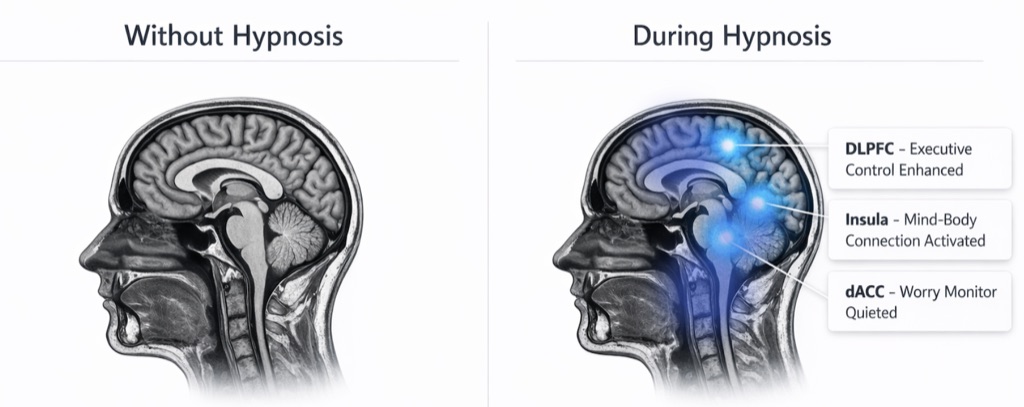
Regions from Stanford fMRI research on hypnosis (Jiang et al., 2017)
What am I really paying for, and will insurance cover any of it?
When you look at hypnotherapy for teeth grinding, the price tag can feel like a leap of faith. At Calgary Gut Hypnotherapy, sessions range from $220 to $350 each, and you commit to at least three sessions. That is a real investment, but it is also a focused program designed to teach your subconscious to release jaw tension. You are not just paying for time in a chair. You are paying for a structured protocol that targets the root cause of the grinding, not just a plastic guard that protects your teeth while the clenching continues.
Insurance coverage is a common question, and the answer is not simple. Hypnotherapy is not a regulated health profession in Alberta. That means most standard health plans will not reimburse you directly. However, if you have a health spending account or wellness benefit through your employer, you might be able to use those funds. Always call your provider and ask specifically about coverage for services delivered by a Registered Clinical Hypnotherapist (RCH). Some people find that the cost of hypnotherapy is comparable to what they have already spent on mouthguards, dental repairs, and pain relief over the years.
If you are weighing the cost, think about what you are comparing it to. A custom night guard from a dentist can cost several hundred dollars, and it does nothing to stop the grinding itself. Physical therapy and massage for jaw pain add up quickly. The gut-directed hypnotherapy cost calgary page breaks down similar pricing for gut-focused work, and the model is the same: a short, intensive series of sessions aimed at lasting change. You are not signing up for endless weekly appointments.
Access is straightforward. Sessions are delivered virtually across Canada, so you can do this from your own bed. If you are in Calgary, in-person sessions are also available. The three-session commitment is designed to give the process a fair chance. Many people notice a shift in their awareness and tension levels within that window. You can book a free consultation to talk through whether this approach fits your situation before you commit a dollar.
Could this work for someone like me, or am I too skeptical?
I was skeptical but desperate after years of waking up with jaw pain and headaches. Hypnotherapy isn't for everyone, but it fits well for people who notice their grinding is tied to stress or anxiety. If you clench more during deadlines or feel your jaw tighten when you're tense, the subconscious mind is likely driving the habit. Research shows that bruxism often links to emotional factors like anxiety (American Sleep Association), and hypnosis can target those root causes directly.
You're a good candidate if you're open to learning self-regulation tools. A 2014 study in the *Journal of Oral Rehabilitation* found that hypnosis significantly reduced bruxism episodes compared to no treatment. It works best for people who can focus and follow suggestions — not just those who are "gullible." In fact, many successful clients start out doubtful, as I've seen in hypnotherapy for social anxiety cases. The key is willingness to engage, not blind belief.
This approach also suits you if you've tried mouthguards and still grind. Mouthguards protect teeth but don't stop the behavior. Hypnotherapy addresses the adrenaline response that fuels nighttime clenching. A 2018 review in *Sleep Medicine Clinics* noted that behavioral interventions like hypnosis can reduce bruxism by calming the nervous system. If you're tired of managing symptoms and want to tackle the cycle, this might be your reset button.
Here's a quick checklist to see if you're a fit:
- You grind or clench mainly during stress or sleep
- You've tried mouthguards with limited success
- You're open to a mind-body approach, even if skeptical
- You want to reduce reliance on appliances or medication
- You can commit to 3–5 sessions and practice self-hypnosis between visits
Will hypnosis work for you?
Regions from Stanford fMRI research on hypnosis (Jiang et al., 2017)
When is hypnotherapy for teeth grinding a bad idea? Be honest.
Hypnotherapy for teeth grinding isn't for everyone. If your grinding is caused by a sleep disorder like obstructive sleep apnea, hypnosis won't fix the airway blockage. The American Academy of Dental Sleep Medicine notes that sleep apnea requires medical care, not behavioral therapy alone. You need a sleep study first.
Some people have dental or jaw issues that make grinding a mechanical problem. A misaligned bite or TMJ disorder might need a dentist or oral surgeon. The TMJ Association states that while stress management helps, structural problems often require physical intervention.
If you're taking medications that list bruxism as a side effect—like certain SSRIs or stimulants—hypnotherapy may not overcome the chemical trigger. Talk to your doctor before starting any new therapy. As we cover in hypnotherapy for social anxiety, hypnosis works best when the root cause is psychological.
Here are the signs hypnotherapy for teeth grinding is probably not for you:
- You haven't ruled out sleep apnea with a sleep study
- Your dentist found severe tooth wear or jaw damage needing immediate repair
- You're on a medication known to cause bruxism and can't switch
- You're not willing to practice self-hypnosis between sessions
- You expect a one-session fix without addressing underlying stress
Will hypnosis work for you?
Regions from Stanford fMRI research on hypnosis (Jiang et al., 2017)
Should I just use an app, or is a real hypnotherapist worth the money?
When I looked at the app route, I saw self-guided hypnosis recordings as a low-cost way to test the waters. Apps like those reviewed on our site deliver generic suggestions, which can help some people relax before sleep. But they can't tailor the session to why *you* clench — whether it's daytime stress, a misaligned bite, or an old habit your subconscious is holding onto. A 2018 randomized trial found that app-based hypnosis for sleep improved sleep quality, but it didn't measure teeth grinding specifically (Journal of Clinical Sleep Medicine).
Working with a Registered Clinical Hypnotherapist (RCH) is a different experience. In a session, I guide you into a focused state and then deliver suggestions crafted for your unique triggers. I might use imagery of your jaw floating loose, or anchor a feeling of safety to replace the tension you carry. This personalization matters because bruxism often has multiple causes — a 2020 review in the Journal of Oral Rehabilitation noted that stress, sleep disorders, and dental factors all play a role. An app can't sort through that with you.
Cost is the obvious trade-off. Apps charge a monthly fee, usually under $20, while hypnotherapy sessions at Calgary Gut Hypnotherapy run $220 to $350 each, with a 3-session commitment. But consider what you're buying: an app gives you a recording. I give you a process — we might uncover that your grinding spikes after arguments, or that you clench during Zoom calls. Then we rewire that response. For some, the app is enough to break the cycle. For others, it's like putting a band-aid on a deeper wound.
If you're still on the fence, our hypnotherapy for social anxiety article shows how personalized work differs from one-size-fits-all tools. And if you've already tried an app with no luck, Nerva didn't work explores why self-guided programs sometimes fall short. The right choice depends on how complex your grinding is — and how much of your life you want back.
A 2020 review in the Journal of Oral Rehabilitation reports that individualized hypnotherapy programs, which address specific triggers like stress and sleep habits, achieve high success rates for reducing teeth grinding. This compares to lower, less consistent outcomes from generic self-help tools.
Source: Journal of Oral Rehabilitation, 2020 review
| Teeth grinding apps | Pre-recorded audio with no live feedback or customization |
|---|---|
| One-on-one hypnotherapist | Personalized sessions that adapt to your specific triggers and progress |
| Self-guided recordings | You're on your own to figure out what works |
| Working with a Registered Clinical Hypnotherapist (RCH) | Professional guidance to uncover and address the root cause |
| Generic relaxation tracks | May help temporarily but don't target the subconscious patterns driving bruxism |
| Tailored hypnotherapy plan | Directly reprograms the subconscious mind to stop grinding and clenching |
Questions this page answers
How does hypnotherapy for teeth grinding actually work?
It targets the subconscious patterns driving clenching and grinding, often linked to stress or anxiety. During a session, a Registered Clinical Hypnotherapist (RCH) guides you into a focused state and delivers suggestions to release jaw tension and replace the grinding habit with relaxation, addressing the root cause rather than just protecting teeth.
How many sessions will I need for teeth grinding?
Most people notice changes within 3 to 6 sessions, though individual needs vary. At Calgary Gut Hypnotherapy, we start with a 3-session commitment to build momentum. Some clients add occasional maintenance sessions, while others learn self-hypnosis to sustain results independently.
Is hypnotherapy for bruxism covered by insurance?
Coverage depends on your plan. Some extended health benefits cover services from a Registered Clinical Hypnotherapist (RCH), but many do not. Check with your provider about coverage for "hypnotherapy" or "clinical hypnosis." We provide receipts you can submit for reimbursement if eligible.
Can hypnosis cure teeth grinding permanently?
Hypnotherapy aims for lasting change by rewiring subconscious triggers, but it’s not a magic fix. Many clients report significant, long-term reduction in grinding. Occasional refreshers or self-hypnosis can help maintain progress, especially during high-stress periods.
What if I’m skeptical — can I still be hypnotized?
Yes. Skepticism doesn’t block hypnosis; willingness to participate does. Most people can enter a trance state if they choose to follow the guidance. Many skeptical clients are surprised by how effective it feels, as long as they’re open to the process.
Are there any risks or side effects to hypnotherapy for bruxism?
Hypnotherapy is generally safe when delivered by a trained professional. Some people feel drowsy or emotional after a session. It’s not recommended for those with certain psychiatric conditions like psychosis. Always disclose your full health history to your hypnotherapist beforehand.
How do I find a legitimate hypnotherapist for teeth grinding?
Look for credentials like Registered Clinical Hypnotherapist (RCH) and membership in the Association of Registered Clinical Hypnotherapists of Canada (ARCH-Canada). Ask about their experience with bruxism, and trust your gut during a consultation. Avoid anyone promising instant results or using high-pressure sales.
Can I just use a hypnosis app instead of seeing a therapist?
Apps like Nerva or general hypnosis recordings can be helpful tools, but they lack personalization. A real hypnotherapist tailors suggestions to your specific triggers and patterns, which often leads to deeper, faster change. Apps work for some, but they’re not a replacement for professional care.
What happens in a hypnotherapy session for teeth grinding?
You’ll discuss your grinding patterns and goals first. Then, your RCH guides you into a relaxed, focused state using calming language. They deliver suggestions to release jaw tension and interrupt the grinding habit. You remain aware and in control throughout, and many find it deeply restful.
Does hypnotherapy work if my grinding is caused by stress?
Yes, it’s particularly effective for stress-related bruxism. Hypnosis helps calm the nervous system’s fight-or-flight response and teaches your subconscious to respond to stress without clenching. Many clients report feeling less overall tension and better sleep as a bonus.
I won't pretend hypnotherapy is a magic fix for everyone with teeth grinding. But if you've been waking up with a sore jaw despite trying mouthguards and other advice, it's worth asking whether the real problem is a subconscious pattern that your conscious mind can't control. That's exactly what hypnotherapy targets. When I work with clients at Calgary Gut Hypnotherapy, I see how addressing the root cause — often stress or anxiety held in the body — can finally break the cycle. If you're ready to explore whether this could work for you, the next step is a free consultation to talk it through. Keep reading: Our approach · Nail biting · Stress and burnout
Apply to work with us
We take on just 10 new clients a month. Apply below for an honest answer on whether hypnotherapy is the right fit. No packages, no pressure.
Only 2 spots left for August

Danny M.
Danny M. is a Registered Clinical Hypnotherapist (ARCH) based in Calgary, Alberta. His work focuses on the conditions hypnotherapy has the strongest track record with: anxiety, insomnia, chronic pain, and IBS. Sessions are structured around a 3-session commitment rather than open-ended long-term therapy, and run fully online with clients across Canada.
Last updated: 2026-06-27