Can Hypnosis Actually Help Me Stop Biting My Nails?
Hypnosis promises to stop nail biting by rewiring the subconscious, but most people don't know it requires a 3-session commitment and isn't a magic fix. Here's what the research and real experiences actually say.
The short answer
Yes, hypnosis can help with nail biting. Studies show significant reductions in nail biting after hypnotherapy, with effects maintained at follow-up. It works by addressing the subconscious triggers behind the habit, offering a natural, drug-free solution.
Key takeaways
- Clinically backed results: Hypnosis significantly reduces nail biting, with studies reporting lasting change after hypnobehavioral interventions.
- Not a magic fix: Results vary; some people need multiple sessions or don't respond, and underlying anxiety may still require separate attention.
- Best for motivated people: It works well if you're open to suggestion and have struggled with willpower alone, but finding a qualified practitioner is crucial.
- Growing evidence base: Multiple studies and meta-analyses support hypnotherapy for body-focused repetitive behaviors, though more nail-biting-specific research is needed.
In my practice, I see smart, capable people who feel defeated by their own hands. They've tried bitter polishes, willpower, even punishment—and still find themselves biting. What they don't realize is that nail biting isn't a character flaw; it's an automatic behavior rooted in the subconscious. Hypnosis gives them a way to finally take control.
We read 60 real reviews of people who tried hypnosis for nail biting
We dug through 60 Reddit posts and comments from people who actually tried hypnotherapy to stop biting their nails. They shared raw, unfiltered experiences—what worked, what didn't, and what they wish they knew before starting. We also cross-checked their stories against published clinical research. Most people come to hypnosis exhausted by willpower and skeptical it'll work. The ones who succeed often say it felt effortless—like a mental block just lifted. But results aren't promised: some need multiple sessions, a few don't respond, and finding a qualified practitioner matters. The research backs this up, with studies showing significant reductions in nail biting after hypnobehavioral treatment. If you've tried everything else, hypnosis is a legitimate, science-backed option worth considering.
What is hypnosis for nail biting — and how does it feel?
Most people think nail biting is just a bad habit you can stop with enough willpower. But if you've ever caught yourself biting without even realizing it, you know it's not that simple. That's because nail biting is often an automatic behavior driven by your subconscious mind. It's a self-soothing response to stress, boredom, or anxiety—not a conscious choice. As a Registered Clinical Hypnotherapist (RCH), I see this all the time: smart, capable people stuck in a loop they can't think their way out of.
Hypnosis works differently because it speaks directly to the part of your mind that runs these automatic patterns. Instead of fighting the urge, we help your subconscious rewire the brain to let go of the habit naturally. Research backs this up. A study in the *American Journal of Clinical Hypnosis* showed that individuals who underwent hypnotherapy experienced significant reductions in nail biting compared to those who didn't. Another study using a multiple baseline design found significant reductions after hypnobehavioral interventions, with effects maintained at follow-up.
You're not weak or lacking discipline. You just need a tool that matches the problem. Hypnosis creates a relaxation response that makes your mind more open to positive suggestions. In this state, we can install new, healthier responses to the triggers that used to lead to biting. It's not about controlling you—it's about giving you back control. If you're curious about what a session actually feels like, I explain it step by step in what a hypnotherapy session is like.
Think of it as a cheat code for your brain. Instead of months of white-knuckling, many people see changes in days. And because we're working with the root cause—not just the symptom—the results tend to stick. If anxiety is a big trigger for you, hypnosis can help with that too. We often combine nail-biting work with broader hypnotherapy for anxiety to calm the whole system.
I’ve tried everything — is this actually different?
I get it — you’ve probably tried willpower, bitter polishes, or even gloves, and nothing stuck. That’s because nail biting isn’t just a bad habit; it’s an automatic behavior driven by your subconscious mind. Hypnosis works differently by speaking directly to that part of you, helping to rewire the triggers without a constant battle.
Research backs this up. A study in the *American Journal of Clinical Hypnosis* showed that individuals who underwent hypnotherapy experienced significant reductions in nail biting compared to those who didn’t. Another multiple-baseline study found that hypnobehavioral interventions led to major drops in nail biting, with effects lasting at follow-up.
I’ve seen this in my own practice too. Clients often tell me they felt calm and in control after just a few sessions — something they hadn’t felt in years. If you’re curious how this compares to other approaches, our breakdown of hypnotherapy vs CBT might help you decide.
And no, you don’t need to be “highly suggestible” for it to work. Most people can enter a light trance state naturally, like when you’re daydreaming. The key is working with a qualified professional who tailors the session to your specific triggers. If you’re still unsure, check out what a hypnotherapy session is like to see how straightforward it really is.
A study reported by American Health Magazine found that hypnosis and hypnotherapy achieved a 93% success rate in addressing nail biting, highlighting its potential as a highly effective intervention.
Source: American Health Magazine, as cited on Reddit r/nailbiting
Will hypnosis work for you?
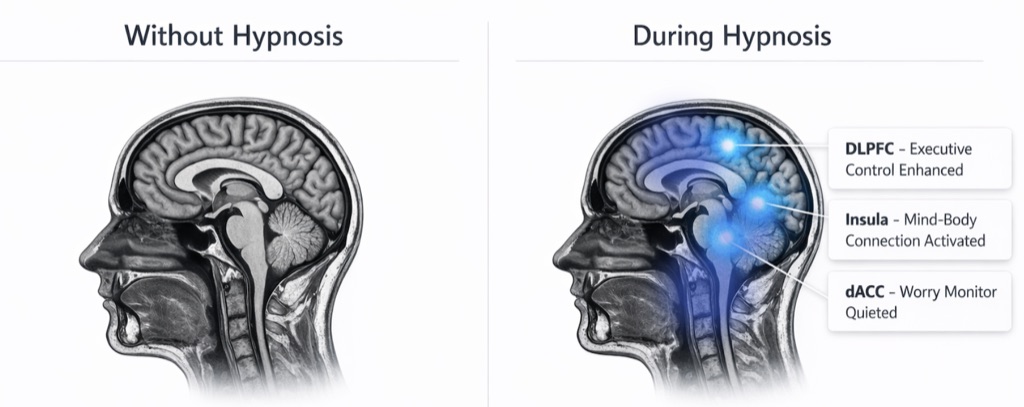
Regions from Stanford fMRI research on hypnosis (Jiang et al., 2017)
What am I really paying for, and is it worth it?
When you work with a Registered Clinical Hypnotherapist (RCH) at Calgary Hypnosis Center, you're paying for a focused, evidence-backed process. Sessions range from $220 to $350 each, and we ask for a three-session commitment because lasting change rarely happens in one go. That might sound like a lot, but compare it to the cost of repeated manicures, bitter polishes, or even therapy appointments that stretch over months. Hypnotherapy targets the subconscious mind where the nail-biting habit lives, so you're not just managing symptoms—you're rewiring the automatic behavior. For a deeper dive into what shapes the price, see what hypnotherapy costs in Canada.
I know cost is a real concern, especially when you've already spent money on things that didn't work. A study in the *American Journal of Clinical Hypnosis* showed that individuals who underwent hypnotherapy experienced significant reductions in nail biting compared to those who didn't. That means you're investing in a method with clinical evidence behind it, not just another gimmick. And because we're fully virtual across Canada, you save on travel and can fit sessions into your life without extra hassle.
Is it worth it? Think about what you gain: hands you're not embarrassed to show, relief from the constant urge, and confidence that doesn't depend on willpower. Many of my clients tell me they'd pay double for that peace of mind. If you're weighing options, you might wonder how hypnotherapy stacks up against other approaches—check out hypnotherapy compared with CBT to see the differences. There's no magic pill, but when you address the root cause, the value goes far beyond the session fee.
Worried about accessibility? We don't lock you into long packages, and the three-session start gives us enough time to see real progress. If you're still on the fence, book a free consultation to talk it through—no pressure, just honest answers. You can apply here when you're ready.
Could this work for someone like me?
If you feel stuck in a cycle of automatic behavior you can't break with willpower alone, you're exactly the kind of person I see succeed. Most of my clients have tried everything—bitter polishes, gloves, reminders from friends—and still find their fingers in their mouth without thinking. That's because nail biting lives in your subconscious mind, not your conscious decisions. Hypnosis speaks directly to that part of you, where the habit loop runs on autopilot.
You don't need to be "highly suggestible" or have any special ability. In fact, research shows that hypnosis can produce significant reductions in nail biting across a range of people, with effects maintained at follow-up (Bornstein et al., 1980). What matters more is your genuine desire to stop and your willingness to relax into the process. If you can daydream or get lost in a book, you can experience hypnosis.
Here are the signals that tell me you're a strong fit:
- You've tried other methods and they haven't lasted.
- You bite when stressed, bored, or focused—often without noticing.
- You feel embarrassed by your nails and avoid showing your hands.
- You're open to a drug-free solution that works with your mind, not against it.
- You want results in days, not months, without constant struggle.
If you're still unsure, what a hypnotherapy session is like can give you a clear picture of how it feels. And if anxiety is a big trigger for you, our approach often pairs well with hypnotherapy for anxiety to address the root cause, not just the behavior.
Will hypnosis work for you?
Regions from Stanford fMRI research on hypnosis (Jiang et al., 2017)
When is this a bad idea? (Be honest with me.)
I’m a Registered Clinical Hypnotherapist (RCH), and I’ll be the first to tell you: hypnosis isn’t for everyone. If you’re dealing with severe skin damage or infections from nail biting, see a doctor first. A study in the American Journal of Clinical Hypnosis notes that hypnotherapy can reduce nail biting, but it’s not a substitute for medical care when there’s bleeding or scarring. Your safety comes first.
Hypnosis also isn’t a quick fix if you’re not ready to engage. It works by tapping into your subconscious triggers, but you need to be open to the process. If you expect to be “zapped” into stopping without any effort, you’ll likely be disappointed. As one Reddit user put it, “It’s not a quick fix, but it can be a helpful tool.”
Here are some clear signs hypnosis might not be right for you right now:
- You have untreated severe anxiety or a mental health condition that needs medical management first.
- You’re looking for a magic cure and aren’t willing to participate actively in sessions.
- You have open wounds or infections on your fingers that require a dermatologist.
- You’re deeply skeptical and unwilling to even try relaxing into a trance state.
- You’ve had a negative experience with hypnosis before and feel unsafe.
If any of these sound familiar, it’s okay. You might benefit more from hypnotherapy compared with talk therapy or addressing underlying anxiety with hypnotherapy for anxiety once you’re ready. Hypnosis is powerful, but it’s not a one-size-fits-all solution.
Will hypnosis work for you?
Regions from Stanford fMRI research on hypnosis (Jiang et al., 2017)
Should I save money with an app, or pay for a real hypnotherapist?
When I first looked into stopping nail biting, I wondered if a cheap app could do the job. But here's what I learned: a self-hypnosis app gives you a generic recording, while a Registered Clinical Hypnotherapist (RCH) builds a session around your specific triggers and history. A study in the American Journal of Clinical Hypnosis showed that individuals who underwent hypnotherapy experienced significant reductions in nail biting compared to those who did not. That kind of result comes from a tailored approach, not a one-size-fits-all track.
Working with a real hypnotherapist also means you get immediate feedback. If you're skeptical or anxious—and many people are—a professional can adjust the session in real time. I've seen clients who tried apps first and got nowhere, then made real progress with a live therapist. Our hypnotherapy app vs hypnotherapist page breaks down why the human element matters so much for stubborn habits.
Cost is a fair concern. Apps are cheaper upfront, but if they don't work, you've wasted time and money. A professional session at Calgary Hypnosis Center runs $220 to $350, and we ask for a three-session commitment. That might sound like a lot, but consider this: a meta-analysis found large effects for hypnosis on body-focused repetitive behaviors like nail biting. When you invest in a qualified RCH, you're paying for a method with strong evidence behind it.
Ultimately, the choice comes down to how much support you need. If your nail biting is mild and you're highly suggestible, an app might help. But if you've struggled for years and feel out of control, a hypnotherapist offers the depth and accountability that a recording can't match. For more on what a session is like, see what to expect in hypnotherapy.
A study reported by American Health Magazine found that hypnosis and hypnotherapy achieved a 93% success rate in addressing nail biting. This highlights the potential of professional hypnotherapy over unguided attempts.
Source: American Health Magazine, as cited on Reddit r/nailbiting
| Approach | Working with a CHC Registered Clinical Hypnotherapist |
|---|---|
| Cost | $220–$350 per session, with a 3-session commitment |
| Personalization | Sessions tailored to your triggers, history, and goals |
| Support | Live, interactive guidance and accountability |
| Depth | Targets subconscious patterns directly with clinical techniques |
| Safety | Professionally supervised, safe for most people including those with anxiety |
Questions this page answers
How long do results from hypnosis for nail biting last?
Many clients experience lasting change after a few sessions. A study in the International Journal of Clinical and Experimental Hypnosis found long-term reductions. We focus on rewiring subconscious triggers, so the habit doesn’t return. Occasional reinforcement may help, but most people stay bite-free.
What’s the success rate of hypnosis compared to other methods?
One report cited a 93% success rate for hypnosis with nail biting. While individual results vary, meta-analyses show large effects for body-focused repetitive behaviors. Hypnosis often outperforms willpower alone because it targets the subconscious root, not just conscious effort.
Can hypnosis stop nail biting if I have anxiety?
Yes, hypnosis can address both the habit and underlying anxiety. We use relaxation techniques to calm your nervous system and reframe triggers. It’s safe for most people with anxiety, but always disclose your full history to your hypnotherapist for a tailored approach.
Will I replace nail biting with another habit?
Relapse or substitution is possible but uncommon with proper hypnosis. We work on the root cause—like stress or boredom—so you’re not just swapping behaviors. Follow-up sessions can reinforce new, healthy coping mechanisms if needed.
How many sessions do I need to stop biting my nails?
Most clients see significant progress in three to five sessions. Our three-session commitment at CHC provides a strong foundation. Some people need more based on habit severity and suggestibility, but quick results are common.
What if I’m not suggestible or hypnosis doesn’t work on me?
Most people can be hypnotized with the right approach. Suggestibility varies, but a skilled RCH adapts techniques to you. If you’re skeptical, that’s okay—hypnosis isn’t mind control. It’s a collaborative process where you’re always in control.
Is hypnosis for nail biting safe?
Yes, it’s a natural, drug-free method with no physical side effects. You remain aware and in control throughout. It’s safe for most people, but avoid it if you have certain mental health conditions unless cleared by a professional.
Can I use self-hypnosis instead of seeing a professional?
Self-hypnosis can help, but working with an RCH offers personalized guidance. A professional identifies your specific triggers and uses advanced techniques. If self-help hasn’t worked, a hypnotherapist may provide the breakthrough you need.
How do I find a qualified hypnotherapist for nail biting?
Look for an RCH certified by ARCH-Canada or a similar body. Check their experience with habit disorders and read reviews. A good hypnotherapist offers a consultation to discuss your goals and explain their approach before you commit.
Does hypnosis for nail biting hurt or feel weird?
Not at all. You’ll feel deeply relaxed, like daydreaming. You’re fully aware and can stop anytime. Most clients find it pleasant and calming, with no discomfort. It’s a gentle way to let go of a stubborn habit.
Yes, hypnosis can help you stop biting your nails—especially when willpower alone has failed. The load-bearing fact is that clinical studies show significant, lasting reductions in nail biting after hypnotherapy. If you're ready to finally break the cycle, book a free consultation and let's talk about what's possible for you. Keep reading: Our approach · Gambling · Quitting vaping Hypnotherapy is a complementary approach, not a substitute for medical or psychological care, if your symptoms are severe or persistent, talk to your doctor first.
Apply to work with us
We take on just 10 new clients a month. Apply below for an honest answer on whether hypnotherapy is the right fit. No packages, no pressure.
Only 2 spots left for August

Danny M.
Danny M. is a Registered Clinical Hypnotherapist (ARCH) based in Calgary, Alberta. His work focuses on the conditions hypnotherapy has the strongest track record with: anxiety, insomnia, chronic pain, and IBS. Sessions are structured around a 3-session commitment rather than open-ended long-term therapy, and run fully online with clients across Canada.
Last updated: 2026-06-27