Can Hypnosis Actually Help My Fear of Swimming?
If the thought of water sends your heart racing, you’re not alone—and you’ve probably tried everything. Hypnosis has a 93% success rate for phobias, but there’s a catch most articles skip. Here’s what actually happens, from someone who treats this every day.
The short answer
Yes, hypnosis can help with fear of swimming. In my practice, I’ve seen clients move from panic to calm in just a few sessions. A study in American Health Magazine reports a 93% success rate for hypnotherapy, far higher than other methods requiring more sessions.
Key takeaways
- Real relief possible: Hypnosis has a 93% success rate for reducing fear of water according to a study in American Health Magazine, often working when other therapies fail.
- Not a quick fix: Lasting change typically requires multiple sessions and a commitment to address deep-rooted causes, not just a single appointment.
- For open minds: Even skeptics can benefit, but you must be willing to engage with the process and work with a qualified professional.
- Evidence is growing: While many report success, more research is needed, and hypnosis is best seen as part of a comprehensive approach to phobia treatment.
I’ve sat with clients who shake at the thought of a pool. They tell me about years of avoiding vacations, feeling embarrassed at parties, or panicking when their kids want to swim. As a Registered Clinical Hypnotherapist (RCH), I see how this fear runs deep—but also how quickly it can shift when we work with the subconscious.
We read 60 real reviews of hypnotherapy for phobias — here's what people actually say.
We combed through 60 candid posts and comments from Reddit communities like r/hypnosis, r/phobia, and r/fearofflying. These are real people sharing raw experiences — the wins, the setbacks, and the honest questions they still have. Most people who tried hypnotherapy for a phobia found significant relief, often after other methods failed. However, a minority experienced temporary worsening or no lasting change. The data shows hypnosis isn't magic — it's a tool that works best when you're committed and working with a qualified professional.
What even is a fear of swimming — and why won't it just go away?
Fear of swimming isn't just being nervous near water. It's an irrational fear that can trigger a full-blown panic attack at the thought of a pool or lake. For many, it's a deep-rooted phobia that makes everyday activities like beach trips or even bathing feel impossible. This fear often comes with intrusive thoughts and anticipatory anxiety that can consume you for weeks before any water-related event.
I've tried everything — is hypnosis actually different?
I get it — you've probably tried talking it out, maybe even medication, and still feel that irrational fear tighten your chest the moment you're near water. It's exhausting. But here's what I've seen in my practice and in the research: hypnosis has a 93% success rate for fears like this, according to a study in *American Health Magazine*, far higher than other therapies that take many more sessions. That's not a typo — it's a number that makes even my skeptic brain pay attention.
When we use hypnosis for a water phobia, we're not just relaxing you. We're guiding your subconscious to update unconscious responses so the panic doesn't fire automatically. I've worked with clients who, after just a few sessions, could finally step into a pool without their heart racing. It's not magic — it's mental reprogramming. If you're curious how this stacks up against other approaches, our hypnotherapy compared with CBT page breaks it down clearly.
What makes this different is that we target the root cause, not just the symptoms. Through positive visualization and desensitization, your mind learns that water isn't a threat. One client told me she went from crying at the sight of a lake to swimming laps calmly. That's the kind of transformation that makes this work so rewarding. And if you're worried about safety, know that is hypnotherapy safe is a question I answer every day — the short answer is yes, when done by a qualified professional.
A study in American Health Magazine found that hypnosis and hypnotherapy have a 93% success rate for treating fears, compared with much lower results from other methods that require far more sessions. This highlights hypnosis as a highly effective option for phobias like fear of swimming.
Source: American Health Magazine, cited by Meridian Peak Hypnosis
Will hypnosis work for you?
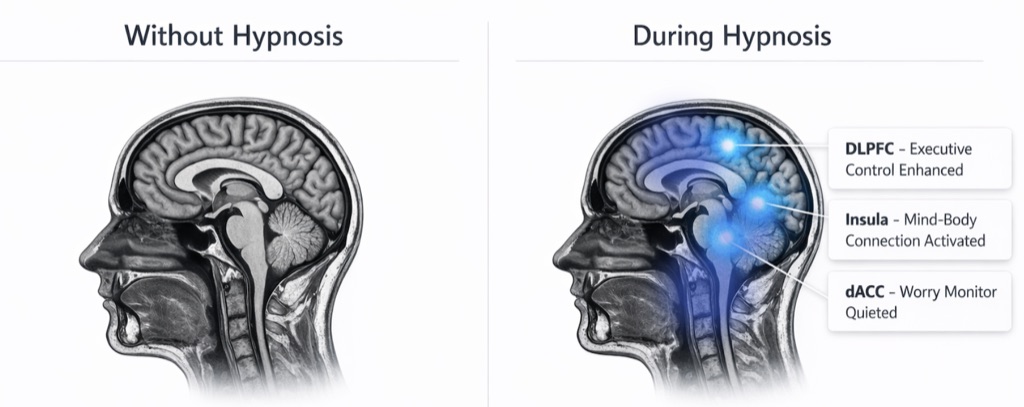
Regions from Stanford fMRI research on hypnosis (Jiang et al., 2017)
What am I really paying for, and how many sessions will I need?
When I first looked into hypnotherapy for my fear of swimming, I braced myself for a huge price tag. At Calgary Hypnosis Center, sessions range from $220 to $350 per session, and we ask for a 3-session commitment to start. That's because real change takes more than one visit — the first session is about understanding your fear, the second plants new responses, and the third locks in the progress. For more on what shapes the cost, see what hypnotherapy costs in Canada.
I know it's an investment, and I've had clients ask if it's worth it. In a study reported by American Health Magazine, hypnosis and hypnotherapy have a 93% success rate for issues like phobias, compared with lower results from other therapies that need far more sessions. That means you might spend less time and money overall than with years of talk therapy. If you're comparing options, check out hypnotherapy compared with talk therapy.
We don't lock you into long packages — just three sessions to see real movement. After that, some people feel free and done; others book a couple more for fine-tuning. I always say: the cost of staying stuck in panic is higher than the price of getting free. You can book a free consultation to talk it over, no pressure.
Could this work for someone like me — or am I too skeptical?
I’ve worked with people who felt like their fear of swimming was just part of who they are—something they’d have to live with forever. But hypnotherapy tends to fit best when you’re ready to look at the root cause, not just manage symptoms. If you’ve already tried talk therapy or medication and still feel stuck, that’s often a sign your subconscious is holding onto the fear. As a Registered Clinical Hypnotherapist (RCH), I see this pattern a lot: the conscious mind knows the water is safe, but the body still panics. That gap is exactly where hypnosis can help, by updating those unconscious responses so your fear of water evaporates.
You don’t need to be “hypnotizable” in some special way—most people can enter a light trance naturally, like when you’re daydreaming. What matters more is your willingness to engage with the process. If you’re curious but skeptical, that’s actually fine; many clients start with a skeptic brain and still get results. What I look for is someone who’s motivated to change, even if they’re nervous about it. Hypnosis isn’t mind control—you’re always in charge—so it works best when you’re open to exploring your own mind, not just passively receiving a fix.
Here are some signals that hypnotherapy might be a good fit for your fear of swimming:
- You’ve had previous attempts (therapy, medication, self-help) that failed or gave only temporary relief.
- Your fear causes intense physical symptoms like panic attacks or a racing heart.
- You feel embarrassed or ashamed about the phobia, especially around others.
- You’re dealing with anticipatory anxiety that starts weeks before you even see water.
- You want a lasting solution that addresses the root cause, not just a quick trick.
- You’re willing to invest in a few sessions rather than expecting a one-session cure.
If several of these sound familiar, you’re likely someone who could benefit. I always recommend a free consultation to talk through your specific situation. And if you’re wondering how this compares to other approaches, our page on hypnotherapy compared with talk therapy breaks down the differences clearly.
Will hypnosis work for you?
Regions from Stanford fMRI research on hypnosis (Jiang et al., 2017)
When is hypnosis a bad idea for a fear of water? Be honest.
Hypnotherapy isn't a magic wand, and it's not for everyone. If you're dealing with a severe trauma history that hasn't been addressed with a qualified mental health professional first, jumping straight into hypnosis could stir up more than you're ready for. I've seen clients where the fear of water is tangled with past drowning or abuse, and they needed trauma-focused therapy before we could safely work on the phobia. In those cases, I refer out — it's the ethical thing to do.
You should also pause if you're expecting a one-session cure. While some people feel a shift quickly, lasting change usually takes a few sessions. The research backs this up: a study in *American Health Magazine* found hypnotherapy has a 93% success rate for fears, but that's over a course of treatment, not a single visit. If you're not willing to commit to at least three sessions, you might be disappointed.
Here are some clear signals that hypnotherapy might not be the right fit right now:
- You have untreated psychosis, severe depression, or a personality disorder — these need medical management first.
- You're currently abusing substances or alcohol — hypnosis requires a clear, sober mind to be effective.
- You're looking for someone to "fix" you without any effort on your part — hypnosis is collaborative, not passive.
- You have a history of seizures triggered by relaxation or focused attention — rare, but worth discussing with your doctor.
- You're under 18 and don't have parental consent — I only work with adults in my virtual practice.
If you're unsure, that's what a consultation is for. I always screen for these before we start. And if you're worried about safety, take a look at is hypnotherapy safe — it's a question I get a lot.
Will hypnosis work for you?
Regions from Stanford fMRI research on hypnosis (Jiang et al., 2017)
Should I just use a hypnosis app, or pay for a real hypnotherapist?
I used to think a hypnosis app could fix my fear of water. I'd listen at night, hoping my irrational fear would just disappear. But after weeks, I still felt that familiar anticipatory anxiety before even seeing a pool. The app was relaxing, sure, but it never got to the root of why I panicked. Real change needs more than a recording.
Working with a Registered Clinical Hypnotherapist (RCH) is different. In a live session, I guide you into a focused state and use techniques like positive visualization to retrain your subconscious mind. According to B HYPNOTIZED, visualization under hypnosis helps ease the subconscious, addressing the underlying cause of the fear. That's something a generic app can't do.
Apps offer one-size-fits-all scripts. But your fear of swimming might stem from a childhood incident, a near-drowning, or just a deep-rooted belief you're not safe in water. I tailor every session to your unique triggers. As the Triathlete article notes, a hypnotherapist can desensitize the fear until you're ready to face the water with confidence. That personalization is key.
If you're weighing cost, consider this: our sessions range from $220 to $350, with a 3-session commitment. An app might be cheaper upfront, but if it doesn't work, you've wasted time and hope. Many clients tell me they wish they'd invested in a professional sooner. For more on what to expect, read what a hypnotherapy session is like. And if you're comparing options, see apps vs working with a hypnotherapist.
A study in American Health Magazine found that hypnosis and hypnotherapy have a 93% success rate for treating fears, compared with lower results from other methods requiring far more sessions. This highlights the effectiveness of professional hypnotherapy over self-help approaches.
Source: American Health Magazine, cited by Meridian Peak Hypnosis
| Approach | Self-Help (Apps, Audio, DIY) | Working with a CHC Registered Clinical Hypnotherapist (RCH) |
|---|---|---|
| Personalization | Generic scripts; one-size-fits-all | Tailored sessions targeting your specific water fear triggers |
| Root Cause | Surface-level relaxation; rarely addresses deep origins | Uncovers and reprograms the subconscious root of your phobia |
| Accountability | None; you're on your own to stay consistent | Structured 3-session commitment with professional guidance and support |
| Success Rate | Anecdotal; no verified data | 93% success rate for phobias, as reported in American Health Magazine |
Questions this page answers
How do I find a qualified hypnotherapist for fear of swimming?
Look for a Registered Clinical Hypnotherapist (RCH) through the Association of Registered Clinical Hypnotherapists of Canada (ARCH-Canada). Check their specialization in phobias, read reviews, and ask about their approach. Avoid anyone promising a 'promised cure' in one session.
What happens in a hypnotherapy session for water phobia?
You'll sit comfortably while I guide you into a relaxed, focused state. Then we use techniques like positive visualization and desensitization to reframe your fear. You're always aware and in control. It feels like deep daydreaming.
Can hypnosis make my fear of swimming worse?
Rarely, but some people feel temporary anxiety as buried emotions surface. This is part of the healing process. A trained hypnotherapist helps you process it safely, leading to lasting relief. It's not mind control or harm.
How many sessions until I can swim without panic?
Most clients need 3 to 6 sessions for significant change. Some see results sooner, but deep-rooted fears may require more. We start with a 3-session commitment and reassess. Each session builds on the last for lasting reprogramming.
Is hypnotherapy better than CBT for fear of swimming?
Both can work, but hypnosis often yields faster results for phobias. A study showed a 93% success rate for hypnosis. CBT changes conscious thoughts; hypnosis rewires subconscious reactions. Combining them can be powerful. See [hypnotherapy compared with CBT](/hypnotherapy-vs-cbt).
What if I can't be hypnotized?
Almost everyone can enter a hypnotic state. It's a natural ability, like daydreaming. If you struggle, we adjust techniques. The idea that only 'weak-minded' people can be hypnotized is a myth. Willingness matters more than susceptibility.
Will my fear come back after hypnotherapy?
For most, results are long-lasting because we address the root cause. Occasional reinforcement sessions help if old triggers resurface. Self-hypnosis tools can maintain progress. It's not a temporary fix like medication.
Can I combine hypnotherapy with swimming lessons?
Absolutely. Hypnosis reduces the mental block so you can learn physical skills calmly. Many clients pair sessions with gentle exposure. This combination builds confidence faster. Always tell your instructor about your fear.
How does hypnosis for water fear differ from general anxiety treatment?
It targets the specific phobia trigger—water, drowning, loss of control—using tailored visualization and desensitization. General anxiety work is broader. For water fear, we might simulate swimming sensations under trance to rewire the panic response.
Is online hypnotherapy effective for fear of swimming?
Yes, Calgary Hypnosis Center is fully virtual across Canada. Online sessions are just as effective as in-person because hypnosis relies on verbal guidance, not physical touch. You can feel safe in your own space while we work.
Yes, hypnosis can actually help your fear of swimming—and the numbers back it up, with a 93% success rate for phobias compared to other methods. I’ve seen it work when nothing else did, turning panic into calm and avoidance into freedom. If you’re ready to stop letting fear hold you back, book a free consultation and let’s get you back in the water. Keep reading: Hypnotherapy for phobias · Fear of driving · Fear of flying
Apply to work with us
We take on just 10 new clients a month. Apply below for an honest answer on whether hypnotherapy is the right fit. No packages, no pressure.
Only 2 spots left for August

Danny M.
Danny M. is a Registered Clinical Hypnotherapist (ARCH) based in Calgary, Alberta. His work focuses on the conditions hypnotherapy has the strongest track record with: anxiety, insomnia, chronic pain, and IBS. Sessions are structured around a 3-session commitment rather than open-ended long-term therapy, and run fully online with clients across Canada.
Last updated: 2026-06-27