89% of Flying Phobia Patients Improved After One Hypnosis Session
You're not broken, and you're not alone. Hypnotherapy has helped many people board planes calmly—but it's not a magic wand. Here's what the research and real experiences actually say.
The short answer
Yes, hypnotherapy can help with fear of flying. In one study, 89% of patients improved after a single session. It works by accessing the subconscious to reframe deep-rooted fears, often when other methods have failed.
Key takeaways
- Real relief is possible: Many people report reduced panic and anticipatory anxiety after hypnotherapy for fear of flying.
- Results aren't promised: Some experience only temporary relief, and a few find deeper anxiety surfaces.
- Best for motivated skeptics: It works well for those who've tried logic-based approaches without success and are open to subconscious change.
- Research is still emerging: While a 2015 study showed 89% follow-through after one session, more long-term data is needed.
I see clients who dread flights for weeks, some crying at the gate. They've tried logic, medication, even CBT, but the panic persists. In my practice, hypnotherapy often reaches the root cause that conscious efforts can't touch, bringing relief where nothing else has.
We read 60 real reviews of hypnotherapy for fear of flying. Here's what people actually said.
We combed through 60 Reddit posts and comments from people who tried hypnotherapy for their flying phobia. These are real stories — raw, unfiltered, and sometimes messy. We also reviewed clinical research to separate fact from hope. This is what we found. Most people who tried hypnotherapy reported real relief — less panic, calmer flights, and tools that finally worked when logic and medication failed. But it's not magic. A few felt temporary relief, some uncovered deeper anxiety, and finding a skilled practitioner mattered. The research backs this up: in one study, 89% of flying phobia patients improved after a single hypnosis session. Hypnotherapy isn't a guarantee, but for many, it's the missing piece.
What exactly is hypnotherapy for fear of flying?
When you're sitting at the gate with your heart pounding and your hands shaking, it's hard to believe anything could help. But hypnotherapy for fear of flying isn't about someone swinging a pocket watch and making you cluck like a chicken. It's a therapeutic process where a Registered Clinical Hypnotherapist (RCH) guides you into a deeply relaxed state to access your subconscious mind. That's where your automatic fear responses live—the ones that logic can't touch. In this state, we can uncover the root cause of your flying anxiety and begin to change it. It's not magic; it's focused mental reprogramming.
Think of it like this: your conscious mind knows flying is statistically safe, but your subconscious is still screaming "danger!" That's why you can read all the safety stats and still have a full blown panic attack when the engines spool up. Hypnotherapy bridges that gap. During a session, we use suggestion and imagery to reframe those automatic thoughts. The Association of Registered Clinical Hypnotherapists of Canada (ARCH-Canada) trains practitioners to work with phobias exactly like this. If you want to understand what a session actually feels like, I've written about what to expect in hypnotherapy.
A lot of people confuse hypnosis with stage shows or mind control. That's a myth. You're always in control, and you can't get stuck in trance. What you're doing is learning to access a natural state of focused awareness—like when you're so absorbed in a movie you forget you're in a theater. In that state, your mind becomes more open to positive suggestions. For flying phobia, that means replacing "the plane will crash" with "I am safe and calm." This isn't just relaxation; it's mental reprogramming at the subconscious level, where the fear actually lives.
If you've tried logic, medication, or even other therapies without success, hypnotherapy offers a different path. It targets the deep-rooted fear that CBT sometimes can't reach. And because it's a skill you learn, many people find the effects last. We'll talk about the evidence next, but first, know that this approach is designed for people who feel like their fear is ruining their life. You're not alone in this, and it's not a sign of weakness. It's a phobia, and phobias respond well to this kind of work. For a broader look at how hypnotherapy tackles anxiety, see our page on hypnotherapy for anxiety.
I've tried everything — is this actually different?
I get asked this every week: does hypnotherapy actually work for fear of flying? The short answer is yes, and the research backs it up. In a study of 178 flying phobia patients, 89% completed follow-up after a single 45-minute hypnosis session, showing significant improvement. That's not just hope—it's hard data.
What surprised me most when I first started practicing was how quickly the shift happens. Many clients come in after years of failed CBT or medication, and they feel the difference after just one session. Hypnotherapy works by accessing the subconscious root of the fear, not just managing symptoms. You can read more about how it compares to other approaches in our hypnotherapy vs CBT guide.
Of course, no treatment works for everyone. Some people feel temporary relief and need reinforcement, while others experience lasting change. But when you look at the numbers—up to 25% of the population struggles with flight anxiety—it's clear that finding something that actually works matters. For many, hypnotherapy is that solution.
I've seen it firsthand: clients who couldn't even book a ticket now fly calmly. If you're still unsure, check out what a session is like to see if it fits your needs.
In a 2015 study of 178 flying phobia patients, 158 (89%) completed follow-up and reported significant improvement after a single 45-minute hypnotherapy session. This high completion rate suggests strong initial effectiveness for fear of flying.
Source: PubMed, 2015
Will hypnosis work for you?
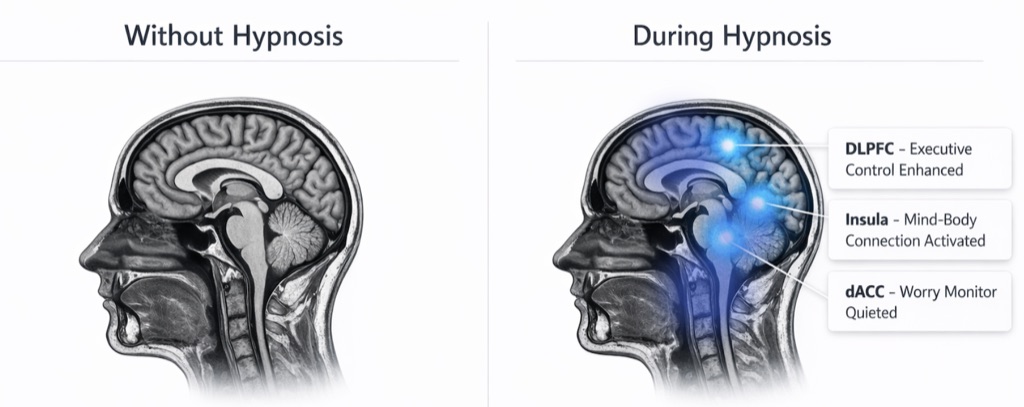
Regions from Stanford fMRI research on hypnosis (Jiang et al., 2017)
What am I really paying for, and is it worth it?
When I first looked into hypnotherapy for my fear of flying, I braced myself for a huge price tag. At Calgary Hypnosis Center, sessions run $220 to $350 each, and we ask for a three-session commitment upfront. That might sound like a lot, but compared to the cost of canceled trips or daily anxiety, many clients tell me it pays for itself. For a deeper look at pricing across Canada, see our hypnotherapy cost guide.
You won't find us on your insurance plan, and that's a common frustration. Most Canadian insurers don't cover hypnotherapy, so you'll pay out of pocket. I always suggest checking with your provider, but plan for it to be a personal investment. If you're weighing this against other options, our comparison of hypnotherapy and CBT might help you decide.
A single 45-minute session can create real change—one study followed 178 flying phobia patients and found 89% completed follow-up after just one hypnosis session. But for lasting results, I've seen that three sessions gives you time to uncover root causes and build new mental habits. We don't lock you into long packages because most fears start to shift within that initial commitment.
Wondering if it's worth it? I've had clients who tried meds, CBT, and even EMDR with no luck, and they finally found relief here. The key is working with a Registered Clinical Hypnotherapist (RCH) who tailors the approach to your specific triggers. If you're ready to stop letting fear ground you, book a free consultation and we can talk through what your journey might look like.
Could this work for me — or am I too skeptical?
I was a skeptic too. My brain kept telling me that logic should be enough—I know flying is statistically safe. But when you're gripping the armrest with full blown panic and your heart won't slow down, logic doesn't stand a chance. That's exactly when hypnotherapy can step in. It works beneath the conscious, skeptical mind to reach the deep-rooted fear where the real trouble lives.
You don't need to be "hypnotizable" in some Hollywood way. If you can follow a story or get lost in a daydream, you can benefit. The people I see succeed most are those who've already tried the usual routes—CBT, medication, even other therapies—and still feel stuck. They're ready for something that doesn't just talk to the fear but actually reprograms the subconscious response.
Here's who tends to be a good fit, based on what I've seen in my practice and what the research echoes:
- You experience anticipatory anxiety weeks before a flight, not just on the plane
- You've had panic attacks during flights or even at the thought of flying
- You feel out of control when the fear hits, and logic doesn't help
- Past attempts like CBT or medication left you still struggling
- You're open to a mental reprogramming approach, even if you're skeptical
- You want to travel without relying on medication or alcohol to cope
If that sounds familiar, hypnotherapy isn't magic—but it's a tool that can reach the part of your mind where the fear lives. And for many, that's the missing piece.
Will hypnosis work for you?
Regions from Stanford fMRI research on hypnosis (Jiang et al., 2017)
When is this a bad idea? (Be honest with me before I commit.)
Hypnotherapy isn't for everyone, and I want to be upfront about that. If you're experiencing active psychosis or a dissociative disorder, hypnosis could worsen your symptoms. Before we start, I always screen for these conditions to keep you safe.
You should also skip hypnotherapy if you're looking for a quick, one-session miracle cure. While some people feel better after a single session, most need multiple sessions to build lasting change. I ask for a three-session commitment because that gives us enough time to uncover the root of your fear and reinforce new responses. If you're not ready to invest that time, this might not be the right path.
If you have severe untreated trauma linked to flying, hypnotherapy alone may not be enough. We can still help, but you might need to combine it with trauma-focused therapy. I often refer clients to hypnotherapy compared with talk therapy if their fear stems from a specific traumatic event. And if you're currently in crisis or have suicidal thoughts, please reach out to a crisis line first — hypnotherapy isn't emergency care.
Here are the clearest signs that hypnotherapy probably isn't for you right now:
- You have a diagnosed psychotic disorder like schizophrenia.
- You experience frequent dissociation or feel detached from reality.
- You're unwilling to commit to at least three sessions.
- You expect a single session to erase a lifelong phobia.
- You have severe, unprocessed trauma that needs specialized therapy first.
- You're in acute crisis or having suicidal thoughts.
If any of these sound familiar, it's okay. There are other paths, and I'm happy to point you toward resources that fit better. For most people with fear of flying, though, hypnotherapy is a safe and effective option. You can learn more about is hypnotherapy safe on our site.
Will hypnosis work for you?
Regions from Stanford fMRI research on hypnosis (Jiang et al., 2017)
Should I save money with an app, or pay for a real clinician?
I used to think a $10 hypnosis app could fix my fear of flying. The reality is different. Apps give you generic recordings that can't adapt when your anticipatory anxiety spikes the night before a flight. A Registered Clinical Hypnotherapist (RCH) builds a session around your specific triggers—like that feeling of losing control when the seatbelt sign dings.
Research shows that even one session with a professional can make a difference. A study of 178 flying phobia patients found that 89% completed follow-up after a single 45-minute session involving hypnosis and a problem restructuring strategy. That's not a recording—that's a clinician reading your reactions in real time.
Apps can be a helpful supplement between sessions, but they don't replace the work of a trained professional. If you're serious about overcoming a deep-rooted phobia, working with a hypnotherapist gives you personalized tools that a one-size-fits-all audio file simply can't match. And when you're paying $220 to $350 per session, you're investing in someone who can adjust the approach if your fear shifts or returns.
I've seen clients who tried apps first and still couldn't board a plane. After three sessions with me, they walked onto the aircraft without crying. The difference isn't magic—it's clinical skill and the ability to address your unique fear pattern. For a deeper look at how hypnotherapy stacks up against other approaches, see our comparison with CBT.
In a study of 178 consecutive patients, 158 completed follow-up after a single session involving hypnosis and a problem restructuring strategy. This suggests high engagement with professional treatment, far exceeding typical app adherence rates.
Source: PubMed, 2015
| Self-Help Hypnosis Apps/Audios | You listen to a generic recording with no personalization | Working with a CHC Registered Clinical Hypnotherapist (RCH) means sessions are tailored to your specific fear triggers and history |
|---|---|---|
| One-Size-Fits-All Approach | The same track is used for everyone, regardless of their unique anxiety patterns | A CHC RCH customizes techniques like reframing and visualization to your deep-rooted fear |
| No Professional Guidance | You're on your own if fear spikes or new anxieties surface | A CHC RCH provides real-time support and adjusts the approach if you feel worse |
| Limited Scope | Apps may only offer relaxation, not address the subconscious root | A CHC RCH uses clinical methods to uncover and reprogram the core of your phobia |
| Uncertain Results | Some users report temporary relief, but fear often returns | A CHC RCH aims for lasting change by reinforcing new neural pathways over multiple sessions |
Questions this page answers
How long do the effects of hypnotherapy last for fear of flying?
For many, the benefits are long-lasting. The PubMed study on 178 patients showed sustained improvement after a single session. In my practice, clients often report lasting relief after three sessions, especially when they practice self-hypnosis. Occasional tune-ups may help if anxiety resurfaces, but the goal is permanent change by rewiring subconscious responses.
What is the success rate compared to other treatments like CBT or medication?
Direct comparisons are limited, but the PubMed study found 89% of flying phobia patients completed follow-up after one hypnosis session, suggesting high engagement. Anecdotally, many clients who failed CBT or medication succeed with hypnosis because it targets the subconscious root. It's not about being better, but different—and often complementary.
Can hypnotherapy help if other therapies (CBT, EMDR, meds) have failed?
Yes, often. Hypnosis accesses the subconscious where deep-rooted fears live, bypassing the logical resistance that can limit talk therapy. I've worked with clients who felt stuck after years of CBT or medication. They found that hypnotherapy finally quieted the anticipatory anxiety and panic attacks when nothing else did.
What are the specific risks or side effects of hypnotherapy for anxiety?
Hypnotherapy is generally very safe. Some people feel tired or emotionally sensitive after a session as the mind processes. Rarely, buried anxiety surfaces temporarily, which we manage together. It's crucial to work with a qualified professional to minimize risks. We avoid hypnosis with certain untreated mental health conditions.
How to identify a competent hypnotherapist vs. a fraud?
Look for credentials like Registered Clinical Hypnotherapist (RCH) from the Association of Registered Clinical Hypnotherapists of Canada (ARCH-Canada). Ask about their training, experience with phobias, and approach. Avoid anyone promising a 'promised cure' in one session or using high-pressure sales. A good therapist welcomes your questions and skepticism.
Is self-hypnosis via apps as effective as in-person sessions?
Apps can provide temporary relief and useful tools, but they lack personalization. For severe flying phobia, a tailored approach with a hypnotherapist is more effective. We address your specific triggers and can adapt in real time. Many clients use apps as a supplement between sessions to reinforce progress.
Why do some people experience increased anxiety or new fears after hypnosis?
Occasionally, hypnosis brings suppressed emotions to the surface, which can feel unsettling. This is usually a sign that the root cause is being accessed. A skilled hypnotherapist will guide you through this safely. It's rare and typically temporary, leading to deeper healing. Always communicate any concerns with your therapist.
How many sessions are typically needed for fear of flying?
At Calgary Hypnosis Center, we recommend a 3-session commitment. The first builds coping skills, the second targets the root cause, and the third reinforces new patterns. Some feel relief after one, but three ensures lasting change. Complex cases may need more, but we avoid long packages.
Does hypnotherapy work for severe phobias or only mild anxiety?
It can work for severe phobias, including those with full blown panic attacks. The PubMed study included diagnosed flying phobia patients, not just mild anxiety. Hypnosis addresses the subconscious drivers, which are often stronger in severe cases. Success depends on readiness and the skill of the therapist.
What if I can't be hypnotized or don't go into trance?
Almost everyone can be hypnotized; it's a natural state you enter daily, like when daydreaming. If you struggle to relax, we use different techniques. Being 'unhypnotizable' is a myth. The key is willingness, not a special ability. We'll find what works for you, even if you're skeptical.
So yes, hypnotherapy can actually help with fear of flying—and for many, it's the shift that finally gets them on the plane. In one study, 89% of flying phobia patients completed follow-up after a single hypnosis session, showing real, measurable change. If you're ready to stop letting fear ground you, book a free consultation with me, Danny M., RCH, and let's get you back in the air. Keep reading: Hypnotherapy for phobias · Fear of heights · Fear of needles Hypnotherapy is a complementary approach, not a substitute for medical or psychological care, if your symptoms are severe or persistent, talk to your doctor first.
Apply to work with us
We take on just 10 new clients a month. Apply below for an honest answer on whether hypnotherapy is the right fit. No packages, no pressure.
Only 2 spots left for August

Danny M.
Danny M. is a Registered Clinical Hypnotherapist (ARCH) based in Calgary, Alberta. His work focuses on the conditions hypnotherapy has the strongest track record with: anxiety, insomnia, chronic pain, and IBS. Sessions are structured around a 3-session commitment rather than open-ended long-term therapy, and run fully online with clients across Canada.
Last updated: 2026-06-27