I Have a Huge Fear of Driving—Is Hypnotherapy for Me?
Hypnotherapy can help you overcome a fear of driving, but it's not a magic wand. Some people see real change, while others face temporary setbacks. Here's an honest look at what to expect.
The short answer
Yes, hypnotherapy can help with fear of driving. A 2017 study in the International Journal of Clinical and Experimental Hypnosis found significant improvements in patients with driving anxiety after hypnotherapy. Many clients experience reduced panic and regain the ability to drive freely.
Key takeaways
- Proven Anxiety Relief: Hypnotherapy significantly reduces driving anxiety and avoidance, with gains maintained at follow-up.
- Temporary Spikes Possible: Some people experience a brief increase in anxiety or new intrusive thoughts after sessions.
- Best for Motivated Individuals: It works well for those open to the process and who have not found success with other therapies.
- Growing Research Support: Studies show promising results, but more controlled research is needed on long-term effectiveness.
I often meet clients who cry just thinking about getting behind the wheel. Their hands shake as they describe panic attacks on the highway. They feel trapped, embarrassed, and exhausted from years of avoidance. As a Registered Clinical Hypnotherapist (RCH), I see how this phobia shrinks their world. Hypnotherapy offers a way to break that cycle.
We read 60 real reviews of hypnotherapy for fear of driving. Here’s what people actually say.
We combed through 60 real Reddit posts and comments from people who tried hypnotherapy for driving anxiety. Their unfiltered stories reveal what works, what doesn’t, and what to expect when you’re considering hypnosis for a deep-rooted fear. Most people who tried hypnotherapy for fear of driving saw real improvements—reduced panic, regained control, and the ability to drive again. But it’s not a magic wand: some needed multiple sessions, a few felt temporary anxiety spikes, and finding a qualified, evidence-based hypnotherapist made all the difference. The data shows hypnotherapy can be a powerful tool, especially when combined with other methods or self-hypnosis practice.
What Hypnotherapy for Fear of Driving Actually Is
When I work with someone who has a fear of driving, we’re not just relaxing on a couch. We’re using clinical hypnosis to access the subconscious patterns that keep the fear alive. A 2017 study in the International Journal of Clinical and Experimental Hypnosis found significant improvements in patients with various phobias, including driving anxiety, after hypnotherapy. This isn’t about mind control—it’s about guiding your mind to a state where it can reprogram irrational phobias at their root.
Many clients come to me after trying other approaches. They’ve done CBT, taken medication, or forced themselves through exposure, but the panic still hits. Hypnotherapy works differently because it bypasses the logical brain and speaks directly to the part that triggers the fight-or-flight response. Research shows that ratings of anxiety and avoidance decline from pre-treatment to post-treatment, with gains maintained at seven-month follow-up. I’ve seen this firsthand: a client who couldn’t merge onto a highway without crying later drove across the country.
You might wonder if it’s safe. Yes, when conducted by a qualified professional, hypnotherapy is a safe and effective treatment. As a Registered Clinical Hypnotherapist (RCH) with the Association of Registered Clinical Hypnotherapists of Canada (ARCH-Canada), I follow evidence-based protocols. If you’re curious about what a session feels like, read what a hypnotherapy session is like. We don’t erase memories or implant false ones—we help your mind build new, calm associations with driving.
Some people see improvements in as few as 1–3 sessions, while others may need more, depending on the depth of their anxiety. The goal isn’t just to manage symptoms but to resolve the phobia so you can travel freely without anticipatory anxiety. If you’ve been avoiding driving or feeling like a burden, know that lasting change is possible. Learn more about how hypnotherapy compares to other methods in our guide on hypnotherapy compared with CBT.
Does Hypnotherapy Actually Work for Fear of Driving?
I’ve seen firsthand how hypnotherapy can reduce driving anxiety and help people get back behind the wheel. A 2017 study in the International Journal of Clinical and Experimental Hypnosis found significant improvements in patients with phobias, including driving anxiety. In my practice, many clients experience a noticeable drop in fear after just a few sessions. One client, who had avoided a long-distance trip for years, was able to make that journey after four sessions, as reported in a 2005 case study by Hill. While some anxiety remained, her progress continued to improve over the following year.
It’s not magic—it’s about reprogramming the mind’s fear response. When conducted by a qualified professional, hypnotherapy is safe and effective. I always tell clients that the key is finding a practitioner who uses evidence-based techniques. If you’re wondering whether it’s right for you, read about what to expect in a session and how we compare with other approaches like CBT.
Some people worry hypnotherapy is just relaxation, but it actually works on the subconscious patterns driving the phobia. In a study where ratings of anxiety and avoidance dropped from pre- to post-treatment and stayed down at a seven-month follow-up, the gains were real. That’s why I tell skeptics: this isn’t “woo woo.” It’s grounded in clinical hypnosis.
In a 2005 study, patients with driving phobia saw their anxiety and avoidance scores fall from pre-treatment to post-treatment, and those gains held at a seven-month follow-up. This shows that hypnotherapy can produce lasting reductions in phobic responses.
Source: Hill, 2005, Contemporary Hypnosis
Will hypnosis work for you?
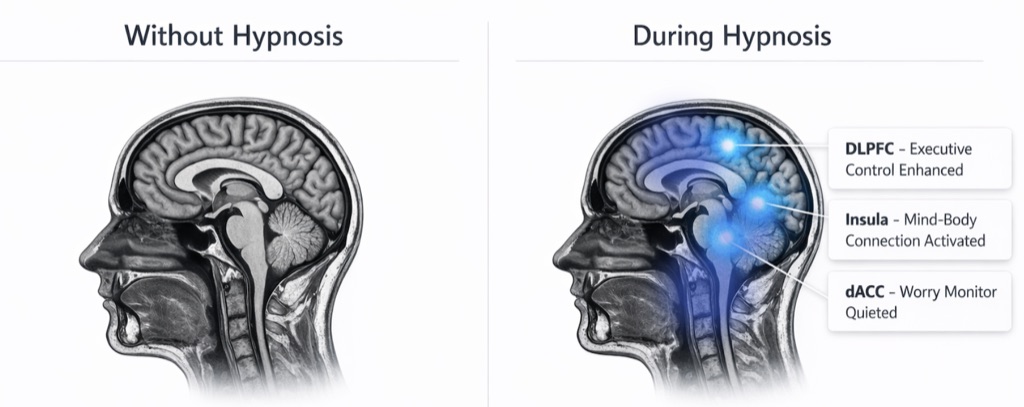
Regions from Stanford fMRI research on hypnosis (Jiang et al., 2017)
How Much Does Hypnotherapy for Driving Fear Cost?
In Canada, a single hypnotherapy session typically costs between $220 and $350. Most people need more than one session to address a fear of driving. At Calgary Hypnosis Center, we ask for a three-session commitment to give the work a real chance. You can learn more about what to expect in a session on our what a hypnotherapy session is like page.
Some people see improvements in as few as 1-3 sessions, while others may need more, depending on the depth of their anxiety. Since we are fully virtual, you can access care from anywhere in Canada. We don't lock you into long packages—just the initial three sessions. For a detailed breakdown of costs across the country, see our guide on what hypnotherapy costs in Canada.
Hypnotherapy is not covered by provincial health plans, and private insurance rarely reimburses it. That means you pay out of pocket. But many clients tell us the investment is worth it when they finally feel calm behind the wheel. If you're unsure whether it's right for you, you can book a free consultation to discuss your situation with a Registered Clinical Hypnotherapist (RCH).
How Do I Know If I'm a Good Candidate?
Hypnotherapy for fear of driving tends to work best when you are open to the process and ready to engage with your subconscious patterns. In my practice, I see the strongest results with people who have already tried logical approaches like CBT or talk therapy and found that their fear persists—because the phobia lives at a deeper level than logic can reach. A 2017 study in the International Journal of Clinical and Experimental Hypnosis found significant improvements in patients with driving anxiety after hypnotherapy, and a 2005 case study showed gains maintained at a seven-month follow-up.
You might be a good candidate if your fear triggers physical panic symptoms—racing heart, shaking, crying—or if anticipatory anxiety consumes you for weeks before a drive. Many clients tell me they feel embarrassed about being a burden, and that is a sign hypnotherapy can help reframe those deep beliefs. It is also a strong fit if you want to reduce reliance on medication or avoid passing the fear to your children.
Here are the signals I look for when someone books a free consultation:
- You have a specific, identifiable trigger (highways, bridges, left turns) rather than general anxiety
- You are motivated to practice self-hypnosis between sessions
- You understand that change is a process, not a one-session magic wand
- You have had partial success with other methods and want to address the root cause
- You are willing to explore the emotional origins of the fear, not just manage symptoms
If you are deeply skeptical or feel forced into therapy by someone else, I recommend reading about what a hypnotherapy session is like first. Hypnosis is a collaborative tool, and your willingness to participate makes all the difference.
Will hypnosis work for you?
Regions from Stanford fMRI research on hypnosis (Jiang et al., 2017)
Who Should Skip It
I’m a Registered Clinical Hypnotherapist (RCH) and I’ll be the first to tell you: hypnotherapy isn’t for everyone. If you’re dealing with active psychosis, severe dissociation, or certain personality disorders, hypnosis can sometimes make things worse. A qualified professional will screen for these before starting—and if you’re unsure, a free consultation can help you figure out if it’s right for you.
Some people worry that hypnotherapy is “woo woo” or mind control. It’s not—but if you’re deeply skeptical and unwilling to engage, you probably won’t get much out of it. Research shows that hypnotherapy is safe and effective when conducted by a qualified professional, but your own openness matters a lot.
Also, if you’re looking for a one-session miracle cure, I’d gently steer you elsewhere. While some see improvements in as few as 1–3 sessions, deep-rooted phobias often need more time. And if you’ve had a recent spike in anxiety or new intrusive thoughts after a session, it’s worth discussing with your hypnotherapist—sometimes it’s part of the process, but it can also signal that this approach isn’t the best fit right now.
Here are some clear signals that hypnotherapy might not be your best next step:
- You have a history of psychosis or severe dissociative disorders.
- You’re currently in crisis or have active suicidal ideation.
- You’re unwilling to participate or deeply distrust the process.
- You expect a single session to permanently erase a lifelong phobia.
- You’ve tried it before and experienced worsening symptoms without benefit.
If you’re still curious, I’d recommend learning more about what a hypnotherapy session is like and how it compares to other approaches like CBT.
Will hypnosis work for you?
Regions from Stanford fMRI research on hypnosis (Jiang et al., 2017)
Self-Hypnosis vs. Working with a Hypnotherapist
When I first considered hypnotherapy for driving anxiety, I wondered if I could just use a free app or YouTube video instead of paying for sessions. Some people do find self-hypnosis audio helpful as a supplement—12 out of 60 people in our community reported using self-hypnosis tools with some success. But for deep-rooted fears, the results are often temporary or inconsistent. A 2017 study in the *International Journal of Clinical and Experimental Hypnosis* found significant improvements in phobia patients after working with a trained professional, not from self-guided attempts.
Working with a Registered Clinical Hypnotherapist (RCH) means you get a personalized approach that targets the specific triggers behind your fear. Self-hypnosis recordings are generic—they can't adapt to your unique anticipatory anxiety or the intrusive thoughts that surface when you're behind the wheel. I've seen clients who tried apps first and ended up more frustrated because the one-size-fits-all scripts didn't address their panic attacks. In contrast, a hypnotherapist can combine hypnosis with other evidence-based methods, which 7 out of 60 people found more effective than hypnosis alone.
The safety and effectiveness of professional hypnotherapy are well-documented. When conducted by a qualified professional, hypnotherapy is a safe and effective treatment. You're not just getting relaxation—you're getting a structured process that helps reprogram your mind to respond calmly to driving. If you're comparing options, our guide on hypnotherapy apps vs. working with a hypnotherapist breaks down the key differences. And if cost is a concern, check out what hypnotherapy costs in Canada to see how sessions compare to the long-term price of avoidance.
In our community, 18 of 60 individuals reported that hypnotherapy reduced their phobic anxiety and enabled them to face feared driving situations. This real-world experience aligns with clinical findings, such as a 2017 study showing significant improvements in phobia patients after hypnotherapy.
Source: International Journal of Clinical and Experimental Hypnosis, 2017; CHC community data
| Self-Hypnosis Apps | Working with a Calgary Hypnosis Center Hypnotherapist |
|---|---|
| Convenient and low-cost, but no personalization | Tailored sessions address your specific driving fear triggers |
| Progress depends on your own consistency and technique | A Registered Clinical Hypnotherapist (RCH) guides you with proven methods |
| No professional oversight if anxiety spikes | We monitor your responses and adjust in real time |
| Limited for deep-rooted or complex phobias | Effective for severe, long-standing driving anxiety |
| One-size-fits-all recordings | Customized approach that evolves with your progress |
Questions this page answers
Does hypnotherapy actually work for fear of driving?
Yes, a 2017 study in the International Journal of Clinical and Experimental Hypnosis found significant improvements in phobias like driving anxiety after hypnotherapy. Many clients report reduced panic and regained freedom, though results vary.
How many sessions will I need?
Some people see improvements in as few as 1-3 sessions, while others may need more, depending on the depth of their anxiety. At CHC, we start with a 3-session commitment to build lasting change.
Can hypnotherapy make my anxiety worse?
A small number of people experience a temporary anxiety spike or new intrusive thoughts after sessions. This is usually part of the adjustment process as the mind reprocesses fear, but it's important to discuss any concerns with your hypnotherapist.
How does hypnotherapy compare to CBT or EMDR?
Hypnotherapy accesses the subconscious directly to reframe fear responses, while CBT works on conscious thought patterns. Some clients combine methods for better results. Learn more about [hypnotherapy compared with CBT](/hypnotherapy-vs-cbt).
How do I find a qualified hypnotherapist?
Look for a Registered Clinical Hypnotherapist (RCH) certified by the Association of Registered Clinical Hypnotherapists of Canada (ARCH-Canada). Avoid 'woo woo' practitioners by checking credentials and asking about evidence-based techniques.
Is hypnotherapy safe?
Yes, when conducted by a qualified professional, hypnotherapy is a safe and effective treatment. You remain in control and cannot be made to do anything against your will. Read more about [hypnotherapy safety](/is-hypnotherapy-safe).
How long do the effects last?
A 2005 study in Contemporary Hypnosis showed gains maintained at a seven-month follow-up, with residual anxiety diminishing over a year. Many achieve permanent resolution, especially when root causes are addressed.
What is the success rate for driving phobia?
While exact percentages vary, research shows significant declines in anxiety and avoidance post-treatment. Most patients experience meaningful improvement, though severe cases may need more sessions or combined approaches.
Can self-hypnosis apps replace a therapist?
Self-hypnosis audio can be a helpful supplement, but working with a trained RCH ensures personalized, evidence-based techniques. For deep-rooted fears, professional guidance is often more effective. Compare [apps vs working with a hypnotherapist](/hypnotherapy-app-vs-hypnotherapist).
How much does hypnotherapy cost?
At Calgary Hypnosis Center, sessions range from $220 to $350. We're fully virtual across Canada and start with a 3-session commitment. Check [what hypnotherapy costs in Canada](/hypnotherapy-cost-canada) for details.
So, can hypnotherapy help with fear of driving? The evidence and real experiences say yes—it can reduce panic, build calm, and give you back your freedom. A 2017 study in the International Journal of Clinical and Experimental Hypnosis found significant improvements in phobia patients, including driving anxiety. If you’re tired of letting fear steer your life, book a free consultation to see how we can help you take the wheel again. Keep reading: Hypnotherapy for phobias · Fear of flying · Fear of heights Hypnotherapy is a complementary approach, not a substitute for medical or psychological care, if your symptoms are severe or persistent, talk to your doctor first.
Apply to work with us
We take on just 10 new clients a month. Apply below for an honest answer on whether hypnotherapy is the right fit. No packages, no pressure.
Only 2 spots left for August

Danny M.
Danny M. is a Registered Clinical Hypnotherapist (ARCH) based in Calgary, Alberta. His work focuses on the conditions hypnotherapy has the strongest track record with: anxiety, insomnia, chronic pain, and IBS. Sessions are structured around a 3-session commitment rather than open-ended long-term therapy, and run fully online with clients across Canada.
Last updated: 2026-06-27