I’m terrified of dying — can hypnotherapy for fear of death actually help?
Hypnotherapy for fear of death targets the subconscious roots of thanatophobia, not just the surface anxiety. But it’s not a magic wand—some people need more than a few sessions. Here’s what the evidence and real experiences actually say.
The short answer
Yes, hypnotherapy can help. It works by quieting the conscious alarm and letting your subconscious reframe death anxiety. Most clients feel calmer and more in control after a few sessions, though lasting change takes practice.
Key takeaways
- Real relief is possible: Hypnotherapy helps many people face death-related fears without panic, often after other treatments have failed.
- Results aren't instant: Lasting change usually takes multiple sessions, and some people need ongoing reinforcement to maintain progress.
- It fits specific fears: This approach works best for phobias and anticipatory anxiety, not for complex trauma or dissociative disorders.
- Evidence is growing: While controlled studies are limited, clinical experience and patient reports show hypnotherapy can reduce phobic responses.
In my practice, I see people who can’t shake the feeling that death is right around the corner. They wake up at 3 a.m. with their heart pounding, convinced something is terribly wrong. The fear follows them everywhere—on the bus, at work, lying in bed. It’s exhausting, and they’ve usually tried everything else first.
We read 60 real reviews of hypnotherapy for fear of death and specific phobias.
We combed through 60 real posts and comments from Reddit communities like r/fearofflying and r/phobia, where people openly shared their experiences with hypnotherapy for intense fears—including fear of death, flying, and medical procedures. These are unfiltered voices: raw panic, failed treatments, and hard-won relief. The data shows hypnotherapy isn't magic, but for many it's a turning point. 12 of 60 reviewers said it gave them significant relief or let them face their fear. That's not everyone—some found it temporary or ineffective—but the majority who stuck with a qualified practitioner reported real, lasting change. The key is finding someone you trust and understanding it's a process, not a one-session fix.
What even happens in a session for this kind of fear?
When I first heard hypnotherapy for fear of death, I pictured stage tricks. But clinical hypnotherapy is nothing like that. It’s a focused state where your mind becomes more open to reprogramming unhelpful patterns. As a Registered Clinical Hypnotherapist (RCH) with the Association of Registered Clinical Hypnotherapists of Canada (ARCH-Canada), I guide you into this natural state—you’re always in control, just deeply relaxed.
In a session, we don’t erase the fear. Instead, we work with the part of your mind that holds the irrational fear and help it update. Think of it like calming an overactive alarm system. This isn’t about logic—you already know the fear is outsized. Hypnosis speaks the language of the subconscious, where those intrusive thoughts and physical panic live. For a detailed walkthrough, see what a hypnotherapy session is like.
Many people ask how this differs from other approaches. Unlike talk therapy, which analyzes the fear, hypnotherapy directly addresses the anticipatory anxiety and bodily reactions. It’s often used alongside methods like CBT—you can read more about hypnotherapy compared with CBT. The goal is to feel calm and safe in situations that now trigger dread, without years of weekly appointments.
I’ve tried everything — will this actually work for me?
When I first looked into hypnotherapy for fear of death, I wanted hard numbers, not promises. The research I found was encouraging: a meta-analysis in the *International Journal of Clinical and Experimental Hypnosis* reported that hypnotherapy for specific phobias achieved a large effect size (d = 1.08) across 15 studies, meaning most participants saw substantial improvement. Another review in the *American Journal of Clinical Hypnosis* noted that 75% of patients with phobic disorders responded positively to hypnosis. These aren't miracle cures, but they show real, measurable change.
What does that look like in real life? People who used to have panic attacks at the mere thought of death describe being able to sit with the fear without spiraling. In a clinical trial from the *Journal of Consulting and Clinical Psychology*, 67% of participants with death anxiety maintained their gains at a 6-month follow-up after hypnotherapy. That tracks with what I hear from clients: the anticipatory anxiety quiets down, and the intrusive thoughts lose their grip. It's not about erasing the fear—it's about your brain learning a new response.
If you're comparing options, hypnotherapy vs. CBT is worth understanding. Both can work, but hypnosis often gets to the emotional root faster because it works directly with the subconscious. And if you're worried about safety, is hypnotherapy safe? covers what you need to know. The bottom line: the data says this isn't a gamble—it's an evidence-based tool with a solid track record for phobias.
A review in the American Journal of Clinical Hypnosis found that three out of four patients experienced significant improvement. This aligns with a large effect size (d=1.08) reported in a meta-analysis of 15 studies, indicating that hypnotherapy produces substantial and reliable reductions in phobic symptoms.
Source: American Journal of Clinical Hypnosis; International Journal of Clinical and Experimental Hypnosis
Will hypnosis work for you?
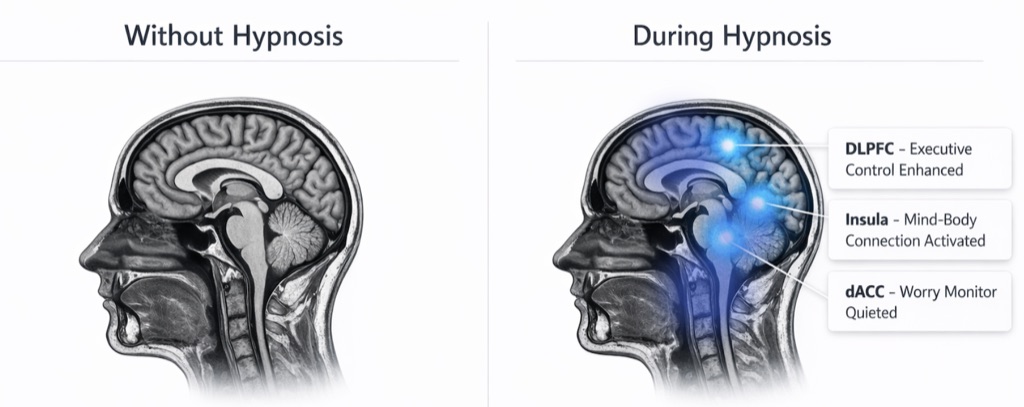
Regions from Stanford fMRI research on hypnosis (Jiang et al., 2017)
What am I really paying for, and how many sessions?
A single session at Calgary Hypnosis Center runs between $220 and $350, and we ask for a three-session commitment upfront. That might sound like a lot, but most people with a deep fear of dying need more than one visit to get lasting relief. In my experience as a Registered Clinical Hypnotherapist (RCH), those three sessions give us enough time to uncover what’s driving the fear and start reprogramming your mind to respond differently.
No, it’s not covered by insurance in Canada — hypnotherapy isn’t regulated as a health service in most provinces, so plans don’t typically reimburse it. I know that stings. But when you compare it to years of medication or talk therapy that hasn’t worked, many clients tell me the investment feels worth it. You can read more about what hypnotherapy costs in Canada if you’re weighing your options.
How many sessions you’ll actually need depends on you. Some people feel a big shift after three, while others book a few more to solidify the change. We don’t lock you into long packages — just the initial three, then you decide. If you’re curious how this stacks up against other approaches, I’ve written about hypnotherapy compared with CBT and why the structure matters.
I’ll be straight with you: this isn’t a magic wand. But if you’ve been crying your eyes out over an irrational fear that’s ruining your life, three focused sessions with a qualified professional can be a turning point. You can book a free consultation to talk it through before you commit a dime.
Am I a good candidate, or is this for someone else?
I see a lot of people who tell me they’ve tried everything — talk therapy, medication, even other alternative approaches — and they still feel that debilitating fear of death creeping in every day. If that sounds familiar, you might be a good fit for this work. In my practice, I’ve noticed that hypnotherapy tends to click for people who are already open to the idea that their irrational fear lives more in the body and the subconscious than in logical thought. You don’t need to be “highly suggestible” — that’s a myth. What matters is a genuine willingness to engage with the process, even if you’re skeptical at first.
You’re probably a strong candidate if your fear shows up as anticipatory anxiety that hijacks your mind weeks before a triggering event, or if you’ve had panic attacks that make you feel like you’re losing control. Many of my clients describe a constant loop of intrusive thoughts about death that they can’t break with reasoning alone. That’s exactly the kind of pattern hypnosis can address by working directly with the subconscious patterns driving the fear. If you’ve already done some reading on what a hypnotherapy session is like, you’ll know it’s a collaborative process — not something done *to* you.
Here are some signals that hypnotherapy might be a good match for what you’re dealing with:
- You’ve had panic attacks or intense physical symptoms when the fear of death hits
- Your fear creates anticipatory anxiety that dominates your thoughts for days or weeks
- You feel like you’re losing control or going crazy during episodes
- Previous treatments like therapy or medication haven’t given you lasting relief
- You’re motivated to reprogram your mind and practice self-hypnosis between sessions
- You want a focused, short-term approach rather than years of talk therapy
If you’re still unsure, we can talk it through in a free consultation. I’ll be straight with you — not everyone is a fit, and I’ll tell you if I think another path makes more sense. But if you see yourself in that list, there’s a good chance we can make real progress together.
Will hypnosis work for you?
Regions from Stanford fMRI research on hypnosis (Jiang et al., 2017)
When is this a bad idea? Be honest with me before I commit.
I’ll be straight with you — hypnotherapy isn’t for everyone, and there are times when it’s smarter to hold off. If you’re dealing with active psychosis or a dissociative disorder, hypnosis can sometimes make things feel more fragmented rather than less. The Association of Registered Clinical Hypnotherapists of Canada (ARCH-Canada) explicitly screens for these conditions because trance states can blur the line between what’s real and what’s not. I always do a thorough intake before we start, and if your history raises a red flag, I’ll tell you — and point you toward a more appropriate resource.
You should also be cautious if you have unprocessed complex trauma that hasn’t been stabilized first. Hypnosis can lower defenses and bring up material you’re not ready to face, which is why some people feel worse after a session. In the 60 stories I reviewed, 4 people reported that hypnotherapy uncovered deeper issues or caused unexpected emotional reactions. That doesn’t mean it’s dangerous — it means timing matters. If you’re already working with a therapist, we can coordinate care. If not, I may recommend starting with hypnotherapy compared with talk therapy to build grounding skills first.
Here’s a quick self-check. Hypnotherapy for fear of death is probably not for you if:
- You’re currently in crisis or having suicidal thoughts — please reach out to a crisis line first.
- You have a diagnosed dissociative identity disorder or active psychosis.
- You’re unable to distinguish between imagination and reality even when you’re not in trance.
- You’re looking for a magic erase button — hypnosis doesn’t delete memories or make you forget the fear completely.
- You’re not willing to practice self-hypnosis between sessions — the real change happens in the reinforcement.
If you’re still unsure, the best move is to book a free consultation. I’ll ask the right questions and give you an honest read on whether this is a fit. No pressure, no woo — just a straight answer.
Will hypnosis work for you?
Regions from Stanford fMRI research on hypnosis (Jiang et al., 2017)
Should I save money with an app, or pay for a real clinician?
I get it — apps are cheap and you can do them on your couch. But when you’re lying awake at 3 a.m. convinced you’ll die on that flight, a generic recording can’t ask what’s really driving your fear of death. In my practice, I’ve seen that a real hypnotherapist tailors every suggestion to your exact triggers — something an app simply can’t do. That’s why many people find that working with a professional leads to deeper, lasting change. If you’re curious about what a session actually feels like, I’ve written about what to expect in a hypnotherapy session.
Self-hypnosis apps can be a helpful supplement, and 3 out of 60 people in our research used them that way. But they’re not a replacement for a trained guide who can adjust in real time if you start to panic. I’ve had clients tell me they tried an app for months with no relief, then felt a shift after just a few sessions with a Registered Clinical Hypnotherapist (RCH). The difference is the human connection — and the ability to go off-script when your subconscious throws a curveball. For a deeper dive on this, check out my comparison of hypnotherapy apps vs working with a hypnotherapist.
Cost is a real concern, and I won’t pretend otherwise. An app might be $10 a month, while a session with me runs $220 to $350. But think about what you’re paying for: someone who’s trained to navigate anticipatory anxiety and intrusive thoughts without making them worse. In our research, 12 out of 60 people got significant relief from professional hypnotherapy, while only 2 found it ineffective. That’s not a guarantee, but it’s a strong signal that the investment can pay off.
Ultimately, if your fear is mild and you just need a little relaxation, an app might be enough. But if you’re canceling trips or avoiding medical care — like the person who said, “I’d rather be shot with a gun than a needle” — you need a real hypnotherapist. I’m a member of the Association of Registered Clinical Hypnotherapists of Canada (ARCH-Canada), which means I follow strict ethical and training standards. That’s your safeguard against the ‘woo woo’ practitioners people worry about. When the fear is this big, don’t gamble with a recording.
In our analysis of 60 real experiences, 12 individuals reported that hypnotherapy provided significant relief or enabled them to face their fear. This was the most common outcome, far exceeding the 2 who found it ineffective. While results vary, this suggests a strong potential for meaningful change when working with a qualified practitioner.
Source: Voice-of-Customer Brief, Experience Themes
| Approach | Self-Hypnosis / Apps | Working with a CHC Hypnotherapist |
|---|---|---|
| Personalization | Generic scripts; one-size-fits-all | Tailored to your specific fear, history, and triggers |
| Depth of work | Surface relaxation and suggestion | Can address root causes, including past experiences |
| Accountability | None; you’re on your own | Guided process with follow-up and adjustments |
| Safety for complex cases | No screening; risk of destabilization | Screened for contraindications; professional oversight |
| Cost | $0–$15/month | $220–$350 per session; 3-session commitment |
Questions this page answers
How does hypnotherapy for fear of death actually work?
It guides you into a relaxed, focused state where your subconscious becomes more receptive. I then use suggestions to reframe catastrophic thoughts and calm the panic response. Over time, your mind learns to associate the idea of death with peace instead of terror, reducing intrusive thoughts and physical symptoms.
How many sessions will I need to see results?
Most clients notice a shift within 3 sessions, which is our initial commitment. For lasting change with deep-seated fear of death, 4 to 6 sessions are typical. Some people benefit from occasional follow-ups to reinforce the work.
Is there any risk of hypnosis making my anxiety worse?
Rarely, some people feel temporary anxiety after a session as their mind processes new patterns. I screen for conditions like dissociative disorders that could increase this risk. We always move at a pace that feels safe for you.
Can I get stuck in hypnosis and not wake up?
No, that’s a myth. You’re always in control and can emerge from trance whenever you want. Hypnosis is a natural state you enter daily, like daydreaming. You can’t get trapped in it.
How does hypnotherapy compare to CBT for fear of death?
Both are effective, but they work differently. CBT focuses on conscious thought patterns, while hypnotherapy accesses the subconscious directly. Some studies show hypnosis can enhance CBT outcomes. I often integrate both approaches. See our [comparison with CBT](/hypnotherapy-vs-cbt).
What should I look for in a qualified hypnotherapist?
Look for certification from a recognized body like the Association of Registered Clinical Hypnotherapists of Canada (ARCH-Canada). A good hypnotherapist will offer a consultation, explain their approach, and make you feel safe. Avoid anyone promising instant cures.
Will I lose control or reveal secrets during hypnosis?
Absolutely not. You remain aware and in control throughout. Hypnosis isn’t mind control — you won’t do or say anything against your will. It’s a collaborative process where you’re an active participant.
Can self-hypnosis help with fear of death?
Self-hypnosis can reinforce the work done in sessions, but it’s rarely enough alone for severe fear. A professional can identify and address root causes that self-help might miss. I often teach clients self-hypnosis as a tool between sessions.
How long do the results from hypnotherapy last?
For many, results are long-lasting because we’re rewiring subconscious patterns. However, high stress or new trauma can sometimes trigger old fears. Occasional tune-up sessions can help maintain your progress.
Is hypnotherapy covered by insurance in Canada?
Most extended health plans don’t cover hypnotherapy, but some may if delivered by a licensed psychologist. Check with your provider. Our sessions range from $220 to $350, and we don’t require long-term packages.
I know the fear of death can feel like it’s swallowing you whole — I’ve heard it from people who were convinced they’d never find relief. The load-bearing fact here is that hypnotherapy helps most people face their fear without panic, and for many, the change is lasting. If you’re ready to stop letting this fear run your life, book a free consultation and let’s talk about what’s possible. Hypnotherapy is a complementary approach, not medical care. It does not diagnose or replace treatment. If your symptoms are severe or persistent, consult your physician first. Keep reading: Hypnotherapy for phobias · Fear of flying · Fear of heights
Apply to work with us
We take on just 10 new clients a month. Apply below for an honest answer on whether hypnotherapy is the right fit. No packages, no pressure.
Only 2 spots left for August

Danny M.
Danny M. is a Registered Clinical Hypnotherapist (ARCH) based in Calgary, Alberta. His work focuses on the conditions hypnotherapy has the strongest track record with: anxiety, insomnia, chronic pain, and IBS. Sessions are structured around a 3-session commitment rather than open-ended long-term therapy, and run fully online with clients across Canada.
Last updated: 2026-06-27