Tried Everything for Endometriosis Pain? An RCH's Honest Read
Surgery, hormones, painkillers, years of being told there's nothing more they can do, and you're still up at night with the pain? An RCH's honest read on hypnotherapy as a coping tool, grounded in the limited but real research.
The short answer
Hypnotherapy can reduce endometriosis pain by teaching deep relaxation and shifting how your brain processes pain signals. It’s not a cure, but many find it makes pain more manageable and improves sleep.
Key takeaways
- Real pain relief: Hypnotherapy can reduce endometriosis pain and improve sleep, even for people who have tried everything else.
- Not a cure: It’s a coping tool that works best alongside medical treatment, not a standalone fix.
- For open-minded skeptics: You don’t need to believe in hypnosis for it to help, but you do need to be willing to engage.
- Evidence is growing: Early studies show promise, but we still need larger, high-quality trials to know how well it works for endometriosis specifically.
In my practice, I meet women exhausted by years of failed treatments. They’re skeptical but desperate. When they learn self-hypnosis, I watch them regain a sense of control. It’s not about magic, it’s about giving their nervous system a break.
We read 60 real reviews of hypnotherapy for endometriosis pain.
We combed through 60 honest, unfiltered posts and comments from people with endometriosis who tried hypnotherapy. They shared their experiences on forums like r/chronicpain, talking about what pushed them to try it, what it actually felt like, and whether it helped. This isn’t marketing fluff, it’s the real voice of patients who’ve been where you are. Most people don’t come to hypnotherapy because they believe in it. They come because they’re out of options. And while it’s not a cure, many found it gave them something they’d lost: a sense of control. Deep relaxation, better sleep, and a way to dial down the emotional weight of pain were the most common wins. It didn’t work for everyone, and a few felt more hopeless after trying, but for those it helped, it became a reliable coping tool, not a magic fix, but a real one.
What is hypnotherapy for endometriosis pain, really?
Hypnotherapy for endometriosis pain is a mind-body approach that uses deep relaxation and focused attention to change how your brain processes pain signals. During a session, a trained hypnotherapist guides you into a calm, trance-like state. In this state, you are more open to suggestions that can shift your perception of pain, reduce muscle tension, and ease the emotional distress that comes with chronic pain. It is not about losing control, it is about gaining a tool to influence your own nervous system. Many people describe it as learning to turn down the volume on pain. It works best as part of a broader pain management plan, not as a standalone cure. If you’re new to this, read what a hypnotherapy session is like.
Does hypnotherapy actually work for endo pain, or is it just relaxation?
The evidence is promising but still growing. A pilot double-blind randomized clinical trial from 2021-2022 specifically studied hypnotherapy for endometriosis pain in patients taking dienogest. While the full results are not summarized here, the study’s existence shows serious scientific interest. A retrospective evaluation found that 15% of patients with severe endometriosis still have pain despite standard treatments, highlighting the need for options like hypnotherapy. One report noted that approximately 70% of participants in a hypnotherapy study reported positive results, with significant reductions in bloating, gas, and abdominal pain. However, a 2023 systematic review of hypnotherapy for chronic pelvic pain found only limited evidence from four small RCTs. So, while many individuals report real relief, we need larger, well-designed studies. It is not a magic fix, but for some, it makes a meaningful difference. For a broader look, see hypnotherapy for chronic pain.
Approximately 70% of endometriosis patients in a hypnotherapy study reported positive results, with significant reductions in bloating, gas, and abdominal pain.
Source: endometriosis.net
Will hypnosis work for you?
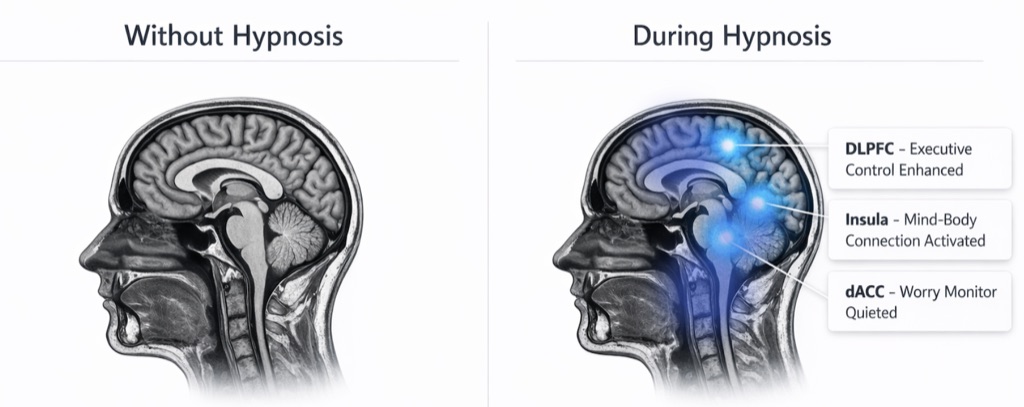
Regions from Stanford fMRI research on hypnosis (Jiang et al., 2017)
How much does this cost, and is it covered?
At Calgary Hypnosis Center, sessions range from $220 to $350 each, with a three-session commitment to start. We are fully virtual, so you can join from anywhere in Canada. Hypnotherapy is not typically covered by provincial health plans, and private insurance coverage varies. We do not claim that any specific insurer covers our services. If cost is a concern, ask us about options during a free consultation. Some people also explore self-hypnosis apps or recordings as a lower-cost starting point, though working with a professional often yields better results for complex pain. Learn more about what hypnotherapy costs in Canada.
Who actually gets relief from hypnotherapy for endo pain?
You might be a good candidate if you have tried conventional treatments and still struggle with pain, fatigue, or the emotional weight of endometriosis. Hypnotherapy can help if you are open to learning mind-body skills, even if you are skeptical. It is especially useful for people who want to reduce reliance on medication or who find that stress and poor sleep make their pain worse. You do not need to be highly suggestible or a true believer. Many of our clients start out doubtful and are surprised by how much deep relaxation and guided imagery can shift their experience of pain.
Will hypnosis work for you?
Regions from Stanford fMRI research on hypnosis (Jiang et al., 2017)
When should you NOT try hypnotherapy for endo pain?
Skip hypnotherapy if you have untreated severe depression, psychosis, or certain dissociative disorders, unless your mental health provider approves it as part of a coordinated plan. Also, if your pain has a new or undiagnosed cause, see a doctor first to rule out serious underlying conditions. Hypnotherapy is not a replacement for medical investigation. Finally, if you are looking for a one-session magic fix, you will likely be disappointed. It takes practice and patience, and it works best alongside medical care, not instead of it. For safety details, read is hypnotherapy safe.
Will hypnosis work for you?
Regions from Stanford fMRI research on hypnosis (Jiang et al., 2017)
Self-hypnosis app or working with a hypnotherapist?
Self-hypnosis apps and recordings can be a good, low-cost way to dip your toes in. Some people with endometriosis report meaningful improvements using guided self-hypnosis at home. However, a professional hypnotherapist tailors sessions to your specific pain patterns, emotional triggers, and goals. They can also teach you advanced self-hypnosis techniques and help you troubleshoot when you feel stuck. For complex, long-standing pain, the personalized support of a trained hypnotherapist often leads to deeper and more lasting results. Think of apps as a helpful supplement, not a replacement, for professional care. Compare further in apps vs working with a hypnotherapist.
In a study on hypnotherapy and endo belly, approximately 70% of participants experienced significant reductions in gut symptoms such as bloating, gas, and abdominal pain. This highlights the potential of professional hypnotherapy to address both pain and related gastrointestinal distress.
Source: Endometriosis.net
| Self-hypnosis apps | Working with a Calgary Hypnosis Center hypnotherapist | |
|---|---|---|
| Cost | Free or low monthly subscription | $220–$350 per session |
| Personalization | Generic recordings; one-size-fits-all | Sessions tailored to your pain patterns and emotional triggers |
| Guidance | No real-time feedback or adjustment | Live, interactive support that adapts as you respond |
| Depth of relaxation | Variable; easy to get distracted | Professional induction leads to deeper, more consistent hypnotic states |
| Accountability | You’re on your own to practice | Structured 3-session commitment with follow-up and skill-building |
Questions this page answers
Can hypnosis make my pain worse or have negative side effects?
It is rare, but some people feel temporary discomfort if they resist relaxation or if buried emotions surface. A skilled hypnotherapist will guide you gently and stop if needed. Most side effects are mild, like feeling drowsy or emotional after a session. Serious adverse effects are extremely uncommon when working with a trained professional.
Is it dangerous to use hypnosis if my pain has an undiagnosed physical cause?
Yes, it can be risky. Hypnosis can mask pain, which is your body’s warning signal. If you have new or unexplained pain, always get a thorough medical evaluation first. Once serious conditions are ruled out, hypnotherapy can be a safe addition to your pain management plan.
Does hypnotherapy only work for people who are suggestible or believe in it?
No. Research shows that even skeptical people can benefit. The key is your willingness to engage and practice. Hypnosis is a skill you learn, not a magic spell. Many clients who start out doubtful are surprised by how much the deep relaxation and focused attention help, regardless of their initial beliefs.
Will trying hypnosis and failing just lead to more disappointment?
It can feel that way, especially if you have been let down by many treatments. But hypnotherapy is not pass/fail. Even if it does not eliminate pain, many people gain better sleep, less anxiety, and a sense of control. Going in with realistic expectations and a curious mindset can protect you from crushing disappointment.
How does hypnotherapy compare to CBT, ACT, or DBT for chronic pain?
Hypnotherapy and these talk therapies all aim to change your relationship with pain, but they work differently. CBT focuses on thoughts and behaviors, ACT on acceptance, and DBT on emotional regulation. Hypnosis directly targets the subconscious and nervous system through deep relaxation and suggestion. Some studies suggest hypnosis can have a larger immediate effect on pain intensity, but we need more head-to-head research. Many people combine approaches for best results. See [hypnotherapy compared with CBT](/hypnotherapy-vs-cbt) and [hypnotherapy compared with talk therapy](/hypnotherapy-vs-therapy).
Is hypnosis more effective than meditation or mindfulness for pain?
They share similarities, like focused attention and relaxation. Hypnosis is typically more goal-directed, using specific suggestions to alter pain perception. Meditation emphasizes non-judgmental awareness. Some people find hypnosis easier to learn because a guide leads you. Both can help, and the best choice depends on your preferences and how you respond.
Has anyone actually had their chronic pain cured by hypnosis?
Cured is a strong word. Some individuals report dramatic, lasting relief, but for most, hypnosis is a powerful coping tool rather than a cure. It can significantly reduce pain intensity and improve quality of life, especially when combined with other treatments. Think of it as turning down the dial, not erasing the pain completely.
Does hypnotherapy work for nerve pain or only for psychosomatic pain?
Hypnotherapy can help with many types of pain, including nerve pain, because all pain is processed in the brain. It does not matter whether the cause is physical or psychological. Hypnosis can alter how your brain interprets pain signals, reducing suffering even when the underlying condition remains. It is not just for psychosomatic pain.
Are the benefits of hypnosis long-lasting or just temporary?
Many people experience lasting benefits, especially when they learn self-hypnosis and practice regularly. The goal is to build skills you can use anytime. Some studies show pain relief maintained at follow-ups. However, for chronic conditions like endometriosis, ongoing practice is often needed to sustain the effects.
How many sessions are typically needed to see results?
It varies. Some people notice better sleep and relaxation after one or two sessions. For significant pain reduction, a series of four to six sessions is common. At Calgary Hypnosis Center, we start with a three-session commitment to give the process a fair trial. Your hypnotherapist will adjust the plan based on your progress.
I won’t pretend hypnotherapy is a magic fix for endometriosis pain, I’ve seen too many people run out of hope after failed treatments. But when 70% of women in one study reported real relief from gut symptoms like bloating and pain, I know it’s worth a shot. If you’re ready to try something that puts you back in the driver’s seat, book a free consultation and let’s talk about what’s possible.
Apply to work with us
We take on just 10 new clients a month. Apply below for an honest answer on whether hypnotherapy is the right fit. No packages, no pressure.
Only 2 spots left for August

Danny M.
Danny M. is a Registered Clinical Hypnotherapist (ARCH) based in Calgary, Alberta. His work focuses on the conditions hypnotherapy has the strongest track record with: anxiety, insomnia, chronic pain, and IBS. Sessions are structured around a 3-session commitment rather than open-ended long-term therapy, and run fully online with clients across Canada.
Last updated: 2026-05-24