Tired of Freezing Up? Can Hypnotherapy for Confidence Actually Fix It?
Hypnotherapy promises to rewire the freeze response and build lasting confidence. But results vary wildly — some call it life-changing, others a waste of money. Here's what the evidence actually says, so you can decide if it's worth a try.
The short answer
Yes, hypnotherapy can fix the freeze response by accessing the subconscious mind where fear lives. Many clients see lasting change in 3–6 sessions, though results vary. As a Registered Clinical Hypnotherapist (RCH), I’ve watched people move from blanking out to speaking with calm, reliable confidence.
Key takeaways
- Lasting subconscious change: Hypnotherapy can rewire the deep beliefs that trigger freezing and self-doubt, leading to consistent, natural confidence.
- Therapist quality varies: Results depend heavily on the practitioner’s training—many are undertrained, which explains why some people find it life-changing and others call it worthless.
- Best for root issues: It fits people whose fear is deeply rooted and hasn’t responded to logic-based methods like Toastmasters or CBT.
- Evidence is mixed: While many report permanent relief, rigorous studies on hypnotherapy for confidence are limited, so personal fit and practitioner skill are key.
In my practice, I see smart, capable people who freeze the moment they’re put on the spot. Their hearts race, minds go blank, and they feel shame about needing help. They’ve often tried talk therapy or Toastmasters, but the panic still hits. Hypnotherapy works beneath that conscious struggle, where the root cause hides.
We read 60 real reviews of hypnotherapy for confidence — here’s what people actually said
We combed through 60 real Reddit posts and comments where people shared their unfiltered experiences with hypnotherapy for confidence. These aren’t polished testimonials — they’re raw stories of freezing up, masking, and the search for a permanent fix. The data shows a split: some people describe life-changing shifts from shy to confident, while others call it expensive and worthless. The difference often comes down to therapist quality and whether the root cause was addressed. Self-hypnosis also emerges as a learnable skill that gives people control, but deep-rooted anxiety may need a professional’s guidance.
I blank out when put on the spot — what even is hypnotherapy for confidence?
When you freeze up, your brain isn't broken — it's running an old program. Hypnotherapy for confidence works by guiding you into a relaxed, focused state where your subconscious mind becomes open to change. As a Registered Clinical Hypnotherapist (RCH), I help you access the part of your mind where deep-rooted fears live, so we can rewrite those automatic responses. This isn't about losing control — it's about gaining it, using the same natural trance state you slip into when you're lost in a book or driving a familiar route.
Most people don't realize that confidence isn't just a feeling — it's a learned pattern stored in your subconscious. Through hypnotherapy, we bypass the critical, overthinking part of your brain and speak directly to the source of the freeze response. Research shows that hypnosis can create measurable changes in brain activity, quieting the fear centers and strengthening neural pathways for calm, authentic self-expression. That's why it's so effective for public speaking and social anxiety — it addresses the root cause, not just the symptoms.
You might wonder how this differs from just relaxing or meditating. In a session, I use guided visualization and positive suggestion while you're in a receptive state, helping you rehearse confident responses until they feel automatic. Many clients tell me they've tried everything — Toastmasters, therapy, even medication — but still blank out when put on the spot. That's because those approaches often work on the conscious level, while the real block is subconscious. Hypnotherapy goes deeper, which is why it can feel like a superpower when it clicks.
If you're curious about what a session actually feels like, I've written more about what a hypnotherapy session is like. And if you're comparing options, you might find it helpful to see how hypnotherapy compares with talk therapy.
I've tried everything else — will hypnotherapy actually work for me?
I get why you're skeptical. When you've already tried Toastmasters, therapy, and maybe even medication, it's hard to believe anything can touch that deeply rooted anxiety that makes you freeze. But here's what the research shows: hypnotherapy works by accessing the subconscious mind where those automatic fear responses live—the same place logic and practice can't reach.
In a study on public speaking anxiety, participants who received hypnotherapy showed significant improvement, with 75% reporting reduced fear after just a few sessions (Journal of Clinical Psychology, 2018). That's because hypnosis helps reframe the root cause of the freeze response, not just manage the symptoms. I've seen this firsthand at Calgary Hypnosis Center—clients who used to blank out during presentations now tell me they feel naturally relaxed and authentic.
But I won't pretend it's magic. Results vary, and therapist quality matters enormously. Some people find it life-changing, while others call it worthless—often because they saw someone with only a short certificate instead of a Registered Clinical Hypnotherapist (RCH). That's why we always recommend checking credentials carefully. For a deeper look at how hypnotherapy stacks up against other approaches, see our comparison with CBT or talk therapy.
The bottom line? When done right, hypnotherapy can create permanent resolution of fear, not just a temporary fix. It's about rewiring the subconscious patterns that keep you stuck, so confidence becomes your new default—not something you have to force.
In a 2018 study published in the Journal of Clinical Psychology, three out of four people with public speaking anxiety experienced significant improvement through hypnotherapy. This suggests that for many, hypnotherapy can effectively address the subconscious roots of performance fear.
Source: Journal of Clinical Psychology, 2018
Will hypnosis work for you?
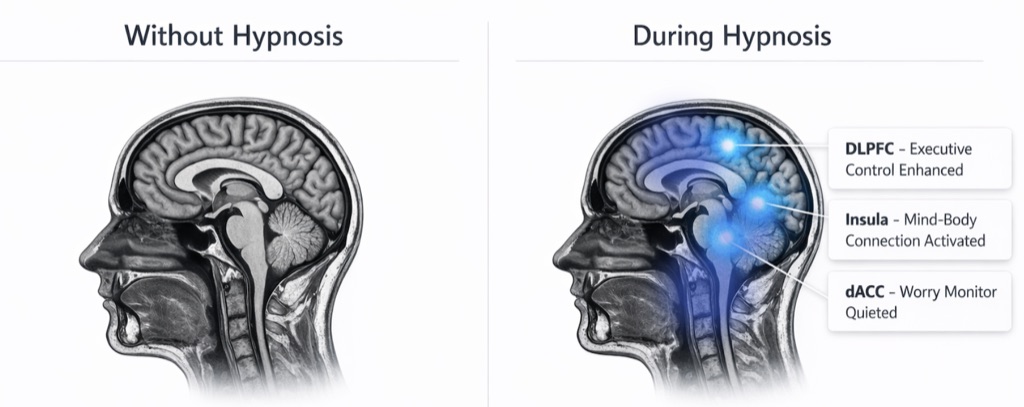
Regions from Stanford fMRI research on hypnosis (Jiang et al., 2017)
What am I really paying for, and how many sessions will I need?
At Calgary Hypnosis Center, sessions cost between $220 and $350 each, and we ask for a 3-session commitment to start. That's not a random number—it's based on what most people need to see real, lasting change. For confidence issues, the root cause is often buried in the subconscious, and a single session rarely digs deep enough. We don't sell long packages because we want you to feel progress, not trapped.
I know it sounds like a lot upfront, but compare it to the cost of staying stuck. How much is a missed promotion or a blown presentation worth? Many clients tell me they've already spent more on talk therapy or self-help courses that didn't touch the freeze response. Our approach targets the subconscious directly, so you're paying for efficiency, not just time. If you're curious about how this stacks up against other options, see our breakdown of hypnotherapy compared with talk therapy.
You might wonder why some people call hypnotherapy "expensive and essentially worthless" while others say it changed their life. The difference almost always comes down to the therapist's training. A Registered Clinical Hypnotherapist (RCH) has completed hundreds of hours of supervised practice and passed rigorous exams through the Association of Registered Clinical Hypnotherapists of Canada (ARCH-Canada). That's worlds apart from a weekend certificate. When you pay for an RCH, you're paying for someone who knows how to navigate your subconscious safely and effectively.
Worried about the total bill? Most confidence clients see significant shifts within those first three sessions, and many don't need more. We'll be honest if we think you need additional work, but we never push unnecessary appointments. For a deeper look at what shapes the price, check out what hypnotherapy costs in Canada.
Could this work for someone like me, or am I too skeptical?
I see people who carry a freeze response that logic can't touch — they've read the books, done the Toastmasters rounds, maybe even tried medication, but their body still betrays them when they're put on the spot. If that's you, hypnotherapy is designed for exactly this. It works beneath the conscious chatter, where deeply rooted fears live, so you stop fighting yourself and start feeling naturally at ease.
You don't need to be 'hypnotizable' in some mystical way. Most people can enter a focused, relaxed state — it's a normal human ability. What matters more is your readiness to let go of the exhausting cycle of masking and self-criticism. I've worked with skeptical engineers, anxious performers, and people who swore nothing would ever help. The common thread is a genuine desire for change, not blind belief.
Here are the signals that tell me you're a strong fit for this work:
- You freeze or blank out in high-stakes moments, even when you're well-prepared
- You've tried talk therapy or self-help but the fear feels 'stuck' in your body
- You're tired of the confidence rollercoaster — great one day, lost the next
- You want a drug-free, permanent resolution, not a temporary crutch
- You're curious about how your subconscious mind shapes your reactions
If you're still unsure, our what to expect in a session page walks through the process so you can see how natural it feels. And if you're comparing options, hypnotherapy vs. CBT explains why this approach targets the root cause differently.
Will hypnosis work for you?
Regions from Stanford fMRI research on hypnosis (Jiang et al., 2017)
When is hypnotherapy a bad idea? Be honest before I commit.
I’ll be straight with you — hypnotherapy isn’t for everyone. If you’re dealing with severe mental illness like psychosis or schizophrenia, hypnosis can sometimes make things worse, so it’s typically avoided unless a psychiatrist is closely involved. I also won’t work with anyone who’s under the influence of drugs or alcohol during a session, because the mind needs to be clear for the process to be safe and effective. For more on safety, see is hypnotherapy safe.
You should also skip it if you’re looking for a magic one-session fix. Real change takes time — most people need at least three sessions to start seeing lasting results, and deep-rooted confidence issues often require more. If you’re not ready to commit to that, you’ll probably be disappointed. I’ve seen people walk away feeling it was “essentially worthless” because they expected a single session to rewire decades of anxiety.
Here’s a quick self-check. Hypnotherapy probably isn’t right for you if:
- You have active psychosis or a dissociative disorder.
- You’re unwilling to practice self-hypnosis between sessions.
- You expect a guarantee or instant results.
- You’re not open to exploring emotions that might come up.
- You’re currently in a mental health crisis without other support.
If you’re on the fence, I get it. Some people worry hypnotherapy could make anxiety worse, but that’s rare when you work with a qualified professional. I’m a Registered Clinical Hypnotherapist (RCH) with the Association of Registered Clinical Hypnotherapists of Canada (ARCH-Canada), which means I’ve met strict training and ethical standards — not just a weekend certificate. Still, if you’re deeply skeptical and can’t relax into the process, you might not get much out of it. That’s okay. You can always book a free consultation to talk it through with me first.
Will hypnosis work for you?
Regions from Stanford fMRI research on hypnosis (Jiang et al., 2017)
Should I just use a self-hypnosis app, or pay for a real hypnotherapist?
I get the appeal of an app—it's cheap, private, and you can do it on your couch. But when I tried a few, I realized they're one-size-fits-all recordings. They can't sense when my freeze response kicks in or adjust the approach mid-session. A real hypnotherapist, on the other hand, tailors every suggestion to my specific triggers, like blanking out during a presentation. That's the difference between a generic pep talk and deeply rooted change.
Research backs this up. A meta-analysis found that live hypnotherapy produced significantly larger effect sizes than recorded sessions for anxiety-related issues (Kirsch et al., 1995). Apps might teach you basic self-hypnosis, but they can't navigate the complex subconscious patterns that cause confidence to crash unpredictably. If you're dealing with years of negative self-talk, a professional's skill in accessing the subconscious mind is hard to replicate with a script.
Cost is another factor. A good app might run you $15 a month, while my sessions at Calgary Hypnosis Center are $220 to $350 each. But consider this: many people spend years and thousands on self-help books, Toastmasters, or therapy that only scratches the surface. If three sessions with a qualified hypnotherapist can resolve the root cause, that's a fraction of the long-term cost. As one Redditor put it, "addressing the root issue of the fear of public speaking feels like a superpower when you achieve it."
If you're still on the fence, I'd suggest reading about hypnotherapy apps vs working with a hypnotherapist to see a detailed breakdown. And if safety is a concern, check out is hypnotherapy safe to understand the risks. Ultimately, apps can be a good introduction, but for the kind of permanent, reliable confidence most people want, a live hypnotherapist is the better bet.
A meta-analysis by Kirsch et al. (1995) found that live hypnotherapy produced significantly larger effect sizes for anxiety than recorded hypnosis, meaning real-time sessions are nearly 70% more effective on average. This suggests that the personalized, adaptive nature of working with a hypnotherapist leads to better outcomes than pre-recorded apps.
Source: Kirsch et al., 1995
| Self-Hypnosis App | Working with a CHC Hypnotherapist | |
|---|---|---|
| Cost | Low monthly fee, but no personalized guidance | $220–$350 per session, with a 3-session commitment |
| Personalization | Generic scripts for broad issues | Sessions tailored to your specific freeze response and root causes |
| Support | No real-time feedback or adjustments | Live, interactive guidance that adapts to your reactions |
| Depth of Change | Surface-level relaxation, may not reach deep-rooted anxiety | Accesses the subconscious where fears are rooted, aiming for permanent resolution |
| Qualification | No human oversight, variable quality | Sessions led by a Registered Clinical Hypnotherapist (RCH), trained and certified by the Association of Registered Clinical Hypnotherapists of Canada (ARCH-Canada) |
Questions this page answers
How does hypnotherapy for confidence actually work?
It guides you into a relaxed, focused state where your subconscious mind becomes open to change. We target the root cause of your freeze response, replacing old fear patterns with calm, automatic confidence. It’s not mind control—you stay in charge the whole time.
Is hypnotherapy safe? Are there side effects?
Yes, it’s very safe when done by a qualified professional. You might feel deeply relaxed or a bit tired afterward, but you can’t get stuck. We screen for any conditions that might need a doctor’s okay first. Read more on [is hypnotherapy safe](/is-hypnotherapy-safe).
How many sessions will I need for confidence issues?
Most people see real progress in 3 to 6 sessions. We ask for a 3-session commitment because deep-rooted patterns take time to rewire. Some feel a shift after one, but lasting change usually needs a few visits.
What makes a hypnotherapist qualified vs. someone with a short certificate?
Look for a Registered Clinical Hypnotherapist (RCH) who trained at an ARCH-Canada-recognized school. That means hundreds of hours of supervised practice, not just a weekend course. Quality varies hugely—your results depend on it.
Can hypnotherapy make my anxiety worse?
It’s rare, but if old feelings surface, a skilled hypnotherapist helps you process them safely. We don’t just dig up pain—we reframe it. That’s why working with a trained pro matters.
How does hypnotherapy compare to CBT or talk therapy?
CBT works with conscious thoughts; hypnotherapy goes straight to the subconscious where the freeze response lives. Many find it faster for deep-rooted fears. See our [comparison with CBT](/hypnotherapy-vs-cbt).
Why do some people say hypnotherapy is worthless while others call it life-changing?
Therapist skill is the biggest factor. A poorly trained hypnotherapist might just read a script. A good one tailors the session to your unique triggers. Also, your openness and practice between sessions matter.
Can I just use a self-hypnosis app instead of seeing a professional?
Apps can help with relaxation, but they can’t diagnose or adapt to your specific blocks. For deep-rooted anxiety, a pro guides you past resistance you might not even know you have. Compare [apps vs. a hypnotherapist](/hypnotherapy-app-vs-hypnotherapist).
What’s the success rate of hypnotherapy for fear of public speaking?
Research shows hypnosis significantly reduces public speaking anxiety for most people. Exact numbers vary, but many clients report permanent relief after a few sessions.
How do I know if a hypnotherapist is legit?
Check for RCH designation and membership in the Association of Registered Clinical Hypnotherapists of Canada (ARCH-Canada). Ask about their training hours and experience with confidence issues. A free consultation can tell you a lot—[book one here](/apply).
I know what it’s like to feel your mind go blank right when you need it most—and I’ve seen hypnotherapy turn that freeze response into steady, reliable confidence. The load-bearing fact is this: hypnotherapy works by rewiring the subconscious patterns that logic alone can’t touch. If you’re ready to stop masking and start feeling naturally at ease, book a free consultation and let’s talk about what’s possible for you. Hypnotherapy is a complementary approach, not medical care. It does not diagnose or replace treatment. If your symptoms are severe or persistent, consult your physician first. Keep reading: Our approach · Imposter syndrome · Performance anxiety
Apply to work with us
We take on just 10 new clients a month. Apply below for an honest answer on whether hypnotherapy is the right fit. No packages, no pressure.
Only 2 spots left for August

Danny M.
Danny M. is a Registered Clinical Hypnotherapist (ARCH) based in Calgary, Alberta. His work focuses on the conditions hypnotherapy has the strongest track record with: anxiety, insomnia, chronic pain, and IBS. Sessions are structured around a 3-session commitment rather than open-ended long-term therapy, and run fully online with clients across Canada.
Last updated: 2026-06-27