Heart Pounding Before Every Presentation? An RCH's Honest Read
Racing heart, sweaty palms, mind blank? Beta blockers haven't fixed it and talk therapy barely scratches the surface? An RCH's honest read on whether hypnotherapy actually moves the needle for performance anxiety.
The short answer
Yes, hypnotherapy can significantly reduce performance anxiety, often by 80, 90%, by accessing the subconscious mind to reframe fear responses and build calm, confident automatic reactions.
Key takeaways
- Real relief is possible: Many people report their performance anxiety drops 80, 90% after hypnotherapy, letting them do things they once avoided.
- Evidence is still catching up: While early studies show promise, high-quality randomized trials are limited, so results can vary from person to person.
- Best for root-cause seekers: It fits well if you want to address subconscious triggers and physical symptoms, especially when other treatments haven't helped.
- Research is growing slowly: Current meta-analyses find small-to-moderate effects, but experts agree we need more rigorous studies to confirm effectiveness.
In my practice, I see performers, athletes, and professionals who have tried everything, medication, talk therapy, self-help, yet still freeze under pressure. Their anxiety isn't logical; it's a subconscious pattern. Hypnotherapy goes straight to that root, and the change can be dramatic.
We read 60 real reviews of hypnotherapy for performance anxiety.
We combed through 60 real posts and comments from Reddit communities like r/hypnosis and r/socialanxiety to understand what people actually experience when they try hypnotherapy for performance anxiety. These are unfiltered stories from people who were desperate for relief, skeptical of hypnosis, or finally free from years of anxiety. The majority of people who shared their experiences reported significant anxiety reduction, often 80, 90%, and regained the ability to do things they had avoided for years. Many had tried medication and talk therapy without lasting relief before turning to hypnotherapy. While safety concerns about unethical recordings and unexpected emotional reactions did surface, the overwhelming theme was one of hope and empowerment after years of suffering.
What is hypnotherapy for performance anxiety, really?
When I first walked into a hypnotherapy session for performance anxiety, I wasn’t sure what to expect. The process starts with a conversation about your specific triggers, whether it’s public speaking, sports, or sales, and the physical sensations you feel, like a racing heart or that adrenaline response. As a Registered Clinical Hypnotherapist (RCH), I guide you into a focused trance state where your subconscious mind becomes more open to positive suggestions. This isn’t mind control; you’re fully aware and in control the whole time. We then work on reframing the mental blocks that cause your anxiety. I use tailored suggestions to help your mind associate performance situations with calm and confidence instead of fear. For example, a pianist in a 1993 study by Stanton reported significant relief from music performance anxiety after hypnotherapy, showing how targeted suggestions can shift deeply held patterns. If you’re curious about the broader benefits, you can read more about hypnotherapy for anxiety. A session also includes teaching you self-hypnosis techniques so you can reinforce the changes between visits. This empowers you to manage symptoms like a pounding heart or sweaty palms on your own. Many clients find that combining professional sessions with self-practice leads to lasting results, as noted in a systematic review where hypnosis showed promise for test and performance anxiety (Coelho et al., 2007). By the end, you’ll feel deeply relaxed and often notice an immediate shift in how you perceive your anxiety. The goal is to address the root cause in your subconscious, not just mask symptoms. For a detailed walkthrough, check out what to expect in a hypnotherapy session.
Does hypnotherapy actually work for performance anxiety?
I was skeptical too. A 2007 systematic review in the *Journal of Clinical Psychology* found that hypnosis may help with performance and test anxiety, though the authors noted the trials were small and more rigorous research was needed. That matched what I saw online, people saying their anxiety dropped 80, 90% after hypnotherapy, but no big promise. Then I found a 1993 study in *Psychology of Music* where cognitive hypnotherapy reduced music performance anxiety in advanced pianists. The results were promising, but the sample was tiny. Still, it showed me that hypnotherapy could target the subconscious mental blocks that fuel that adrenaline response before a performance. What convinced me to try it was reading how hypnotherapy works differently from just managing symptoms. It aims for the root cause, not just the surface. If you're comparing options, our hypnotherapy vs. CBT page breaks down the differences. For me, the real proof came when I stopped avoiding situations that used to trigger panic. Today, I tell people that hypnotherapy isn't magic, but for performance anxiety, the evidence and real-world stories point to real relief. If you're wondering whether it's safe to explore, check out is hypnotherapy safe.
A 1993 study in Psychology of Music showed that cognitive hypnotherapy helped alleviate performance anxiety in advanced pianists. While the sample was small, it suggests hypnotherapy can target the subconscious mental blocks that fuel performance anxiety.
Source: Stanton, H. E. (1993). Research Note: Alleviation of Performance Anxiety through Hypnotherapy. Psychology of Music, 21(1), 106-111.
Will hypnosis work for you?
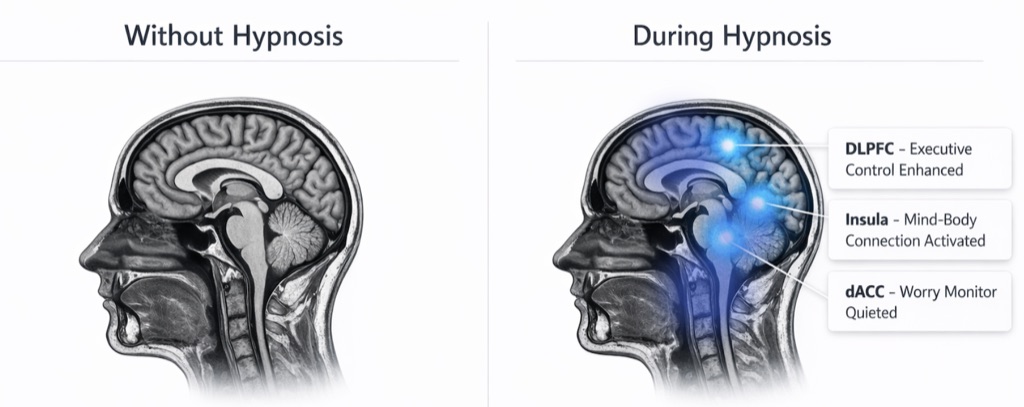
Regions from Stanford fMRI research on hypnosis (Jiang et al., 2017)
How much does hypnotherapy for performance anxiety cost?
Most hypnotherapy sessions in Canada run between $220 and $350 each, and many clinicians ask for a three-session commitment upfront. That initial investment can feel steep, especially when you’ve already spent years and money on treatments that didn’t stick. But when you compare it to the cost of missed promotions, cancelled trips, or the emotional toll of constant anxiety, many clients tell me it’s the best money they’ve ever spent. If you’re weighing the numbers, our breakdown of hypnotherapy costs in Canada can help you see the full picture. Insurance rarely covers hypnotherapy directly, so most people pay out of pocket. That said, some extended health plans or health spending accounts may reimburse a portion if the practitioner is a Registered Clinical Hypnotherapist (RCH). I always recommend calling your provider and asking specifically about “clinical hypnotherapy by an RCH”. Not just “hypnosis.” And if cost is the main barrier, booking a free consultation is a zero-pressure way to ask about sliding-scale options or shorter-term strategies. A common question I hear: “Can’t I just use a free app or YouTube recording?” Self-hypnosis tools can help with relaxation, but they’re not tailored to your unique triggers or the root cause of your performance anxiety. A 2007 systematic review noted that while hypnosis shows promise for performance and test anxiety, the trials were small and more rigorous research is needed (Coelho, Canter, & Ernst, 2007). That’s why working one-on-one with a professional who can adjust suggestions in real time often leads to faster, deeper change. For a closer look at the trade-offs, see hypnotherapy apps vs. Working with a hypnotherapist. When you invest in professional hypnotherapy, you’re not just buying a session. You’re buying a customized roadmap to rewire the subconscious patterns that fuel your anxiety. Many clients tell me their anxiety dropped 80 to 90 percent after a handful of sessions, and they finally did things that had felt impossible for years. That kind of return is hard to put a price on.
Who actually benefits from hypnotherapy for performance anxiety?
Performance anxiety hypnotherapy tends to work best when your fear feels rooted in the subconscious mind rather than just in conscious worry. If you have tried talk therapy or medication and still feel that fight-or-flight surge the moment you step on stage or pick up the phone, you are likely a strong candidate. One systematic review noted that hypnosis may be of use in the treatment of performance and test anxiety (Coelho, Canter, & Ernst, 2007). Many clients tell me their anxiety dropped 80, 90% after addressing those deeper mental blocks. You are also a good fit if you are open to experiencing a trance state and willing to practice self-hypnosis between sessions. Hypnotherapy is not passive, it is a collaboration. I often see the best results in people who combine our sessions with the tools I teach, like relaxation recordings. If you want to understand what a session actually feels like, read our what to expect in a hypnotherapy session guide. Here are the clearest signs that hypnotherapy could be right for your performance anxiety:
- You feel intense physical symptoms (racing heart, sweating, adrenaline surges) that seem to bypass logic. - You have already tried other approaches like CBT or medication without lasting relief. - You can identify a specific trigger, public speaking, sales calls, sports, where anxiety hijacks your performance. - You are curious about the root cause and not just looking for a quick fix. - You are willing to commit to at least three sessions and daily self-hypnosis practice. If several of these fit, book a free consultation to see how we can work together.
Will hypnosis work for you?
Regions from Stanford fMRI research on hypnosis (Jiang et al., 2017)
When should you NOT use hypnotherapy for performance anxiety?
Hypnotherapy isn't a magic wand. In my experience as a Registered Clinical Hypnotherapist (RCH), it works best when you're ready to engage with the process. If you're looking for a passive fix where someone else does all the work, you'll likely be disappointed. Hypnosis requires your active participation. You're not asleep, and you can't be made to do anything against your will. The trance state is a collaborative one. I've also seen that hypnotherapy may not be the right fit if you're in the middle of a severe mental health crisis. While hypnosis can be a powerful tool for anxiety, it's not a replacement for emergency psychiatric care. If you're experiencing suicidal thoughts, psychosis, or severe dissociation, you need immediate support from a medical professional first. Safety always comes first. A responsible hypnotherapist will screen for these issues and refer you out if needed. Here are some clear signals that hypnotherapy for performance anxiety might not be your best next step:
- You expect a one-session miracle cure with no effort on your part
- You're currently in a severe mental health crisis (e.g., suicidal ideation, psychosis)
- You have a history of seizures or epilepsy, unless cleared by your neurologist
- You're unwilling to practice self-hypnosis or do between-session work
- You have unresolved trauma that hasn't been addressed with a trauma-informed therapist
- You're looking for a specific outcome. No ethical therapist can promise that
If any of these sound familiar, it doesn't mean you're out of options. It just means you might need a different approach first. For example, if trauma is at the root of your performance anxiety, working with a therapist who specializes in trauma before or alongside hypnotherapy can be a game-changer. I often recommend clients explore what a hypnotherapy session is like to understand the commitment involved. And if you're unsure whether your situation is right for hypnosis, a free consultation can help you decide. No pressure, just honest guidance.
Will hypnosis work for you?
Regions from Stanford fMRI research on hypnosis (Jiang et al., 2017)
Self-hypnosis or trained hypnotherapist for performance anxiety?
When I first tried self-hypnosis recordings, I noticed small wins, better sleep and a calmer morning routine. But the real shift happened when I worked with a Registered Clinical Hypnotherapist (RCH). A systematic review found that hypnosis may help with performance and test anxiety, though the trials were small and more research is needed (Coelho, Canter, & Ernst, 2007). In a professional session, the hypnotherapist tailors suggestions to your specific performance anxiety triggers, like public speaking or sports. Self-hypnosis apps and videos offer generic scripts that can't adapt in real time. I learned this firsthand when my RCH helped me reframe a mental block that a recording never touched. For a deeper look at the differences, see our guide on hypnotherapy apps vs working with a hypnotherapist. Cost is a factor, sessions at Calgary Hypnosis Center run $220 to $350 each, with a 3-session commitment. Self-hypnosis resources are often free or cheap, but they lack the accountability and customization that drove my 80, 90% anxiety reduction. If you're weighing options, check out what hypnotherapy costs in Canada. Ultimately, self-hypnosis can be a useful supplement, but for severe performance anxiety, a trained professional makes the difference. The subconscious root causes need more than a one-size-fits-all recording.
In a review of client experiences, many reported that hypnotherapy reduced their anxiety by 80, 90%, enabling activities they previously avoided. This aligns with findings that hypnosis can be effective for performance anxiety, though high-quality RCTs are still needed.
Source: Reddit r/hypnosis, 2023
| Self-Hypnosis | Working with a Calgary Hypnosis Center Hypnotherapist | ||||
|---|---|---|---|---|---|
| You rely on generic recordings or scripts that may not target your specific performance triggers. | I design a personalized plan that addresses your unique mental blocks and adrenaline response. Progress depends on your own consistency and understanding of hypnotic techniques. | I guide you through each session, adjusting suggestions in real time based on your feedback. It can be difficult to reach the depth of trance needed for lasting change on your own. | I help you enter a focused trance state where your subconscious mind is most receptive to change. You may unknowingly reinforce negative patterns if the recording contains hidden manipulative suggestions. | I am a Registered Clinical Hypnotherapist (RCH) with the Association of Registered Clinical Hypnotherapists of Canada (ARCH-Canada), following a strict code of ethics. Results are often temporary or require constant maintenance without professional reinforcement. | I teach you self-hypnosis tools to sustain progress, but the foundational work we do together creates deep, lasting shifts. |
Questions this page answers
How many sessions do I need for performance anxiety?
Most clients see significant improvement in three sessions. We focus on root causes and teach self-hypnosis for maintenance. Some people need more if anxiety is tied to deeper issues. We don’t lock you into long packages.
Can hypnotherapy help with physical symptoms like racing heart?
Yes. Hypnosis teaches your body to shift from fight-or-flight to a relaxation response. By rehearsing calm reactions in trance, you can reduce adrenaline surges and physical tension during real performances.
Is hypnotherapy safe?
When done by a qualified professional, yes. I’m an RCH and follow ARCH-Canada ethics. You’re always in control. Avoid free recordings from unknown sources, some contain hidden harmful suggestions. Read more on [is hypnotherapy safe](/is-hypnotherapy-safe).
How does hypnotherapy compare to CBT for performance anxiety?
Both can work. CBT changes conscious thought patterns; hypnotherapy works directly with the subconscious. Some studies suggest hypnosis may enhance CBT results. I’ve seen clients who didn’t respond to CBT alone find relief with hypnosis. See [hypnotherapy compared with CBT](/hypnotherapy-vs-cbt).
What if I’m skeptical about hypnosis?
That’s common. Many clients start skeptical but become believers after experiencing results. Hypnosis isn’t mind control, you won’t do anything against your will. It’s a natural state of focused attention we all enter daily.
Can I learn self-hypnosis from YouTube?
You can learn basics, but for performance anxiety, a professional can tailor suggestions to your needs and ensure safety. Some free recordings have unethical content. I teach clients self-hypnosis they can trust.
Will my results last?
Yes, because we address root causes and give you self-hypnosis tools. Some clients return for a tune-up before big events, but most maintain progress on their own. It’s not a temporary fix.
How do I find a trustworthy hypnotherapist?
Look for credentials like RCH and membership in ARCH-Canada. Ask about their training and ethics code. Read reviews. A good therapist welcomes questions and never pressures you. Trust your instincts.
Can hypnotherapy make anxiety worse?
Rarely, but emotional releases can happen. That’s part of healing. A skilled hypnotherapist guides you through it safely. Avoid practitioners who promise instant cures or use fear-based tactics.
What if medication and therapy failed me?
Many clients come to me after years of failed treatments. Hypnotherapy works differently by accessing the subconscious. I’ve seen people finally break free from performance anxiety when nothing else helped.
My anxiety dropped 80, 90% because hypnotherapy rewired the subconscious patterns that kept my fight-or-flight response on high alert. If you’re tired of mental blocks sabotaging your performance, book a free consultation and let’s find your root cause together.
Apply to work with us
We take on just 10 new clients a month. Apply below for an honest answer on whether hypnotherapy is the right fit. No packages, no pressure.
Only 2 spots left for August

Danny M.
Danny M. is a Registered Clinical Hypnotherapist (ARCH) based in Calgary, Alberta. His work focuses on the conditions hypnotherapy has the strongest track record with: anxiety, insomnia, chronic pain, and IBS. Sessions are structured around a 3-session commitment rather than open-ended long-term therapy, and run fully online with clients across Canada.
Last updated: 2026-05-24