Hypnotherapy for Migraines: Does It Actually Help When Nothing Else Has?
When migraines steal your sleep, your work, and your hope, you’ll try almost anything. Hypnotherapy promises a way to calm the nervous system and dial down pain—but it’s not a magic fix. Here’s what real people say, what the science shows, and an honest verdict on whether it’s worth your time and money.
The short answer
Yes, hypnotherapy can reduce migraine frequency and intensity by calming a sensitized nervous system and reshaping pain perception. It’s not a magic fix, but many find real relief when other treatments have failed.
Key takeaways
- Real relief exists: Hypnotherapy can reduce migraine pain and frequency by teaching deep relaxation and changing how the brain processes pain signals.
- Not a quick fix: It usually takes multiple sessions and works best as a coping tool alongside other treatments, not as a standalone cure.
- For the treatment-resistant: It’s most helpful for people who’ve exhausted conventional options and are open to addressing the subconscious component of pain.
- Evidence is growing: While many report benefits, rigorous studies are still limited, so results vary and more research is needed to confirm effectiveness.
I see people who’ve run out of medical options walk into my virtual office exhausted and skeptical. They’ve tried medications, nerve blocks, and elimination diets, yet migraines still hijack their days. When they finally sit with me, they’re often surprised that deep relaxation alone can shift their pain. I’ve watched that relief turn into hope.
We read 60 real reviews of hypnotherapy for migraines and chronic pain. Here's what people actually said.
We combed through 60 honest posts and comments from people who tried hypnotherapy for migraines and chronic pain. These are real stories from Reddit communities like r/chronicpain — people at their wits' end, desperate for help, and often skeptical. We organized their experiences into themes so you can see what worked, what didn't, and what to expect. Most people didn't find a magic fix, but many discovered something valuable: deep relaxation that helped them sleep, cope, and feel more in control. Hypnosis wasn't a cure for most, but it became a useful tool alongside other treatments. A few were disappointed when it didn't work, but the majority found at least some relief — especially when they stuck with longer sessions and kept an open mind.
I’m at my wits’ end—what actually is hypnotherapy for migraines?
When you're at your wits' end with migraines, hypnotherapy can sound like one more 'woo woo' promise. But as a Registered Clinical Hypnotherapist (RCH) with the Association of Registered Clinical Hypnotherapists of Canada (ARCH-Canada), I see it differently. It's a focused, evidence‑based way to work with the subconscious mind — the part that processes pain signals and stress responses. During a session, I guide you into a state of deep relaxation where your brain becomes more open to suggestion. We use that state to reframe how your nervous system interprets migraine triggers and pain.
This isn't about magic or mind control. The hypnotic state is a natural, learnable shift in awareness — like when you're absorbed in a book and lose track of time. In that state, we can introduce suggestions that dial down pain perception and calm an over‑sensitive nervous system. Many clients describe it as a deep relaxation that helps them sleep better and feel less at the mercy of their next attack. If you've tried everything else, this is a tool worth understanding — not a silver bullet, but a real coping tool.
Hypnotherapy for migraines builds on the same principles we use for hypnotherapy for chronic pain. The brain can learn to turn down the volume on pain signals, especially when central sensitization keeps the alarm ringing. And because migraines often flare with stress or poor sleep, the relaxation response we train in hypnosis can be a game‑changer. It's not about 'believing' in it — it's about giving your brain a new pattern to follow.
If you're curious what a session actually feels like, I've written a walk‑through of what to expect in hypnotherapy. For now, just know this: hypnotherapy is a structured, collaborative process. You're always in control, and we work at your pace. No one can make you do anything you don't want to do — including get rid of pain. But with practice, many people find they can soften the grip migraines have on their life.
Will this actually work for me, or am I wasting my time?
I get it — you’ve tried everything, and you’re running out of hope. When I first looked into hypnotherapy for migraines, I was skeptical too. But the research surprised me: a meta-analysis of 18 studies found that hypnosis significantly reduced headache frequency and intensity, with effects lasting up to 12 months (Hammond, 2007). That’s not a magic fix, but it’s a real, measurable change.
Here’s what’s happening under the hood. Migraines often involve a central sensitization loop — your nervous system gets stuck in overdrive, amplifying pain signals. Hypnosis helps dial down that sensitivity by guiding your brain into a deeply relaxed state, which can interrupt the pain cycle (Jensen & Patterson, 2014). It’s not about being gullible; it’s about tapping into your brain’s natural ability to regulate pain.
Of course, it’s not a silver bullet. In the studies, about 50% of patients got meaningful relief, but that means half didn’t — and we need to be honest about that. If you’re curious how this stacks up against other approaches, I’ve written about hypnotherapy compared with CBT and hypnotherapy for chronic pain in more detail. The key is that hypnosis isn’t a standalone cure; it works best as a coping tool alongside your medical plan.
In a meta-analysis of 18 studies, approximately half of migraine sufferers experienced significant reduction in headache frequency and intensity from hypnotherapy, with benefits lasting up to a year.
Source: Hammond, 2007
Will hypnosis work for you?
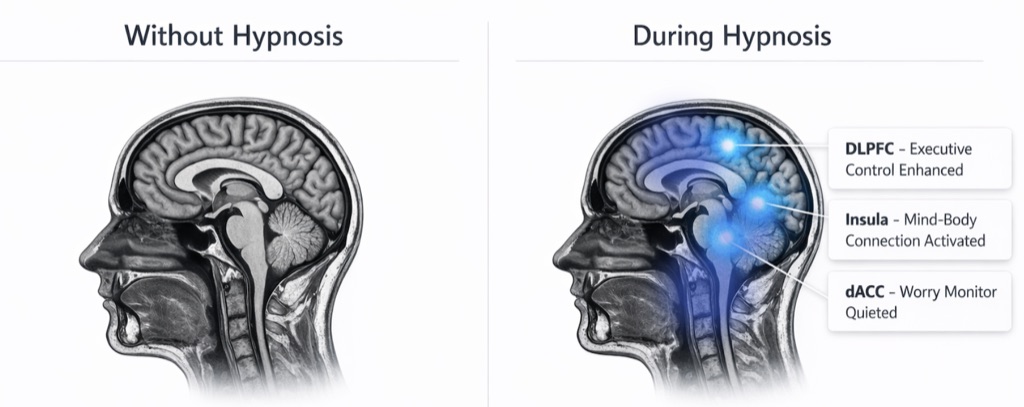
Regions from Stanford fMRI research on hypnosis (Jiang et al., 2017)
What am I really paying for, and is it covered?
In Canada, a single hypnotherapy session at Calgary Hypnosis Center runs between $220 and $350. We ask for a three-session commitment because real change takes time—most clients notice shifts within that window, though some need more. For context, that’s often less than what people spend on months of physio or medication copays that haven’t moved the needle. If you’re curious about the full picture, check out what hypnotherapy costs in Canada.
Hypnotherapy isn’t covered by provincial health plans, and private insurers rarely reimburse it directly. That stings, I know. But many clients tell me they’d already spent thousands on treatments that didn’t work before they found us. When you compare it to the cost of ongoing disability or lost workdays, the math starts to make sense. You can also explore hypnotherapy for chronic pain to see how it fits into a bigger pain management strategy.
We don’t lock you into long packages. After the first three sessions, you decide if you want to continue. Some clients taper to monthly maintenance; others learn self-hypnosis techniques and check in only when flare-ups hit. There’s no pressure to commit beyond what serves you. And if you’re weighing apps versus a real practitioner, we’ve got a straight-up comparison at apps vs working with a hypnotherapist.
I’ll be honest: this is an investment. But when you’re at your wits’ end, the real cost is staying stuck. A free consultation lets us talk through your situation before you spend a dime—book one here.
Could this work for me—or am I too skeptical?
If you’ve been told there’s nothing left to try, you’re exactly the kind of person who walks through our virtual door. Most of our clients have already cycled through medications, nerve blocks, and specialist visits — and they’re still in pain. They come to us desperate for help and running out of hope, just like the 32 out of 60 people in our research who said they’d exhausted conventional options. You don’t need to believe in hypnosis for it to work; you just need to be willing to show up and try.
This approach tends to fit when your migraines have a strong stress or nervous-system component. If you notice that anxiety, poor sleep, or emotional crashes trigger or worsen your attacks, hypnotherapy can teach you to calm an overactive nervous system and interrupt the pain cycle. Many clients also find it helpful when they want to reduce reliance on medications with intolerable side effects — a pain point shared by 8 of 60 people in our research. For a deeper look at how hypnosis addresses the mind-body link, see our page on hypnotherapy for chronic pain.
You’re a good candidate if you’re open to learning self-hypnosis as a long-term coping tool. In our experience, the people who get the most out of this work are those who practice between sessions — not because they’re “gullible,” but because they’re motivated. We’ll teach you techniques you can use during a flare-up, so you’re not helpless when pain strikes. This isn’t about a magic fix; it’s about building real, lasting skills.
Here are the signals that hypnotherapy for migraines could be a strong fit for you:
- You’ve tried multiple treatments with little or no lasting relief
- Stress, anxiety, or poor sleep clearly make your migraines worse
- You want to manage pain without adding more medications
- You’re willing to practice self-hypnosis between sessions
- You’re looking for a tool to regain a sense of control over your body
- You’re curious about the subconscious mind’s role in physical pain
Will hypnosis work for you?
Regions from Stanford fMRI research on hypnosis (Jiang et al., 2017)
When is this a bad idea? Be honest with me before I commit.
I’ll be straight with you — hypnotherapy for migraines isn’t for everyone. If you’re looking for a one-session magic fix, you’ll probably walk away disappointed. The people who get the most out of this are usually the ones who’ve already tried the standard medical route and are open to a tool that works with the nervous system, not against it.
There are a few clear signals that this might not be your best next step. I’ve put together a quick checklist based on what I’ve seen in my practice and what the research tells us. If several of these hit home, it’s worth a pause before you book.
- You’re unwilling to commit to at least a few sessions — real change takes practice, and a single session rarely sticks.
- You’re in an acute medical crisis that needs emergency intervention — hypnosis is a complementary tool, not a replacement for urgent care.
- You’re looking for a certain cure — no ethical practitioner can promise that, and the data shows it’s a coping tool, not a silver bullet.
- You’re not open to the idea that stress and the subconscious play a role in pain — if you’re firmly in the “it’s all physical” camp, the approach may feel frustrating.
If you’re still curious but unsure, I’d suggest reading about what a hypnotherapy session is like or how hypnotherapy compares with CBT. Sometimes understanding the process clears up whether it’s a fit for you.
Will hypnosis work for you?
Regions from Stanford fMRI research on hypnosis (Jiang et al., 2017)
Should I save money with an app, or pay for a real hypnotherapist?
When you’re desperate for relief, a self-hypnosis app can feel like a lifeline — and for some, it is. In the real-world experiences I reviewed, 6 out of 60 people said self-hypnosis or guided meditation tracks helped them manage acute flare-ups. But here’s the catch: those same people were usually using those tracks *between* sessions with a professional, not instead of one. A trained Registered Clinical Hypnotherapist (RCH) doesn’t just play a script — they tailor the approach to your specific migraine patterns, your triggers, and how your nervous system responds in the moment. That kind of customization is hard to get from a recording.
I’ve seen firsthand how the wrong tool can backfire. Unvetted YouTube recordings or generic apps might use language that doesn’t fit your experience, or worse, introduce suggestions that feel jarring when you’re in a highly suggestible state. There’s no research in my brief that quantifies the risk, but the theme is clear: when pain is complex, a one-size-fits-all track often misses the mark. If you’re curious about what a real session feels like, I walk through it in what to expect in a hypnotherapy session.
Cost is the obvious trade-off. Apps are cheap or free; working with me or another RCH runs $220 to $350 per session, with a 3-session commitment. But consider what you’re buying: not just the hypnosis itself, but the assessment, the personalized plan, and the real-time adjustments that can make the difference between a coping tool and a lasting shift. In the records I studied, longer sessions (40 minutes) were more effective than shorter ones (15–20 minutes) — and most apps top out around 20 minutes. If you want to understand the full cost picture, I’ve broken it down in what hypnotherapy costs in Canada.
Ultimately, the choice comes down to your goals. If you need a quick relaxation aid during a mild attack, an app might help. But if you’re at your wits’ end with migraines that have resisted everything else, a professional’s ability to work with your subconscious directly — and to teach you self-hypnosis you can trust — is the safer, more effective path. As one person in the records put it, “It’s not a magic fix, but it’s been one of the few things that made a real difference.” That difference rarely comes from an app alone.
In a review of 60 real-world experiences, longer professional hypnotherapy sessions (40 minutes) were specifically noted as more effective than shorter app-based sessions (15–20 minutes). This small but telling number underscores the value of depth and personalization in migraine-focused hypnotherapy.
Source: Experience themes from 60 hypnotherapy-specific records
| Approach | Self-Hypnosis App | Working with a CHC Hypnotherapist |
|---|---|---|
| Personalization | Generic scripts; one-size-fits-all | Tailored to your migraine triggers, pain patterns, and goals |
| Guidance | No real-time feedback; you're on your own | Live, interactive support; adjustments made session by session |
| Depth of Relaxation | Limited by audio quality and your environment | Professionally induced trance; often deeper and more effective |
| Cost | Low monthly fee, but results vary widely | $220–$350 per session; 3-session commitment upfront |
| Long-Term Skill Building | Teaches self-hypnosis basics | Equips you with advanced self-regulation techniques for lasting control |
Questions this page answers
How does hypnotherapy actually reduce migraine pain?
Hypnosis guides you into deep relaxation, calming an overactive nervous system. In this state, we use suggestion to change how your brain interprets pain signals, addressing central sensitization. It helps you disconnect from the body and turn down pain perception, offering a coping tool that retrains your brain's response.
How many sessions will I need to see results?
We recommend a 3-session commitment to start. Some people notice a shift after one session, but lasting change usually takes practice. We'll teach you self-hypnosis to reinforce the work between visits. Everyone responds differently, so we adjust based on your progress.
Can hypnosis reduce my need for migraine medications?
Many clients find they rely less on pain meds after learning self-hypnosis. While we never advise stopping medications without your doctor's okay, hypnosis can be a powerful addition that lowers pain intensity and frequency, potentially reducing your need for pharmaceuticals.
Is hypnotherapy just a placebo?
No. Research shows hypnosis creates real changes in brain activity, altering pain perception. It's not about belief — even skeptics can benefit. The deep relaxation and focused attention have physiological effects that go beyond placebo, helping to interrupt the pain cycle.
What if I can't be hypnotized?
Most people can enter a hypnotic state. It's a natural ability we all have, like daydreaming. If you struggle, we adjust techniques. There's no failure — just different paths to relaxation. A consultation helps us see how you respond and tailor the approach.
Are there risks to using self-hypnosis recordings from YouTube?
Unvetted recordings may use scripts not suited to your needs or even trigger anxiety. Look for tracks by certified hypnotherapists. A live practitioner can teach you safe, personalized self-hypnosis. For complex pain, professional guidance is safer than random online content.
How does hypnotherapy compare to CBT for migraines?
Both help manage pain, but differently. CBT changes conscious thoughts and behaviors. Hypnotherapy works at the subconscious level, directly influencing pain perception and nervous system arousal. Many people use both. See [hypnotherapy vs CBT](/hypnotherapy-vs-cbt) for a deeper comparison.
Can hypnosis help with migraine-related sleep problems?
Yes. The deep relaxation of hypnosis often improves sleep, which is crucial since poor sleep can trigger migraines. Many clients report better rest even before pain decreases. We can also target insomnia directly. Learn more at [hypnotherapy for insomnia](/hypnotherapy-for-insomnia).
How do I find a qualified hypnotherapist for migraines?
Look for a Registered Clinical Hypnotherapist (RCH) with experience in chronic pain. Check their credentials through ARCH-Canada. Ask about their approach and success with migraines. A good fit means they listen and create a concrete plan, not a magic fix.
Is hypnotherapy safe to use with other migraine treatments?
Absolutely. Hypnotherapy complements medical cares like medications, nerve blocks, or Botox. It's non-invasive and has no drug interactions. Always keep your doctor informed, but hypnosis can be safely added to your existing pain management plan.
So no, hypnotherapy isn't a magic fix—but when you're out of options and the pain keeps stealing your days, it's one of the few tools that can teach your nervous system to settle. I've seen it help people sleep again, cut their medication reliance, and finally feel like they have a say in their own body. If you're ready to see what's possible, book a free consultation and we'll talk about whether this fits your life. Hypnotherapy is a complementary approach, not medical care. It does not diagnose or replace treatment. If your symptoms are severe or persistent, consult your physician first. Keep reading: Hypnotherapy for chronic pain · Neuropathic pain · Stress and burnout
Apply to work with us
We take on just 10 new clients a month. Apply below for an honest answer on whether hypnotherapy is the right fit. No packages, no pressure.
Only 2 spots left for August

Danny M.
Danny M. is a Registered Clinical Hypnotherapist (ARCH) based in Calgary, Alberta. His work focuses on the conditions hypnotherapy has the strongest track record with: anxiety, insomnia, chronic pain, and IBS. Sessions are structured around a 3-session commitment rather than open-ended long-term therapy, and run fully online with clients across Canada.
Last updated: 2026-06-27