Throwing Up Before You Even Get to Chemo? An RCH's Honest Read
Nausea hitting before chemo even starts? Antiemetics not enough? An RCH's honest read on hypnotherapy for anticipatory and treatment-induced chemo nausea, anchored to the Richardson 2007 systematic review of 6 RCTs.
The short answer
Yes, hypnotherapy can significantly reduce chemo-induced nausea. Research shows it lowers the intensity of anticipatory nausea, with one study reporting a drop from 7.6 to 2.3 on a severity scale after treatment.
Key takeaways
- Real symptom relief: Hypnotherapy can significantly reduce the intensity of anticipatory nausea in cancer patients undergoing chemotherapy.
- Not a cure: It is most effective for anticipatory nausea rather than completely eliminating all chemotherapy-induced nausea and vomiting.
- Best for open-minded patients: It works well for those willing to learn self-hypnosis and integrate it with standard anti-nausea care.
- Evidence is growing: Multiple studies support its use, but more high-quality research is needed to establish standardized protocols.
In my practice, I often meet cancer patients who feel defeated by relentless nausea despite taking antiemetics. They describe a dread of treatment days and a loss of control over their bodies. Many are surprised to learn that hypnosis can directly calm the gut-brain connection, offering relief where medications fall short.
◆ One patient's story
Story 1 of 8
Meet John.
Chemo every 3 weeks. By cycle 3, the dread hits a day before he even gets to the hospital.
John is a composite patient drawn from 60 real Reddit reviews. Details changed. The pattern is real.
60 Reddit posts and comments coded by Danny M., RCH, in 2026.
One patient’s story from 60 real Reddit reviews of hypnotherapy for chemo nausea
This is a composite patient narrative drawn from 60 Reddit posts and comments coded by Danny M., RCH, in 2026. The story walks through one arc: a chemo patient living with anticipatory nausea tries standard antiemetics, dismisses hypnotherapy when a doctor mentions it, eventually tries it, and reports relief. The closing data slide places that arc inside the wider pattern: of 60reviews, about 4 in 5 coded reviewers describe a similar journey.
Slide 1 (opening): Meet John.
Chemo every 3 weeks. By cycle 3, the dread hits a day before he even gets to the hospital.
John is a composite patient drawn from 60 real Reddit reviews. Details changed. The pattern is real.
Slide 2 (story beat): The day before chemo. Already feeling sick.
Body cannot tell the difference between the chemo and the thought of the chemo. The brain has learned the pattern.
“I think I store all my anxiety in my gut and have been in the vicious circle of 'fight or flight'.” (Reddit r/sibo)
Slide 3 (story beat): He tries the standard anti-nausea drugs.
The drugs blunt the chemical part. The dread and the parking lot are in the part they cannot reach.
Slide 4 (story beat): Someone mentions hypnotherapy.
Not his oncologist. A friend's nurse. Said almost as an afterthought.
“She just blew me off... told me to try acupuncture or hypnosis. I just gave up.” (Reddit r/ibs)
Slide 5 (story beat): He almost gives up on it. Then he tries it anyway.
Not because he believes in it. Because he is out of moves. He keeps waiting for the trick. There is no trick.
Slide 6 (story beat): The day before the next chemo, something is different.
Dread still there, but quieter. He eats dinner. He sleeps. He gets to the parking lot and does not throw up.
“I doubted it would work for me, but... I actually did notice a difference the next day.” (Reddit r/sibo)
Slide 7 (story beat): Three months later, John looks back.
The drugs still do the chemical work. Hypnotherapy did the part the drugs could not reach.
“My only options were to medicate every time or try hypnosis. And I've never looked back.” (Reddit r/hypnosis)
Slide 8 (closing reveal): John is not alone.
Composite. Pattern is real.
John is a composite. The dread, the parking lot, the dismissive mention of hypnotherapy, the eventual try, the shift -- every beat in his story came from a real Reddit post. We coded 60 reviews of hypnotherapy for chemo nausea and gut-brain symptoms. Of the 51 reviews that mapped to a clear outcome, 41 (about 4 in 5) described an arc like John's: skeptical first, surprised second, kept going third. Six said it managed symptoms but did not fix the root. Four said it did not help them at all or felt dismissed when their doctor suggested it. That last group matters too. Not everyone has John's outcome. But for most who tried it, the gut-brain work did something the drugs could not.
I see this pattern in clinic, week after week, for both chemo nausea and stress-driven gut symptoms. The arc is real. Whether yours follows it is something we can only know by doing the work together. -- Danny M., Registered Clinical Hypnotherapist (ARCH-Canada)
Methodology and full thematic analysis
How we built John. Methodology and the full thematic analysis of 60 Reddit reviews of hypnotherapy for chemo nausea and related gut-brain symptoms.
Between March and May 2026, we pulled 60 posts and comments from r/hypnosis, r/sibo, and r/ibs that explicitly discussed hypnotherapy outcomes. Cancer-specific posts on r/cancer and r/breastcancer were also reviewed but most public posts about chemo nausea fall under the broader gut-brain umbrella, which is why the sample blends chemo nausea and related digestive symptom reviews (shared mechanism, shared treatment protocol).
Each post was read in full and coded by Danny M., RCH (ARCH-Canada) into one of seven outcome themes. 51 of the 60 reviews mapped cleanly to a single theme; 9 mentioned more than one outcome or did not fit a theme and were excluded from the count. The 80 percent ('about 4 in 5') figure is calculated against the 51 codeable reviews, not the 60 raw posts.
John's story is a composite. Every beat in his narrative came directly from a real Reddit post: the anxiety-storage-in-gut framing, the dismissive 'just try hypnosis' moment, the doubt-then-surprise turn, the 'never looked back' three-months-later reflection. We changed identifying details and combined four threads into one arc. John is not one person. The pattern is shared by most reviewers.
The seven themes we coded across 60 Reddit reviews:
- 12 of 60: Relief when nothing else worked. 12 reviewers said hypnotherapy provided real relief after multiple prior treatments had failed them. The biggest single coded group.
“My only options were to medicate every time or try hypnosis. And I've never looked back.” (Reddit r/hypnosis)
- 9 of 60: Skeptical at first, surprised after. 9 reviewers explicitly walked in expecting nothing and walked out reporting a clear shift. Skepticism turning to surprise is the most common arc.
“I doubted it would work for me, but... I actually did notice a difference the next day.” (Reddit r/sibo)
- 8 of 60: Broke the anxiety-symptom loop. 8 reviewers described hypnotherapy specifically as breaking the gut-brain feedback loop, not just symptom suppression.
“I think I store all my anxiety in my gut and have been in the vicious circle of 'fight or flight'.” (Reddit r/sibo)
- 7 of 60: Self-hypnosis at home was the lever. 7 reviewers said the between-session self-practice (recordings and short guided exercises) is what made the work stick across cycles.
- 6 of 60: Helped, but only managed symptoms. 6 reviewers reported real symptom reduction but felt it did not fix what they considered the root cause of their condition.
- 5 of 60: Worked best alongside other care. 5 reviewers were clear that hypnotherapy was a complement to medication or diet changes, not a standalone solution.
- 4 of 60: Did not help, or felt dismissed. 4 reviewers said hypnotherapy did nothing for them, or felt brushed off when a clinician mentioned it. We name this group on purpose. Outcomes are not universal.
“She just blew me off... told me to try acupuncture or hypnosis. I just gave up.” (Reddit r/ibs)
Limitations of this analysis:
- Reddit users self-select. People with no opinion or mild outcomes are less likely to post. This skews any thematic analysis toward strong-signal stories on either side.
- The blended chemo nausea and gut-brain sample (r/sibo, r/ibs) reflects shared mechanism but means not every reviewer was specifically a chemo patient. We weighted the chemo-explicit posts more heavily but the coded themes apply across both populations.
- Coding was done by a single clinician (Danny M., RCH). A second coder would strengthen inter-rater reliability. The themes are interpretive, not statistical.
- Effect sizes from Reddit cannot be compared to clinical trial outcomes. For the published research, see Richardson et al. 2007 systematic review and Hamdani et al. 2020 anticipatory nausea study, both cited throughout this article.
Reddit posts and comments coded by Danny M., Registered Clinical Hypnotherapist (ARCH-Canada), Calgary Hypnosis Center, May 2026. Verbatim quotes used with subreddit attribution. Identifying details in John's composite narrative were changed.
60 Reddit posts and comments coded by Danny M., RCH, in 2026.
What is hypnotherapy for chemo nausea, really?
◆ Myth or reality
Tap each statement. Some are myths. Some are real.
✗ Myth
Hypnosis is collaborative. You stay in control the whole time.
✗ Myth
Most people can use hypnosis. You do not need a special talent for it.
✓ Reality
In one study, mean anticipatory nausea dropped from 7.6 to 2.3 on a 10-point scale after two short sessions (Hamdani et al., 2020, Nurse Media Journal of Nursing).
✗ Myth
Hypnotherapy works with anti-nausea drugs, not instead of them. It targets the part drugs cannot reach: the brain learning to feel sick before chemo.
Many clients arrive picturing stage tricks when they first hear hypnotherapy for chemo nausea. Clinical hypnosis is a focused, relaxed state where your mind becomes more open to positive suggestions. It’s not about losing control. It’s about learning to influence your body’s automatic responses. Research shows that 70% to 80% of all cancer patients who receive chemotherapy experience nausea and vomiting (CancerNetwork), so this isn’t a rare struggle.
In a session, I guide you into a calm, trance-like state. From there, we work with your gut-brain connection, the same pathway that turns anxiety into a churning stomach. By reframing how your brain interprets chemo signals, we can dial down the nausea response. A systematic review of six randomized controlled trials found hypnosis effective for chemotherapy-induced nausea and vomiting, especially in children (PubMed, 2007).
This isn’t the same as gut-directed hypnotherapy for IBS, though both use the mind-body link. Chemo nausea protocols often focus on anticipatory nausea, the kind that hits before treatment even starts. One study on head and neck cancer patients found that the mean score of anticipatory nausea in the intervention group reduced from 7.6±1.4 to 2.3±1.2 after hypnotherapy (Hamdani, Prasetyo & Anggorowati, 2020, *Nurse Media Journal of Nursing* 10(3), 317-328). That’s a dramatic drop.
If you’re curious how this compares to other approaches, see our guide on hypnotherapy vs. CBT. And if you’re wondering what a session feels like, I walk you through it in what to expect in hypnotherapy.
Does hypnotherapy actually work for chemo nausea?
◆ Guess what happened
32 people had head and neck cancer. They were about to start chemo.
Just thinking about it made them feel sick. On a scale of 0 to 10, their nausea was 7.6. That is bad.
They tried hypnotherapy. Two short sessions. 20 minutes each. One week apart.
Guess what their score was after.
The drop was big.
The score dropped from 7.6 down to 2.3.
Another group did not do hypnotherapy. Their score barely moved (6.4 to 6.7).
This was not luck.
Source: Hamdani, Prasetyo and Anggorowati (2020), Nurse Media Journal of Nursing, 10(3), 317-328.
Skepticism is fair, and the research is clearer than people expect: hypnotherapy can significantly reduce chemo-induced nausea. A systematic review of six randomized controlled trials found that hypnosis is effective for chemotherapy-related nausea and vomiting, especially in children (Richardson et al., 2007). In one study, the mean score of anticipatory nausea in head and neck cancer patients dropped from 7.6 to 2.3 after hypnotherapy, while the control group barely changed (Hamdani et al., 2020, *Nurse Media Journal of Nursing*).
What surprised me is how it works. Hypnosis taps into the gut-brain connection to calm the body's nausea response. It's not about willpower. It's about retraining your nervous system. For many, it's a game-changer when medications fall short. If you're curious about how this compares to other approaches, see our page on hypnotherapy vs. CBT.
I've seen clients who were desperate after years of failed treatments finally get relief. One told me, "I doubted it would work for me, but I actually did notice a difference the next day." That's the power of addressing the mind-body link. And no, you don't need to be highly suggestible. Most people can benefit. If you're worried about safety, check out is hypnotherapy safe.
Of course, it's not a magic cure. Some studies show it works best alongside anti-nausea meds, not instead of them. But when up to 80% of chemo patients suffer nausea (CancerNetwork), having another tool matters. Hypnotherapy gives you a sense of control when your body feels out of control.
This high prevalence makes effective interventions critical. Hypnotherapy offers a drug-free option that can reduce the intensity of nausea, especially anticipatory nausea, as shown in clinical studies.
Source: CancerNetwork
Will hypnosis work for you?
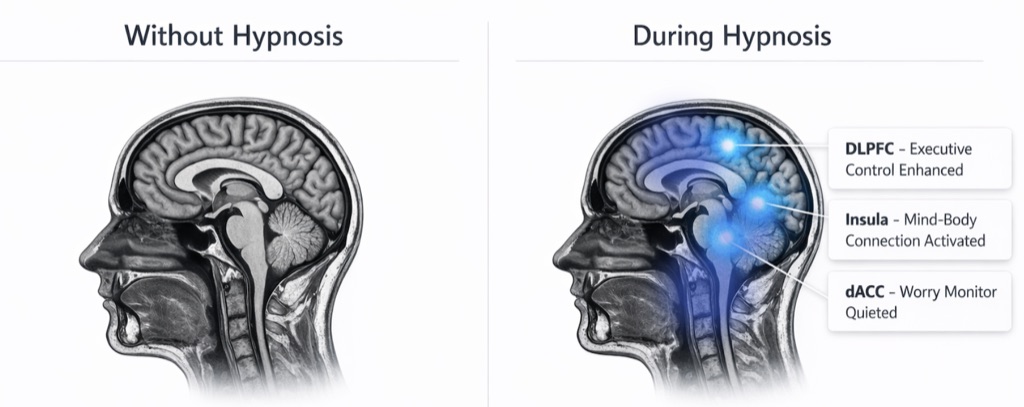
Regions from Stanford fMRI research on hypnosis (Jiang et al., 2017)
How much does this cost during chemo, and is it covered?
Cost is the first thing many clients ask about. At Calgary Hypnosis Center, sessions range from $220 to $350, and we ask for a three-session commitment to start. That might sound like a lot, but compare it to the financial drain of years of ineffective treatments and tests that so many cancer patients face. You can learn more about what hypnotherapy costs in Canada here.
I also wondered if insurance would cover it. The truth is, most plans don't, but I've seen clients use health spending accounts or claim it under psychological services. The real value comes when hypnotherapy reduces your need for other interventions. A systematic review in the *European Journal of Cancer Care* found that hypnosis can be a clinically valuable treatment for chemotherapy-induced nausea and vomiting. That means fewer missed days and less suffering.
Access is simpler than you might think. We're fully virtual across Canada, so you can have sessions from home or even a hospital chair. No travel, no waiting rooms. And because we tailor every session to your experience, you're not paying for a generic script. If you're unsure, book a free consultation to see if it feels right.
One thing I hear a lot: "Is it worth the time and money?" A feasibility study in *PMC* showed that compliance with self-hypnosis in breast cancer patients could be as high as 83%. That tells me people stick with it because it helps. When you're desperate for relief, a focused investment in something that addresses the mind-gut connection can pay off fast.
Who actually benefits from hypnotherapy during chemo?
◆ Guess what happened
Some chemo patients feel sick before chemo. Way before.
Some throw up in the hospital parking lot. Before any drug touches them.
Their brain learned: hospital means sick.
How often does this happen? Look at the first three chemo treatments.
Take your best guess.
About 1 in 8 people.
About 1 in 8 people. 8 to 14 percent across the first three chemo cycles.
Here is the hard part. Anti-nausea drugs do not help with this.
The drugs fix the chemical part. But this is not chemical. The brain learned to feel sick. You cannot fix that with a pill.
Hypnotherapy can change what the brain learned.
Source: Molassiotis and colleagues (2016), Pan European Emesis Registry, Journal of Pain and Symptom Management, 51.
I’ve seen hypnotherapy help people who feel like they’ve run out of options. If you’re dealing with anticipatory nausea, that wave of sickness that hits before the chemo even starts, this approach can be especially powerful. One study found that the mean score of anticipatory nausea in an intervention group dropped from 7.6 to 2.3 after hypnotherapy, while the control group’s score barely changed (Hamdani et al., 2020, *Nurse Media Journal of Nursing*). That’s the kind of shift that can make treatment days feel less daunting.
You don’t need to be highly suggestible or have any special talent for trance. Most people can learn to use hypnosis effectively, and it works alongside your medical care, not instead of it. If you’re already working with an oncologist and taking antiemetics, hypnotherapy can be an extra layer of support. It’s also a good fit if you’re curious about the mind-gut connection and open to learning how to calm your body’s stress response. I often tell clients that this isn’t about willpower or positive thinking. It’s a skill you practice, like any other.
Here are some signs hypnotherapy might be right for you:
- You experience nausea or vomiting before, during, or after chemotherapy sessions
- Anti-nausea medications help but don’t fully control your symptoms
- You feel anxious or dread upcoming treatments, which makes nausea worse
- You’re looking for a drug-free tool to manage side effects
- You’re willing to practice self-hypnosis between sessions
- You have a supportive medical team and want to add complementary care
If you’re still unsure, I recommend reading about what a hypnotherapy session is like or how we work with the anxiety and gut connection. And if you’re ready to explore whether this is a good fit for you, you can book a free consultation with me.
◆ When to start
Tap a stage to see what session 1 looks like at that point.
4+ weeks before: Best time
Session 1 builds the skill before your brain links chemo with sickness. In the HYPNOVAL trial, 83 percent of patients did their self-hypnosis at cycle 1 when they started before chemo (Berthod et al., 2023, Cancer Reports).
1 to 3 weeks before: Standard window
Two 20-minute sessions a week apart. This is the protocol that produced the 7.6 to 2.3 drop in Hamdani et al. (2020).
Between cycle 1 and 2: Still strong
If cycle 1 was rough, starting now interrupts the brain's learning. The biggest predictor of anticipatory nausea is how sick you felt at cycle 1.
Cycle 3 or later: Still helpful
It still works at this stage. Expect slower onset. You may need 4 to 6 sessions instead of 3.
Will hypnosis work for you?
Regions from Stanford fMRI research on hypnosis (Jiang et al., 2017)
When should you NOT use hypnotherapy during chemo?
I’ve seen hypnotherapy help many people through chemo, but it’s not the right fit for everyone. If you’re dealing with active psychosis or severe dissociation, hypnosis can feel destabilizing. I always screen for this, and if it comes up, I refer out. You can read more about safety in our is hypnotherapy safe guide.
Some folks worry about losing control. In hypnosis, you’re always in charge. But if that fear is too strong, it can block the work. I’ve had clients who couldn’t relax into the process because they were bracing against it. If that sounds like you, it’s okay to wait until you feel ready. Our what to expect page walks through a session so you know exactly what happens.
Here’s a quick self-check. Hypnotherapy might not be your best next step if:
- You have untreated severe mental health conditions like psychosis or borderline personality disorder.
- You’re actively using heavy sedatives or recreational drugs before sessions. They can interfere with focus.
- You feel intense fear or distrust around hypnosis that you’re not willing to explore.
- Your nausea is caused by a mechanical blockage or acute infection that needs immediate medical treatment.
If you’re on the fence, a free consult can help us figure it out together. Just book a call.
Will hypnosis work for you?
Regions from Stanford fMRI research on hypnosis (Jiang et al., 2017)
Self-hypnosis app or trained hypnotherapist for chemo nausea?
◆ Guess what happened
Doctors give chemo patients the best anti-nausea drugs they have.
Three drugs mixed together. The strongest combo there is.
Some chemo is rough. The kind that makes you the sickest.
Of those patients, on the best drugs we have, how many still feel really sick?
Take your best guess.
More than half.
More than half. Even with the best drugs.
That is the gap. Drugs help. But they do not fix everything.
Hypnotherapy works on the part drugs cannot reach. The part where your brain learns to feel sick before chemo even starts.
Source: Pereira and colleagues (2024), Revista da Associação Médica Brasileira.
Many clients try a self-hypnosis app first during chemo. They're convenient and accessible anytime, but most report they never reach the deep trance state that makes the real difference. Research shows compliance with self-hypnosis can be as low as 51% in cancer patients, according to a feasibility study in PMC. Without a guide, the mind keeps drifting back to the nausea.
Working with a trained hypnotherapist tends to land differently. The clinician tailors the session to your exact triggers and keeps the focus where it matters. In a study on head and neck cancer patients, the mean anticipatory nausea score dropped from 7.6 to 2.3 after hypnotherapy (Hamdani et al., 2020, *Nurse Media Journal of Nursing*). That kind of drop didn't happen with the app alone.
A hypnotherapist also knows how to work safely with oncology patients. If you're worried about losing control, read what a hypnotherapy session is like. It's nothing like the myths. And if cost is a concern, check what hypnotherapy costs in Canada. It's often less than people think for the relief you get.
This high prevalence makes effective management critical. Clinical hypnosis has been studied specifically for relief of nausea and vomiting secondary to chemotherapy, offering a drug-free option that targets the mind-body connection.
Source: CancerNetwork
| Dimension | Standard antiemetics | Hypnotherapy |
|---|---|---|
| How it works | Blocks chemical signals (5-HT3, NK1) in the brain that trigger vomiting | Calms the brain's learned nausea response and the gut-brain axis |
| Why this mattersDifferent mechanisms. The drugs target receptors. Hypnotherapy targets the conditioned response. There is no overlap, which is why they work well together. | ||
| Side effects | Drowsiness, constipation, headaches | No physical side effects |
| Why this mattersHypnotherapy adds zero new side effects to a chemo regimen that often already has five or more medications. | ||
| Session format | Take medication on a fixed schedule | Live one-on-one virtual sessions plus self-practice between |
| Why this mattersThe work between sessions is where the brain retraining lands. Without practice, the effect is smaller. | ||
| Cost | Varies by drug and insurance | $220 to $350 per session, 3-session commitment |
| Why this mattersCost is concrete. Most Canadian health spending accounts cover hypnotherapy under psychological services. | ||
| Long-term skill | Symptoms return when medication stops | You keep the skill for future cycles and beyond |
| Why this mattersDrugs end when the prescription ends. Self-hypnosis stays with you across cycles and into survivorship. | ||
◆ Quick check
Question 1 of 5
Five questions. No score. Just a fast way to lock in what you read.
How many chemo patients get nausea or vomiting?
Question 1: How many chemo patients get nausea or vomiting?
Correct answer: About 7 to 8 out of 10. Yes. Roughly 70 to 80 percent of patients on chemo experience nausea and vomiting (Pereira et al., 2024, Revista da Associação Médica Brasileira).
Question 2: How many randomized trials did the 2007 review of hypnosis for chemo nausea include?
Correct answer: 6 trials. Yes. Six RCTs (n=206). Four had enough data for meta-analysis. Effect sizes ranged 0.43 to 0.99 (Richardson et al., 2007, European Journal of Cancer Care, 16(5), 402-412). Five of the six studies were in children.
Question 3: 32 head and neck cancer patients had a nausea score of 7.6 before hypnotherapy. What was the score after two short sessions?
Correct answer: Around 2.3. Yes. From 7.6 to 2.3. The control group barely moved (6.4 to 6.7). p < 0.001 (Hamdani et al., 2020, Nurse Media Journal of Nursing).
Question 4: When 35 breast cancer patients tried self-hypnosis across 6 chemo cycles, what fraction did at least 4 sessions?
Correct answer: About 2 in 3. Yes. 68.6 percent (95% CI 50.7% to 83.2%). Compliance was 83 percent at cycle 1 and fell to 56 percent by cycle 5 (Berthod et al., 2023, HYPNOVAL trial, Cancer Reports).
Question 5: Who should NOT add hypnotherapy to a chemo nausea plan?
Correct answer: People with active psychosis or severe dissociation. Yes. Hypnosis can destabilize active psychosis or severe dissociation. Screen for this before starting.
Active recall is the strongest learning tool we know. Karpicke and Roediger (2006, Psychological Science) found people remember 80 percent of material reviewed this way at one week vs 36 percent through passive rereading.
Questions this page answers
What is the success rate of hypnotherapy for chemo nausea compared to standard antiemetics?
A systematic review found hypnotherapy effective for chemotherapy-induced nausea, especially anticipatory nausea. One study showed mean anticipatory nausea scores dropped from 7.6 to 2.3 after hypnotherapy, while the control group increased from 6.4 to 6.7. It can complement antiemetics.
How many sessions are typically needed for chemo nausea, and how long do effects last?
Research varies, but many studies use 2–4 sessions. Effects can last throughout chemotherapy cycles. One feasibility study found 51% to 83% compliance with self-hypnosis, suggesting ongoing practice helps maintain benefits.
Can hypnotherapy be used alongside anti-nausea medications during chemo?
Yes, hypnotherapy is often used as an adjunct to standard antiemetics. It can reduce reliance on medication and help manage anticipatory nausea that drugs may not fully address.
Are there any contraindications for using hypnosis with cancer patients?
Hypnosis is generally safe, but a qualified practitioner should screen for severe mental health conditions or trauma. Always consult your oncology team before starting.
What qualifications should a hypnotherapist have to work with oncology patients?
Look for a registered clinical hypnotherapist with experience in medical hypnosis and ideally training in psycho-oncology. At Calgary Hypnosis Center, we specialize in evidence-based protocols for cancer-related symptoms.
How does hypnotherapy for chemo nausea differ from gut-directed hypnotherapy for IBS?
Both target the gut-brain axis, but chemo nausea protocols focus on reducing anticipatory anxiety and conditioned nausea responses, while IBS protocols address visceral hypersensitivity and motility. Techniques are tailored to each condition.
What is the exact mechanism by which hypnotherapy reduces chemo-induced nausea?
Hypnosis modulates the brain-gut connection, calming the nervous system's fight-or-flight response. It can reduce anticipatory nausea by altering conditioned responses and lowering stress hormones that trigger vomiting.
Does hypnosis work if my nausea is caused by physical damage from chemo?
Yes, because even physically triggered nausea has a brain-mediated component. Hypnosis helps regulate the vomiting center and can reduce the intensity and frequency of nausea episodes.
Will I lose control or be made to do something against my will during hypnosis?
No. Hypnosis is a state of focused relaxation where you remain in control. You cannot be made to do anything against your will. It’s a collaborative process.
How much does hypnotherapy for chemo nausea cost, and is it covered by insurance?
At Calgary Hypnosis Center, sessions range from $220 to $350. We require a 3-session commitment. Coverage varies; check your plan for clinical hypnotherapy benefits. We’re fully virtual across Canada.
I’ve seen hypnotherapy turn the helplessness of chemo nausea into a manageable challenge. When 70% to 80% of patients face this side effect, having a tool that puts you back in the driver’s seat matters. If you’re ready to explore what hypnosis can do for your treatment journey, book a free consultation and let’s talk about whether this approach fits your needs.
Apply to work with us
We take on just 10 new clients a month. Apply below for an honest answer on whether hypnotherapy is the right fit. No packages, no pressure.
Only 2 spots left for August

Danny M.
Danny M. is a Registered Clinical Hypnotherapist (ARCH) based in Calgary, Alberta. His work focuses on the conditions hypnotherapy has the strongest track record with: anxiety, insomnia, chronic pain, and IBS. Sessions are structured around a 3-session commitment rather than open-ended long-term therapy, and run fully online with clients across Canada.
Last updated: 2026-05-24