Hypnosis is often misunderstood, largely due to its portrayal in movies and on stage. While stage hypnosis is designed for entertainment, clinical hypnotherapy is a therapeutic tool used in a professional setting. Let's explore the profound differences.
What is Stage Hypnosis?
Stage hypnosis is a form of entertainment where a hypnotist performs in front of an audience, inviting volunteers to participate in various comical acts while ostensibly in a hypnotic state. The primary goal is amusement and spectacle, not personal change or therapy. Participants are often chosen for their willingness to be outgoing and their suggestibility, making for an engaging show.

What is Clinical Hypnotherapy?
Clinical hypnotherapy, on the other hand, is a recognized therapeutic practice employed by trained and certified professionals. It involves guiding a client into a relaxed, focused state of consciousness (trance) to help them address specific issues, modify behaviors, or achieve personal goals. This is a collaborative process, focused entirely on the client's well-being. To understand more about the therapeutic application, consider reading our post on what is hypnotherapy.
of the more dramatic behaviours in stage hypnosis are driven by social compliance and audience expectation alongside genuine hypnotic responsiveness, not by mind control.
Source: Heap and Aravind (2002), Hartland's Medical and Dental Hypnosis (4th ed.), pp. 380-393.
Key Differences: Intent, Environment, and Ethics
The fundamental distinction lies in intent. Stage hypnosis aims to entertain, often by encouraging participants to act in amusing ways. Clinical hypnotherapy aims for therapeutic outcomes, using hypnosis as a tool for personal growth and healing.
The environment also differs significantly. Stage hypnosis takes place in public, with an emphasis on performance. Clinical hypnotherapy occurs in a private, confidential setting, ensuring a safe space for the client. Ethical guidelines strictly govern clinical practice, focusing on client autonomy and avoiding any form of manipulation or exploitation. A qualified hypnotherapist adheres to these standards rigorously.

Side-by-side comparison
A practitioner's shorthand on the six dimensions people most often ask about.
| Dimension | Stage hypnosis | Clinical hypnotherapy |
|---|---|---|
| Purpose | Entertainment, spectacle | Therapeutic change, symptom relief |
| Setting | Public stage, audience present | Private 1:1 session, confidential |
| Participant selection | Self-selected highly suggestible volunteers | Anyone willing; clinician adapts to your suggestibility |
| Practitioner training | Performance craft, no clinical training required | Clinical training, credentialing, supervised practice |
| Cost | Ticket price; one-off entertainment | $220 to $350 per session; 3-session starter commitment at CHC |
| Ethical standards | Entertainment-industry norms | Informed consent, scope of practice, professional ethics |
Common Misconceptions About Hypnosis
Many people believe that under hypnosis, you are asleep or unconscious. This is false. Hypnosis is a state of focused attention, similar to deep meditation or being completely absorbed in a book or movie. You are fully aware and can recall what happened during the session. Another misconception is that you can get "stuck" in hypnosis. This is impossible. Hypnosis is a natural state, and you can emerge from it whenever you choose.

of people can experience some degree of hypnotic responsiveness on standardized scales, with roughly 10 to 15% in the highly hypnotizable range, ~30% moderate, and the rest weak.
Source: Woody and Barnier, Oxford Handbook of Hypnosis (2008), Ch. 8 on individual differences.
Wondering if hypnosis would even work on you?
Take the free 60-second hypnotizability quiz and get your personalized results.
Take the Free Quiz →When clinical hypnotherapy is not the right fit
Honest scoping matters. Clinical hypnotherapy is not the right tool if any of the following apply.
- You are in active psychosis or recently hospitalized for severe mental illness. Hypnosis is contraindicated until you are stable and your treating physician clears adjunctive work.
- You have a history of dissociative identity disorder or severe dissociation. A trauma-trained specialist should lead, not a generalist clinical hypnotherapist.
- You are coming for memory recovery. Hypnosis is not a reliable tool for recovering forgotten events; the false-memory risk is real.
- You are being pressured by someone else to attend. Hypnosis only works when you are choosing it for yourself.
- You expect a one-session cure for a multi-year problem. Most clinical work needs 3 to 8 sessions, depending on complexity.
Ready for Real Change?
Discover how clinical hypnotherapy can help you achieve your personal goals in a safe, supportive environment.
Learn About Our Approach →Choosing the Right Path for You
If you're seeking entertainment, a stage hypnosis show can be a fun experience. However, if you're looking for personal development, overcoming challenges, or improving your well-being, clinical hypnotherapy is the appropriate choice. Always ensure your hypnotherapist is qualified, certified, and operates ethically. For those interested in specific therapeutic applications, such as quitting smoking, our article on hypnotherapy for smoking cessation provides more insight.

The Science Behind Clinical Hypnotherapy
Modern clinical hypnotherapy is backed by neuroscience research, showing measurable changes in brain activity during hypnotic states. It's used to manage pain, reduce anxiety, overcome phobias, and improve habits by accessing the subconscious mind's capacity for change. The efficacy of clinical hypnosis is increasingly recognized in complementary medicine.

We believe in the power of clinical hypnotherapy. If after 3 sessions you don't feel a genuine shift, we stop. No pressure. No upsell.
Explore Our Approach →Investment & Options
Choose the path that fits your needs
Cost Per Session Comparison
~$300/session for 6 personalized sessions
- 6-8 personalized sessions
- Custom to your triggers
- Direct support throughout
Best for complex cases or trauma-related eating
ApplyJust $37/session — same content, 10x less cost
- 6 full sessions (same content as 1:1)
- Self-paced, repeat anytime
- Lifetime access forever
30-day satisfaction guarantee. Not for you? Full refund.
$350 for one 45-min session
- One 45-min session
- No program structure
Just want to see what it's like
Inquire via EmailWill hypnosis work for you?
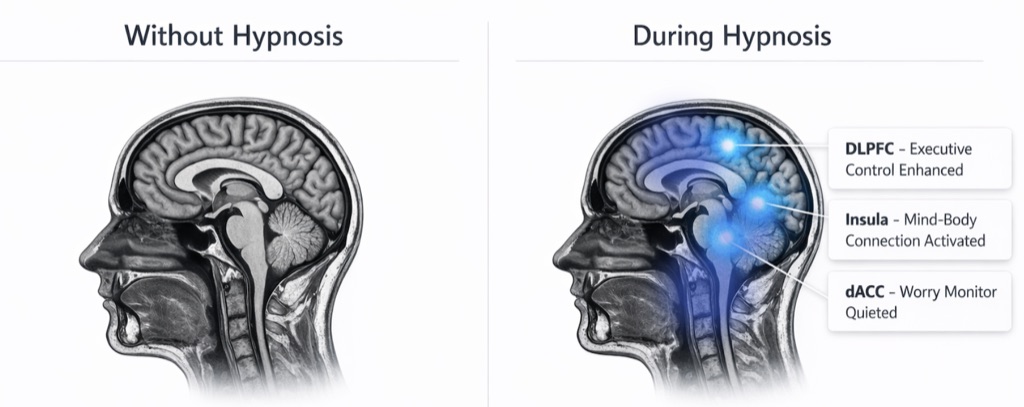
Regions from Stanford fMRI research on hypnosis (Jiang et al., 2017)
Currently accepting 4 new weight loss clients per month
Next available: August 11th
Ready to Transform Your Life?
- Personalized, confidential sessions
- Address root causes of challenges
- Achieve lasting behavioral changes
- Guided by certified hypnotherapists
📅 Limited slots available. Schedule today to secure your transformation.
FAQ
Is stage hypnosis real?
Stage hypnosis involves genuine hypnotic principles, but its primary purpose is entertainment. Volunteers are often highly suggestible and willing to participate, creating a dynamic show. It's a demonstration of hypnotic phenomena within a theatrical context, not a therapeutic intervention.
Can I be made to do something I don't want to in hypnotherapy?
No, in clinical hypnotherapy, you remain in control and aware throughout the session. A hypnotherapist cannot make you do anything against your will, values, or moral code. It's a collaborative process where you guide the changes you wish to make.
How does clinical hypnotherapy actually work?
Clinical hypnotherapy works by guiding you into a deeply relaxed, focused state, often called a trance. In this state, your subconscious mind becomes more receptive to positive suggestions and insights. This allows for the exploration and reframing of thoughts, feelings, and behaviors, leading to desired changes.
How many sessions does clinical hypnotherapy take?
Most clients see meaningful change in 3 to 6 sessions for issues like phobias, stress, and habit change. Chronic conditions such as IBS or chronic pain typically need 8 to 12 sessions. At Calgary Hypnosis Center we ask for a 3-session starter commitment so you can confirm fit before going further.
What does clinical hypnotherapy cost?
At Calgary Hypnosis Center, sessions are $220 to $350 per session depending on complexity, with a 3-session starter commitment. Sessions are fully virtual across Canada. There are no long packages or lock-ins.
Can clinical hypnotherapy combine with medication or other therapies?
Yes. Clinical hypnotherapy is regularly used alongside cognitive behavioural therapy, medication, and primary medical care. It is positioned as a complementary tool, not a replacement for medical treatment.
Wondering if hypnosis would even work on you?
Take the free 60-second hypnotizability quiz and get your personalized results.
Take the Free Quiz →Keep Reading
- How Does Hypnotherapy Work? The Science Behind Clinical Hypnosis
- Finding a Qualified Hypnotherapist in Calgary
- Hypnotherapy for Alcohol Addiction
- Hypnotherapy for Fibromyalgia Pain
Written by Danny M., Registered Clinical Hypnotherapist (ARCH-Canada). Hypnotherapy is not a regulated health profession in Alberta. This article is informational and does not substitute for medical or psychological advice. If you are in crisis, contact your physician or emergency services.