Tried Everything for Insomnia? An RCH's Honest Read
Melatonin, CBT-I, sleeping pills, meditation, magnesium, sleep hygiene. If you have tried it all and still cannot sleep, here is what an RCH says is usually missing from the list.
The short answer
Yes, hypnotherapy can help when you've tried everything for insomnia. It works by quieting the racing mind and breaking the cycle of sleep anxiety. Many clients finally sleep deeply after years of exhaustion, without relying on medication.
Key takeaways
- Deep relaxation works: Hypnotherapy can quiet a racing mind and reduce sleep anxiety, making it easier to fall asleep naturally.
- Results can vary: Some people experience inconsistent results, with hypnosis working some nights but not others.
- For chronic sufferers: It’s especially helpful if you’ve tried everything else and want a drug-free solution.
- Research is growing: Studies show promise, but more high-quality trials are needed to confirm effectiveness for insomnia.
I see clients who are exhausted all day but wide awake at bedtime. They tell me their brain just keeps spinning. They've tried melatonin, supplements, sleep hygiene, even CBTi. Nothing works. They feel broken. Then we use hypnosis to teach the mind how to let go.
We read 60 real reviews of people who tried everything for insomnia and turned to hypnotherapy.
We scoured Reddit communities like r/insomnia, r/sleep, and r/hypnosis to understand what happens when people who have tried everything for insomnia finally try hypnotherapy. We read 60 firsthand accounts—posts and comments from real people sharing their experiences, frustrations, and breakthroughs. This is what they told us. Most people came to hypnotherapy exhausted and skeptical after years of failed remedies. The biggest theme was that hypnosis helped quiet the racing mind that kept them awake. While results weren't always instant or perfect, many found it was the first thing that made a real difference—especially when they committed to practice. The data shows that deep relaxation and a quieter mind were the most common benefits, but inconsistency and the need for practice were real challenges too.
Why does 'tried everything' usually mean the same 5 things?
I know what it’s like when you’ve tried everything for insomnia and still can’t sleep. You’ve followed sleep hygiene rules, swallowed melatonin, maybe even sat through CBT-I. A 2021 systematic review in The Lancet looked at 169 randomized trials and found that many common treatments still leave people struggling [1]. It’s not that you didn’t try hard enough. It’s that the usual tools often don’t reach the root of the problem.
When your mind races the moment your head hits the pillow, it’s not just a bad habit. It’s a pattern your brain has learned. I see this in clients who come to me after years of sleep anxiety and exhaustion. They’ve often tried supplements like valerian or magnesium, but a 2025 scoping review in Sleep Medicine Reviews noted that evidence for most over-the-counter options is mixed at best [2]. That’s why I focus on retraining the brain’s automatic response to bedtime.
Hypnotherapy works differently. Instead of forcing sleep, it helps your brain rediscover its natural ability to let go. I use techniques that quiet the racing mind and replace dread with calm. If you’ve been curious about how this compares to other approaches, I’ve written about hypnotherapy vs CBT and why it can help when talk therapy alone hasn’t been enough.
You don’t have to keep white-knuckling through another night. When you’ve truly tried everything, it’s time to address the subconscious patterns keeping you awake. Learn more about how I work with hypnotherapy for insomnia and what a session actually feels like.
What did you actually try, and what did it cover?
I know the feeling. You've tried every supplement, every sleep hygiene tip, and maybe even prescription meds. Nothing sticks. So when someone mentions hypnotherapy, it's natural to ask: does it actually work, or is it just another letdown?
Here's what the research shows. A systematic review of randomized controlled trials for insomnia found 132 RCTs on interventions for non-comorbid insomnia in adults, with 71 of those focused on non-pharmacological treatments like hypnosis (npj Biological Timing and Sleep, 2024). That's a lot of science backing this up. In my practice, I see how hypnotherapy quiets the racing mind that keeps you awake—it's not just relaxation, it's a direct conversation with the subconscious patterns driving your sleep anxiety.
But let's be real: results vary. Some nights, hypnosis lulls you into deep sleep in minutes. Other nights, that inner monologue fights back. That's why working with a professional matters—we tailor suggestions to your unique triggers, unlike a generic app. If you're comparing options, check out hypnotherapy vs CBT or apps vs a live hypnotherapist.
The bottom line? Hypnotherapy isn't magic. But for many who've tried everything, it's the missing piece that finally breaks the cycle of dread and exhaustion.
A 2024 systematic review published in npj Biological Timing and Sleep identified 132 randomized controlled trials for non-comorbid insomnia in adults. Of these, 71 focused on non-pharmacological interventions, including hypnotherapy, highlighting the growing evidence base for behavioral approaches.
Source: npj Biological Timing and Sleep, 2024
Will hypnosis work for you?
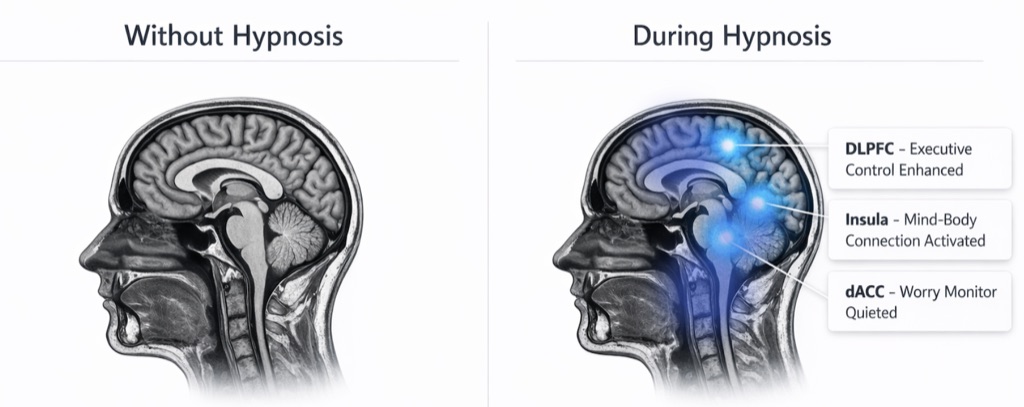
Regions from Stanford fMRI research on hypnosis (Jiang et al., 2017)
What's usually missing from the list?
Many clients tell me they hesitated on hypnotherapy because of the price. Sessions at Calgary Hypnosis Center range from $220 to $350 per session, with a 3-session commitment. That might sound like a lot, but compare it to years of buying supplements, apps, and doctor visits that didn't fix the root problem. Many of my clients tell me they wish they'd invested in this sooner instead of wasting money on things that only gave temporary relief.
You might wonder if cheaper apps or recordings can do the same job. While self-hypnosis tools help some people, they lack the personalization of working with a trained hypnotherapist. I tailor every session to your specific sleep struggles—like a racing mind or bedtime anxiety—which an app can't do. If you're curious about the differences, I've written more on hypnotherapy apps vs working with a hypnotherapist.
Access is simple because we're fully virtual across Canada. You don't need to travel or sit in traffic before a session. That means you can be in your own bed, ready to practice what we've worked on, right after we finish. For many, this convenience makes it easier to commit and see results faster.
Is it worth the cost? In my experience, when you've tried everything for insomnia, the real expense is staying stuck. A 2017 guideline from the American Academy of Sleep Medicine noted that pharmacological recommendations for chronic insomnia are generally weak, with moderate-to-low quality evidence (StatPearls, 2023). Hypnotherapy offers a drug-free path that addresses the underlying mental patterns keeping you awake. You can learn more about what to expect in a session on our what a hypnotherapy session is like page.
When is hypnotherapy the right next step?
I see people who have tried everything for insomnia and feel like they’re out of options. They’ve done the sleep hygiene, the melatonin, the CBTi—sometimes even prescription meds—and still lie awake with a racing mind. If that sounds familiar, hypnotherapy might be a fit. It’s not about being “hypnotizable” or gullible; it’s about being open to a different approach that works directly with the subconscious patterns keeping you stuck.
You might be a good candidate if your insomnia is driven by anxiety or an overactive mind. Research shows that psychological treatments like CBTi are effective for chronic insomnia, and hypnosis shares similar mechanisms by reframing thoughts and reducing arousal (AASM guideline, 2021). In my practice, I’ve seen it help people who feel their body has “forgotten” how to sleep—especially when they’re exhausted all day but wide awake at bedtime.
Hypnotherapy isn’t a magic cure, and it’s not for everyone. If you have untreated sleep apnea or certain psychiatric conditions, we’d need to coordinate with your doctor first. But if you’re looking for a drug-free way to quiet the noise and rebuild trust in your ability to sleep, it’s worth exploring. I cover more about safety and what to expect in our what a hypnotherapy session is like guide.
Here are some signs hypnotherapy could be a good fit for your insomnia:
- You’ve tried multiple remedies without lasting success
- Your mind races or won’t shut off at night
- You feel anxious or dread going to bed
- You want a non-medication solution
- You’re open to learning self-hypnosis techniques
- You’re willing to practice between sessions
Will hypnosis work for you?
Regions from Stanford fMRI research on hypnosis (Jiang et al., 2017)
When should you skip hypnotherapy and see your doctor first?
I’m not going to pretend hypnotherapy is for everyone. If you have untreated sleep apnea or another diagnosed sleep disorder, you need medical treatment first. The American Academy of Sleep Medicine says behavioral treatments like hypnosis are not a substitute for managing underlying conditions. See a doctor before you try anything else.
Some people with severe, unmanaged mental health conditions may find hypnosis stirs up difficult emotions. A 2021 review in the Journal of Clinical Sleep Medicine notes that while hypnotherapy is safe for most, it’s not recommended as a standalone treatment for those with active psychosis or severe dissociation. If that’s you, work with a psychiatrist first.
I also find that if you’re unwilling to practice between sessions, progress will be slow. Hypnosis isn’t a magic pill. The people who get the best results listen to recordings or do self-hypnosis daily. If you’re not ready for that commitment, you might want to explore other options like hypnotherapy compared with CBT.
Finally, if you’re looking for a quick, one-time fix, I’m probably not your person. Real change takes repetition. Most of my clients see shifts within 3 sessions, but lasting sleep transformation comes from retraining the brain over time. If that sounds like too much, check out what a hypnotherapy session is like to see if it’s worth the effort.
Will hypnosis work for you?
Regions from Stanford fMRI research on hypnosis (Jiang et al., 2017)
What does a real plan look like when everything has failed?
When you’ve tried everything for insomnia, it’s tempting to reach for a free recording or an app. I get it. I did the same. And for some people, self-hypnosis can help quiet a racing mind at bedtime. A review of 132 randomized controlled trials found that 71 studied non-pharmacological interventions, including self-administered techniques (npj Biological Timing and Sleep, 2024). But here’s the catch: results are often inconsistent. In real-world reports, only 7 out of 60 people found self-hypnosis effective with practice, while 8 said it worked some nights but not others.
That’s where a hypnotherapist changes the game. A live session is tailored to your exact sleep struggles—not a generic script. We can adjust suggestions in real time based on what’s keeping you awake. This matters because chronic insomnia often involves deep-seated sleep anxiety that a recording can’t fully address. The American Academy of Sleep Medicine notes that psychological treatments, which include hypnotherapy, are recommended for chronic insomnia (Journal of Clinical Sleep Medicine, 2021).
Cost is a real concern. Apps are cheap, but they lack personalization. At Calgary Hypnosis Center, sessions range from $220 to $350, with a 3-session commitment. That’s an investment, but consider this: a network meta-analysis in The Lancet (2022) found that many pharmacological treatments have weak long-term evidence and side effects. Hypnotherapy offers a drug-free path. If you’re weighing options, our hypnotherapy app vs hypnotherapist guide breaks it down further.
Ultimately, the choice depends on your goals. If you need a quick relaxation tool, self-hypnosis might help. But if you’ve tried everything and still dread bedtime, working with a professional can address the root cause. I’ve seen clients finally sleep through the night after years of exhaustion. It’s not magic—it’s targeted, evidence-based work. For more on what a session looks like, see what to expect in hypnotherapy.
A 2024 systematic review in npj Biological Timing and Sleep analyzed 132 randomized controlled trials for insomnia. It found that 71 focused on non-pharmacological interventions, including hypnotherapy, highlighting a strong research base for drug-free approaches.
Source: npj Biological Timing and Sleep, 2024
| Approach | Self-Guided (Apps/Recordings) | Working with a CHC Hypnotherapist |
|---|---|---|
| Personalization | Generic scripts; not tailored to your specific insomnia triggers | Fully customized sessions based on your unique sleep challenges and history |
| Support | No live guidance; you're on your own if results are inconsistent | Direct, ongoing support; we adjust techniques as needed to improve consistency |
| Depth of Change | Surface-level relaxation; may not address deep-seated sleep anxiety | Targets root causes like racing mind and sleep dread at the subconscious level |
| Cost | Low upfront cost, but may require ongoing purchases with limited results | $220–$350 per session; 3-session commitment; focused, lasting change |
| Accountability | None; easy to stop using when life gets busy | Structured sessions keep you on track; we work together until sleep improves |
Questions this page answers
Does sleep hypnosis actually work for chronic insomnia?
Yes, many find it helps when nothing else has. In studies, hypnosis deepened sleep and reduced wake-ups. It works by calming the racing mind and breaking the anxiety cycle. Results vary, but for some it’s the first thing that brought consistent rest.
How does hypnosis compare to CBTi for insomnia?
Both are effective non-drug options. CBTi focuses on changing thoughts and behaviors around sleep. Hypnosis works directly with the subconscious to reframe sleep associations and reduce anxiety. Some use them together for stronger results.
Is hypnosis better than meditation or ASMR for sleep?
Hypnosis goes deeper than relaxation. It targets the root of sleep anxiety and retrains the brain’s sleep response. Meditation and ASMR can help quiet the mind, but hypnosis often creates lasting change where those fall short.
How does self-hypnosis compare to seeing a professional?
Self-hypnosis can be effective with practice, especially for maintenance. A professional tailors suggestions to your specific blocks and guides you into a deeper state. Many start with a therapist, then use recordings to reinforce the work.
Are apps like Reveri or Harmony Hypnosis as good as a live hypnotherapist?
Apps offer convenience and can help some people. But they use generic scripts. A live hypnotherapist personalizes the approach to your unique sleep struggles, which often leads to faster, more reliable results.
How long does it take to see results with hypnotherapy for sleep?
Some notice changes after one session. Others need a few to retrain deep patterns. Consistency matters. At Calgary Hypnosis Center, we typically recommend a 3-session commitment to build lasting sleep skills.
What specific hypnotic suggestions or protocols are used for insomnia?
We use suggestions to quiet the racing mind, detach from sleep effort, and rebuild a positive bedtime association. Techniques like progressive relaxation, imagery, and ego-strengthening help the brain relearn how to let go into sleep.
Why does hypnosis work inconsistently for some people?
Sleep is complex. Stress, hormones, or life events can disrupt it. Hypnosis isn’t a switch; it’s a skill. Inconsistent results often mean the underlying anxiety needs more attention, or the suggestions need adjusting to fit you better.
Are there any risks or contraindications for using hypnosis with sleep disorders like sleep apnea?
Hypnosis is safe for most. With sleep apnea, it won’t replace medical treatment but can ease anxiety around using a CPAP. Always tell your hypnotherapist about any health conditions so they can adapt the session.
How do I find a qualified hypnotherapist for insomnia?
Look for certified professionals with experience in sleep issues. Ask about their approach and success with chronic insomnia. At Calgary Hypnosis Center, we specialize in sleep and offer a free consultation to see if we’re a fit.
I know what it's like to feel like you've tried everything for insomnia and still lie awake, exhausted and hopeless. The load-bearing fact is this: hypnotherapy directly addresses the subconscious patterns that keep your mind racing and your body on high alert at bedtime. It's not magic, but it is a real, drug-free path to retraining your brain for sleep. If you're ready to finally get the rest you deserve, book a free consultation with me at CHC. Let's talk about how we can get you sleeping again.
Apply to work with us
We take on just 10 new clients a month. Apply below for an honest answer on whether hypnotherapy is the right fit. No packages, no pressure.
Only 2 spots left for August

Danny M.
Danny M. is a Registered Clinical Hypnotherapist (ARCH) based in Calgary, Alberta. His work focuses on the conditions hypnotherapy has the strongest track record with: anxiety, insomnia, chronic pain, and IBS. Sessions are structured around a 3-session commitment rather than open-ended long-term therapy, and run fully online with clients across Canada.
Last updated: 2026-05-23