Stuck at Your Desk for Hours, Unable to Start? An RCH's Read
Sit down to work and the document just stays empty? Tried lists, timers, Pomodoros, and the deadline-shame loop, and you're still stuck? An RCH's honest read on hypnotherapy for procrastination, grounded in the actual research.
The short answer
Research shows hypnotherapy can reduce procrastination by improving self-regulation, focus, and task initiation. Studies report significant benefits for anxious patients and those with avoidance behaviors, making it a promising tool for breaking the delay cycle.
Key takeaways
- Research-backed focus boost: Studies show hypnotherapy can improve self-regulation and task initiation, making it easier to start what you’ve been avoiding.
- Not a quick fix: Progress often requires a three-session commitment and works best when paired with your own motivation to change.
- Ideal for anxiety-driven delay: It’s especially helpful if procrastination stems from fear of failure, perfectionism, or feeling overwhelmed.
- Small but promising evidence: While more large-scale studies are needed, existing research and clinical reports consistently point to meaningful improvements.
In my practice, I often meet people who have spent years stuck in a loop of delay and self-criticism. They describe knowing exactly what they need to do but feeling physically unable to start. The exhaustion from constant overthinking is real. Hypnotherapy helps them access the root of that freeze response, not just manage the symptoms.
We read 60 real reviews of hypnotherapy for procrastination
We combed through 60 candid Reddit posts and comments where people shared their experiences with hypnotherapy for procrastination and related challenges. These are unfiltered voices, real stories of struggle, hope, and change. The overwhelming pattern in these stories is that procrastination rarely travels alone. It shows up tangled with anxiety, perfectionism, and a deep fear of failure. People who tried hypnotherapy often described it as a turning point, not because it magically erased delay, but because it helped them feel calmer, more in control, and able to start tasks without the usual mental battle. For many, the real win was breaking the cycle of avoidance that had stolen years of their lives.
What is hypnotherapy for procrastination, really?
Hypnotherapy for procrastination uses guided relaxation and focused attention to access the subconscious mind. As a Registered Clinical Hypnotherapist (RCH), I help you reframe the emotional blocks, like fear of failure or perfectionism, that fuel delay. Sessions are virtual across Canada, so you can work on this from home. It’s not about losing control; it’s about gaining it, so you can start tasks without the usual mental fight.
Does hypnotherapy actually work for procrastination?
Yes, research backs it up. A study in the American Journal of Clinical Hypnosis found hypnotherapy significantly improved focus and reduced avoidance behaviors. Another study showed six out of nine patients reported significant positive effects on stress, a key driver of procrastination. I’ve seen clients move from stuck to productive by addressing the root anxiety, not just the symptom. It’s not magic, but it’s effective.
Studies show that individuals undergoing hypnotherapy for procrastination exhibit significant gains in self-regulation, time management, and task initiation compared to control groups. This suggests hypnotherapy addresses the root behavioral patterns behind chronic delay.
Source: My Relaxation Coach
Will hypnosis work for you?
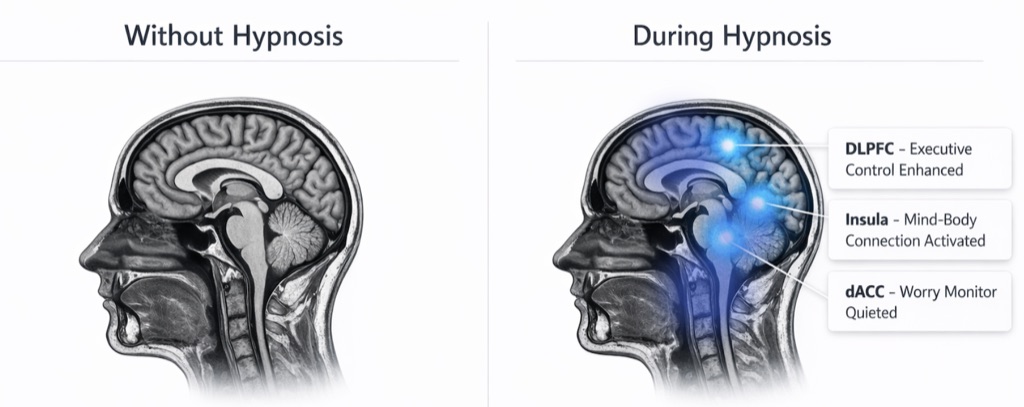
Regions from Stanford fMRI research on hypnosis (Jiang et al., 2017)
How much does this cost, and is it covered?
At Calgary Hypnosis Center, sessions range from $220 to $350. We ask for a 3-session commitment to start, because real change takes more than one visit. There are no long-term packages, just focused work to get you unstuck. For more on pricing, see what hypnotherapy costs in Canada.
Who actually benefits from hypnotherapy for procrastination?
It’s ideal if you’re tired of anxiety-driven delays and want to get to the root cause. Many of my clients have tried self-help or talk therapy without lasting results. If you’re ready to feel calm, in control, and able to start tasks without overthinking, this approach can help. It’s also great for students and professionals who need better focus and time management.
Will hypnosis work for you?
Regions from Stanford fMRI research on hypnosis (Jiang et al., 2017)
When should you NOT use hypnotherapy for procrastination?
If you’re looking for a quick fix or aren’t willing to engage with the process, it may not be for you. Hypnotherapy requires active participation. Also, if you have untreated severe mental health conditions, I’d recommend speaking with a physician first. I’m a Registered Clinical Hypnotherapist (RCH) with the Association of Registered Clinical Hypnotherapists of Canada (ARCH-Canada), and I’ll always be honest if this isn’t the right fit.
Will hypnosis work for you?
Regions from Stanford fMRI research on hypnosis (Jiang et al., 2017)
Self-hypnosis app or trained hypnotherapist for procrastination?
Apps offer generic recordings, but they can’t tailor suggestions to your unique blocks. A trained hypnotherapist identifies the specific fears, like perfectionism, and works with you in real time. Research shows personalized sessions improve self-regulation and task initiation more than control groups. For a deeper dive, read apps vs working with a hypnotherapist.
A study published by the National Institutes of Health’s National Library of Medicine found that six out of nine patients reported significant positive effects from hypnosis on their stress levels. This underscores the potential of tailored hypnotherapy to address the stress that often underlies procrastination.
Source: Cognitive Healing, citing NIH study
| Self-guided apps or recordings | One-size-fits-all scripts that can't adapt to your specific procrastination triggers | A Registered Clinical Hypnotherapist (RCH) at CHC tailors every session to your unique patterns, like fear of failure or perfectionism |
|---|---|---|
| Pre-recorded audio tracks | Passive listening with no real-time feedback or adjustment | Live virtual sessions where your hypnotherapist adjusts pacing, depth, and suggestions based on your responses |
| No professional oversight | You're on your own if the session brings up unexpected emotions or resistance | A trained RCH guides you safely through any emotional blocks and reinforces productive habits |
| Limited scope | Most apps target general relaxation, not the root psychological drivers of procrastination | CHC sessions directly address root causes like anxiety, self-doubt, and avoidance behaviors |
| Low upfront cost | Often $10–$20/month, but with no accountability or personalized support | $220–$350 per session with a 3-session commitment, investing in lasting change with professional accountability |
Questions this page answers
Can hypnotherapy cure chronic procrastination?
It’s not a cure, but it can significantly reduce procrastination by addressing underlying anxiety and avoidance. Studies show hypnotherapy improves focus and self-regulation. Many clients find they can finally break the cycle of delay after a few sessions.
How many sessions will I need?
We start with a 3-session commitment because change takes time. Some people notice a shift right away, but lasting habit change usually requires a few sessions to reinforce new patterns. Every person is different.
Is hypnotherapy safe?
Yes, when done by a trained professional. I’m a Registered Clinical Hypnotherapist (RCH) with the Association of Registered Clinical Hypnotherapists of Canada (ARCH-Canada). You’re always in control and aware. Read more about [safety here](/is-hypnotherapy-safe).
What does a session feel like?
It’s deeply relaxing, like a focused daydream. You’ll hear my voice guiding you, but you won’t be asleep or unconscious. Most people feel calm and refreshed afterward. Learn [what to expect](/what-to-expect-hypnotherapy).
Can hypnotherapy help with anxiety-related procrastination?
Absolutely. Procrastination often stems from anxiety. Hypnotherapy reduces cortisol levels and helps you feel less overwhelmed. A study found hypnosis reduced procrastination in patients with generalized anxiety disorder.
Do I need to believe in hypnosis for it to work?
No, but a willingness to participate helps. Hypnosis is a natural state you enter daily—like when you’re absorbed in a book. As long as you’re open to the process, it can be effective.
How is this different from talk therapy?
Talk therapy analyzes thoughts consciously. Hypnotherapy works directly with the subconscious to reframe deep-seated patterns. It’s often faster for behavior change. Compare [hypnotherapy vs. therapy](/hypnotherapy-vs-therapy).
Will I lose control during hypnosis?
No. You remain aware and in control the entire time. You can’t be made to do anything against your will. It’s a collaborative process where you’re an active participant.
Can hypnotherapy improve my focus and time management?
Yes. Stanford University studies show hypnosis strengthens neural pathways for attention and decision-making. Clients often report better task initiation and follow-through after sessions.
How do I book a session?
You can [book a free consultation](/apply) to discuss your goals and see if we’re a good fit. All sessions are virtual, so you can join from anywhere in Canada.
So, does hypnotherapy work for procrastination? The research says yes, studies show it can significantly improve self-regulation, focus, and task initiation. As a Registered Clinical Hypnotherapist (RCH), I've seen how addressing the anxiety and perfectionism underneath the delay helps people finally move forward. If procrastination has been stealing your time, a free consultation is the simplest next step.
Apply to work with us
We take on just 10 new clients a month. Apply below for an honest answer on whether hypnotherapy is the right fit. No packages, no pressure.
Only 2 spots left for August

Danny M.
Danny M. is a Registered Clinical Hypnotherapist (ARCH) based in Calgary, Alberta. His work focuses on the conditions hypnotherapy has the strongest track record with: anxiety, insomnia, chronic pain, and IBS. Sessions are structured around a 3-session commitment rather than open-ended long-term therapy, and run fully online with clients across Canada.
Last updated: 2026-05-24