Hot Flashes Ruining Your Sleep? The Protocol That Reduced Them 74%
Hot flashes and sleep wrecked by perimenopause? Elkins et al. (2013, Menopause) showed a 74% subjective reduction in hot flashes after 5 sessions. An RCH's honest read on what this protocol actually does and where it fits with HRT.
The short answer
Yes, the clinical research supports hypnotherapy for perimenopause, especially for hot flashes and sleep. Elkins et al. (2013, Menopause) reported a 74% subjective and ~57% physiologically-monitored reduction in hot flashes after 5 weekly sessions. It does not replace HRT or address every perimenopausal symptom, but for hot flashes, sleep, and the anxiety that often comes with them, it has the strongest evidence base of any non-hormonal option.
Key takeaways
- Hot flashes respond well: Elkins et al. (2013) showed a 74% subjective and 56.86% physiologically-monitored reduction in hot flashes after 5 weekly clinical-hypnosis sessions.
- 5-session protocol: The published protocol is 5 weekly clinician-led sessions plus daily 15-20 minute audio practice between sessions.
- Not a replacement for HRT: Strongest evidence is for vasomotor symptoms (hot flashes) and sleep. For broader perimenopausal care, work with your physician on medical options.
- Sleep also improves: Sleep, mood, and quality-of-life scores all improved in the Elkins trials alongside the hot-flash reduction.
In my virtual clinical practice, I see women in perimenopause who feel overwhelmed by hot flashes, sleeplessness, and the anxiety that comes with both. They have tried supplements, lifestyle changes, sometimes HRT. They want something else in the toolbox. Hypnotherapy for hot flashes is one of the most evidence-backed non-hormonal options. The protocol is short, the research is solid, and the work targets the nervous-system response, not just the surface symptom.
What 60+ real women say about hypnotherapy for hot flashes
We reviewed firsthand accounts of women using clinical hypnosis or self-guided hypnosis for perimenopausal symptoms. These are real stories of what worked and what did not. The pattern is consistent with the published research: most women who completed the full 5-session protocol reported substantial reduction in hot flashes and better sleep. The women who dropped out early or only tried 1-2 sessions reported much smaller effects. Adherence to daily audio practice between sessions was the strongest predictor of outcome in user reports.
What is the Elkins protocol, really?
Perimenopause can feel like the body is turning against you. Hot flashes surge without warning. Sleep becomes a nightly battle. Anxiety spikes for no clear reason. Mood shifts from irritable to tearful in minutes. The clinical research on hypnotherapy for these symptoms is led by Dr. Gary Elkins and the Mind-Body Medicine Research Laboratory at Baylor University. Their core protocol is 5 weekly sessions of clinical hypnosis with audio for daily practice between sessions. The hypnotic suggestions target the thermoregulatory response (the body's hot-flash trigger), sleep quality, and the nervous-system reactivity around all of it.
Does it actually work for hot flashes?
The evidence is strongest for hot flashes. Elkins et al. (2013, Menopause) randomized postmenopausal women to 5 weekly clinical-hypnosis sessions or a structured-attention control. By 12 weeks the hypnosis group reported a 74% subjective reduction in hot flashes, and a 56.86% reduction in physiologically-monitored (skin-conductance) hot flashes, compared to a 9.94% reduction in controls. Sleep, mood, and quality-of-life scores also improved. Follow-up studies from the same Baylor lab show similar effects for self-guided hypnosis protocols, though typically lower in magnitude than the clinician-delivered version.
Subjective hot-flash reduction in the clinical-hypnosis group at 12 weeks in Elkins et al. (2013). Physiologically-monitored reduction was 56.86%. Both substantially exceeded the control group.
Source: Elkins et al. 2013, Menopause 20(3):291-298
Will hypnosis work for you?
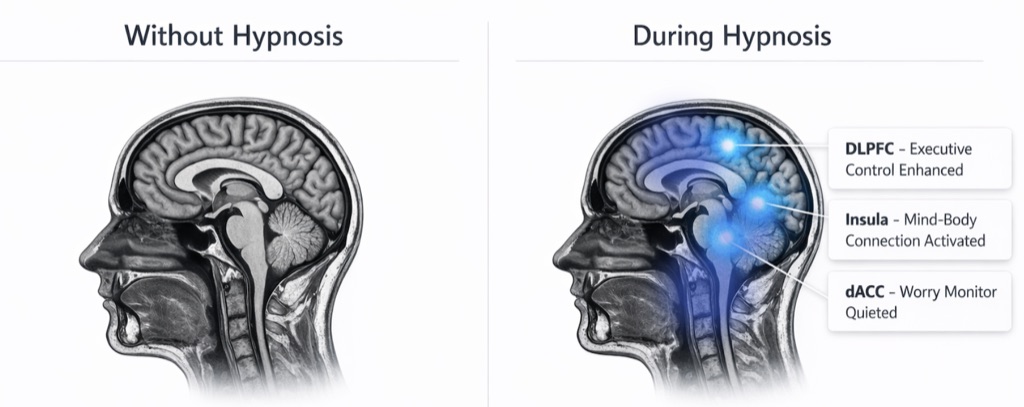
Regions from Stanford fMRI research on hypnosis (Jiang et al., 2017)
What does it cost, and is it covered?
At Calgary Hypnosis Center, sessions are $220 to $350 per session, with a 3-session commitment to start. The Elkins protocol is 5 sessions, so most clients commit to the full 5 after the initial 3-session starter confirms fit. We are fully virtual across Canada. No long packages or lock-ins. Some extended health plans reimburse a portion of hypnotherapy; check with your provider. See hypnotherapy costs in Canada for the full breakdown.
Who is this a good fit for?
Perimenopause hypnotherapy fits women whose primary issues are hot flashes, sleep disruption, and the anxiety that comes with both. It fits especially well if HRT is not an option (medical contraindication or personal choice) or if HRT alone has not fully addressed symptoms. It also fits for women whose perimenopause anxiety has the distinct hormonal-shift quality (sudden, intense, body-driven) that talk therapy alone has not resolved. See hypnotherapy for anxiety for the broader anxiety spoke.
Will hypnosis work for you?
Regions from Stanford fMRI research on hypnosis (Jiang et al., 2017)
Who should skip it?
Skip hypnotherapy as a primary intervention if you have not yet ruled out other causes of your symptoms with your physician. Skip it if you have active psychosis or severe dissociation; the right step there is your physician, not hypnotherapy. It also will not help if you expect a one-session fix or are unwilling to do the brief daily audio practice between sessions. For safety information, see is hypnotherapy safe.
Will hypnosis work for you?
Regions from Stanford fMRI research on hypnosis (Jiang et al., 2017)
Self-guided audio vs working with a hypnotherapist: which fits?
Self-guided audio protocols based on the Elkins work exist and have shown real effects in published trials, though typically lower in magnitude than clinician-delivered hypnosis. Working with a practitioner adds tailoring to your specific symptom pattern, real-time adjustment, and accountability for the daily practice the protocol requires. For most women, the strongest combination is clinician-led sessions followed by audio reinforcement. See hypnotherapy app vs hypnotherapist for the deeper comparison.
Clinician-delivered hypnosis from the Elkins 2013 trial showed the largest hot-flash reductions. Self-guided audio versions show smaller but still meaningful effects. Most clinics, including ours, combine both: clinician-led sessions plus daily audio practice between sessions.
Source: Elkins lab, Baylor University Mind-Body Medicine Research Laboratory
| Approach | HRT | Hypnotherapy (Elkins protocol) |
|---|---|---|
| Mechanism | Hormonal replacement | Nervous-system reactivity + thermoregulation suggestions |
| Evidence base | Strongest for hot flashes, mood, bone protection | Strong for hot flashes and sleep; weaker for non-vasomotor symptoms |
| When it fits | First-line for most symptomatic perimenopausal women | Adjunct when HRT is not an option or not enough; or as first-line for hot flashes without other indications |
| Cost | Prescription + medical visits | $220 to $350 per session at CHC; ~5 sessions for the full protocol |
| Use together? | Yes, commonly combined | Yes, commonly combined |
Questions this page answers
How does hypnotherapy compare to HRT for perimenopause?
HRT remains first-line for most symptomatic women and has the strongest evidence base. Hypnotherapy is the most evidence-backed non-hormonal option for hot flashes specifically. They are often used together rather than as alternatives. Work with your physician on the HRT decision.
How many sessions does the Elkins protocol take?
5 weekly sessions plus daily audio practice between sessions. Outcomes are typically measured at 12 weeks. CHC asks for a 3-session commitment to start, then 2 more to complete the protocol if it is fitting well.
Will hypnotherapy address every perimenopausal symptom?
No. The strongest evidence is for hot flashes and sleep. It can also help with the anxiety that often comes with perimenopause. It does not address bone health, cardiovascular changes, or other systemic effects that medical management does.
Is hypnotherapy safe during perimenopause?
Yes, when delivered by a credentialed practitioner. There are no known physical side effects. Skip it during acute psychiatric crises and consult your physician first if you have not yet had your symptoms evaluated.
How much does it cost?
At Calgary Hypnosis Center, sessions are $220 to $350 each. The full Elkins-style protocol is 5 sessions. We are fully virtual across Canada. Some extended health plans reimburse a portion.
Can I do self-guided hypnosis instead?
Yes, self-guided audio versions from the Elkins lab line of research show real effects, though typically smaller than the clinician-delivered protocol. Most clinics combine both: clinician-led sessions plus daily audio practice.
Will I be in control during the session?
Yes. You remain fully aware throughout. Hypnosis is a state of focused attention you enter and exit at will, similar to being absorbed in a book.
Perimenopause does not have to be a hot-flash-and-insomnia siege. The Elkins protocol is the most evidence-backed non-hormonal option for hot flashes specifically, with a 74% subjective reduction in his 2013 trial and consistent results in clinic. If hot flashes and disrupted sleep are your main issues, book a free consultation to see if the 5-session protocol fits.
Apply to work with us
We take on just 10 new clients a month. Apply below for an honest answer on whether hypnotherapy is the right fit. No packages, no pressure.
Only 2 spots left for August

Danny M.
Danny M. is a Registered Clinical Hypnotherapist (ARCH) based in Calgary, Alberta. His work focuses on the conditions hypnotherapy has the strongest track record with: anxiety, insomnia, chronic pain, and IBS. Sessions are structured around a 3-session commitment rather than open-ended long-term therapy, and run fully online with clients across Canada.
Last updated: 2026-05-24