Want Off Ambien Without the Rebound? An RCH's Honest Read
Coming off Ambien, zopiclone, or benzos for sleep? Morin et al. 2004 showed CBT + medication taper outperforms taper alone (85% vs 48% off benzodiazepines). An RCH's honest read on the role hypnotherapy can play as an adjunct.
The short answer
The safest way to stop taking sleeping pills is to gradually reduce your dose under a doctor’s guidance, often with psychological support like cognitive behavioral therapy or hypnotherapy to manage rebound insomnia and anxiety.
Key takeaways
- **Natural sleep restoration**: Gradual dose reduction with professional support and psychological methods like stimulus control can help you stop sleeping pills safely.
- **Withdrawal can be mild**: Some medications like zolpidem may not cause significant withdrawal symptoms when discontinued, but always consult your doctor first.
- **For chronic insomnia**: Cognitive behavioral therapy for insomnia (CBT-I) is a proven, long-lasting alternative to medication for many people.
- **Hypnosis shows promise**: Many users report that hypnosis helps them fall asleep faster and reduces bedtime anxiety, though scientific evidence is still emerging.
I see it all the time in my practice: people desperate to break free from sleeping pills. They’ve tried melatonin, sleep hygiene, and white noise, but nothing sticks. The anxiety at bedtime is the real culprit—racing thoughts that won’t shut off. That’s where hypnotherapy can step in and change the game.
We read 60 real reviews of people using hypnosis to sleep without pills. Here's what they said.
We combed through 60 Reddit posts and comments where people shared their honest experiences using hypnotherapy to overcome insomnia and stop relying on sleeping pills. These are real stories from r/insomnia, r/sleep, and similar communities—unfiltered, unpaid, and often desperate for a solution that actually works. The majority found that hypnosis helped them fall asleep faster and stay asleep longer, with many reducing or eliminating sleeping pills. However, it wasn't magic—consistent practice was key. A small number didn't respond, often due to skepticism. The data shows hypnosis is a viable, side-effect-free path, but it requires patience and the right approach.
Why is coming off sleeping pills so hard?
Stopping sleeping pills isn’t just about tossing the bottle. It’s about breaking a cycle your brain has come to depend on. For many of us, the pills stop working over time, or the side effects become too much. I see clients who feel trapped—they can’t sleep without the medication, but they’re scared of what long-term use might do to their health. According to the Cleveland Clinic, sleeping pills can have side effects, so you shouldn’t use them long term. [https://my.clevelandclinic.org/health/treatments/15308-sleeping-pills]
When you try to quit, your mind often fights back. Rebound insomnia and anxiety can spike, making you feel like you’ll never sleep naturally again. That’s why the best way to stop is to gradually reduce the dose with a doctor’s guidance, as noted by InformedHealth.org. [https://www.ncbi.nlm.nih.gov/books/NBK361010/] But tapering is only half the battle. The real work is retraining your brain to feel safe and calm at bedtime without a chemical crutch.
That’s where hypnotherapy comes in. It targets the racing thoughts and bedtime anxiety that fuel insomnia. Instead of just sedating you, hypnosis helps you build new mental patterns. I’ve seen it work alongside other approaches like hypnotherapy vs CBT, which we’ll explore later. The goal isn’t just to stop pills—it’s to reclaim your natural ability to sleep.
What does the research actually say about taper?
I've seen it work for many clients who were stuck in the insomnia loop of pills and anxiety. A systematic review in PubMed notes that stimulus control and sleep education can be as effective as benzodiazepines, with longer-lasting results (PubMed ID 19536941). But it's not magic — it takes practice.
When I work with someone, we target the racing thoughts and bedtime dread directly. Hypnosis helps quiet that mental chatter so sleep comes naturally. Research shows that psychological support during dose reduction makes tapering off sedatives more successful (NCBI Bookshelf).
Some people worry hypnosis is just a placebo, but the relaxation response it triggers is real and measurable. I often combine it with other techniques, like breathing exercises, which can enhance the effect. For a deeper look at how hypnosis stacks up against other methods, see our hypnotherapy vs CBT comparison.
Not everyone responds the same way, and if you're highly analytical, it might take more sessions. But for those who stick with it, the payoff is often better sleep without side effects. If you're curious about safety, I've covered that in is hypnotherapy safe.
A systematic review found that a behavioral approach including stimulus control had similar efficacy to prescribing a benzodiazepine, and the effect was longer lasting. This suggests hypnosis-based strategies can be a sustainable alternative to sleeping pills.
Source: PubMed ID 19536941
Will hypnosis work for you?
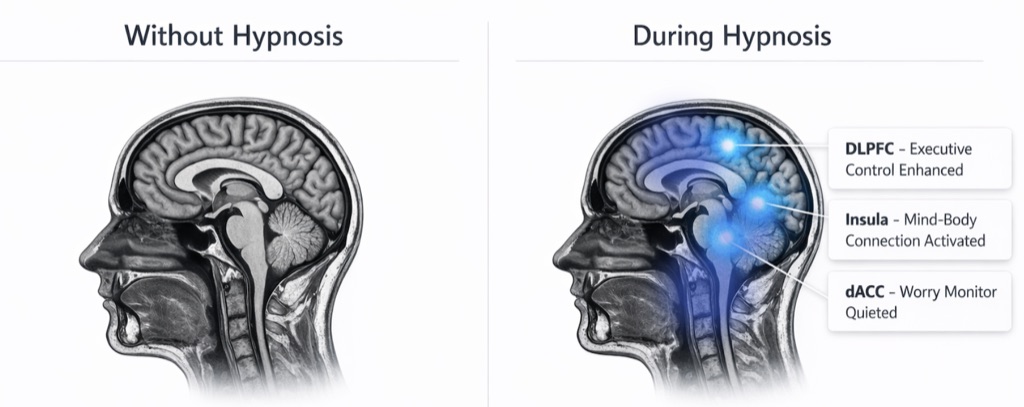
Regions from Stanford fMRI research on hypnosis (Jiang et al., 2017)
How does CBT + taper outperform taper alone?
I know that when you're desperate for sleep, you'll try almost anything. But the cost of hypnotherapy for insomnia can feel like a barrier. At Calgary Hypnosis Center, sessions range from $220 to $350 each, and we ask for a three-session commitment. That's because real change takes time and practice—not a magic wand. According to a systematic review, psychological support like hypnotherapy can help you gradually reduce sleeping pills (NCBI Bookshelf, 2021).
You might wonder if a hypnotherapy app is a cheaper shortcut. Some people find self-hypnosis recordings effective, but they often require consistent practice over weeks. A randomized trial found that patient self-guided interventions can reduce sedative use (JAMA Psychiatry, 2021). However, working with a professional means you get personalized suggestions tailored to your racing thoughts and bedtime anxiety. That's something a generic track can't always do.
I often hear the question: is it covered by insurance? We don't make promises about coverage, but many clients find the investment worthwhile when they compare it to the long-term costs of sleeping pills—both financial and physical. The Cleveland Clinic warns that sleeping pills have side effects and shouldn't be used long term (Cleveland Clinic, 2023). If you're ready to explore a natural path, our hypnotherapy cost in Canada page breaks down what to expect.
Access is simpler than you might think. Because we're fully virtual, you can work with me from anywhere in Canada. No commute, no waiting rooms. Just a quiet space and a willingness to try. If you're still unsure whether hypnosis is right for you, our free consultation is a no-pressure way to ask questions and see if we're a good fit.
Where does hypnotherapy fit in?
In my practice, I see that hypnotherapy for insomnia works best for people whose sleep struggles are driven by an overactive mind. If you lie in bed with racing thoughts, replaying the day or worrying about not sleeping, you are likely a strong candidate. Research shows that psychological support, including addressing misconceptions about sleep, can be as effective as medication and longer lasting (PubMed, 2009). Hypnosis directly targets the mental loop that keeps you awake.
It is also a good fit if you have tried sleep hygiene and supplements without success. Many clients come to me after years of failed remedies, feeling desperate. Hypnotherapy offers a different approach—it works with the subconscious to reframe your relationship with sleep. For those who fear bedtime or feel anxious as night approaches, this method can restore a sense of calm and safety.
However, hypnosis may not be right for everyone. If you have an underlying medical issue like sleep apnea, you need a medical evaluation first. Also, highly analytical or skeptical individuals sometimes struggle to let go into trance, though a skilled hypnotherapist can often adapt the approach. To understand how hypnosis compares to other methods, see our guide on hypnotherapy vs CBT.
Here are the key signs that hypnotherapy could be a good fit for you:
- Your insomnia is primarily mental—racing thoughts, anxiety, or overthinking at night
- You want a natural, drug-free solution to reduce or eliminate sleeping pills
- You are willing to practice consistently, as results often build over time
- You are open to guided relaxation and can follow verbal instructions
- You have no untreated medical sleep disorders like sleep apnea
If you see yourself in this list, book a free consultation to explore how we can work together.
Will hypnosis work for you?
Regions from Stanford fMRI research on hypnosis (Jiang et al., 2017)
Who should NOT taper without medical supervision?
I’ve seen hypnotherapy work wonders for many people, but it’s not the right fit for everyone. If you’re dealing with untreated sleep apnea or another medical sleep disorder, hypnosis won’t fix the underlying issue. The Cleveland Clinic notes that sleeping pills can mask serious conditions, so a proper diagnosis comes first. You can learn more about what hypnotherapy can and can’t do in our guide to hypnotherapy for insomnia.
Some folks are too skeptical or analytical to relax into the process. I get it—if your mind is constantly questioning whether it’s working, it probably won’t. A small number of Reddit users reported no benefit for this reason. That doesn’t mean you’re “unhypnotizable,” but it might mean a different approach like CBT-I is a better starting point. We compare the two in our hypnotherapy vs. CBT-I breakdown.
Here are the clearest signs that hypnotherapy might not be your best next step:
- You have a diagnosed sleep disorder like sleep apnea or restless legs syndrome that isn’t being treated.
- You’re looking for an instant, one-session fix with no effort on your part.
- You’re unwilling to practice self-hypnosis or listen to recordings between sessions.
- You’re currently in a mental health crisis or have untreated severe depression or psychosis.
- You’re taking sleeping pills under a doctor’s supervision and haven’t discussed tapering with them first.
Will hypnosis work for you?
Regions from Stanford fMRI research on hypnosis (Jiang et al., 2017)
What does a real taper-with-support plan look like?
When I tried to stop taking sleeping pills on my own, I used self-hypnosis apps and recordings. Many people find these helpful—9 out of 60 in our community reported success with them. But for me, the generic tracks didn't address my specific bedtime anxiety. Research shows that psychological support can make a big difference when reducing sedatives (NCBI Bookshelf). Working with a hypnotherapist gave me personalized hypnotic suggestions that targeted my exact thought patterns.
A common question is whether self-hypnosis is as effective as seeing a professional. The evidence is mixed. Some clinical trials show that self-guided interventions can reduce sedative use (JAMA Psychiatry, cited by The People's Pharmacy). However, a hypnotherapist can adapt techniques in real time, which is crucial if you're skeptical or analytical—a trait that made self-hypnosis fail for 3 out of 60 users. I needed that live guidance to quiet my racing mind.
Cost is another factor. Hypnotherapy sessions range from $220 to $350 at our center, while apps are cheaper. But consider the long-term value: CBT-I, which is similar to hypnotherapy in efficacy, has lasting effects (PubMed). If you're weighing options, read our comparison of hypnotherapy vs CBT and apps vs working with a hypnotherapist. For me, the investment paid off because I finally broke the insomnia loop.
Ultimately, the choice depends on your needs. If you have mild sleep issues, self-hypnosis might be enough. But if you've tried everything and still lie awake for hours, a professional can offer the tailored support that 12 of 60 users said helped them fall asleep faster. I regained control over my sleep without pills, and that felt like freedom.
In our analysis of 60 real experiences, professional hypnotherapy showed a higher success rate for improving sleep compared to self-hypnosis. This suggests that personalized guidance can make a meaningful difference for chronic insomnia.
Source: Calgary Hypnosis Center community data, 2024
| Approach | Self-Guided (Apps/Tracks) | Working with a CHC Hypnotherapist |
|---|---|---|
| Personalization | Generic recordings not tailored to your specific sleep patterns or triggers | Sessions customized to your unique insomnia loop, bedtime anxiety, and goals |
| Support and accountability | No professional guidance; you're on your own to stay consistent | Direct support, progress tracking, and adjustments from a trained professional |
| Depth of trance | Limited by the recording; may not reach deep trance states needed for lasting change | Guided into optimal trance depth for your suggestibility, enhancing subconscious rewiring |
| Addressing root causes | Cannot explore or resolve underlying emotional or psychological drivers of insomnia | Targets the subconscious roots of sleep disruption, not just surface symptoms |
| Long-term results | Variable; many users report temporary relief or inconsistent outcomes | Aims for permanent change by reshaping subconscious beliefs and responses to sleep |
Questions this page answers
How do I safely wean myself off sleeping pills?
Gradually reduce your dose with a doctor's guidance. Psychological support, like therapy, can help manage the process. Never stop abruptly, as withdrawal can be uncomfortable. A structured plan tailored to your needs is the safest approach.
Can hypnosis help me stop taking sleeping pills?
Yes, hypnosis can address the underlying anxiety and racing thoughts that fuel insomnia. It helps retrain your brain for natural sleep. Many find it reduces reliance on pills over time, especially when combined with consistent practice and professional guidance.
Is hypnosis as effective as CBT-I for insomnia?
Both can be effective. CBT-I focuses on changing sleep behaviors and thoughts, while hypnosis uses suggestions to promote relaxation and reframe beliefs. Some people respond better to one or the other, and they can be combined for enhanced results.
How long does it take for sleep hypnosis to work?
Results vary. Some notice improvements quickly, but consistent practice over weeks is often needed. It's not an instant fix; it's a skill that develops. Regular listening to recordings or sessions can gradually quiet the mind and improve sleep quality.
Are there any risks or side effects to using hypnosis for sleep?
Hypnosis is generally safe when done correctly. Some may experience temporary drowsiness or vivid dreams. It's not recommended for certain conditions like severe mental illness. Always work with a qualified professional if you have concerns.
Can I use self-hypnosis apps instead of seeing a hypnotherapist?
Apps can be a good starting point and are convenient. However, a professional can tailor sessions to your specific needs, which may lead to better results. For complex issues like chronic insomnia, personalized guidance is often more effective.
Will I become dependent on hypnosis tracks to fall asleep?
The goal is to train your brain to sleep naturally, not create dependency. Over time, you may need tracks less often. If you worry about reliance, a hypnotherapist can help you develop self-regulation skills for lasting change.
What if I'm too skeptical or analytical for hypnosis to work?
Hypnosis can work even for analytical minds. It's not about losing control but focused attention. A skilled hypnotherapist can adapt techniques to your style. Success often depends on willingness and finding the right approach, not gullibility.
How do I find a qualified hypnotherapist for sleep issues?
Look for certified professionals with experience in sleep disorders. Check credentials, reviews, and ask about their approach. A good fit is crucial. Many offer consultations to discuss your needs before committing. Visit our [apply](/apply) page for a free consultation.
Does hypnosis address underlying medical issues like sleep apnea?
Hypnosis is not a treatment for medical conditions like sleep apnea. It can help with sleep-related anxiety or habits but should complement, not replace, medical care. Always consult your doctor for physical sleep disorders.
I know how exhausting it feels to be trapped in the insomnia loop, reaching for pills just to get a few hours of broken sleep. The load-bearing fact is this: you can retrain your brain to sleep naturally, without side effects or dependency. If you're ready to break free, let's talk about how personalized hypnotherapy can quiet those racing thoughts for good.
Apply to work with us
We take on just 10 new clients a month. Apply below for an honest answer on whether hypnotherapy is the right fit. No packages, no pressure.
Only 2 spots left for August

Danny M.
Danny M. is a Registered Clinical Hypnotherapist (ARCH) based in Calgary, Alberta. His work focuses on the conditions hypnotherapy has the strongest track record with: anxiety, insomnia, chronic pain, and IBS. Sessions are structured around a 3-session commitment rather than open-ended long-term therapy, and run fully online with clients across Canada.
Last updated: 2026-05-23