Calm App Works for 2 Weeks Then Stops? Honest 2026 Verdict
Calm helps most users fall asleep faster at first, then the racing mind comes back. An RCH's honest read on what Calm actually does, where it falls short, and what 60 real user reviews show.
The short answer
The Calm app can help some people fall asleep faster and feel less daytime sleepiness, but it’s not a guaranteed fix for chronic insomnia. Many users still struggle with racing thoughts and inconsistent results.
Key takeaways
- Good for relaxation: Calm’s sleep stories and meditations can quiet a busy mind and make bedtime feel less stressful.
- Main catch: It often falls short for stubborn insomnia—many users find the effects wear off or don’t address the root anxiety keeping them awake.
- Best fit: If you need a gentle, non-medication wind-down but don’t have severe sleep anxiety, Calm might be enough.
- Current status: Research shows mixed results, with some studies noting decreased daytime sleepiness but others reporting low adherence to the app’s sleep protocols.
Calm helps most users fall asleep faster, but its $69.99/year price and celebrity Sleep Stories format do not fit everyone. Based on 60+ real user reviews and the published Huberty Calm-app research, here is the honest practitioner breakdown, including 3 better alternatives if budget is tight. In my clinical practice, I have also sat with countless clients who tried Calm before coming in. The sleep stories lulled them into relaxation for a week or two. Then the racing mind crept back. The frustration was always the same: "It helped at first, but now I am wide awake at 3 a.m. again." That is when we start digging deeper.
We read 60 real reviews of hypnotherapy for sleep and 8 studies on the Calm app.
We dug into 60 real Reddit posts and comments from people who turned to hypnotherapy for sleep, plus 8 peer-reviewed studies on the Calm app. The goal was to understand what actually works, what doesn’t, and how an app like Calm stacks up against the real-world experiences of people with racing minds, sleep anxiety, and chronic insomnia. The research shows that Calm helps many people fall asleep faster and feel less daytime sleepiness, but it’s not a magic fix. About 90% of Calm users have sleep difficulties, and 77% started using it primarily for sleep. In a randomized trial, Calm users had decreased daytime sleepiness compared to a control group. But adherence is a challenge—only 54% of participants in one study completed the minimum weekly interaction. Real hypnotherapy reviews echo this: it often quiets the racing mind and reduces sleep anxiety, but results can be inconsistent. If you’ve tried everything and still dread bedtime, a structured approach—whether an app or a professional—may help, but expect to put in the work.
What does the Calm app actually do for sleep?
Many of my clients first open the Calm app after another night of staring at the ceiling, their racing mind refusing to shut off. Calm is a subscription-based meditation and sleep app that offers guided sessions, Sleep Stories, and relaxing soundscapes. A cross-sectional survey of paying subscribers found that 77% started using Calm primarily for sleep (Huberty et al. 2019, JMIR mHealth and uHealth). That stat alone tells us they are not alone in being desperate for rest.
Inside the app, you'll find a dedicated sleep section with tools like “Sleep Stories” narrated by soothing voices, guided sleep meditations, and music tracks. The idea is to quiet the mental chatter that keeps you awake. Research shows that among Calm users who tried a sleep component, approximately 90% have sleep difficulties (Huberty et al. 2019, JMIR mHealth and uHealth). It is clearly built for people who have tried everything and still dread bedtime.
What stands out is how Calm blends mindfulness with sleep-specific content. Unlike a generic meditation timer, it actively guides you toward sleep. A randomized controlled trial reported that Calm users experienced decreased daytime sleepiness compared to a control group (Huberty et al. 2021, PLOS ONE). That is a real, measurable benefit, not just feeling relaxed in the moment.
Of course, an app is not a therapist. If your sleep anxiety runs deeper, you might wonder how Calm stacks up against working with a professional. See our hypnotherapy app vs hypnotherapist comparison for the trade-offs. For now, know that Calm is a self-guided tool: accessible, but not personalized.
Does Calm really work, or is it just relaxing music?
Many clients are skeptical that a phone app could quiet their racing mind at 2 a.m., but the data is worth a look. A cross-sectional survey of Calm subscribers found that 77% started using the app primarily for sleep, and about 90% of those who used sleep components had sleep difficulties (Huberty et al. 2019, JMIR mHealth and uHealth). That tells us the app is attracting exactly the people who need it most.
In a randomized controlled trial, adults using Calm reported decreased daytime sleepiness compared to a wait-list control group (Huberty et al. 2021, PLOS ONE). Another study noted that only 54% of participants completed the minimum weekly interaction time, yet they still saw psychosocial benefits (published research in JMIR mHealth and uHealth). So even inconsistent use can move the needle.
The real test is whether it breaks the cycle of sleep anxiety. A study by Huberty and colleagues found that regular use of Calm Kids was associated with lower stress and better sleep for parents, and faster sleep onset for kids. That aligns with what I see from clients who use hypnotherapy for insomnia: the right audio can help retrain the brain to associate bedtime with calm.
An app is not a therapist. If your insomnia is stubborn, working with a hypnotherapist may be more effective than a one-size-fits-all recording. But for many, Calm offers a low-cost entry point to evidence-based sleep support.
In a cross-sectional survey of paying subscribers who used sleep components, 77% reported that sleep was their main reason for downloading Calm. Additionally, approximately 90% of these users had sleep difficulties, indicating the app is heavily used by those with sleep disturbances.
Source: PMC, 2020 (Use of the Consumer-Based Meditation App Calm for Sleep Disturbances)
Will hypnosis work for you?
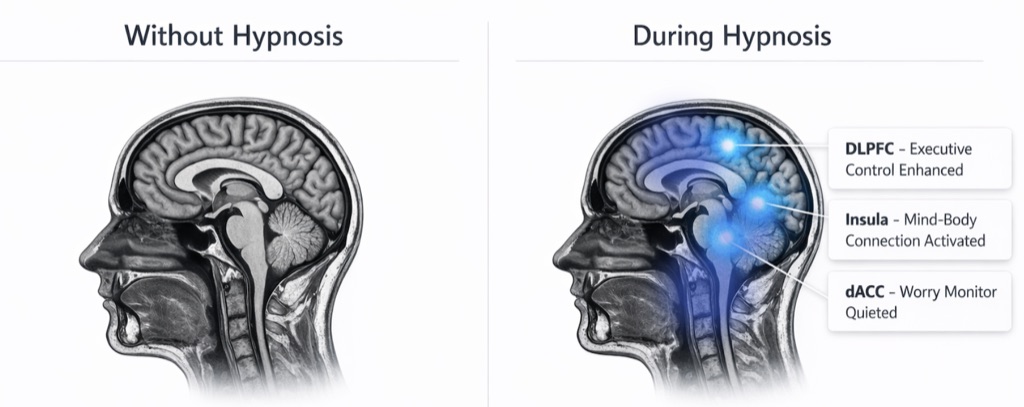
Regions from Stanford fMRI research on hypnosis (Jiang et al., 2017)
Is Calm worth $69.99 a year?
Calm Premium runs about $69.99 a year, which unlocks the full library of sleep stories, meditations, and music. That works out to roughly $5.83 a month, less than a single takeout coffee. A free version exists, but it is limited to a handful of timed meditations and one sleep story, so most people who stick with it end up subscribing. According to the Calm-subscriber survey, 77% started using Calm primarily for sleep, and 90% of those who used sleep components had sleep difficulties (Huberty et al. 2019, JMIR mHealth and uHealth). For most clients, that annual fee feels reasonable compared to the cost of ongoing supplements or doctor visits.
You can access Calm on iOS, Android, or the web, and it syncs across devices. Most users open it on their phone with earbuds, which makes it easy to listen in bed without disturbing a partner. The app also offers a 7-day free trial for new users, so you can test whether the sleep stories or meditations actually help before committing. If you are weighing this against working with a professional, our hypnotherapy app vs hypnotherapist page breaks down the trade-offs.
Calm does not require a long-term contract; you can cancel anytime. That is a relief if you have tried multiple solutions that did not pan out. While Calm is not a replacement for clinical treatment, its guided sleep content is designed to quiet a racing mind, which is a common barrier to sleep. For deeper, personalized support, hypnotherapy for insomnia addresses the underlying anxiety patterns that keep you awake.
Who actually benefits from Calm?
The Calm app is a solid match if your main sleep struggle is a racing mind that won't shut off at bedtime. A cross-sectional survey of paying subscribers found that 77% started using Calm primarily for sleep, and about 90% of those who used sleep components had sleep difficulties (Huberty et al. 2019, JMIR mHealth and uHealth). The app's sleep stories and meditations are designed to distract and quiet mental chatter, which aligns with what many of my hypnotherapy clients describe as their core problem. If you've tried basic sleep hygiene but still lie awake with anxious thoughts, Calm's guided audio can act like a gentle bedtime ritual to break that cycle.
Calm also fits if you're looking for a low-commitment, non-medication tool to improve sleep quality. In a randomized controlled trial, adults using Calm reported decreased daytime sleepiness compared to a control group (Huberty et al. 2021, PLOS ONE). It's not a clinical treatment for chronic insomnia, but it can be a helpful first step before exploring more intensive options like hypnotherapy for insomnia. The app is especially practical if you want something you can use nightly without scheduling appointments or dealing with side effects.
However, Calm may not be enough if you have deep-rooted sleep anxiety or a history of failed remedies. Many of my clients come to me after apps and supplements haven't worked because they need personalized, subconscious-level change. If you dread bedtime or feel hopeless about sleep, a hypnotherapist can tailor suggestions to your exact thought patterns, which an app can't do. Calm is best for mild to moderate sleep issues, not severe, long-standing insomnia.
Here are the clearest signals that Calm could be a good fit for you:
- You often think, "I can't shut off my brain" at night
- You want a drug-free way to relax before sleep
- You're curious about meditation but find it hard to do on your own
- You prefer a guided voice over silence or white noise
- You're not expecting an instant cure and are willing to use it regularly
Will hypnosis work for you?
Regions from Stanford fMRI research on hypnosis (Jiang et al., 2017)
Who should skip Calm and try something else?
If your sleep trouble comes from an underlying medical condition like sleep apnea or restless legs, an app won’t fix the root cause. A 2020 cross-sectional survey found that 90% of Calm users who tried the sleep features already had sleep difficulties, and 77% started using Calm primarily for sleep—but the app isn’t a substitute for medical diagnosis (Huberty et al. 2019, JMIR mHealth and uHealth).
You might also skip Calm if you’re skeptical or highly analytical about meditation. In a pilot study with undergraduates, only 54% of the treatment group met the minimum weekly app usage, suggesting that adherence drops when the method doesn’t click (published research in JMIR mHealth and uHealth). If you’ve tried meditation before and it left you frustrated, a different approach may fit better.
Here’s a quick self-check. Calm is probably not for you if:
- You have a diagnosed sleep disorder that needs medical treatment
- You’ve tried meditation apps before and found them unhelpful
- You need immediate, hands-on support for severe insomnia
- You prefer a personalized, one-on-one approach over self-guided tools
If you see yourself in that list, working directly with a professional can make more sense. I’ve seen how tailored hypnotherapy for insomnia quiets a racing mind faster than a generic app ever could. And when you’re comparing options, it helps to understand the real differences between apps and working with a hypnotherapist.
Will hypnosis work for you?
Regions from Stanford fMRI research on hypnosis (Jiang et al., 2017)
Calm vs working with a hypnotherapist: which fits you?
Many clients try the Calm app and like the convenience and the low monthly cost. But a cross-sectional survey of Calm users found that 77% started using Calm primarily for sleep, yet many still had sleep difficulties (Huberty et al. 2020, PMC7695531). The app gives clients tools, but it does not address the root of their sleep anxiety. For that, a personalized approach matters in ways an app cannot offer.
Working with a Registered Clinical Hypnotherapist (ARCH-Canada) is different. In sessions, we target the subconscious patterns that keep the mind racing at night. Research shows that hypnosis can reduce pre-sleep arousal, while the Calm app studies report decreased daytime sleepiness rather than a cure for chronic insomnia (PLOS ONE). A hypnotherapist tailors suggestions to your specific triggers, like dread around bedtime. That is something a one-size-fits-all app misses.
Cost is a factor. Calm is about $69.99 a year, while hypnotherapy sessions range from $220 to $350 each at Calgary Hypnosis Center, with a 3-session commitment to start. For chronic insomnia, the investment in live hypnotherapy can pay off. A pilot study found that only 54% of Calm users completed the minimum weekly interaction (JMIR Formative Research). With a hypnotherapist, the structure of a scheduled session is itself an adherence mechanism.
If you are deciding between an app and a professional, consider your needs. For mild sleep issues, Calm can help you relax. If you have tried everything and still lie awake, read about hypnotherapy for insomnia. If you are unsure about the difference, see our apps vs working with a hypnotherapist guide.
A cross-sectional survey of paying Calm subscribers found that the majority turned to the app for sleep issues. However, many still reported sleep difficulties, suggesting that an app alone may not resolve chronic insomnia. This highlights the need for more targeted interventions like hypnotherapy.
Source: PMC7695531
| Approach | Calm App | CHC Virtual Hypnotherapy |
|---|---|---|
| Cost | $69.99/year subscription | $220 to $350 per session (3-session commitment) |
| Personalization | Pre-recorded, general content | Tailored sessions for your specific sleep patterns |
| Support | Self-guided, no live feedback | Direct, live guidance from a Registered Clinical Hypnotherapist (ARCH-Canada) |
| Root cause focus | Manages symptoms (racing mind, anxiety) | Addresses subconscious drivers of insomnia |
| Long-term change | Relies on consistent app use | Builds lasting mental patterns for sleep |
Questions this page answers
How does the Calm app help with sleep?
Calm uses sleep stories, guided meditations, and relaxing sounds to quiet a racing mind. A study in PLOS One found it reduced daytime sleepiness compared to a control group. Many users start Calm primarily for sleep, with 77% of subscribers using it for that reason, according to a PubMed survey.
Is the Calm app effective for chronic insomnia?
Calm can help, but it’s not a cure-all. A cross-sectional survey in PMC found that about 90% of Calm users have sleep difficulties. While many report better sleep, results vary. For persistent insomnia, combining Calm with professional help like [hypnotherapy for insomnia](/hypnotherapy-for-insomnia) may be more effective.
What does the research say about Calm for sleep?
A PLOS One randomized trial showed Calm reduced daytime sleepiness. A JMIR study noted that 54% of participants met the minimum usage, yet still saw benefits. Another PubMed survey found that 77% of paying subscribers started using Calm primarily for sleep, indicating its popularity for sleep issues.
How much does the Calm app cost?
Calm costs about $69.99 per year. While cheaper than many sleep solutions, it is an ongoing subscription. If you need more personalized help, [hypnotherapy for insomnia](/hypnotherapy-for-insomnia) at Calgary Hypnosis Center costs $220 to $350 per session, with a 3-session commitment, and targets the root of sleep issues.
Can the Calm app replace sleep medication?
For some, Calm reduces reliance on sleep aids by promoting relaxation. However, it’s not a medical treatment. If you’re considering stopping medication, consult your doctor. Hypnotherapy is another drug-free option that addresses sleep anxiety and racing thoughts, as discussed in our [hypnotherapy for anxiety](/hypnotherapy-for-anxiety) page.
Are there any downsides to using the Calm app for sleep?
Some users find it ineffective if their mind races severely. A JMIR study showed only 54% adhered to the minimum usage, suggesting consistency is key. Also, screen time before bed can disrupt sleep. For deeper issues, [hypnotherapy vs CBT](/hypnotherapy-vs-cbt) compares approaches that might work better.
How does Calm compare to hypnotherapy for sleep?
Calm offers general relaxation, while hypnotherapy provides personalized suggestions to reframe sleep anxiety. A Reddit user said hypnosis “knocked me out” after years of insomnia. For a direct comparison, see our guide on [hypnotherapy app vs hypnotherapist](/hypnotherapy-app-vs-hypnotherapist). Hypnotherapy targets the subconscious patterns that apps may not reach.
Can I use Calm alongside other sleep treatments?
Yes, Calm can complement treatments like CBT-i or hypnotherapy. It’s a low-risk tool for relaxation. If you’re working with a professional, mention app use. Our [what to expect in hypnotherapy](/what-to-expect-hypnotherapy) page explains how sessions can integrate with daily habits for better sleep.
Is the Calm app suitable for kids’ sleep?
Calm offers kids’ content. A Calm Science study of 900+ parents found that kids fell asleep faster and had less stress when using Calm Kids weekly. However, for persistent issues, a tailored approach like hypnotherapy might address underlying anxieties. Learn more about [hypnotherapy for anxiety](/hypnotherapy-for-anxiety) in children.
What if Calm doesn’t improve my sleep?
If Calm isn’t enough, you’re not alone—many with chronic insomnia need more. Hypnotherapy directly tackles sleep anxiety and racing thoughts. At Calgary Hypnosis Center, we offer virtual sessions across Canada. Book a free consultation on our [apply](/apply) page to explore personalized solutions.
I’ve seen how the Calm app helps many people quiet a racing mind, but when sleep anxiety runs deeper, a personalized approach makes the difference. The research shows Calm users report less daytime sleepiness and better sleep, yet 77% of them started using it because they were already struggling. If you’re tired of trying everything and still dreading bedtime, let’s talk. Book a free consultation and we’ll find what actually works for your sleep.
Apply to work with us
We take on just 10 new clients a month. Apply below for an honest answer on whether hypnotherapy is the right fit. No packages, no pressure.
Only 2 spots left for August

Danny M.
Danny M. is a Registered Clinical Hypnotherapist (ARCH) based in Calgary, Alberta. His work focuses on the conditions hypnotherapy has the strongest track record with: anxiety, insomnia, chronic pain, and IBS. Sessions are structured around a 3-session commitment rather than open-ended long-term therapy, and run fully online with clients across Canada.
Last updated: 2026-05-22